Following Jesus

Walking with Jesus

The disciple and evangelist Matthew, the former tax collector, purposefully arranged his Gospel of Jesus to emphasize what it means to truly follow Christ. Matthew knew a thing or two about discipleship and following Jesus, having walked away from a lucrative business because Jesus called him. However, the hardest thing for Matthew was likely not giving up the money, as it was daily facing people who knew his past and many who held it over his head – except Jesus. Only grace has the power to change our lives and make us willing to face anything, for good or for ill.

For Matthew, the first sermon of Jesus, The Sermon on the Mount (Matthew 5-7), was meant to move the massive crowd of people physically following Christ to spiritually, ethically, and with heartfelt devotion following Jesus as committed disciples embracing the true way of righteousness – mercy, purity, and peacemaking.

In chapters 8-10 of his Gospel, Matthew narrates amazing events of miracles and healing including: the blind receiving sight; the lame getting on their own two feet and walking; those with leprosy being cured; the deaf hearing; the dead raised to life; and, the good news of God’s benevolent reign preached to the poor. Jesus was not only inviting people to be disciples; he was developing disciples through the sheer force of mercy. This was no sign-up sheet Christianity. This was deliverance from physical and spiritual oppression to a life of walking in the gracious way of Christ, no matter what the cost.

This was beautiful and wonderful ministry. It was life-changing and earth-shattering. However, most of the crowd who followed Jesus around observing the divine interventions were unfazed. In my mind, I picture the crowd like a bunch of social media followers who troll through others stuff and offer little except criticism when they see something that they do not like or agree with.

Jesus had his own comparison. He asked the crowd: To what can I compare this generation? Christ was angling for his listeners to consider the current state of the people and the society. He answered his own question with a saying that the people were familiar with: “We played the flute for you, and you did not dance; we sang a dirge, and you did not mourn.” (Matthew 11:17)

The saying Jesus quoted pertains to weddings and funerals. He was saying that the crowd standing right in front of him, seeing him and seeing his works up close and personal, are like people who have their backs against the wall during a celebration dance at weddings. They are also like people who show no grief and don’t cry at funerals.  In other words, they are dull. They have Jesus right in front of their faces, and they do not see him because they are expecting someone else.

Most of the people could not get over the fact that Jesus hung-out with people who were not like them and kept focusing his ministry on folks who need it the most. Jesus was giving a stinging rebuke – and they knew it. Jesus was essentially calling the unmoved crowd a bunch of bratty little kids who sit around waiting for their idea of Messiah to come along.

Bottom line: Jesus had no acceptance for them simply because they were not willing to accept him on his terms and in his way. So, Jesus then clearly communicated who is accepted with him: Those who need him. They are accepted because the Father has revealed Jesus and truth to the least and the lost. Little children were always overlooked and forgotten people in the ancient world – low on the totem pole of human hierarchy and viewed mostly as potential adults who would someday contribute to society.

Kids need to be cared for. And that is the key to why Jesus spoke of becoming like little children: kids need the care of others or they will not make it. They know it. The plan of God is to bless those who are poor in spirit, not those who think they “already know all that stuff” and have no need for a Messiah who only meets the needs of immigrants, people of color, the aged and the infirm. Those who know their need for a Savior come to Jesus asking for help and find the open arms of God. Those who only know their spiritual pedigree and how much others need them, are glad they are not like people beneath them, and ask for nothing – these are the people who will find themselves looking at God’s back.

The needy are accepted because they humble themselves and come to Jesus and exchange their yokes. Christ’s invitation goes out to all those for whom religion and church has become a grind, for whom trying to always be a good Christian is like carrying a heavy burden. We are invited to replace our heavy yoke with the yoke of Jesus.
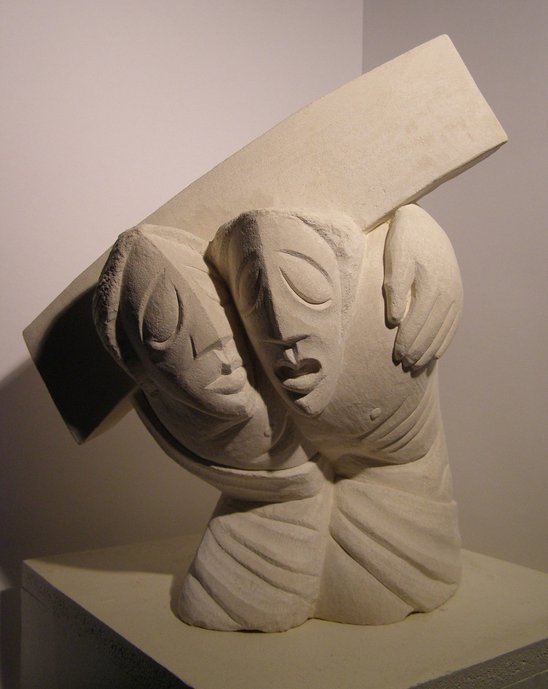
Simon and Jesus by Nicholas Mynheer
Jesus and Simon by Nicholas Mynheer

A “yoke” was a rabbi’s set of rules based in his interpretation of the Law. The disciples of a rabbi would follow him around everywhere and continually listen to his view of how to live the Scripture in everyday life. There were rabbis whose yoke weighed people down with endless rules on every detail of life. Jesus would later say about such teachers:

“They tell you to do things, but they themselves don’t do them. They make strict rules and try to force people to obey them, but they are unwilling to help those who struggle under the weight of their rules. They do good things so that other people will see them.” (Matthew 23:3-5)

Jesus, contrary to other rabbis, taught the Beatitudes and Sermon on the Mount as his yoke, which was a form of living from the heart, and not just to put on a good show for others.

Jesus said “learn from me” because he is gentle and humble in heart. Jesus is not going to turn us away when we sincerely and humbly come to him; in fact, he invites us to come so we might bask in God’s acceptance:

“Come to me, all of you who are tired and have heavy loads, and I will give you rest. Accept my teachings and learn from me, because I am gentle and humble in spirit, and you will find rest for your lives. The burden that I ask you to accept is easy; the load I give you to carry is light.” (Matthew 11:28-30, NCV)

If faith has become all too familiar, if you have lost your sense of awe and wonder about God, if you desire something more than just keeping up with the Christian Jones’s and fulfilling a checklist of Christian duty, then there is an invitation for you to come to Jesus – offered by Christ himself. We get to walk with Jesus.

3374b-thetable

For Christians everywhere throughout the world for two millennia the Table is the place to come in remembrance, communion, and hope. We remember the once for all sacrifice of Christ which unburdened us of our heavy load of sin. We commune with this same Christ now in the present. We anticipate our future hope with confident expectation that Christ is coming again. The Table is an invitation for us to eat and drink of Christ. The words of Keith and Kristyn Getty and Stuart Townsend’s “Communion Hymn” capture Christ’s acceptance of us and our need to receive such grace:

Behold the Lamb who bears our sins away,
Slain for us – and we remember
The promise made that all who come in faith
Find forgiveness at the cross.
So we share in this bread of life,
And we drink of His sacrifice
As a sign of our bonds of peace
Around the table of the King.

The body of our Savior Jesus Christ,
Torn for you – eat and remember
The wounds that heal, the death that brings us life
Paid the price to make us one.
So we share in this bread of life,
And we drink of His sacrifice
As a sign of our bonds of love
Around the table of the King.

The blood that cleanses every stain of sin,
Shed for you – drink and remember
He drained death’s cup that all may enter in
To receive the life of God.
So we share in this bread of life,
And we drink of His sacrifice
As a sign of our bonds of grace
Around the table of the King.

And so with thankfulness and faith we rise
To respond, – and to remember
Our call to follow in the steps of Christ
As His body here on earth.
As we share in His suffering
We proclaim Christ will come again!
And we’ll join in the feast of heaven
Around the table of the King.

Amen.

Luke 10:21-24 – Freedom and Blessing

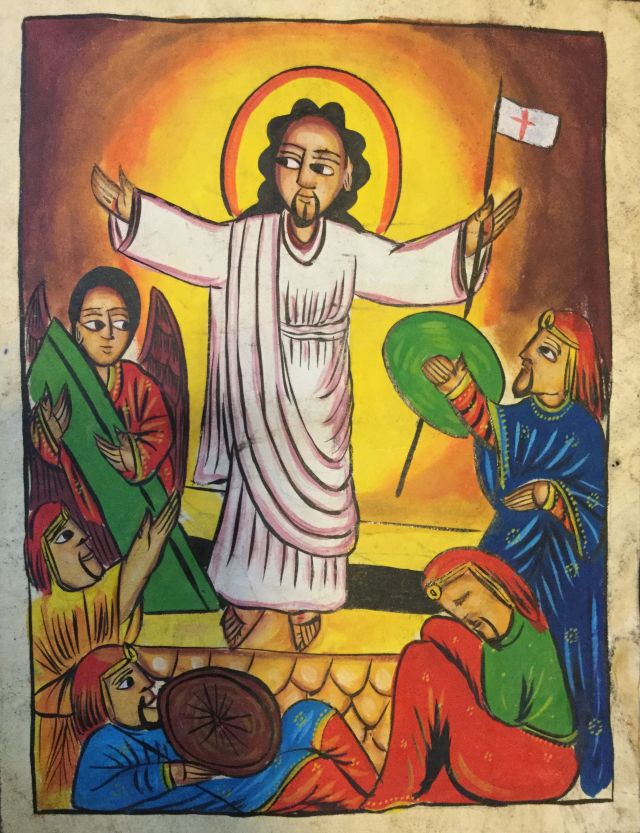
Ethiopian Jesus 2
Ethiopian Orthodox depiction of Jesus teaching

Then Jesus rejoiced in the Holy Spirit and said, “I praise you, Father, Lord of heaven and earth, because you have hidden these things from the people who are wise and smart. But you have shown them to those who are like little children. Yes, Father, this is what you really wanted.

“My Father has given me all things. No one knows who the Son is, except the Father. And no one knows who the Father is, except the Son and those whom the Son chooses to tell.”

Then Jesus turned to his followers and said privately, “You are blessed to see what you now see. I tell you, many prophets and kings wanted to see what you now see, but they did not, and they wanted to hear what you now hear, but they did not.” (NCV)

A healthy view of Holy Scripture is to look at it as an unfolding drama of redemption. Ever since the fall of humanity, God has been on a rescue mission to reclaim, redeem, and restore people. This human project has obviously taken several millennia; and, it still has not reached its fulfillment.

The Christian tradition understands that the climax of victory and final restoration to our true state as humans will occur when Christ returns. By warning us that divine mysteries are hidden to some and revealed to others is Jesus’ way of cautioning us toward triumphalism and self-congratulation. Yes, redemption is a reality; and, it is also not a reality. It is both here and is coming. We are delivered from sin, death, and hell – and, we still labor against the evil machinations of systemic world problems, our own sinful nature, and a demonic realm which is looking for every opportunity to exploit sin’s residue upon the earth.

What this all means on a practical basis is that the good old days for some were the bad old days for others. History is always written by the winners and those in power. The hidden voices are typically squelched. The vision of Jesus is that all kinds of people, not just a certain segment of winners, should enjoy God’s favor.

There were ancient people who longed for spiritual and physical freedom. They looked forward into history and had the hope of Messiah and God’s promises being fulfilled. History is still unfolding. People yet remain locked in personal bondage and large swaths of humanity still experience oppression and a longing to enjoy blessings which others possess and take for granted.

On this Independence Day in the United States it is important that we recognize and hold together both the blessings of realized freedom along with the limits of others’ freedom. And, with this realization, we continue to actively work for all people and keep praying that God’s kingdom come and God’s will be done, here on earth, as it is always done in heaven.

Frederick Douglass
Frederick Douglass, circa 1852

So, today, I am lifting a voice from history which exemplifies the struggle of the black experience in America. The following is a small portion from a speech by the ex-slave Frederick Douglass orated on July 4, 1852, nine years before civil war, with President Millard Fillmore and many congressional politicians in attendance:

“The feeling of the nation must be quickened; the conscience of the nation must be roused; the propriety of the nation must be startled; the hypocrisy of the nation must be exposed; and its crimes against God and man must be proclaimed and denounced. What, to the American slave, is your 4th of July? I answer: a day that reveals to him, more than all other days in the year, the gross injustice and cruelty to which he is the constant victim. To him, your celebration is a sham; your boasted liberty, an unholy license; your national greatness, swelling vanity; your sounds of rejoicing are empty and heartless; your denunciations of tyrants, brass fronted impudence; your shouts of liberty and equality, hollow mockery; your prayers and hymns, your sermons and thanksgivings, with all your religious parade, and solemnity, are, to him, mere bombast, fraud, deception, impiety, and hypocrisy — a thin veil to cover up crimes which would disgrace a nation of savages. There is not a nation on the earth guilty of practices more shocking and bloodier than are the people of these United States, at this very hour.”

Because history is forever unfolding, freedom and blessing develop over time and come more powerfully to some than others. True spiritual discernment, with the awareness to labor on behalf of the common good, does not ultimately come through astute observation and superior intellect; it comes by divine revelation. God will both conceal and reveal according to divine purposes and not human agendas.

Christian spirituality cannot be reduced to praying a sinner’s prayer and then maintaining a holding pattern on earth until heaven. Rather, Jesus remains present in this world through the person of the Holy Spirit and is continually interceding on behalf of those who need freedom and blessing. As Christ’s Body, Christians are to be the hands and feet of Jesus, animated by the Spirit to bring God’s ethical and benevolent regime to those who need it most.

If we are blessed, we are to pass blessing on without prejudice. For the kingdom of God belongs to the poor in spirit.

Dear God, Creator of the universe and all that inhabit it, we come as your Church, and as individuals, in humble submission to your word and your way. God, you are the Alpha and Omega, The Almighty Judge and The Forgiver of All Sins, so we come with humility and contrition on behalf of generations past, present and those yet unborn. We ask that you forgive us and create in us a new spirit. Bind our hearts and send forth the healing power that you and you alone can give to us and this sin-sick world. Bring us into reconciliation with one another and restore us to your righteous and holy path. Amen.

Romans 7:7-20 – Facing Our Bundle of Contradictions

contradiction
“Humanity is an embodied paradox, a bundle of contradictions.”-Charles Caleb Colton, 1780-1832

What shall we say, then? Is the law sinful? Certainly not! Nevertheless, I would not have known what sin was had it not been for the law. For I would not have known what coveting really was if the law had not said, “You shall not covet.” But sin, seizing the opportunity afforded by the commandment, produced in me every kind of coveting. For apart from the law, sin was dead. Once I was alive apart from the law; but when the commandment came, sin sprang to life and I died. I found that the very commandment that was intended to bring life actually brought death. For sin, seizing the opportunity afforded by the commandment, deceived me, and through the commandment put me to death. So then, the law is holy, and the commandment is holy, righteous and good.

Did that which is good, then, become death to me? By no means! Nevertheless, in order that sin might be recognized as sin, it used what is good to bring about my death, so that through the commandment sin might become utterly sinful.

We know that the law is spiritual; but I am unspiritual, sold as a slave to sin. I do not understand what I do. For what I want to do I do not do, but what I hate I do. And if I do what I do not want to do, I agree that the law is good. As it is, it is no longer I myself who do it, but it is sin living in me. For I know that good itself does not dwell in me, that is, in my sinful nature. For I have the desire to do what is good, but I cannot carry it out. For I do not do the good I want to do, but the evil I do not want to do—this I keep on doing. Now if I do what I do not want to do, it is no longer I who do it, but it is sin living in me that does it. (NIV)

The Apostle Paul’s vulnerable expression of his dilemma resonates deeply with many people. There are times when we say things to ourselves such as, “I told myself I wasn’t going to be like my mother, and here I am responding just like she would;” “I know better than to drive by the liquor store on my way home and pick up a pint of vodka, yet, I still did it;” or, “I don’t want to die, but my thoughts keep racing about a plan for suicide.” And, there are many more situations in which we are both frustrated and befuddled by our doing the things we do not want to do, and not doing the things we want to do.

Yes, indeed, Paul’s existential angst is a timeless description of our common human condition. We all can relate to the seeming inability to do what is right in so many situations. It can really drive us nuts, even to a constant and never-ending low-level discouragement that underlies almost everything we do.

Paul’s prescription for dealing with this does not rely on law. He understood that putting our willpower and effort into obeying commands gets us nowhere because we will eventually fail. Neither our brains nor our spirits work that way. Our willpower was never designed to be the driver of what we do and do not do. If anything, willpower, and the lack thereof demonstrate just how much we are climbing the ladder on the wrong wall. People are a bundle of contradictions, doing good, then bad, and flip-flopping back and forth with great frustration.

God’s law was not crafted to transform us from the inside-out. The law has three solid purposes, none of which are meant to bring deep personal transformation: attention to the law works to restrain sin in the world; use of the law provides us with a helpful guide for grateful living in response to divine grace; and, it’s use here by Paul is to show us how bad off we really are in this world and in need of forgiveness.

We need a change of habits, and this is different than adopting a list of laws. Habits are developed from our desires, our affections. In other words, we do what we love – more specifically, our ultimate love(s) drive us to do what we want. To put it in a straightforward way: We sin because we like it. And the path to overcoming any besetting sin is to have an ultimate love trump the lesser sin which we like.

St Augustine quote 2

For example, I have developed daily habits or rituals of faith which enable me to commune with God. I love God with all my heart, soul, mind, and strength, and this ultimate love enables me to push out all competing gods who want my devotion. I also love my wife with all my heart. We work on developing habits of a marital relationship which reinforce our love for each other. Love is what drives me to do right and good by her.

So, what do we do when we mess up? For the Christian, no matter what the question is, the answer is always grace. God’s grace in the finished work of Jesus Christ applied to us by the Holy Spirit is the operative power that changes lives. The law has no power to do that kind of work. Freedom from the tyranny of our misplaced desires and disordered loves comes from Christ’s forgiveness through the cross. Like a lover enamored with his beloved, our desires become oriented toward Jesus for his indescribable gift to us. That is the strength of grace.

Saving God, I thank you for delivering me from sin, death, and hell through your Son, the Lord Jesus.  May your Holy Spirit apply the work of grace to my life every day so that I can realize spiritual healing and practical freedom from all that is damaging and destructive in my soul.  Amen.

Romans 7:1-6 – Becoming Holy

AgnusDay new creation

Do you not know, brothers and sisters—for I am speaking to those who know the law—that the law has authority over someone only as long as that person lives? For example, by law a married woman is bound to her husband as long as he is alive, but if her husband dies, she is released from the law that binds her to him. So then, if she has sexual relations with another man while her husband is still alive, she is called an adulteress. But if her husband dies, she is released from that law and is not an adulteress if she marries another man.

So, my brothers and sisters, you also died to the law through the body of Christ, that you might belong to another, to him who was raised from the dead, in order that we might bear fruit for God. For when we were in the realm of the flesh, the sinful passions aroused by the law were at work in us, so that we bore fruit for death. But now, by dying to what once bound us, we have been released from the law so that we serve in the new way of the Spirit, and not in the old way of the written code. (NIV)

Romans chapters 6-8 are the Apostle Paul’s pointed discussion of how we become holy in a real and practical way. The theological word we typically use for this is “sanctification,” which means “to become holy,” and “set apart” for God. To be delivered from sin, death, and hell through the person and work of Jesus Christ is not the end of the story; it is just the beginning of becoming a new creation.

Becoming holy and righteous in our everyday lives boils down to this: identity and belonging. One of the healthiest ways of looking at the entirety of the Bible’s message is that we belong to God. Our identities are thoroughly wrapped around Jesus. The process of realizing this and coming to grips with it is how we grow as people in holiness and righteousness.

Because of Christ’s finished work on the cross, we have been delivered from the realm of sin. Our change in status from condemned to accepted provides us the awareness to make daily affirmations of faith and live a new life. However, the sinful nature (flesh) or the old person is still there. Although it is now toothless, our past can and often does exert a powerful influence on us. Even though there is a medium-rare T-bone steak on the table for us to enjoy, there are times we go back to the old bologna sandwich with stale white bread.

Yet, we need no longer live falling short of our true humanity because we belong to God. We are adopted into God’s family, having been orphaned by sin’s cruel influence. Yet, just because we have been saved from the power of sin, sin itself has not become extinct. We still must deal with it. We are alive to God and need to take up this great spiritual reality and live into it, for the force of sin still exists in the world.

We deal with sin’s continued presence (the world, the flesh, and the devil) through embracing God’s grace versus trying to overcome it with the law. Paul used an illustration from marriage to expand our understanding of grafting grace into our daily lives. By law, a married woman is bound to her husband (keeping in mind this sense of belonging was the predominant view of marriage in Paul’s day). Yet, if the husband dies, the wife is released from the legal marriage. If she were to give herself to another man while her husband is still alive and they are married, then she becomes an adulteress. However, if she is a widow, then marries again, she is not an adulteress.

Paul applies this understanding to our relationship with the law. Death has separated us from the law. We died with Christ. Therefore, we have been set free from the law and have become alive to grace. As believers in Jesus, we “belong to another, to him who was raised from the dead” (Romans 7:4). “When Christ’s body hung upon the cross, when God spared not his own Son but gave him up for us all” (Romans 8:32); “when Christ took on himself for us all the curse of the law which inflicted all of us (Galatians 3:13); then, we died to the law. God’s grace has made the death of Jesus the death of all from the realm of sin (2 Corinthians 5:14).

Resized_20170617_114022

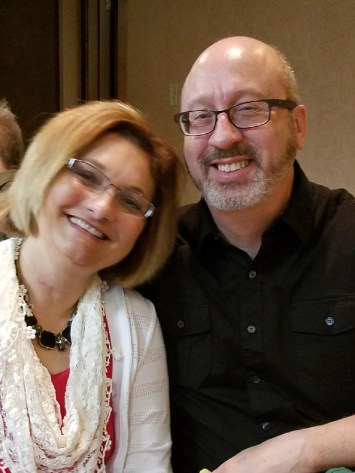
As a married man, let me use Paul’s illustration to get down to the gist of his teaching. Yes, I am legally married and belong to my wife. I made vows to my wife on our wedding day which bind me legally to do what I said I would do. Yet, if I fulfill those vows in a strictly legalistic manner, I can vouch for my wife that this would qualify as an acceptable situation for her. You see, my wife (and, me, too!) are freely bound to one another in love and grace. I care for my wife because I love her deeply, and not because it is my legal duty to do so.

The Christian life was neither designed nor meant to serve as a bare legal contract or covenant between us and God. God forbid such a thought! Jesus died to clear us from all the legality stuff so that we could freely love and serve God with joyful abundance and gratitude. You see, I am follower of Jesus because I love him deeply. What impels and motivates me is God’s grace. The law is there and has its place. However, it is not the law that causes me to be a Christian; it is the love of Christ which saved me from myself and compels me to live like Jesus.

We pray that God himself, the God of peace, will make you pure—belonging only to him. We pray that your whole self—spirit, soul, and body—will be kept safe and be blameless when our Lord Jesus Christ comes. The one who chose you will do that for you. You can trust him. (1 Thessalonians 5:23-24, ERV)