Max Baer, Jr. playing the incomparable country as corn flakes Jethro Bodine on The Beverly Hillbillies
I rejoiced greatly in the Lord that at last you renewed your concern for me. Indeed, you were concerned, but you had no opportunity to show it. I am not saying this because I am in need, for I have learned to be content whatever the circumstances. I know what it is to be in need, and I know what it is to have plenty. I have learned the secret of being content in any and every situation, whether well fed or hungry, whether living in plenty or in want. I can do all this through him who gives me strength. Yet it was good of you to share in my troubles. Moreover, as you Philippians know, in the early days of your acquaintance with the gospel, when I set out from Macedonia, not one church shared with me in the matter of giving and receiving, except you only. (NIV)
In the English language, the words “you” and “your” can be either singular or plural. Unless, of course, we go with the southern “y’all.” But for a northerner like me, I’ve got to determine which by looking at the context that it’s in. In the language of the New Testament, Greek, we know which words are singular and which are plural because, well, they’re different words which aren’t spelled the same. It’s important to know in the book of Philippians that all the “you” pronouns are plural. That’s important because the theme of unity and solidarity runs affectionately throughout the Apostle Paul’s letter to the Church in Philippi. In fact, for Paul, the reason he gibbers on so much about joy in his letter is because it’s only realized when unity is around. Unity really dills Paul’s pickles.
The entire Philippian church and not just those two really caring parishioners like Uncle Bundlejoy and Cousin Cozysweet, shared in Paul’s troubles with him. The whole kit-and-caboodle partnered with him through financial resources, prayer, and ministry. Paul had confidence that every need the Philippians had would be supplied just as sure as God put worms in sour apples.
They learned a valuable lesson from Paul: that unity through generosity brings contentment in all circumstances and eases anxieties. The Philippian believers got a glimpse of the paradox that through giving they become rich. When tightwad believers are around, a church frets so much they could worry the horns off a billy goat. But when generosity settles in, people are more content than a flea on a pup.
Folks who only care about their personal needs and independent wealth aren’t right in the head – their cornbread’s not done in the middle. God wants everyone to know the blessing of working together in a worthy common cause. Generosity and contentment go together like bacon and eggs. A charitable spirit in a group of people leads to more joy and happiness than a gopher in soft dirt.
Hoarding makes a church more nervous than a long-tailed cat in a room full of rocking chairs. If we want to be free of backbiting and worry, then we need to be wild about generosity. Give like the sun and the whole world grows tall.
Be generous with your money, generous with your words of encouragement toward others, and generous with your gratitude to God. Besides, giving is more fun than a sack full of kittens. And if you do give till you laugh, maybe you’ll see good ol’ Paul standing there grinning like a possum eating a sweet potato.
Generous God, your storehouse of grace and mercy is infinite and unending. Help me to partner with you in a way that makes my generosity flow in the same direction yours does so that Jesus Christ is glorified, and his church is edified through the power of the Holy Spirit. Amen.
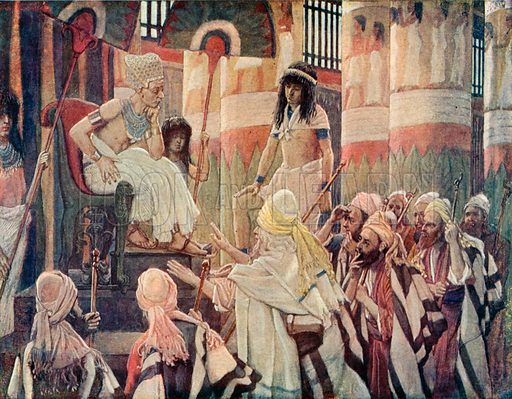
Joseph presents Jacob and his brothers to Pharaoh by French artist James Jacques Joseph Tissot (1836-1902)
And God spoke to Israel in a vision at night and said, “Jacob! Jacob!”
“Here I am,” he replied.
“I am God, the God of your father,” he said. “Do not be afraid to go down to Egypt, for I will make you into a great nation there. I will go down to Egypt with you, and I will surely bring you back again. And Joseph’s own hand will close your eyes.”
Then Jacob left Beersheba, and Israel’s sons took their father Jacob and their children and their wives in the carts that Pharaoh had sent to transport him. So, Jacob and all his offspring went to Egypt, taking with them their livestock and the possessions they had acquired in Canaan. Jacob brought with him to Egypt his sons and grandsons and his daughters and granddaughters—all his offspring.
These are the names of the sons of Israel (Jacob and his descendants) who went to Egypt:
Reuben the firstborn of Jacob. The sons of Reuben: Hanok, Pallu, Hezron and Karmi.
The sons of Simeon: Jemuel, Jamin, Ohad, Jakin, Zohar and Shaul the son of a Canaanite woman.
The sons of Levi: Gershon, Kohath and Merari.
The sons of Judah: Er, Onan, Shelah, Perez and Zerah (but Er and Onan had died in the land of Canaan).
The sons of Perez: Hezron and Hamul.
The sons of Issachar: Tola, Puah, Jashub and Shimron.
The sons of Zebulun: Sered, Elon and Jahleel.
These were the sons Leah bore to Jacob in Paddan Aram, besides his daughter Dinah. These sons and daughters of his were thirty-three in all.
The sons of Gad: Zephon, Haggi, Shuni, Ezbon, Eri, Arodi and Areli.
The sons of Asher: Imnah, Ishvah, Ishvi and Beriah. Their sister was Serah. The sons of Beriah: Heber and Malkiel.
These were the children born to Jacob by Zilpah, whom Laban had given to his daughter Leah—sixteen in all.
The sons of Jacob’s wife Rachel:
Joseph and Benjamin. In Egypt, Manasseh and Ephraim were born to Joseph by Asenath daughter of Potiphera, priest of On.
The sons of Benjamin: Bela, Beker, Ashbel, Gera, Naaman, Ehi, Rosh, Muppim, Huppim and Ard.
These were the sons of Rachel who were born to Jacob—fourteen in all.
The son of Dan: Hushim.
The sons of Naphtali: Jahziel, Guni, Jezer and Shillem.
These were the sons born to Jacob by Bilhah, whom Laban had given to his daughter Rachel—seven in all.
All those who went to Egypt with Jacob—those who were his direct descendants, not counting his sons’ wives—numbered sixty-six persons. With the two sons who had been born to Joseph in Egypt, the members of Jacob’s family, which went to Egypt, were seventy in all.
Now Jacob sent Judah ahead of him to Joseph to get directions to Goshen. When they arrived in the region of Goshen, Joseph had his chariot made ready and went to Goshen to meet his father Israel. As soon as Joseph appeared before him, he threw his arms around his father and wept for a long time.
Israel said to Joseph, “Now I am ready to die, since I have seen for myself that you are still alive.”
Then Joseph said to his brothers and to his father’s household, “I will go up and speak to Pharaoh and will say to him, ‘My brothers and my father’s household, who were living in the land of Canaan, have come to me. The men are shepherds; they tend livestock, and they have brought along their flocks and herds and everything they own.’ When Pharaoh calls you in and asks, ‘What is your occupation?’ you should answer, ‘Your servants have tended livestock from our boyhood on, just as our fathers did.’ Then you will be allowed to settle in the region of Goshen, for all shepherds are detestable to the Egyptians.”
Joseph went and told Pharaoh, “My father and brothers, with their flocks and herds and everything they own, have come from the land of Canaan and are now in Goshen.” He chose five of his brothers and presented them before Pharaoh.
Pharaoh asked the brothers, “What is your occupation?”
“Your servants are shepherds,” they replied to Pharaoh, “just as our fathers were.” They also said to him, “We have come to live here for a while, because the famine is severe in Canaan and your servants’ flocks have no pasture. So now, please let your servants settle in Goshen.”
Pharaoh said to Joseph, “Your father and your brothers have come to you, and the land of Egypt is before you; settle your father and your brothers in the best part of the land. Let them live in Goshen. And if you know of any among them with special ability, put them in charge of my own livestock.”
Then Joseph brought his father Jacob in and presented him before Pharaoh. After Jacob blessed Pharaoh, Pharaoh asked him, “How old are you?”
And Jacob said to Pharaoh, “The years of my pilgrimage are a hundred and thirty. My years have been few and difficult, and they do not equal the years of the pilgrimage of my fathers.” Then Jacob blessed Pharaoh and went out from his presence.
So, Joseph settled his father and his brothers in Egypt and gave them property in the best part of the land, the district of Rameses, as Pharaoh directed. Joseph also provided his father and his brothers and all his father’s household with food, according to the number of their children. (NIV)
Jacob Blesses Pharaoh by Welsh artist Owen Jones, 1869
God likes fulfilling his promises to us – even and especially when we are in Egypt – in the world. Sometimes we work too hard at avoiding the world and creating heaven on earth right now. God knew what the Israelites would face: four-hundred years of slavery in Egypt. Yet, God sent them anyway. Often, the people of God grow more in times of trial and hardship, than in times of plenty and peace.
The trip to Egypt included everyone in Israel. There is a genealogical list of those who made the journey because God fulfills his promises through people. These are the folks who would carry on accomplishing the will of God. Joseph and Jacob, the son, and the father, are reunited. Joseph diplomatically planned where the gang would live and work because Egyptians looked down on shepherds. Much like the ancient Israelites, we must navigate a world that is okay with us being in it yet not okay with us in the middle of things.
In the Old Testament, Egypt represents the world. It is interesting God sent his people to live there. God seeks to create a people for his Name who are distinct from Egypt, yet, live among the people of the world. There is a continual tension for God’s people to be holy and unique, not assimilating into the world’s mold; and, yet, at the same time, God wants them to have a constant engagement and interaction with the world. Therefore, two extremes are to be avoided: to focus solely on being a holy people through complete severance from the world as much as possible; and, to seek relevance in the culture through wholesale jettison of distinctiveness so that the sacred and the secular are connected.
God safeguards a distinct people so that they will be a preservative in the world. Godly people are neither to live in a vacuum, cut off from the world altogether, nor to be wed to the world so that the two are indistinguishable. We live in a fundamentally broken world in need of the peace and grace of spiritual people within it. The Church has had to struggle with how to live in the world for two-thousand years. We have the advantage of drawing from a rich Christian history. For there is nothing we face now which has not been faced by the church before.
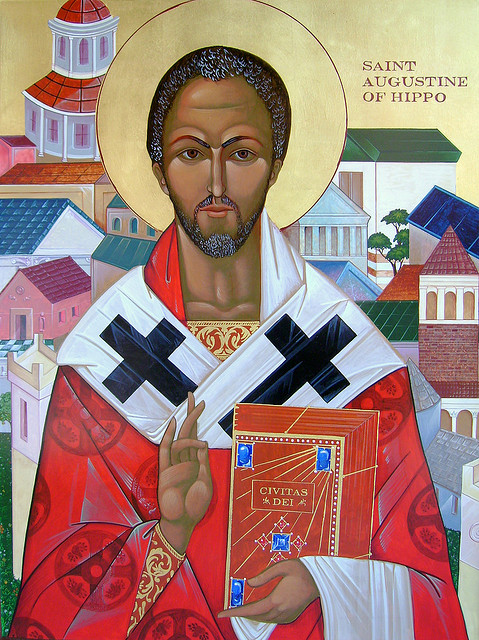
Saint Augustine wrote his seminal work, City of God, in about 413 C.E. The Roman empire had fallen, and pagans were blaming the Church because Christianity had become wed to the state. The people of God were unsure how to proceed. So, Augustine sought to help Christians think about how to live in a post-Christian society.
Augustine’s work is lengthy and quite in-depth, so, the following is a brief distilling of his main arguments. For Augustine, there are four essential institutions: two visible institutions; and, two invisible institutions:
The Church – is a divinely established institution, designed to lead people to God.
The State – is a political institution, adhering to political virtues to establish the peace.
The City of Heaven – is made up of those predestined for salvation.
The City of the World – is made up of those destined for eternal damnation.
We must pursue the City of Heaven, which for Augustine, is the pursuit of justice and righteousness. Augustine gave a clarion call for people to choose which city they will pursue, especially because many tended to blur the distinctions between the visible institutions of church and state.
Augustine’s conclusion is that the purpose of history is to show the unfolding of God’s plan. This involves fostering the City of Heaven and filling it with worthy citizens. Therefore, the fall of Rome, a visible city so important to the people of Augustine’s day, was not near as important to the invisible God.
Maintaining an eternal perspective can help us today. The collapse of jobs, the scourge of a racialized society, the loss of life due to COVID-19, and injustice are significant events and circumstances – important enough to consider deeply how those issues will be handled. Augustine called out the people of his day for ignoring invisible spiritual solutions for the great problems among them.
Returning to the book of Genesis, a question arises: Will the Israelites become a nation through assimilation with Egypt and its institutions, or will they maintain their distinction as God’s people by relying on God’s covenant promises? There are no easy answers to living in the world. However, it is important we struggle with how to get along in it.
God is the principal actor in the created world. God chooses to use his people as instruments of blessing to it. Joseph’s wisdom and diplomacy, given by God, turned potentially catastrophic situations into times of prosperity. God, too, will use us as dispensers of wisdom – applying truth to concrete situations for the betterment of all involved.
Joseph handled the delicate situation of his brothers being shepherds while all shepherds were detestable to Egyptians. Joseph brought the two worlds together through artful negotiation between the interests of both Pharaoh and the Israelites. He created a win/win scenario by setting up his brothers to help Pharaoh with his own needs in caring for livestock. In the end, all parties were satisfied because Joseph maintained a focus on needs instead of only advocating one side.
Rather than getting bogged down in promotion of methods and means, a sage approach is to maintain a focus on needs – which requires careful listening and a stance of empathy. Then, we can work toward prosperity for all instead of hardening into reified positions. A lot of problems in the church, work, society, and family can be turned to blessing if we seek the wisdom that comes from God.
May the Lord bless you and keep you; and, make his face shine on you and be gracious to you. May the Lord turn his face toward you and give you peace. Amen.
Temptation in the Wilderness by British artist Briton Rivière, 1912
Finally, be strong in the Lord and in his mighty power. Put on the full armor of God, so that you can take your stand against the devil’s schemes. For our struggle is not against flesh and blood, but against the rulers, against the authorities, against the powers of this dark world and against the spiritual forces of evil in the heavenly realms. Therefore, put on the full armor of God, so that when the day of evil comes, you may be able to stand your ground, and after you have done everything, to stand. Stand firm then, with the belt of truth buckled around your waist, with the breastplate of righteousness in place, and with your feet fitted with the readiness that comes from the gospel of peace. In addition to all this, take up the shield of faith, with which you can extinguish all the flaming arrows of the evil one. Take the helmet of salvation and the sword of the Spirit, which is the word of God. And pray in the Spirit on all occasions with all kinds of prayers and requests. Be alert and always keep on praying for all the Lord’s people. (NIV)
Today’s New Testament lesson has some densely packed verses concerning spiritual warfare. There are three major imperatives or commands for every believer and every church:
Be strong in the Lord because we are in an invisible war.
Put on the whole armor of God and prepare for spiritual battle.
Take up your spiritual weapons and fight.
We are to be vigilant since Satan and his wicked spirits are highly organized for evil with devious schemes and stratagems designed to blunt our spiritual growth. We are to put on the necessary armor of truth, righteousness, and peace to defend ourselves against the inevitable attacks. We are to use our spiritual weapons of faith, salvation, and the word of God to advance against the darkness.
To do just that, the following is a focused and thoroughly Christian prayer I have used for many years both for myself and with others. I suggest praying it out loud in its entirety each day for the next two weeks to push back the dark forces:
Heavenly Father, I bow in worship and praise before You. I cover myself with the blood of the Lord Jesus Christ as my protection. I surrender myself completely in every area of my life to You. I take a stand against all the work of Satan that would hinder me in my prayer life. I address myself only to the True and Living God and refuse any involvement of Satan in my prayer.
Satan, I command you, in the Name of the Lord Jesus Christ, to leave my presence with all your demons. I bring the blood of the Lord Jesus Christ between us.
Heavenly Father, I worship You and give You praise. I recognize that You are worthy to receive all glory and honor and praise. I renew my allegiance to You and pray that the Holy Spirit would enable me in this time of prayer. I am thankful, Heavenly Father, that You have loved me from eternity past and that You sent the Lord Jesus Christ into the world to die as my substitute. I am thankful that the Lord Jesus Christ came as my representative and that through Him You have completely forgiven me; You have adopted me into Your family; You have assumed all responsibility for me; You have given me eternal life; You have given me the perfect righteousness of the Lord Jesus Christ so that I am now justified. I am thankful that in Christ You have made me complete, and that You have offered Yourself to me to be my daily help and strength.
Heavenly Father open my eyes that I might see how great You are and how complete Your provision is for this day. I am thankful that the victory the Lord Jesus Christ won for me on the cross and in His resurrection has been given to me and that I am seated with the Lord Jesus Christ in heaven. I take my place with Him and recognize by faith that all wicked spirits and Satan himself are under my feet. I declare that Satan and his demons are subject to me in the name of the Lord Jesus Christ.
I am thankful for the armor You have provided. I now put on the belt of truth, the breastplate of righteousness, the sandals of peace and the helmet of salvation. I lift the shield of faith against all the fiery arrows of the enemy; and I take in my hand the sword of the Spirit, the Word of God. I choose to use Your Word against all the forces of evil in my life. I put on this armor and live and pray in complete dependence upon You, Holy Spirit.
I am grateful, Heavenly Father, the Lord Jesus Christ disarmed all power and authorities, triumphing over them by the cross. I claim all victory for my life today. I reject all the insinuations, accusations, and temptations of Satan. I affirm that the Word of God is true, and I choose to live today in the light of God’s Word. Heavenly Father, I choose to live in obedience to You and in fellowship with You. Open my eyes and show me the areas of my life that do not please You. Work in me to cleanse me from all ground that would give Satan a foothold against me. I do in every way stand into all that it means to be Your adopted child and I welcome all the ministry of the Holy Spirit in my life today.
By faith and in dependence upon You I put off the old person and stand into all the victory of the crucifixion where the Lord Jesus Christ provided cleansing from the sinful nature. I put on the new person and stand into all the victory of the resurrection and the provision He has made for me to live above sin.
Today I put off the old nature with its selfishness and I put on the new nature with its love. I put off the old nature with its fear and I put on the new nature with its courage. I put off the old nature with all its deceitful lusts and I put on the new nature with its righteousness, purity, and honesty.
In every way I stand into the victory of Christ’s ascension and glorification, in which everything was made subject to Him. I claim my place in Christ as victorious with Him over all the enemies of my soul. Holy Spirit, I pray that you would fill me. Come into my life, break down every idol and cast out every enemy of my soul.
I am thankful, Heavenly Father, for the expression of Your will for my daily life as You have shown me in Your Word. I, therefore, claim all the will of God for my life today. I am thankful that You have blessed me with every spiritual blessing in Christ. I am thankful that You have given me new life into a living hope by the resurrection of Jesus from the dead. I am thankful that You have made provision for me so that today I can live filled in the Holy Spirit with love, joy, peace, patience, kindness, goodness, gentleness, and self-control. I recognize and affirm that this is Your will for me and so I reject and resist all the attempts of Satan and his demons to rob me of the will of God. I refuse today to believe my feelings of worthlessness and I hold up the shield of faith against all the accusations, distortions, and insinuations that Satan would put into my mind. I claim the will of God for my life today.
In the Name of the Lord Jesus Christ I completely surrender myself to You, Heavenly Father, as a living sacrifice. I choose not to be conformed to this world. I choose to be transformed by the renewing of my mind. I pray that You would show me Your will and help me to walk in Your ways today.
I am thankful, Heavenly Father, the weapons we fight with are not the weapons of the world, but have divine power to demolish strongholds, arguments, and every pretension that sets itself up against the knowledge of God. I take captive every thought to make it obedient to Christ. Therefore, in my own life today I tear down the strongholds of Satan and smash the plans of Satan that have been formed against me. I demolish the strongholds of Satan against my mind, and I surrender my mind to You, Holy Spirit. I affirm, Heavenly Father, that You have not given me a spirit of fear but a spirit of power, love, and self-discipline. I break and smash the strongholds of Satan formed against my emotions today. I give my will to You. I choose to make right decisions of faith. I smash the strongholds of Satan formed against my body today. I give my body to You and recognize that I am Your temple. I rejoice in Your mercy and grace.
Heavenly Father, I pray now and through this day that You would strengthen and enlighten me. Show me the ways Satan is hindering, tempting, lying, and distorting the truth in my life. Help me to be the kind of person who pleases You. Help me to be aggressive in prayer and faith. Help me to think rightly, and actively practice Your Word. Help me to give You Your rightful place in my life.
I cover myself with the blood of the Lord Jesus Christ and pray that You, Holy Spirit, would bring all the work of Christ’s crucifixion, resurrection, ascension, and all Your work of Pentecost into my life today. I deliberately surrender myself to You, God. I refuse to be discouraged. You are the God of all hope. You have proven Your power by resurrecting Jesus from the dead, so I claim this victory over all satanic forces in my life. I pray in the Name and through the blood of the Lord Jesus Christ with thanksgiving. Amen.
Who is wise and understanding among you? Let them show it by their good life, by deeds done in the humility that comes from wisdom. But if you harbor bitter envy and selfish ambition in your hearts, do not boast about it or deny the truth. Such “wisdom” does not come down from heaven but is earthly, unspiritual, demonic. For where you have envy and selfish ambition, there you find disorder and every evil practice. But the wisdom that comes from heaven is first pure; then peace-loving, considerate, submissive, full of mercy and good fruit, impartial and sincere. Peacemakers who sow in peace reap a harvest of righteousness. (NIV)
The great challenge of life for everyone is to respond to it rightly – to handle the people, situations, and responsibilities of life well. We all need wisdom. Wisdom is doing right and just things in the concrete actual situations of life.
Wisdom is much like driving a car. There is a certain body of knowledge that you need to drive. Driving is much more than knowing the driving manual and passing the driving test. The purpose of knowing the laws and how to drive a car is so that you can drive well on actual roads under all kinds of traffic and weather situations. Driving wisely means you keep your eyes on the road and are mindful of all that is going on around you and even within you. You do not fret about why there is a curve in the road or a stop sign in a certain location. You do not try and figure out the mechanics of a stoplight, or the philosophy behind the engineering layout of the road system. You just try to do what needs to be done on the road to get where you need to go by responding to the conditions as they come. In Midwest America where I live, if you drive a car, you will face snow and ice conditions; you will have to respond to a deer in the road; you will have to deal with other drivers and practice wise defensive driving skills. And you must come to grips with your own road rage when getting from point A to point B when it does not go as you think it should.
Wisdom in the Christian life includes and is more than knowledge. The Bible is not a three-ring binder that covers every single life situation that you can simply look up and follow the three steps. Rather, Holy Scripture has a body of knowledge contained in differing kinds of literary genres to give us wise guidance for all of life. Like driving a car, Christian wisdom involves being attentive and mindful of the people and circumstances around us as we move through life by responding with gracious practical knowledge to everything and everyone. So, then, wisdom is the practical application of biblical truth to all of life.
Wise people possess two distinguishing marks: a good life, and a humble life.
A wise person is the same inside and out, with integrity between the inner attitude and outward behavior. The motive for being good springs from a disposition of meekness and gentleness.
The distinguishing mark of the unwise person is hidden agendas.
The unwise are continually doing something, which on the surface seems altruistic and good, yet something else is driving them: bitter envy and selfish ambition. If we want to live the good life, it begins with identifying the envy that will sometimes arise within us and the selfish ambition that goes with it – then choose a path of true wisdom by embracing the good gifts and abilities of others and delight in them. At the same time, we focus on our own gifts and abilities and are at peace with them, able to express them. There is real beauty when this happens.
False wisdom (selfish pride) is earthly, unspiritual, and evil. It relies on tactics of manipulation, power politics, parking lot conversations, and passive-aggressive behavior. Having good intentions but utilizing bad methods to get it is false wisdom. Having an evil intention but cloaking it in good words is demonic. Our words and our behavior both need to be good.
The unwise person has a pathological progression occurring within them:
Envy over not having something someone else has or losing something that was once possessed.
Devious plans for dealing with it.
Using pious language to cloak that plan in religious garb.
Strife, division, and disharmony to get what they want.
Unhealthy practices and habits of life which damage others.
The wise person, in contrast to the unwise, possesses seven characteristics which enables them to live well and enjoy a good life:
Pure. There are no mixed motives with purity – no hidden agendas, no secret desires that are self-serving. It is a purification through repentance of the old unwise person and embrace of the new through the cross of Jesus.
“Create in me a pure heart, O God, and renew a steadfast spirit within me” (Psalm 51:10). “Blessed are the pure in heart, for they shall see God” (Matthew 5:8).
Peace-loving is more than the absence of conflict. Peace is to embrace harmony, to work well together, and to enjoy full relational experiences. Wise and godly people are healers, active in bringing unity and integration.
“Blessed are the peace-makers for they will be called children of God” (Matthew 5:9). “Whoever of you loves life and desires to see many good days, keep your tongue from evil and your lips from speaking lies. Turn from evil and do good; seek peace and pursue it” (Psalm 34:13-14).
Considerate of others is to be flexible, open to reason, level-headed in anxious situations, gentle, non-combative, non-retaliatory, and generally understanding. It is the wisdom to make allowances for the weaknesses and shortcomings of others and takes the kindest possible perspective.
“Remind the people… to be ready to do whatever is good, to slander no one, to be peaceable and considerate, and always to be gentle toward everyone” (Titus 3:1-2).
Submissive attitudes and actions are a choice. If a person is coerced into submission, that is slavery, not submission. To submit means to willingly place oneself under someone else’s authority. The submissive person is teachable and humbly receives correcting wisdom.
“Submit to one another out of reverence for Christ” (Ephesians 5:21).
Merciful. Mercy is compassion in action. It is to empathize with the needs of others, and then do something about it. There is always good fruit that results from mercy.
“Blessed are the merciful, for they will be shown mercy” (Matthew 5:7).
Impartial people are without favoritism. It is to be the same person toward everyone. They are steady, consistent, and not swayed by the crowd; and, do not act one way with a certain group of people, and then act different with another group. Impartial people have a passion for justice and despise injustice, believing that all people’s needs must be met with equity.
“Do not pervert justice; do not show partiality to the poor or favoritism to the great but judge your neighbor fairly” (Leviticus 19:15).
Sincere hearts are without hypocrisy. The sincere person is the same both inside and out, having no ulterior motives and no skeletons in the closet.
“Now that you have purified yourselves by obeying the truth so that you have sincere love for you brothers, love one another deeply, from the heart” (1 Peter 5:22).
The telltale signs of false wisdom are envy and selfishness – resulting in disorder and all kinds of unhealthy practices. Conversely, the signs of true heavenly wisdom are good deeds done from a devoted heart to God and a humble attitude – resulting in righteousness and peace. This, my friends, is the good life.
Heavenly Father take me to the place where I am saved from my pride and arrogance and where Christ’s humility is center stage, where I am lifting clean hands and a pure heart to you. Take me to the place where I am no longer looking at obstacles but looking down upon them, where I can see clearly, and my decisions are flooded with your divine light, truth, and justice. I bend my knee and receive your truth. I open my ears to receive your counsel. I open my heart to receive your godly wisdom through Jesus Christ in the power of the Holy Spirit. Amen.