O God, you are my God; I earnestly search for you. My soul thirsts for you; my whole body longs for you in this parched and weary land where there is no water. I have seen you in your sanctuary and gazed upon your power and glory. Your unfailing love is better than life itself; how I praise you! I will praise you as long as I live, lifting up my hands to you in prayer. You satisfy me more than the richest feast. I will praise you with songs of joy.
I lie awake thinking of you, meditating on you through the night. Because you are my helper, I sing for joy in the shadow of your wings. I cling to you; your strong right hand holds me securely. (NLT)
Regular readers of this blog know I believe the book of Psalms to be a vast resource for devotion, worship, and prayer. In dark or distressing times when we don’t know what to pray, how to lament, or what to say to God; in the joyful and peaceful times when we want to proclaim praise, give thanks, or express our blessings and longings; and, in every season of our lives, the psalms offer us robust theology, human emotion and need in all its vulnerable reality, and a connected path between the two.
Today’s psalm was originally uttered to God when David was roaming in the wilderness avoiding King Saul’s malevolent and murderous intent. David expressed his yearning desire and hope to connect with God and gain solace and guidance, step by step, by the Lord who sees and satisfies. David praised God within a life-and-death circumstance, longing to be satiated with spiritual food and drink.
Whatever situation we find ourselves in, and wherever our path takes us, the psalms help form and shape a profound spirituality of deep connection with the God we long to know and experience.
The psalms are so much more than ancient poems, prayers, and songs; they are words alive with the potential to bridge us to God. I often write my own translations and personally contemporize the psalms which helps me to approach God during my own wilderness experiences. So, here is my take on this psalm:
O God, you are my God; I am putting all my effort into seeking you.
my soul is thirsty for you.
my body is weak looking for you,
like in a desert where there is no water.
I am no stranger to you because I have seen you work before,
and I have gotten a glorious glimpse of your power in the past.
I have experienced that your steadfast love is better than life itself,
and I now bank on those times and praise you despite my trouble.
I choose to keep on remembering you and blessing your holy name.
In the mighty name of Jesus, I will lift my hands in praise, even if it looks weird to others.
I know that my soul will be satisfied in you, just like when I get a medium rare T-bone steak and corn on the cob.
And I will use my mouth to praise you with joy, no matter the circumstances,
when I remember you on my bed and cannot sleep,
and meditate on your wonderful grace as I lie there with my eyes wide open.
for you have always been my help,
and sitting on your lap I will be supremely confident and sing for joy.
Welcome, friends! Just as we need a strong physical spine for good health, equally necessary is a healthy spiritual spine with good strong theology holding us up. Click the video below and let’s worship the Lord…
And, here is Psalm 99 put to song and performed by the Sons of Korah…
Psalm 99 by the Sons of Korah
May you be strengthened with all power according to God’s glorious might so that you may have great endurance and patience. Amen.
Our ideas of God take shape in the many ways we live our lives. A God who is always right, fair, just, and loving in everything he says and does is a God we can trust. A cranky god who is aloof and indifferent does not help anyone. Yet, with the one true God we can be assured of strong spiritual support for any and every situation. When we have as our ally a robust theology which informs how we think and gives shape to how we act, then we can step forward with confidence knowing God has our back.
Sound theology needs to be identified, nurtured, and expressed in daily life. The Old Testament psalms are pregnant with vigorous views of God, as well as being the Church’s prayer book. Each individual psalm invites us to see God in a new or fresh way and inspires us to pray. Using the psalms as boots-on-the-ground prayer provides a firm foundation from which to know, worship, and serve God.
Here is my own translation of Psalm 99, which is meant to capture the spirit of the text. I encourage you to pray it over slowly, several times, and with appropriate emotional flavor behind the words:
The LORD rules everything; let all people everywhere who live unjustly, shake in their boots!
God sits enthroned above all creation; let the earth rumble on its foundation!
The LORD is great among his people.
In fact, God is far above all people.
Let everyone, no matter who they are or where they are from, praise Your great and awesome name. God is holy!
Mighty Ruler, the lover of everything that is just and right,
You are the One who established what is fair and equitable.
You labored behind the scenes for causes which are just and right,
and brought harmonious relations to folks at odds with each other.
Magnify the LORD, our God!
Approach the Divine with great and mindful humility!
God is holy!
Godly people of old such as Moses and Aaron were among the Lord’s devout followers.
Those like Samuel were among the humble who called on God’s Name.
People from times long ago have cried out to the LORD and have gotten an answer.
God spoke to the ancient Israelites in a great pillar of cloud.
They sought to keep and entrust the divine rules given to them.
O LORD our God, you answered them.
You were a forgiving God to them,
yet, you also were the One who held them accountable when they slid off the rails.
Magnify the LORD our God!
Humble yourselves and worship at God’s holy mountain,
because no one is like the LORD our God, a holy Helper!
Let’s get some hearty divine beliefs under our belt with the help of Psalm 99 so that we can live by faith, hope, and love…
God is Universal
A healthy view of God enables us to live with confidence no matter the circumstances. There is no place we can go where God is not there already. The Lord is universal – not tied to any distinct location, culture, class, race, gender, ethnicity, or group of people. God reigns supreme as Lord of all, not just some. The Lord is everywhere:
Where could I go to get away from your spirit? Where could I go to escape your presence? If I went up to heaven, you would be there. If I went down to the grave, you would be there too! If I could fly on the wings of dawn, stopping to rest only on the far side of the ocean— even there your hand would guide me; even there your strong hand would hold me tight! If I said, “The darkness will definitely hide me; the light will become night around me,
even then the darkness isn’t too dark for you! Nighttime would shine bright as day, because darkness is the same as light to you! (Psalm 139:7-12, CEB)
God is not only our God but everyone’s God – which means you will find God amongst both Democrats and Republicans, upper class and lower class, black and white, American and Asian, in every nation of the world, and within all societies. No one group of people have the corner on God, for God is much too big for that – which also means God is not limited to looking just like an old white northern European heritage male Protestant minister.
God is Just
It is important to have a proper definition of biblical justice. In the way many use the word, it refers to punishing those who do wrong and deserve incarceration. Although this idea is included in the meaning, it is only a secondary understanding of justice. The primary essence of justice is ensuring everyone has what they need to thrive and flourish on this earth – that there are no obstacles to people realizing their full humanity in God’s image.
Conversely, injustice means someone, a group of people, or even a nation is withholding resources and blocking persons, either knowingly or unknowingly, from thriving in life. A punitive implication of justice comes into play here. Unjust authorities must be replaced or even punished for their gross negligence in failing to provide for the common good of all persons under their responsibility.
Throughout Holy Scripture God spotlights those who are underprivileged and under resourced through no fault of their own. Those who love justice seek to rise above ignorance; be non-judgmental; use power on behalf of others; and are vigilant to operate fairly and equitably in all things.
The reason aliens, strangers, widows, and orphans are oft mentioned in the Bible is because they were the most vulnerable people in the ancient world to unjust actions and policies. God acts on their behalf so they will experience a fair distribution of resources instead of retribution from others.
The Lord your God is God of gods and Lord of lords, the great, powerful, and awe-inspiring God. He never plays favorites and never takes a bribe. He makes sure orphans and widows receive justice. He loves foreigners and gives them food and clothes. So, you should love foreigners, because you were foreigners living in Egypt. (Deuteronomy 10:17-19, GW)
“You must defend those who are helpless and have no hope. Be fair and give justice to the poor and homeless.” (Proverbs 31:8-9, CEV)
“I want to see a mighty flood of justice, an endless river of righteous living.” (Amos 5:24, NLT)
God is Relational
The Lord graciously gives guidance. God has spoken in the past in answer to those who called upon the name of the Lord. God’s presence was with the Israelites in their desert sojourn. God provided laws and promises to help them. And it was all done with the intimacy of a father and mother to a beloved child.
The powerful, living Spirit of God is available to us today, as well. The fallen nature of this world and our own sin is overcome through the grace of forgiveness in Christ. Even Jesus himself closely identifies with us and offers prayers on our behalf:
Jesus looked toward heaven and prayed, “Father, the hour has come. Glorify your Son, that your Son may glorify you. For you granted him authority over all people that he might give eternal life to all those you have given him. Now this is eternal life: that they know you, the only true God, and Jesus Christ, whom you have sent. I have brought you glory on earth by finishing the work you gave me to do. And now, Father, glorify me in your presence with the glory I had with you before the world began. I have revealed you to those whom you gave me out of the world. They were yours; you gave them to me, and they have obeyed your word. Now they know that everything you have given me comes from you. For I gave them the words you gave me, and they accepted them. They knew with certainty that I came from you, and they believed that you sent me. I pray for them. I am not praying for the world, but for those you have given me, for they are yours. All I have is yours, and all you have is mine. And glory has come to me through them.” (John 17:1-10, NIV)
God is Holy
God is pure, set apart from injustice, wickedness, and sin. There are no impurities of mixed motives or malevolent plans with God. God’s holiness is the ground of the divine Being. In other words, the Lord does not simply act holy in all responses, plans, and works; the very essence and character of God is holiness. Therefore, God only acts consistent with this inherent personhood. Sacred words and actions come from the holy God.
And this is what engenders trust with the psalmist and caused him to acknowledge the great and wonderful help God gives. God’s holiness encompasses both divine transcendence and immanence, that is, the Lord is both far and near at the same time, all the time. And that theological understanding is of great worth to the worshiping and devout believer.
Each Sunday Christians all over the world gather and pray, “Our Father who art in heaven.” God is as near as a parent to a child and also reigns in heaven far above all – at the same time, all the time. God maintains a close and intimate relationship with humanity while also keeping a distance from injustice and unrighteousness.
Let us, along with the multitudes of heaven, proclaim God’s holiness:
“Holy, holy, holy is the Lord God Almighty, who was, and is, and is to come… You are worthy, our Lord and God, to receive glory and honor and power, for you created all things, and by your will they were created and have their being.” (Revelation 4:8, 11, NIV)
Our holy God lives forever in the highest heavens, and this is what he says: “Though I live high above in the holy place, I am here to help those who are humble and depend only on me.” (Isaiah 57:15, CEV)
God is our holy Helper. The Lord’s assistance is available, abundant, and awesome. So, let us take courage and pray with confidence and boldness to the God who listens and answers.
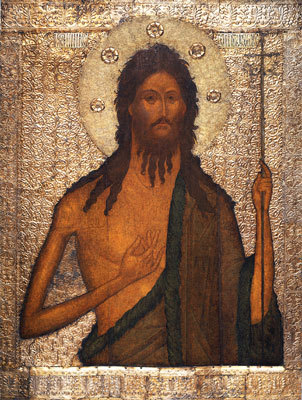
16th century Russian Orthodox icon of John the Baptist
At that time Herod the tetrarch heard the reports about Jesus, and he said to his attendants, “This is John the Baptist; he has risen from the dead! That is why miraculous powers are at work in him.”
Now Herod had arrested John and bound him and put him in prison because of Herodias, his brother Philip’s wife, for John had been saying to him: “It is not lawful for you to have her.” Herod wanted to kill John, but he was afraid of the people, because they considered John a prophet.
On Herod’s birthday the daughter of Herodias danced for the guests and pleased Herod so much that he promised with an oath to give her whatever she asked. Prompted by her mother, she said, “Give me here on a platter the head of John the Baptist.” The king was distressed, but because of his oaths and his dinner guests, he ordered that her request be granted and had John beheaded in the prison. His head was brought in on a platter and given to the girl, who carried it to her mother. John’s disciples came and took his body and buried it. Then they went and told Jesus. (NIV)
John’s murder is a story about our world – a world of power, sex, and intrigue. Times may change, but people across the ages do not change. Humanity is fundamentally the same in every century. And the world is still the world, no matter the historical time.
The contrast between Herod and John supply us with two types of people who exist throughout every age of humankind, offering us the choice of which way we will go with our lives. The story illustrates for us the reality of living in a fallen world as a devout person.
The Herod in today’s Gospel lesson was a son of Herod the Great, the one who killed all the male babies when Jesus was born in order to try and get rid of any rival king (Matthew 2:1-18). King Herod is displayed in the narrative as a tragic and pathetic figure who is ruled by his own lusts. He seems too proud and wimpy to admit he made a rash promise and killed a man just to save face with his guests at a party.
Talk about a Jerry Springer worthy family drama, here it is: The Herod family was rich, proud, and downright violent. They tended to marry within their own clan to hold their power and possessions for themselves. Herodias married her uncle Herod Philip; Salome was their daughter. Later, Salome married Philip the tetrarch, half-brother to Herod Philip. Through marriage, Salome became both aunt and sister-in-law to her mother. Then the Herod in our story married Herodias, who had been married to Herod’s half-brother, Herod Philip. Having fallen in love with Herod Antipas, Herodias divorced Herod Philip to marry Herod Antipas. Sheesh, nothing like complicated family drama.
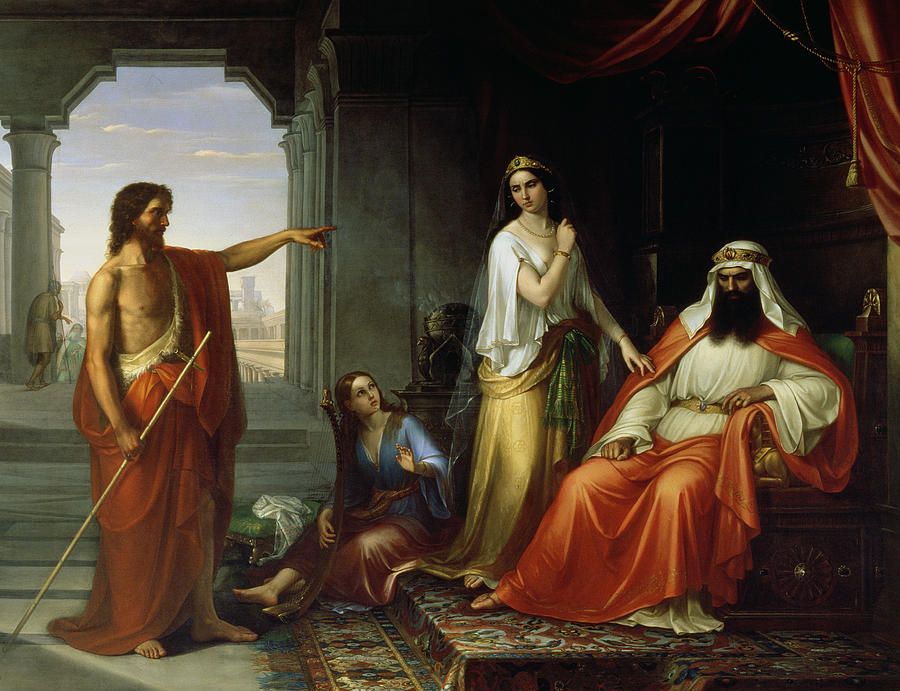
St. John the Baptist Rebuking Herod by Italian artist Giovanni Fattori (1825-1908)
Into this violation of Old Testament marriage laws (the Herod’s were Jewish) came John who made no bones about the fact this was not right (Leviticus 18:16, 20:21). Herodias nursed a grudge against John for speaking out against her and Herod’s choices. Hell, hath no fury like a woman’s scorn, and when Herodias found an opportunity to get rid of John, she coached her daughter into asking for John the Baptist’s head on a platter. Herod, too insecure to take back his ridiculous promise and look like a fool, consented to the execution of John.
In contrast to all this tragic theater is John the Baptist. John was a messenger of God and a preacher of repentance. As one who was preparing the way for Jesus, his message was simple and to the point: Repent, for the kingdom of God is near. John got into trouble and lost his life because he spoke truth to power by meddling in the life of King Herod and his family. The Herod’s were the political establishment of the day, and John did not temper his words when dealing with them.
There is a refreshing integrity about John. He was always the same no matter where he was, and no matter who the people were around him. In contrast to Herod, John was bold, courageous, confident, unafraid, and secure enough in his relationship with God to engage in ministry without thought to the consequences. He was unconcerned for what others might think of him if he proclaimed truth in the public square, and it did end up costing him his life.
The story of John the Baptist’s death speaks about the hostility of this world. And it prefigured and foreshadowed the death of Jesus. Like John, Jesus was executed by the civil authorities. Herod, like Pilate after him, hesitated to execute and was swayed by the crowd. Herodias, like the chief priests toward Jesus, finally got her way through scheming and manipulation. John’s disciples came and took his body and buried it, just like Joseph of Arimathea and Nicodemus did for Jesus.
These stories, on the surface of things, appear to be only gloom and doom. Yet, there is a message of hope and joy. The absurd is working out itself in deliverance from sin, death, and hell. Through death, Jesus conquered death. We now have no fear of death; its sting has been taken away. Without fear of death, we have no reason to fear life with its troubles and tribulations.
The fork in the road is between the way of John or Herod. It is a values-based decision. If worth is derived from what we do, what we have, and/or other’s opinion of us, we will likely identify more with Herod and his choices. If there is a preoccupation with hoarding power and control, this is the path of Herod.
Conversely, if the ultimate value is in knowing Christ crucified and the power of his resurrection, then we identify with John as our spiritual ancestor. If security and worth is derived from being in Christ, then there is boldness to speak truth to power and give grace to the powerless.
Herod saw no further than his immediate needs and safety; he failed to discern his own heart. Because of his spiritual blindness, Herod did not look away from himself and look to God. Faith in Jesus comes when persons look away from themselves and look to Christ who holds the power to free all from spiritual bondage.
Let us look to the example of John the Baptist who consistently sought to do the will of God as best as he understood it. Together with all God’s people past and present, we declare that God is with us, the kingdom of God is near, and the love of Christ brings faith and hope.
Almighty God, through your providence John the Baptist was wonderfully born and was sent to prepare the way of your Son, our Savior by the preaching of repentance. Lead us to repent according to his preaching and, after his example, constantly to speak the truth, boldly to rebuke vice, and patiently to suffer for truth’s sake; through Jesus Christ your Son, our Lord, who is alive and reigns with you, in the unity of the Holy Spirit, one God, now and forever. Amen.