1 Samuel 3:1-21 – Speak, Lord, for I Am Listening

The boy Samuel ministered before the Lord under Eli. In those days the word of the Lord was rare; there were not many visions.

One night, Eli, whose eyes were becoming so weak that he could barely see, was lying down in his usual place. The lamp of God had not yet gone out, and Samuel was lying down in the house of the Lord, where the ark of God was. Then the Lord called Samuel.

Samuel answered, “Here I am.” And he ran to Eli and said, “Here I am. You called me.”

But Eli said, “I did not call; go back and lie down.” So, he went and lay down.

Again, the Lord called, “Samuel!” And Samuel got up and went to Eli and said, “Here I am. You called me.”

“My son,” Eli said, “I did not call; go back and lie down.”

Now Samuel did not yet know the Lord: The word of the Lord had not yet been revealed to him.

A third time the Lord called, “Samuel!” And Samuel got up and went to Eli and said, “Here I am. You called me.”

Then Eli realized that the Lord was calling the boy. So, Eli told Samuel, “Go and lie down, and if he calls you, say, ‘Speak, Lord, for your servant is listening.’” So, Samuel went and lay down in his place.

The Lord came and stood there, calling as at the other times, “Samuel! Samuel!”

Then Samuel said, “Speak, for your servant is listening.”

And the Lord said to Samuel: “See, I am about to do something in Israel that will make the ears of everyone who hears about it tingle. At that time, I will carry out against Eli everything I spoke against his family—from beginning to end. For I told him that I would judge his family forever because of the sin he knew about; his sons blasphemed God, and he failed to restrain them. Therefore, I swore to the house of Eli, ‘The guilt of Eli’s house will never be atoned for by sacrifice or offering.’”

Samuel lay down until morning and then opened the doors of the house of the Lord. He was afraid to tell Eli the vision, but Eli called him and said, “Samuel, my son.”

Samuel answered, “Here I am.”

“What was it he said to you?” Eli asked. “Do not hide it from me. May God deal with you, be it ever so severely, if you hide from me anything that he told you.” So, Samuel told him everything, hiding nothing from him. Then Eli said, “He is the Lord; let him do what is good in his eyes.”

The Lord was with Samuel as he grew up, and he let none of Samuel’s words fall to the ground. And all Israel from Dan to Beersheba recognized that Samuel was attested as a prophet of the Lord. The Lord continued to appear at Shiloh, and there he revealed himself to Samuel through his word. (NIV)

Old Testament stories are typically arranged in such a way that we can perceive clear contrasts between the good guy and the bad guy. In our lesson today, Samuel is the good guy and Eli the bad guy. The contrast between them are two different ways of being quiet.

On the one hand we have the boy Samuel, who took a posture of listening. Samuel was quiet and heard the voice of the Lord. He responded with few words, with a spirit of listening. Eli the old priest, on the other hand, was also quiet, but for all the wrong reasons. Eli’s sons were also priests. They received sacrifices from God’s people and deliberately mishandled their responsibility. The sons cared not a whit for what the Lord really wanted. Eli knew what his sons were doing, and he was eerily quiet about their gross negligence as priests.

There is a time for everything – a time to speak and a time to be quiet. And when being quiet is required, it is for the purpose of listening. Listening seems a lost art and a forgotten ability in our day and age. People can be so concerned to express their opinions and say what they want to say that the virtue of listening is neither valued nor cherished.  However, God puts a premium on listening.

“A person who talks too much gets into trouble. A wise person learns to be quiet.”

Proverbs 10:19, ERV

One of the reasons the art of listening is not well-practiced is that we esteem busyness over taking the time for silence. We cannot seem to slow down enough to listen. Yet, if we are to hear the voice of God, we must be still and silent long enough to listen to what the Spirit is trying to say to us.

We might be uncomfortable with silence and seek to fill any quiet space with noise to not have to deal with what is really going on inside of us. I once attended a ministerial retreat. One of the pastors I got to know was a church planter in an urban ministry. He grew up in a large family in the inner city. And he talked – a lot! He was a beehive of words and constant locomotion. During our lunch together, the retreat host made a pronouncement: Beginning after the meal, there was to be absolutely no talking until lunch the next day. There was to be a full twenty-four hours of total silence.

Some might think this was some sort of punishment. But that line of thinking exposes how much words and noise mean to us. The sole purpose of the silence was to put us in a position for listening to God. As you might imagine, my church planter friend had a difficult time. When we broke the silence the next day, he confessed he had never in his entire life been quiet for more than fifteen minutes. However, here is what he said about his time of silence: 

“Those twenty-four hours of silence were the loudest hours I have ever experienced. My mind was so noisy and so filled with stuff that when night came it nearly drove me nuts. But in the morning, as the noise started to fade away, I could begin to hear the still small voice of God.” 

This wonderful brother went back to his church a different pastor, determined to sit still long enough and be quiet long enough to hear what God wanted for his life and work.

If we want to hear God speak to us, we must take the same approach as the boy Samuel and say, “Speak, Lord, for your servant is listening.” Then, be quiet and listen. Any fool can babble on about their gripes and opinions. But the wise person discerns that talking is overrated. Silence, solitude, listening, and learning were the virtues practiced by Jesus. The kingdom of God comes to earth when those ideals are cherished.

Another reason we might not value listening is that we do not want to hear what God is saying. After all, it might not be something we would like to hear. Old Eli did not get good news from Samuel’s listening to the Lord. Yet here is where words are to follow listening. When we take the time to listen to God, we must do and say what God tells us to do and speak. And that can be scary. 

I would like you to do something: Take ten minutes every day for the next week to do nothing but sit in silence for the purpose of listening. Begin your time with Samuel’s phrase: “Speak, Lord, for I am listening.”  Then, be quiet, and listen. Pay attention to what is going on inside of you. Meditate on that phrase, or another Bible passage. Afterwards, take a few moments to write down how you felt during the time, and any insights you discovered.

Loving God, we admit to being uncomfortable with silence. Listening is such hard work! We confess to you our propensity of filling every nook and cranny of our lives with being busy and productive, achieving and doing. We admit that we keep looking for you to act without first listening to what you are saying to us. We choose today to take the posture of listening to your Holy Spirit speak to us through your Holy Word. Give us the courage to act on what you tell us. We lean into the faith we have in the Lord Jesus so that our lives may be shaped and formed in ways that please you. Be gracious to answer us and lead us to the green pastures and quiet waters of your sacred space. Amen.


Matthew 2:1-12 – Epiphany of the Lord

Star of Bethlehem by German painter Waldemar Flaig (1892-1932)

Jesus was born in Bethlehem in Judea, during the reign of King Herod. About that time some wise men from eastern lands arrived in Jerusalem, asking, “Where is the newborn king of the Jews? We saw his star as it rose, and we have come to worship him.”

King Herod was deeply disturbed when he heard this, as was everyone in Jerusalem. He called a meeting of the leading priests and teachers of religious law and asked, “Where is the Messiah supposed to be born?”

“In Bethlehem in Judea,” they said, “for this is what the prophet wrote:

‘And you, O Bethlehem in the land of Judah,
    are not least among the ruling cities of Judah,
for a ruler will come from you
    who will be the shepherd for my people Israel.’”

Then Herod called for a private meeting with the wise men, and he learned from them the time when the star first appeared. Then he told them, “Go to Bethlehem and search carefully for the child. And when you find him, come back, and tell me so that I can go and worship him, too!”

After this interview the wise men went their way. And the star they had seen in the east guided them to Bethlehem. It went ahead of them and stopped over the place where the child was. When they saw the star, they were filled with joy! They entered the house and saw the child with his mother, Mary, and they bowed down and worshiped him. Then they opened their treasure chests and gave him gifts of gold, frankincense, and myrrh.

When it was time to leave, they returned to their own country by another route, for God had warned them in a dream not to return to Herod. (NLT)

The Three Kings, Ethiopian Orthodox Church

Each year on January 6 in the Church Calendar, after the twelve days of Christmas, is the celebration of Epiphany. Christ’s coming to this earth as a child and becoming like us is much more than a baby in a manger.  Epiphany helps to bring a vision and understanding of God’s glory to all kinds of people in the world.

Epiphany means “manifestation” or “appearance.” The event which is associated with this season is the visit of the Magi to Jesus. Included in this time of the year between the seasons of Christmas and Lent is a special emphasis on the teaching and healing ministry of Jesus. The great celebration and focus of these weeks is that salvation is not limited to Israel but extends to the Gentiles, as well.

Every season in the Christian Year has its unique angle of grace. With Epiphany, we see that one of the most scandalous truths of Christianity is that God graces common ordinary people who seem far from God with the gift of Jesus. God grants repentance that leads to life for all kinds of people no matter their race, ethnicity, class, or background. It is a wondrous and astounding spiritual truth that God’s gracious concern is not limited to a certain type of person or a particular group of people.

Grace is and ought to be the guiding factor in how we interact with people. Losing sight of grace leads to being critical and defensive. Like King Herod of old, a graceless person becomes enamored with earthly power and control. But embracing grace leads to the humility of seeing the image of God in people quite different from ourselves. Like the Apostle Peter, who learned in a vision to bring the gospel to non-Jews, old legalisms begin to be worn away so that people from all walks of life can have access to Jesus and his gracious saving and healing ministry. (Acts 10-11:18)

Grace brings down barriers and does away with unnecessary distinctions between others. The appropriate response to mercy is to glorify God for such marvelous light and amazing work.

It is a merciful reality that the Magi, or Wise Men, pagan astrologers, were directed to the Messiah. A light was provided to lead them to Jesus. Apart from God’s care and intervention they would have remained in darkness.  And it is no less true for people today. This old broken world is wrapped in darkness. All kinds of people have no light at the end of the tunnel of their lives for hope and new life. The gospel of Jesus Christ brings that light to those walking around with no ability to see. Jesus, in his teaching ministry, exhorted his followers not to hide their light but to let it shine for all to see. (Matthew 5:14-16)

Sometimes, maybe oftentimes, the best way to bring resolution to our own troubles and problems is through helping others make sense of their lives through the gracious light of Christ so that they can see an appearance, an epiphany, of what their lives can be in the gracious rule of the kingdom of God. 

As we celebrate Epiphany and journey with Jesus through his earthly upbringing and into his gracious ministry to people, let us keep vigilance to not let our light grow dim. Instead, let us hunger and thirst after Christ’s righteousness so that our joy is full, and our light is bright.

God of mercy, Lord of all, you have gifted the Church through the goodness of your grace to be your hands and do your work, to be your voice and share your words, to bring healing to broken lives. You have graciously gifted your people with the blessings of your Spirit, the power to transform lives and make all things new. Now may our hearts receive, our mouths proclaim, our hands prepare for service so that the love that we have may overflow into the hearts of others, and receive your grace, your renewing Spirit, and your love, through Jesus Christ our Savior. Amen.

Luke 6:27-31 – Love Your Enemies

“But to you who are listening I say: Love your enemies, do good to those who hate you, bless those who curse you, pray for those who mistreat you. If someone slaps you on one cheek, turn to them the other also. If someone takes your coat, do not withhold your shirt from them. Give to everyone who asks you, and if anyone takes what belongs to you, do not demand it back. Do to others as you would have them do to you.” NIV)

“Maturity is looking at every person we meet and saying to yourself, ‘I will never, God helping me, do anything to harm you: not by angrily lashing out at you, lusting over you, faithlessly slipping away from you, verbally hitting back at you, or even justifiably disliking you.’”

–Frederick Dale Bruner

Here are a few rhetorical questions, considering the astounding words from Jesus to love enemies: Have you ever had someone not like you?  Offend you? Purposely say or do things that upset you? I once had a next-door neighbor who was plain mean. Once, when my dog accidentally strayed into her yard and left a package, she picked it up and placed the package directly in front of my backdoor. 

When such things happen, it is tempting to respond in kind with the same behavior as the obnoxious person.  Many of us have sly passive aggressive tendencies of getting back at others when they do or say offensive things, and we consider them an enemy.

The situation with my neighbor was frustrating, yet quite benign. It is an entirely different matter trying to love someone who has deeply hurt us. Their words of malice or actions of abuse are evil, and we naturally seek to defend and respond by hurting them back. This is no trite saying of Jesus to proclaim that we are to love the enemy. It will be hard to love a villain apart from the grace of God, and Jesus knew what he was asking of us.  He does not ask of us anything that he himself has not already done.

We are often pleased with ourselves if we love our family and friends, because even that is a struggle for us, at times. We need to treat all people with respect and kindness, even active love, because that is what God does.

Jesus did not say anything new in calling for neighbor love. The Old Testament clearly says to do so: 

You must not take revenge nor hold a grudge against any of your people; instead, you must love your neighbor as yourself; I am the Lord. (Leviticus 19:18, CEB)

Nowhere in the Old Testament does it say to hate your enemy. However, over time, the idea became popular that if we are told to love our neighbor, then we must hate our enemy (who is not our neighbor). Jesus was once asked, “Who is my neighbor?” He responded by telling the parable of the Good Samaritan. The conclusion to that parable is that everyone I encounter is my neighbor, and so must be shown mercy when they are in need. (Luke 10:25-37)

Jesus let us know that when we walk in the way of love, we will sometimes be treated harshly by the world (Matthew 5:10-12).  When that happens, Christ says we must not exact revenge or retaliate. Even more, we are to respond with overt gestures of love, rather than simply ignoring them.

We are to pray for our enemies. It is hard to hate someone or a group of people when we are devoted to praying for them. Pray the Spirit would open their eyes so they can see the error of their way. Make sure to leave the judgment to God, for that is divine business, not ours.

We are to love because God loves. To love those who offend us emulates God’s benevolence. When we love our enemies, without expecting anything in return, we imitate God’s character as children of God:

Watch what God does, and then you do it, like children who learn proper behavior from their parents. Mostly what God does is love you. Keep company with him and learn a life of love. Observe how Christ loved us. His love was not cautious but extravagant. He did not love to get something from us but to give everything of himself to us. Love like that. (Ephesians 5:1-2, MSG)

If we have no love for our enemies, then we are no different from them. Christians are to be distinctive because of the way they treat others, especially outside the faith. We are to model our lives after God’s love, not by the standard of niceness to those who are nice to us. God does not expect us to live as followers of Jesus by only showing reciprocity, that is, just giving back to those who already have given something to us. Instead, we give even when we are persecuted. We do this because God shows no distinction in the distribution of sunshine and rain. Showing basic respect and goodness to all people, no matter who they are, can be God’s rain and sun toward others.

“To return evil for good is devilish. To return good for good is human. To return good for evil is divine. To love as God loves is moral perfection.” Alfred Plummer

Grace, undeserved kindness, is not something we can just conjure up, as if we might will ourselves to love our enemies. It is not natural – it is supernatural, and so must come from a supernatural Being. 

During World War II, a Lutheran pastor, imprisoned in a German concentration camp, was tortured by an S.S. officer who wanted to force him to a confession.  The pastor did not respond to the torture.  His silence only enraged the officer to such a degree that he hit the pastor harder and harder until he finally exploded and shouted at him, “don’t you know that I can kill you!?”  The pastor looked him the eye and said, “Yes, I know – do what you want – but I have already died.”  At that point, the officer lost power over the pastor.  All of the officer’s cruelty had been based on the idea that the pastor would hold onto his life as his most valuable property and would be willing to give a confession in exchange for his life.  But with the grounds for his violence gone, torture had become a ridiculous and futile activity.

Our human relationships may easily become subject to verbal violence, bitterness, and destruction, when we make enemies of each other and treat people as properties to be defended or conquered instead of precious gifts to be received. If we have nothing to defend, then we have no enemies who can harm us.

Jesus, Prince of Peace,
you have asked us to love our enemies 
and pray for those who persecute us.
We pray for our enemies and those who oppose us.

With the help of the Holy Spirit, 
may all people learn to work together 
for the justice which brings true and lasting peace.
Holy Spirit of God, we ask you for the strength and the grace to love those who harm us, that we may shine as beacons of Christian light in a world of revenge, retaliation, and darkness.

We pray for those who have hurt us.
Bless them always and in every way, Lord.

We pray for those who hate us.
Bless them always and in every way, Lord.

We pray for those who insult us.
Bless them always and in every way, Lord.

We pray for those who have stolen from us.
Bless them always and in every way, Lord.

We pray for those who will not hear us.
Bless them always and in every way, Lord.

We pray for those who have hurt our church.
Bless them always and in every way, Lord.  Amen.

Psalm 110 – The Priest King

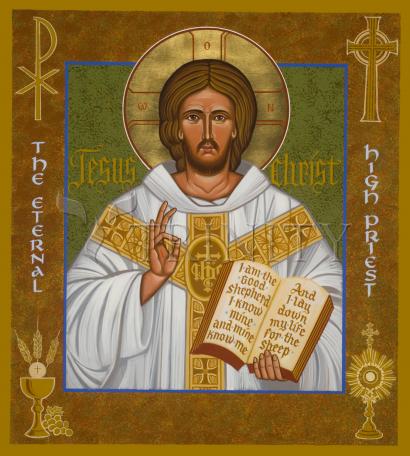
Jesus Christ – Eternal High Priest by American painter Joan Cole

The Lord says to my lord:

“Sit at my right hand
    until I make your enemies
    a footstool for your feet.”

The Lord will extend your mighty scepter from Zion, saying,
    “Rule in the midst of your enemies!”
Your troops will be willing
    on your day of battle.
Arrayed in holy splendor,
    your young men will come to you
    like dew from the morning’s womb.

The Lord has sworn
    and will not change his mind:
“You are a priest forever,
    in the order of Melchizedek.”

The Lord is at your right hand;
    he will crush kings on the day of his wrath.
He will judge the nations, heaping up the dead
    and crushing the rulers of the whole earth.
He will drink from a brook along the way,
    and so he will lift his head high. (NIV)

Today’s reading is the most quoted psalm in the New Testament (twenty-four times) and is mentioned in the Apostle’s Creed. The reason for this is, of course, because Christ’s apostles discerned Jesus as the messianic ruler of the psalm. The writer of Hebrews had the purpose of emphasizing the superiority of Jesus Christ over all others, and so, lifted this psalm, along with other psalms, and placed it in the beginning of his argument:

In the past God spoke to our ancestors through the prophets at many times and in various ways, but in these last days he has spoken to us by his Son, whom he appointed heir of all things, and through whom also he made the universe. The Son is the radiance of God’s glory and the exact representation of his being, sustaining all things by his powerful word. After he had provided purification for sins, he sat down at the right hand of the Majesty in heaven. So, he became as much superior to the angels as the name he has inherited is superior to theirs….

But about the Son he says,

“Your throne, O God, will last for ever and ever;
    a scepter of justice will be the scepter of your kingdom.
You have loved righteousness and hated wickedness;
    therefore God, your God, has set you above your companions
    by anointing you with the oil of joy.”

He also says,

“In the beginning, Lord, you laid the foundations of the earth,
    and the heavens are the work of your hands.
They will perish, but you remain;
    they will all wear out like a garment.
You will roll them up like a robe;
    like a garment they will be changed.
But you remain the same,
    and your years will never end.”

To which of the angels did God ever say,

“Sit at my right hand
    until I make your enemies
    a footstool for your feet”? (Hebrews 1:1-13, NIV)

Jesus the King of the World in Czestochowa, Poland

In Christianity, Jesus is the ultimate Mediator between God and people. Neither angel nor any human can fill such a role. The author of Hebrews wanted to make it clear that Jesus is the rightful Ruler of all creation. Christ’s authority is far and above all others. So, Christians are never defenseless in this world. Believers have a sovereign Mediator and King to willingly submit to, knowing that Jesus has the power and authority to back up his words of love and assurance.

Jesus has the unique combination of being both King and Priest, the One who intercedes for us and leads us with compassionate leadership. Again, the author of Hebrews uses Psalm 110 to emphasize this:

Every high priest is selected from among the people and is appointed to represent the people in matters related to God, to offer gifts and sacrifices for sins. He can deal gently with those who are ignorant and are going astray, since he himself is subject to weakness. Therefore, he has to offer sacrifices for his own sins, as well as for the sins of the people. And no one takes this honor on himself, but he receives it when called by God, just as Aaron was.

In the same way, Christ did not take on himself the glory of becoming a high priest. But God said to him,

“You are my Son;
    today I have become your Father.”

And he says in another place,

“You are a priest forever,
    in the order of Melchizedek.”

During the days of Jesus’ life on earth, he offered up prayers and petitions with fervent cries and tears to the one who could save him from death, and he was heard because of his reverent submission. Son though he was, he learned obedience from what he suffered and once made perfect, he became the source of eternal salvation for all who obey him and was designated by God to be high priest in the order of Melchizedek. (Hebrews 5:1-10, NIV)

Jesus Christ demonstrated and proved he is qualified to be the rightful Priest and King through obedient suffering. That means he is perfectly suited and able to help us. Christ is no detached and aloof King and Priest. He knows exactly what it is like to be a human in this broken and fallen world. Such divine empathy translates into solid emotional and spiritual support because, as the Christian tradition holds, Jesus has taken care of the sin issue once for all through the Cross.

The Messiah’s enemies, whose final defeat is certain, are not Gentile kingdoms or human institutions. The ultimate foes are the hostile and evil principalities and powers of this dark world, including death itself. The universal reign of Jesus, the exalted Son of David, brings deliverance from guilt, shame, and injustice as the unique God-Man.

In this unabashed Christian view of Psalm 110, Jesus is our perfected high priest who is able for all time to save those who approach God, since he always lives to make intercession for us. (Hebrews 7:25)

The appropriate response to such a great King and Priest is submissive loyalty and eternal praise.

May it be so to the glory of God.

O Lord our God: Reign in power over us, through your Son, Jesus Christ – for he is exalted over all governments and authorities, all ideologies and creeds, and all human hearts and souls. King Jesus: Be enthroned in our lives, in all people everywhere, as our mediator and atoning sacrifice. Spirit of God: Reign in power over us through Jesus Christ and give us the victory over all the enemies of our souls, within and without, for the glory of your Name. Amen.