I have always felt comforted during thunderstorms. Having grown up in Iowa, strong thunderstorms are a given every summer. When my daughters were small children and frightened by the loud clap of thunder, I would say to them, “That’s just God letting us know he is powerful and watching over us.”
God spoke and stirred up a storm… So, they cried out to the Lord in their distress, and God brought them out safe from their desperate circumstances. God quieted the storm to a whisper; the sea’s waves were hushed. (Psalm 107:25, 29-30, CEB)
God’s very voice is the source of all power. In the beginning God created the heavens and the earth – with words. The Lord Almighty spoke the entire world into existence. God’s words are generative, that is, the speech of God creates and gives life. When God’s voice goes forth, things happen:
God said, “Let there be light,” and there was light… (Genesis 1:3, NIV)
God said, “Let there be a vault between the waters to separate water from water….” And it was so. (Genesis 1:6-7, NIV)
God said, “Let the waters under the sky come together into one place so that the dry land can appear.” And that is what happened. (Genesis 1:9, CEB)
God said, “Let the earth produce plants—some to make grain for seeds and others to make fruits with seeds in them. Every seed will produce more of its own kind of plant.” And it happened. (Genesis 1:11, NCV)
God said, “Let lights appear in the sky to separate the day from the night. Let them be signs to mark the seasons, days, and years. Let these lights in the sky shine down on the earth.” And that is what happened. (Genesis 1:14-15, NLT)
God said, “Let the land produce living creatures according to their kinds: the livestock, the creatures that move along the ground, and the wild animals, each according to its kind.” And it was so. (Genesis 1:24, NIV)
God creates and gives through speech. Yes, the mechanism of God’s provision for us is words. This means language is vitally important. The Lord creates, gives, sustains, and blesses creation through language – with humans as the only creatures formed in the image and likeness of God.
God said, “Now we will make humans, and they will be like us. (Genesis 1:26, CEV)
People, then, are capable of speech. Even more, with our ability of language, we also have the capacity to form generative words. We have the God-given means to give life with our speech.
“Life and death lie in the power of language.”
helen keller
I believe we all intuitively know this is true. As we reminisce the history of our lives, we can observe events where another’s words impacted us so significantly that it was as if they gave us the gift of life. We never forget those words. We also have had times when another’s words cut us emotionally and it felt as if a part of us died. We tend to remember those as well, and they hold us back in our own life-giving speech to ourselves and others.
“The godless destroy their neighbors by their words, but the righteous are saved by their knowledge.” (Proverbs 11:9, CEB)
We must listen to the voice of the Lord. God’s speech does not disappoint or destroy. God’s Word is eternal life. The better we listen to God, the better we can have the generative power of words to provide life for others. It only takes a cursory look at Holy Scripture to realize that words are powerful and are to be used with great care. We are all to continually develop the craft of wordsmithing so that we might ascribe to the Lord the glory due his name as well as bless the world.
“As a tree gives fruit, healing words give life, but dishonest words crush the spirit.” (Proverbs 15:4, NCV)
The language we use—spoken and written words, sign language, facial expressions, bodily gestures, singing—helps us understand ourselves and lets us create relationships with others. Our words give us the power to describe our past, define our present, and dream of our future.
“Words from wise people are like water bubbling up from a deep well—the well of wisdom.” (Proverbs 18:4, ERV)
“Words are singularly the most powerful force available to humanity. We can choose to use this force constructively with words of encouragement, or destructively using words of despair. Words have energy and power with the ability to help, to heal, to hinder, to hurt, to harm, to humiliate and to humble.”
Yehuda Berg
We need to speak mindfully, paying careful attention to give people words of encouragement and compassion. We must discipline ourselves to use our words in a way that conveys respect, gentleness, and humility.
We adults may balk at the notion that words are anything more than a creative expression. Yet, as I believe is typical with most things, children are closer to the kingdom of God. They effortlessly make connections between words and reality whereas us older folks barely have an idea this even occurs. My grandson once remarked when I was talking to him about being cautious at the playground, “How am I supposed to meet new people if I can’t talk to strangers?”
“When I asked my son (5 years old) how his day was, he said it was awesome. I asked him what made it so awesome – his response was ‘because I wanted it to be.’”
Tanya Niedzwiecki (Huffington Post, November 2015)
The voice of the Lord exhibits a mighty God who has the power to create, recreate, and renew with but a word. As people in God’s likeness, our words are powerful tools to be used with wisdom and care. Our speech allows us to praise God and encourage one another. Even more, the use of language enables us to speak into existence new realities for ourselves and others. May those words bring forth hope and blessing to a world in need of healing.
One day as Jesus was standing by the Lake of Gennesaret, the people were crowding around him and listening to the word of God. He saw at the water’s edge two boats, left there by the fishermen, who were washing their nets. He got into one of the boats, the one belonging to Simon, and asked him to put out a little from shore. Then he sat down and taught the people from the boat.
When he had finished speaking, he said to Simon, “Put out into deep water, and let down the nets for a catch.”
Simon answered, “Master, we’ve worked hard all night and haven’t caught anything. But because you say so, I will let down the nets.”
When they did, they caught so many fish that their nets began to break. So, they signaled their partners in the other boat to come and help them, and they came and filled both boats so full that they began to sink.
When Simon Peter saw this, he fell at Jesus’ knees and said, “Go away from me, Lord; I am a sinful man!” For he and all his companions were astonished at the catch of fish they had taken, and so were James and John, the sons of Zebedee, Simon’s partners.
Then Jesus said to Simon, “Don’t be afraid; from now on you will fish for people.” So, they pulled their boats up on shore, left everything, and followed him. (NIV)
One of the most fundamental characteristics of God is generosity. God’s benevolent nature defines the divine stance toward humanity. This may not seem overly remarkable with only cursory thoughts about God. Yet, when the infinite holiness of God intersects with the prideful arrogance of sinful people, gracious generosity is the unpredictable and amazing result.
Many people on planet earth have been raised with a god who is aloof and curmudgeonly. Such a god gets easily angry and zaps people with lightning or some natural disaster. It is no wonder so many persons have fled from belief in God. Can we, however, entertain the notion that the Creator God of the universe is quite the opposite? In Jesus, we have on display the basic disposition of the Divine.
The Miraculous Catch of Fish by Belgian artist Erik Tanghe
On one occasion, Peter (a guy who could raise the ire of most gods) was going about his business fishing in the Sea of Galilee. Having not yet encountered Jesus but stopping to listen to his words, Peter ended up having this stranger literally get in the boat with him, uninvited. There was something remarkably different and compelling about Jesus since Peter did not immediately toss him out. Such a calm, confident, and gracious nature – nothing like Peter had expected. So, here is this plan fisherman face-to-face with the Christ of God.
Jesus told Peter to put the boat out and cast the nets. Peter, an experienced fisherman and knowledgeable about the water, knew for certain that he would not catch anything. But, out of deference to Jesus, he did so, anyway. The result was such a large catch of fish that the nets nearly broke from the weight.
Peter’s response is instructive. He fell at the feet of Jesus and said, “Depart from me, for I am a sinful man, O Lord.” Peter came up against his own small faith. He rightly discerned that he did not deserve such generosity from Jesus, an overflowing abundance given to him despite his unbelief. In the face of such grace, in the vortex of an incredible mercy, having seen the generosity of God directed squarely at him, Peter left it all behind to follow Jesus.
So, here we have the nature and character of God before us. No cranky deity. No exasperated God ready to raise a storm and toss the boat over with Peter in it. No, Jesus, the Son of God, does not operate that way. There is no strong-arming people into faith. God’s tactics steer clear of manipulation through guilt, or mind-twisting others through shaming them.
Instead, God is beautifully and simply present with people – showing grace and generosity in places where one would least expect to find it. When confronted with such love, what would you do?
Early in my life, I viewed God as some eternally bored deity who would occasionally get out his divine BB gun and shoot people in the rear, just for something to do. God, in my understanding, cared nothing for the real lived experiences of people on earth. But much like Peter of old, Jesus showed up unannounced in my life. And what I found was like Peter – a kind, benevolent Being who showered such generous love on me that my heart was immediately captured. I have never looked back since.
We intuitively know down in our gut, in our bones, when genuine Love is among us because it immediately connects with the deepest needs of our lives. No evangelist must convince us with offering free gold crosses or promised blessings. None of that matters when love incarnate is present, when the great God of all is among us. Peace, hope, and faith are the results of divine presence. They cannot be conjured or ginned up through excessive asceticism or extreme discipline. Love is a gift. Love is a person. And it is given generously and graciously from the One whose very nature is charitable and hospitable.
Gracious God, you sent your Son to me even though I was neither looking for him nor expecting anything from him. Thank you for breaking-in to my life so that I could break-out for you with glory, honor, and praise. Amen
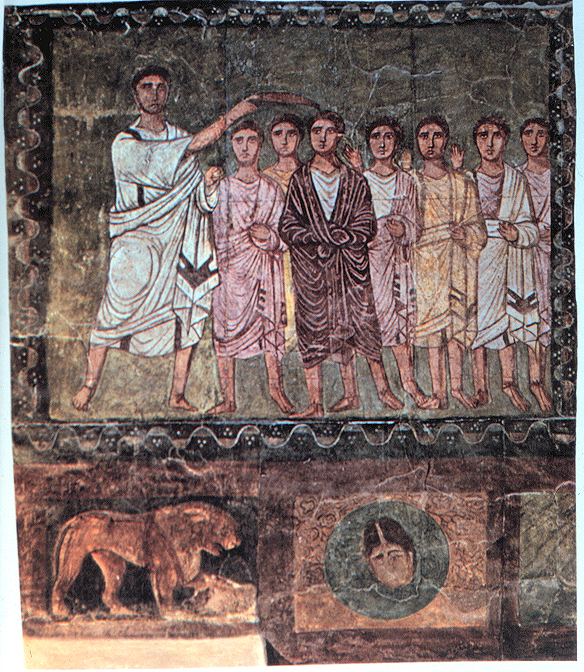
Samuel Anoints David as King, Syrian Orthodox Church, 3rd Century C.E.
The Lord said to Samuel, “How long will you mourn for Saul, since I have rejected him as king over Israel? Fill your horn with oil and be on your way; I am sending you to Jesse of Bethlehem. I have chosen one of his sons to be king.”
But Samuel said, “How can I go? If Saul hears about it, he will kill me.”
The Lord said, “Take a heifer with you and say, ‘I have come to sacrifice to the Lord.’ 3 Invite Jesse to the sacrifice, and I will show you what to do. You are to anoint for me the one I indicate.”
Samuel did what the Lord said. When he arrived at Bethlehem, the elders of the town trembled when they met him. They asked, “Do you come in peace?”
Samuel replied, “Yes, in peace; I have come to sacrifice to the Lord. Consecrate yourselves and come to the sacrifice with me.” Then he consecrated Jesse and his sons and invited them to the sacrifice.
When they arrived, Samuel saw Eliab and thought, “Surely the Lord’s anointed stands here before the Lord.”
But the Lord said to Samuel, “Do not consider his appearance or his height, for I have rejected him. The Lord does not look at the things people look at. People look at the outward appearance, but the Lord looks at the heart.”
Then Jesse called Abinadab and had him pass in front of Samuel. But Samuel said, “The Lord has not chosen this one either.” Jesse then had Shammah pass by, but Samuel said, “Nor has the Lord chosen this one.” Jesse had seven of his sons pass before Samuel, but Samuel said to him, “The Lord has not chosen these.” So, he asked Jesse, “Are these all the sons you have?”
“There is still the youngest,” Jesse answered. “He is tending the sheep.”
Samuel said, “Send for him; we will not sit down until he arrives.”
So, he sent for him and had him brought in. He was glowing with health and had a fine appearance and handsome features.
Then the Lord said, “Rise and anoint him; this is the one.”
So, Samuel took the horn of oil and anointed him in the presence of his brothers, and from that day on the Spirit of the Lord came powerfully upon David. Samuel then went to Ramah. (NIV)
Solitude by Polish artist Piotr Dura
Appearances can be deceiving. One of the best ways to see beyond mere physical sight is to engage in the spiritual practice of solitude. Solitude is not loneliness but a deliberate retreat from normal routines to be alone with the Lord. The faith of both Samuel and David were strengthened through solitude. It prepared them for public service and made them godly. Because they had established patterns of being alone with God, they had an inward solitude even when in a crowd. That is why Samuel could have an interaction with the Lord, even when among lots of people.
Solitude is important because it is the true path to listening well. A person whose faith has been shaped through solitude has an ability to carry on a dialogue with God while, at the same time, having a conversation with others.
Christ’s relationship with the Father was formed through solitude. Jesus was able to have simultaneous conversations with God and people since he practiced solitude on a regular basis. Jesus began his ministry with solitude (Matthew 4:1-11); made major decisions through solitude (Luke 6:12); and taught his disciples to practice solitude (Matthew 17:1-9; 26:36-46).
Solitude is necessary because engaging the world is important. Effective interaction with others requires times of retreat for solitude with God. Solitude as a spiritual discipline:
Gives us freedom from the need for constant noise and activity.
Allows God to shape our faith rather than conform to the world.
Liberates us from other people’s expectations for us.
Helps quiet internal noise and racing thoughts so we can better listen to God.
Provides the opportunity for reflection upon and preparation for future events.
Creates encouraging speech for the benefit of others.
Fuels a desire to keep practicing solitude because of its benefit.
Solitude taught Samuel obedience.
Samuel learned obedience through years of solitude with old Eli the priest. “Speak Lord, for I am listening” became a way of life for Samuel, as he was trained in how to listen well.
Samuel’s greatness as the Judge of Israel did not lie in his original ideas or the initiatives he took, but in simple obedience to the commands of God. Years of obscurity and solitude as a child created the ability to hear and carry-out what the Lord told him to do.
Even Samuel, as godly as he was, could not rely on personal observations about choosing the next king of Israel. Because he had long years of practicing solitude with the Lord, Samuel was able to clearly hear divine speech and anointed the right person as king. Samuel did not trust his own judgment but relied on God’s direction.
Solitude characterizes God.
Christians serve a triune God of Father, Son, and Spirit. God has complete and perfect solitude along with focused engagement with humanity. Through spending time with God, people can simultaneously interact with divinity and humanity. It is a bit like my wife who began her broadcasting career in radio by simulcasting the AM station in one ear of her headphones, and the FM station in the other ear. She could que a record for the FM station while, at the same time, forecasting the weather for the AM station. Her ability was born of practice and commitment to her craft. In the same way, we have been given a vocation to engage the church and world, and the ability to have a solitude of heart while interacting with others.
God, unlike us, sees us completely, inside-and-out – which is why we are dependent upon solitude of heart so that we can make proper judgments. God urged Samuel to not look at the outward appearance because this is how wrong judgments happen.
Solitude formed David into a king.
David was on nobody’s short list to become king. He was so far out there as a candidate for the position that his own family did not even think it necessary to have him present for the sacrificial feast. It is just like God to have a way of choosing the people we think would be the least likely to do anything.
Being in the pasture day after day and night after night by himself was just the right curriculum that trained the next king. Shepherding was not a lonely affair for David. It was a rich experience of solitude which developed a solid relationship with God. Out in the field, away from all the wrong judgments of the world, David learned to discern God’s voice – a skill he carried with him the rest of his life.
Solitude might seem unrealistic for extroverts, and only something for introverts. Yet, solitude is essential to creating a robust faith in God. The following are some steps toward the practice of solitude and allowing it to bring you into a closer walk with the Lord.
Practice “little solitudes” in the day. The early morning cup of coffee or shower, the drive-time to work, the lunch break, the quiet at night when all is dark and everyone in bed are opportunities for solitude with God to reorient and redirect our lives.
Find or create a quiet place designed specifically for solitude. It might be a room, a closet, or a chair. It might be outdoors. It can be anywhere that helps you be free from distraction and invites you to connect deeply with Jesus.
Begin the day by spending at least 10 minutes alone with God in silence. Over time, work your way to even more minutes, even hours. I am a believer in an hour a day keeping the devil away. Eventually, take an entire day away, every few months. Consider taking a weekend or even a week away once a year.
Read Holy Scripture slowly and meditatively. Listen to what the Spirit may be saying in your reading.Keep a journal handy and write down your observations. Allow prayers to arise from what you hear from the Lord.
This might seem optional only for those with discretionary time – but it is no more optional than planting in the Spring to get a harvest in the Fall. Such fruit results in the slaying of giants….







 Rev. Tim Ehrhardt