John (349-407 C.E.) was Archbishop of Constantinople in the late fourth and early fifth centuries. His delivery of sermons must have been quite memorable and effective since John’s nickname was “the golden-tongued.” John Chrysostom preached through much of the Bible and about 600 of his sermons have survived to this day. The following message was proclaimed on Easter morning (c.400 C.E.) and is still read each year in many Eastern Orthodox and Roman Catholic churches.
Are there any who are devout lovers of God? Let them enjoy this beautiful bright festival!
Are there any who are grateful servants? Let them rejoice and enter into the joy of their Lord!
Are there any weary with fasting? Let them now receive their wages!
If any have toiled from the first hour, let them receive their due reward; If any have come after the third hour, let them with gratitude join in the Feast! And he that arrived after the sixth hour, let him not doubt; for he too shall sustain no loss. And if any delayed until the ninth hour, let them not hesitate; but let them come, too. And he who arrived only at the eleventh hour, let him not be afraid by reason of his delay. For the Lord is gracious and receives the last even as the first. He gives rest to the one that comes at the eleventh hour, as well as to the one that toiled from the first.
To this one He gives, and upon another He bestows. He accepts the works as He greets the endeavor. The deed He honors and the intention He commends. Let us all enter into the joy of the Lord!
First and last alike receive your reward; rich and poor, rejoice together! Sober and slothful, celebrate the day! You that have kept the fast, and you that have not, rejoice today for the Table is richly laden!
Feast royally on it, the calf is a fatted one. Let no one go away hungry. Partake, all, of the cup of faith. Enjoy all the riches of His goodness!
Let no one grieve at his poverty, for the universal kingdom has been revealed. Let no one mourn that he has fallen again and again; for forgiveness has risen from the grave. Let no one fear death, for the Death of our Savior has set us free. He has destroyed it by enduring it.
He destroyed Hades when He descended into it. He put it into an uproar even as it tasted of His flesh. Isaiah foretold this when he said, “You, O Hell, have been troubled by encountering Him below.”
Hell was in an uproar because it was done away with. It was in an uproar because it is mocked. It was in an uproar, for it is destroyed. It is in an uproar, for it is annihilated. It is in an uproar, for it is now made captive. Hell took a body, and discovered God. It took earth, and encountered Heaven. It took what it saw, and was overcome by what it did not see. O death, where is thy sting? O Hades, where is thy victory?
Christ is Risen, and you, o death, are annihilated! Christ is Risen, and the evil ones are cast down! Christ is Risen, and the angels rejoice! Christ is Risen, and life is liberated! Christ is Risen, and the tomb is emptied of its dead; for Christ having risen from the dead, is become the first-fruits of those who have fallen asleep.
The death of Christ, Holy Hill, Hubertus, Wisconsin
Christ suffered here on earth. Now you must be ready to suffer as he did because suffering shows that you have stopped sinning. It means you have turned from your own desires and want to obey God for the rest of your life. You have already lived long enough like people who don’t know God. You were immoral and followed your evil desires. You went around drinking and partying and carrying on. In fact, you even worshiped disgusting idols. Now your former friends wonder why you have stopped running around with them, and they curse you for it. But they will have to answer to God, who judges the living and the dead. The good news has even been preached to the dead, so that after they have been judged for what they have done in this life, their spirits will live with God. Everything will soon come to an end. So be serious and be sensible enough to pray. Most important of all, you must sincerely love each other, because love wipes away many sins. (CEV)
I haven’t been a confessing Christian my entire life. I can relate to Peter’s exhortation. I still remember what it feels like to live my life without any thought to God or spiritual matters. The thing about partying and immorality is that it’s a life filled with constant movement. Slowing down only makes one come face-to-face with what is truly inside the soul.
If someone has an empty vacuous soul, or a damaged spirit, or a broken heart, then attempting to drink or work away the inner pain makes sense when there’s no regard for God. The last thing I ever wanted to do was suffer, yet until I had my spiritual awakening, it seemed I could never outrun the hurt no matter how hard I tried, even with all the constant locomotion.
Today is Holy Saturday – a quiet place sandwiched between the ignominy of the cross and the celebration of resurrection – a day of solitude, silence, and stillness. This is something of a lost day for many folks. In fact, many Christians haven’t had a thought that Holy Saturday could have any significance. Yet, this very day has its place in the scheme of the Christian life.
There cannot be resurrection and new life without death and dying to self. There must be suffering before there can be glory. Whenever Christians quickly jump to triumphal language about victory and speak little-to-nothing about suffering, then we are left with a cheap grace which has been purchased with the counterfeit currency of velocity.
Today is meant for us to get out of our heads and wrap our hearts around the important reality that Jesus Christ was in the grave. It was real suffering on Good Friday. It was a real death on Holy Saturday. There is no movement. All is silent and still. Jesus is in the solitude of a dark tomb. There’s no getting around it. If we want a Resurrection Day with all its celebration and glory, then we cannot circumvent Holy Saturday.
To put this in the spirit of the Apostle Peter: Are we ready to follow Jesus and suffer as he did? Are we willing to stop our striving, manifested through constant movement, and embrace the Holy Saturday of solitude, silence, stillness with its contemplation and embrace of suffering? Will you and I have sense enough to pray? Will we practice a Christian counter-cultural shift and face the ridicule of friends so that we might take some much-needed time to be with Jesus in the tomb? Or are we so antsy and anxious that we just want to leap into Easter with no solidarity with our Lord in the grave?
You may think I’m being a bit too hard or harsh or cold…. That’s because Jesus is cold. He has a bonified cold dead body. It’s no fake death. There’s no “swoon theory” here, as if Christ only passed-out and did a weird divine fainting spell. Nope. He’s dead. And if you and I want to live with Jesus, we must die with Jesus.
Anyone who tries to promise new life apart from journeying with Jesus into the grave is a spiritual charlatan. Only through death can there be life.
On this Holy Saturday, let’s intentionally slow down, do less, give ourselves a large chunk of unstructured time, and put aside routine matters. Fill the time with unfettered access to God in Christ. Slowly read the Gospel accounts of Christ’s death and burial. Read the book of 1 Peter. Allow prayers to arise from the careful and mindful reading of Scripture. Feel the solidarity with Jesus, journey with him along the way from life to death… so that there might be a truly glorious resurrection filled with abundant life and flourishing – a life that doesn’t need hedonism and workaholism to feel happy and significant.
May you die well so that you might live well.
Loving Lord Jesus, today all is silent. You died a horrific death and gave incredible mercy from your wounded heart. Now you rest in the tomb as the soldiers keep vigil. I also keep vigil, although in a quite different way. I know this day doesn’t last forever; there is tremendous glory coming. Yet, for now I sit quietly mourning your death. Assist me, God Almighty, to enter the sorrow and the silence of this Holy Saturday. Today, help me to wait patiently and to sit with this constellation of emotions swirling around my heart. As I keep this sacred vigil, fill me with hope – not only looking forward to the celebration of your Resurrection – yet also to anticipate the hope of my own share in the new life you offer, as you lay lifeless and still. May your rest transform the brokenness of my own soul, my weaknesses, and my sin. I express my trust, O God, in your mighty power to do all things through Jesus Christ, my Lord, your beloved Son, who lives and reigns with you and the Holy Spirit, one God, now and forever. Amen.
Golgotha by Norwegian artist Edvard Munch (1863-1944)
The Lord says, “See, my servant will act wisely. People will greatly honor and respect him. Many people were shocked when they saw him. His appearance was so damaged he did not look like a man; his form was so changed they could barely tell he was human. But now he will surprise many nations. Kings will be amazed and shut their mouths. They will see things they had not been told about him, and they will understand things they had not heard.”
Who would have believed what we heard? Who saw the Lord’s power in this? He grew up like a small plant before the Lord, like a root growing in a dry land. He had no special beauty or form to make us notice him; there was nothing in his appearance to make us desire him. He was hated and rejected by people. He had much pain and suffering. People would not even look at him. He was hated, and we didn’t even notice him.
But he took our suffering on him and felt our pain for us. We saw his suffering and thought God was punishing him. But he was wounded for the wrong we did; he was crushed for the evil we did. The punishment, which made us well, was given to him, and we are healed because of his wounds. We all have wandered away like sheep; each of us has gone his own way. But the Lord has put on him the punishment for all the evil we have done.
He was beaten down and punished, but he didn’t say a word. He was like a lamb being led to be killed. He was quiet, as a sheep is quiet while its wool is being cut; he never opened his mouth. Men took him away roughly and unfairly. He died without children to continue his family. He was put to death; he was punished for the sins of my people. He was buried with wicked men, and he died with the rich. He had done nothing wrong, and he had never lied.
But it was the Lord who decided to crush him and make him suffer. The Lord made his life a penalty offering, but he will still see his descendants and live a long life. He will complete the things the Lord wants him to do. “After his soul suffers many things, he will see life and be satisfied. My good servant will make many people right with God; he will carry away their sins. For this reason I will make him a great man among people, and he will share in all things with those who are strong. He willingly gave his life and was treated like a criminal. But he carried away the sins of many people and asked forgiveness for those who sinned.” (NCV)
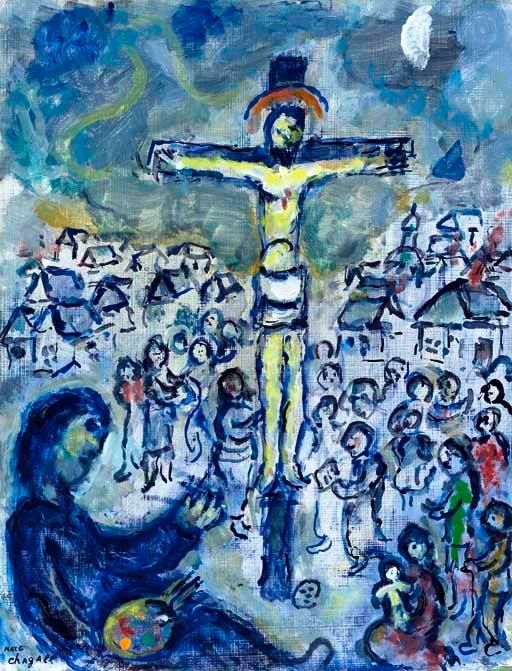
Le peintre et le Christ (The Painter and the Christ) by Marc Chagall (1887-1985)
With all the suffering in this world due to ongoing diseases, natural disasters, moral distress, and so much more, it might seem awkward that Christians everywhere would observe a day called “Good” Friday.
Considering the hard circumstances of so many people, to call today “good” might appear cruel and out of touch with the world. Even for Christians, at first glance, “Good Friday” can seem a bit oxymoronic for a day observing the torture and death of an innocent man.
Some would argue that Christ is no longer on the cross and we need to give all our focus on the resurrected Jesus and victory. No need for all this suffering stuff. Yet, the Resurrection only has meaning because of this very day, Good Friday. Without the Suffering Servant of Isaiah, there is no King Jesus.
For Christians everywhere, this day is an incredibly good day because the crucifixion of Jesus Christ means the redemption of the world. On this day followers of Jesus remember and commemorate the events that led up to the cross; unpack those events and interpret them with profound meaning and significance; and worship Jesus with heartfelt gratitude because of the redeeming work of the cross.
The bulk of the New Testament Gospels of Matthew, Mark, Luke, and John are given over to the final week of Christ’s life, especially leading to the cross. Good Friday observances often take a somber form due to the brevity of Christ’s experience on the cross.
On this day, Christians remember the last words of Christ, and recognize the significant impact his death had on the immediate persons around him. Believers also contemplate the lasting results of that singular death as an atoning sacrifice; perfect love; reconciliation between God and humanity; victory over evil; and the redemption of all creation.
Sadness, then, is far from the only emotive expression today. It is also appropriate to feel wonder, gratitude, and deep satisfaction for the accomplishment of deliverance from the power of sin. There is the recognition that something profound and meaningful has truly happened in the egregious suffering of Jesus. Thus, we not only remember the anguish of Christ, but what that horrible torment accomplished. In fact, the cross of Jesus is so significant that an eternity of considering its impact could never plumb the depths of its far-reaching effects.
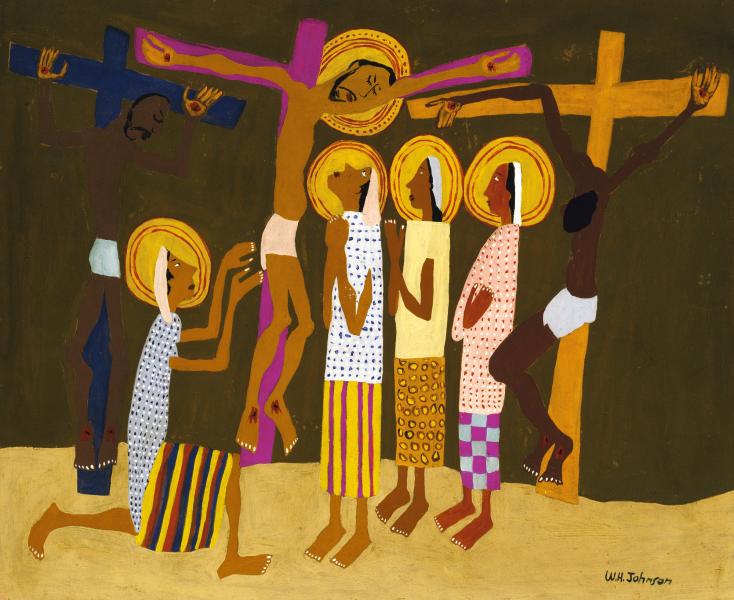
Mount Calvary by William H. Johnson (1901-1970)
With such profound meaning, one would think that Good Friday is a hugely observed day on the Christian Calendar. Yet, for a chunk of churches and Christians, it is not. The cross is not a popular subject. Maybe it’s because neither Christian nor non-Christian wants to ponder something so bloody and sad.
Episcopal priest Fleming Rutledge has adroitly put her finger on the issue: “Religious people want visionary experiences and spiritual uplift; secular people want proofs, arguments, demonstrations, philosophy, and science. The striking fact is that neither one of these groups wants to hear about the cross.” Indeed, as the Apostle Paul has said, the cross of Christ is “a stumbling block to Jews and folly to Gentiles” (1 Corinthians 1:23).
A personalized religion which leaves the cross out of the picture (too much violence and sacrifice) might seem appealing yet will only leave us bereft of the communion of the saints both past and present. Consider the ancient witness of the Church:
“I believe in Jesus Christ, his only Son, our Lord… he suffered under Pontius Pilate, was crucified, died, and was buried; he descended to hell.”
Apostles’ Creed
“For our sake he [Christ] was crucified under Pontius Pilate; he suffered death and was buried.”
Nicene creed
Christ suffered “in both body and soul – in such a way that when he sensed the horrible punishment required by our sins ‘his sweat became like great drops of blood falling down on the ground.’ He cried, ‘My God, my God, why have you forsaken me?’ And he endured all this for the forgiveness of our sins. Therefore, we rightly say with the Apostle Paul that we know nothing ‘except Jesus Christ, and him crucified;’ we ‘regard everything as loss because of the surpassing value of knowing Christ Jesus our Lord.’ We find all comforts in his wounds and have no need to seek or invent any other means than this one and only sacrifice, once made, which renders believers perfect forever.” –Belgic Confession, Article 21
And let us consider further the New Testament witness:
“Jesus suffered outside the gate in order to sanctify the people through his own blood. Therefore, let us go forth to him outside the camp, and bear the abuse he endured.” (Hebrews 13:12-13, NIV)
“May I never boast of anything except the cross of our Lord Jesus Christ, by which the world has been crucified to me, and I to the world.” (Galatians 6:14, NRSV)
The extent of Good Friday goes far beyond a day on the calendar; it is the fulcrum upon which all of Christianity hinges. Because Christ suffered, our suffering has meaning. Each situation of trauma; every case of disease; all suffering and wholesale hard circumstances only make sense, in the Christian tradition, when they are viewed in solidarity with cross of Jesus Christ.
So, today, let Christians everywhere contemplate the cross, observe the salvation accomplished through Christ’s death, and offer prayers and petitions for those who need deliverance from the power of evil. Let us worship God in Jesus Christ because of the suffering on the cross.
Welcome, friends. The Gospel of John, chapter 13, provides the last words and final actions of Jesus Christ for his disciples. And it all centers in humble love. Click the videos below, and let us observe and remember…
Maundy Thursday, Pastor Tim Ehrhardt
Behold the Lamb (Communion Hymn) – sung by Keith & Kristyn Getty, words by Stuart Townsend, 2009
Holy God, you give us this meal of bread and wine in which we celebrate your great compassion; grant that we may work with you to fulfil our prayers, and to love and serve others as Christ has loved us; this we ask through Jesus Christ our Redeemer, who is alive with you in the unity of the Holy Spirit, one God, now and for ever. Amen.







 Rev. Tim Ehrhardt