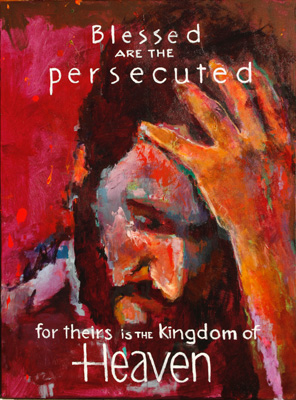
Psalm 111 – Praise

painting by P.J. Bruzzi

Shout praises to the Lord!
    With all my heart
I will thank the Lord
    when his people meet.
The Lord has done
    many wonderful things!
Everyone who is pleased
with God’s marvelous deeds
    will keep them in mind.
Everything the Lord does
    is glorious and majestic,
    and his power to bring justice
    will never end.

The Lord God is famous
for his wonderful deeds,
    and he is kind and merciful.
He gives food to his worshipers
    and always keeps his agreement
    with them.
He has shown his mighty power
    to his people
    and has given them the lands
    of other nations.

God is always honest and fair,
    and his laws can be trusted.
    They are true and right
    and will stand forever.
God rescued his people,
    and he will never break
his agreement with them.
    He is fearsome and holy.

Respect and obey the Lord!
This is the first step
    to wisdom and good sense.
    God will always be respected. (Contemporary English Version)

Sometimes we forget. Difficult challenges, heavy stress, or daunting responsibilities might become the focus of our lives to such a degree that we lose sight of the big picture. Today’s psalm helps us to back up the truck and take a sweeping panoramic view. The backdrop to all those concerns we presently experience is a Divine Being who is unfazed by any trouble. In other words, God’s got this.

The basis for this settled faith is a realization of who God is and what God has done.

Whereas change and loss is a reality all people must navigate, it is a comfort to know there are some things which never change. God is the One who is the same yesterday, today, and forever. God’s character is always right, just, and good. And God makes good on all promises.

Throughout the psalter, there are admonitions to praise the Lord. I personally do not believe the reason for this is because God requires adoration, like some self-centered narcissist. No, I think it has to do with God knowing we have a need to praise.

Our brains are complex organs. There is a lot we don’t know about it. Yet, what we now know is that things like gratitude, adoration, beauty, affirmation, and praise changes our brain chemistry in a healthy way.

Yes, praising the Lord perfectly syncs with our brains in such a way as to cause mental health.

People’s lives are improved when we are attentive to God’s law, God’s promises, and God’s works. Attention to these will surely result in praise. Everything God has created is good. All creation bears witness to the beauty and majesty of its Creator.

Believers throughout the millennia are a great cloud of witnesses, testifying to the veracity of God’s benevolent and gracious deeds. And together with them, we anticipate with confident faith the culmination of God’s promises when Jesus returns. This is basic Christian theology – and it is theology which is robustly sustains us through any type of trouble.

People need to delight in what is good, right, just, and beautiful.

Our brains are designed for it. The acknowledgment of the good is a sacred conduit which links us to the Designer of all that is good. Enjoyment of food and drink, fellowship with friends, participation in family life, and worshiping together with believers who share our most cherished spiritual values, is a gift from a benevolent God. It is worthy of offering praise.

God feeds us in many ways – with both physical and spiritual food. Pausing for gratefulness and thanksgiving is an appropriate and mentally healthy way of responding to the gift of nourishment. And acknowledging that all God’s commands and laws are trustworthy, through lifting prayers of gratitude for such a rich bounty of spiritual food, moves us into a healthy groove of wellness.

All of this healthy living is the way of wisdom. Attention to God and God’s Word is the starting place for a wise way of being in the world. The biblical psalms are much like a tutor which teaches us the best paths to walk in our daily life.

When we take the narrow road of righteousness, we discover the gifts of understanding informed by wisdom, self-control established through sage counsel, and knowledge guided by love.

The activity which bookends and binds such gifts together is praise to the Lord. Praise is what opens us up to the possibilities of life as it is meant to be lived. To press the transformation and enjoyment even deeper, believers shout their praise with raucous noise.

For true spirituality is not always staid and silent. It is also boisterous and loud.

Open my lips, O Lord, and my mouth shall proclaim your praise. Let the words of my mouth and the meditation of my heart be acceptable in your sight, O Lord, my strength and my Redeemer. Glory be to the Father, to the Son, and to the Holy Spirit, as it was in the beginning, it is now, and ever shall be, forever and ever. Amen.

1 Kings 1:1-30 – Facing Death

King David was now an old man, and he always felt cold, even under a lot of blankets. His officials said, “Your Majesty, we will look for a young woman to take care of you. She can lie down beside you and keep you warm.” They looked everywhere in Israel until they found a beautiful young woman named Abishag, who lived in the town of Shunem. They brought her to David, and she took care of him. But David did not have sex with her.

Adonijah was the son of David and Haggith. He was Absalom’s younger brother and was very handsome. One day, Adonijah started bragging, “I’m going to make myself king!” So, he got some chariots and horses, and he hired fifty men as bodyguards. David did not want to hurt his feelings, so he never asked Adonijah why he was doing these things.

Adonijah met with Joab the son of Zeruiah and Abiathar the priest and asked them if they would help him become king. Both of them agreed to help. But Zadok the priest, Benaiah the son of Jehoiada, Nathan the prophet, Shimei, Rei, and David’s bodyguards all refused.

Adonijah invited his brothers and David’s officials from Judah to go with him to Crawling Rock near Rogel Spring, where he sacrificed some sheep, cattle, and fat calves. But he did not invite Nathan, Benaiah, David’s bodyguards, or his own brother Solomon.

When Nathan heard what had happened, he asked Bathsheba, Solomon’s mother:

Have you heard that Adonijah the son of Haggith has made himself king? But David doesn’t know a thing about it. You and your son Solomon will be killed, unless you do what I tell you. Go say to David, “You promised me that Solomon would be the next king. So why is Adonijah now king?”

While you are still talking to David, I’ll come in and tell him that everything you said is true.

Meanwhile, David was in his bedroom where Abishag was taking care of him because he was so old. Bathsheba went in and bowed down.

“What can I do for you?” David asked.

Bathsheba answered:

Your Majesty, you promised me in the name of the Lord your God that my son Solomon would be the next king.But Adonijah has already been made king, and you didn’t know anything about it.He sacrificed a lot of cattle, calves, and sheep. And he invited Abiathar the priest, Joab your army commander, and all your sons to be there, except Solomon, your loyal servant.

Your Majesty, everyone in Israel is waiting for you to announce who will be the next king. If you don’t, they will say that Solomon and I have rebelled. They will treat us like criminals and kill us as soon as you die.

Just then, Nathan the prophet arrived. Someone told David that he was there, and Nathan came in. He bowed with his face to the ground and said:

Your Majesty, did you say that Adonijah would be king? Earlier today, he sacrificed a lot of cattle, calves, and sheep. He invited the army commanders, Abiathar, and all your sons to be there. Right now, they are eating and drinking and shouting, “Long live King Adonijah!” But he didn’t invite me or Zadok the priest or Benaiah or Solomon. Did you say they could do this without telling the rest of us who would be the next king?

David said, “Tell Bathsheba to come here.” She came and stood in front of him. Then he said, “The living Lord God of Israel has kept me safe. And so today, I will keep the promise I made to you in his name: Solomon will be the next king!” (Contemporary English Version)

Death isn’t exactly a popular subject. You might think, since all of us will eventually experience it personally, and most of us have seen it up close through dying loved ones, we would talk it up as something to face and deal with squarely…. Yet, we don’t.

Death ought to teach us how to live, how to face our limitations, and how to accept hardship and the inevitable.  Through today’s Old Testament lesson, I want us to observe four differing responses to the impending death of King David:

King David’s Servants

The servants of David treated his downward health as a problem to be solved. They were essentially sidestepping the whole death situation. The servants knew the David who was vigorous and took on enemies and problems. They wanted him to act like a king, so they looked for the miracle cure of a virgin who would be some sort of fix for David. In the ancient world, a king’s vitality was always linked to his sexual vigor. The servants thought if they could arouse David, he would be back to his old kingly self. In other words, the servants were trying to avoid death. And, of course, it didn’t work.

King David’s Son, Adonijah

Whereas the servants were scheming a way to get the old David back in the saddle, Adonijah was impatient to see his father David in the grave. He wanted his dad, the king, out of the way so he could pursue his own kingship. So, Adonijah simply proclaimed himself king, maybe hoping to hasten David’s death. Adonijah was just looking for his own opportunity and ended up losing his own life for it. Adonijah never understood the true dynamics of life and death – that life is complicated, and death should be honored, not used for personal gain.

King David’s Wife, Bathsheba

Bathsheba wanted to make sure her son Solomon became king. Reading today’s narrative, you might wonder why King David needed a virgin – where in the world was his wife!?  Bathsheba shows up to see David, not because she wanted to keep him warm and comfort him, but because she was concerned for her son. For Bathsheba, David simply became a means to an end – someone who could help her negotiate a difficult situation.

King David’s Caregiver, Abishag

Throughout this story, we have no recorded words from Abishag. Everyone else had plenty to say. In contrast to all of the other people, Abishag is simply a witness to David’s deteriorating health, and eventual death. She is like a hospice worker, who exists to ease the person’s pain in the end of life. In this, we can perhaps learn more from Abishag than from anyone else – to be present, to listen, to serve.

Unfortunately, death brings out the worst in some people. But if we will face death and not view it as a problem to be solved, an opportunity to be seized, or a difficulty to be negotiated, I believe we will find the grace of God when we become sacred witnesses to death.

The Lord Jesus faced death. Christ didn’t try to avoid death. He wasn’t impatient to get it over with. And it was not a difficulty to stoically endure. Our Lord’s death is our life – and it has brought meaning to both our lives and to our own eventual deaths.

Into your hands, O merciful Savior, we commend all your servants staring death in the face today. We, your people, humbly ask that you acknowledge these sheep of your own fold, these lambs of your own flock, and these sinners of your own redeeming. Receive them into the arms of your mercy, into the blessed rest of everlasting peace, and into the glorious company of the saints in light. Amen.

John 6:35-40 – The Bread of Life

I Am the Bread of Life by Joseph Matar

Jesus said, “I am the Bread of Life. The person who aligns with me hungers no more and thirsts no more, ever. I have told you this explicitly because even though you have seen me in action, you don’t really believe me. Every person the Father gives me eventually comes running to me. And once that person is with me, I hold on and don’t let go. I came down from heaven not to follow my own agenda but to accomplish the will of the One who sent me.

“This, in a nutshell, is that will: that everything handed over to me by the Father be completed—not a single detail missed—and at the wrap-up of time I have everything, and everyone put together, upright and whole. This is what my Father wants: that anyone who sees the Son and trusts who he is and what he does and then aligns with him will enter real life, eternal life. My part is to put them on their feet alive and whole at the completion of time.” (The Message)

Bread has always been a food staple throughout human history. Whereas many people today try and avoid bread because of either carbohydrates or gluten, a lack of bread in the ancient world usually meant people would starve to death. Bread is a big deal.

So, when Jesus gave a self-description as the Bread of Life, he was saying a lot.

The cup we use in the Lord’s Supper and for which we give thanks to God: when we drink from it, we are sharing in the blood of Christ. And the bread we break, when we eat it, we are sharing in the body of Christ. (1 Corinthians 10:16, GNT)

After the Israelites were delivered by God from their bondage in Egypt, and found themselves in the desert without food, the divine provision of manna – a unique kind of bread – literally showed up on the desert floor every morning. It was just enough for everyone for that day. Once the Israelites entered the Promised Land, the manna disappeared.

As Jesus entered fully into his earthly ministry, throngs of people began following him. At one point, the thousands of men, women, and children were together with nothing but a couple of fish and a few loaves of bread. Much like the miraculous provision of manna which sustained their ancestors centuries earlier, Jesus multiplied the measly morsels of bread into enough to feed the entire bunch, with leftovers.

Little is much when God is in it. Just a smidgeon of Jesus is enough to fill a crowd of growling stomachs.

The Lord Jesus is not like a loaf of bread bought in a grocery store which has all kinds of funky additives, loaded up with sugars, and questionable ingredients you can’t even pronounce. Christ is fortified with everything we need to thrive and flourish. Jesus is so packed with good stuff that a seemingly paltry communion wafer is filling and satisfying.

The bread that comes down from heaven isn’t like what your ancestors ate. They died, but whoever eats this bread will live forever. (John 6:58, CEV)

Just as bread is a simple mixture of water and flour, so partaking of Jesus is rather uncomplicated. There aren’t hoops to jump through or lengthy recipes to follow. If we simply align ourselves with Christ, come to him and believe, we will never be hungry again.

The world needs bread. They ask for bread. In response, Jesus gave them himself.

Give us the bread we need for today. (Matthew 6:11, CEB)

All the world has to offer, and of which so many humans strive to obtain and accumulate treasures on earth, money and possessions, does not bring ultimate satisfaction. The drive for more is never satiated. Humanity is afflicted with boredom, dissatisfaction, anxiety, and worry over losing what they have and fretting about how they can obtain just one more thing in the misguided belief their fear will finally melt.

But it doesn’t. So, like a hamster running in a wheel and going nowhere, there is the constant activity of racing thoughts and workaholic behavior to try and somehow keep ahead. Yet, authentic rest never comes. The more the striving, the more the anxiety.

There is a divine/human responsibility and cooperative at work. Jesus will hold us secure. And we need to let him do it, and fully align our lives according to Christ’s words and ways. The divine bread is available. God isn’t going to force feed us. We will need to take and eat.

It requires faith to take and eat. We might wonder: Will I like it? Is it really going to satisfy me? What if I’m allergic to it? Do I need some other food handy to eat in case I gag or vomit? Will there be pie? Mac & cheese? Bacon? (insert your own comfort food) Do I have to eat alone?

Try it. You’ll like it.

My own experience of having tasted much of what the world has to offer, and tasting the good flavor of God’s grace, I can say that I never want to go back to the gruel of guilt and shame.

I have tasted and seen that the Lord is good. And that is what I want for you, too.

Taste and see that the Lord is good; blessed is the one who takes refuge in him. (Psalm 34:8, NIV)

The bread is for me, and it is for you. There is plenty of bread for the life of everyone in the world. No rationing is necessary. This is the place of abundance.

“I am the living bread which came down from heaven. If anyone eats of this bread, he will live forever; and the bread that I shall give is My flesh, which I shall give for the life of the world.” (John 6:51, NKJV)

Almighty and everlasting God, I thank and praise you for feeding me with Jesus, the Bread of Life. Send your Holy Spirit so that I may by faith obtain and eternally enjoy your divine grace, the forgiveness of sins, unity with Christ, and everlasting life; through Jesus Christ my Lord. Amen.

Psalm 57 – Prayer and Praise in the Middle of Trouble

Above the Heavens by painter Melani Pyke

Be merciful to me, O God, be merciful to me,
    for in you my soul takes refuge;
in the shadow of your wings I will take refuge,
    until the destroying storms pass by.
I cry to God Most High,
    to God who fulfills his purpose for me.
He will send from heaven and save me,
    he will put to shame those who trample on me.
God will send forth his steadfast love and his faithfulness.

I lie down among lions
    that greedily devour human prey;
their teeth are spears and arrows,
    their tongues sharp swords.

Be exalted, O God, above the heavens.
    Let your glory be over all the earth.

They set a net for my steps;
    my soul was bowed down.
They dug a pit in my path,
    but they have fallen into it themselves.
My heart is steadfast, O God,
    my heart is steadfast.
I will sing and make melody.
    Awake, my soul!
Awake, O harp and lyre!
    I will awake the dawn.
I will give thanks to you, O Lord, among the peoples;
    I will sing praises to you among the nations.
For your steadfast love is as high as the heavens;
    your faithfulness extends to the clouds.

Be exalted, O God, above the heavens.
    Let your glory be over all the earth. (New Revised Standard Version)

One thing we all share about the human experience is that, sooner or later, someone or a group of people will let us down. 

On top of that, many have experienced, or will experience, some sort of abuse and victimization from another person or group – leaving one scarred by trauma. What’s more, there are those who have even had their very lives at risk because someone intentionally sought to actually kill them. That is the company David found himself in when King Saul, and when his son Absalom, sought to do away with his life.

To David’s credit, he never retaliated and did not try and turn the tables by putting a hit out on either Saul or Absalom. Instead, David cried out to God. And we get to listen in on the prayer. Today’s psalm is David’s prayerful reliance upon the God in whom he put all his trust and praise. 

The entire basis of prayer is to let God be God. So, how do we exactly do that?

When the storms of life assail us, calloused persons trample on us with impunity, devious individuals set traps for us, and greedy organizations prey upon us, we refuse to respond in kind. Instead, we deliberately praise God and rely on divine protection, praying to the Lord and steadfastly holding to our confidence that if God is for us, nothing can be against us.

That advice may seem like some sort of pie-in-the-sky rot of ginning up positive thoughts when there is nothing positive to be seen in the experience. Indeed, we must never, and I repeat, never invalidate another’s experience nor our own, when those experiences are hellish.

Yet, there is also always hope. There are two unshakable truths which are constant and never diminished by any adverse circumstance: God is present. And God loves.

If we know nothing else, and all else seems to be descending into the abyss of tragedy, the twin towers of divine presence and attention stand tall as the strongest sentinels over our dilapidated situation and struggling faith.

Letting God be God means not trying to exercise control over things we have no control over – but affirming that the Lord is willing and capable of handling our worst. It could be that we are stuck in the belly of whale because, without our knowing, there are sharks surrounding us who cannot get to us.

Our perspective of matters is, at best, severely limited. It is much better to place faith in the God who sees it all with an expansive eye which misses nothing.

One of the best things about the psalms is that they are a wonderful collection of prayers we can adopt for our own. Not only can we use them for ourselves, but we are also obliged to do so. If anyone has been in an adverse situation so deep that it feels like having ambled into a pride of lions, it is quite likely that the experience leaves one with no adequate words to say. It’s as if you are paralyzed with fear. 

So, let the psalm say for you what you cannot even begin to utter yourself. The Word of God is not meant to sit on a coffee table or rest on a shelf; it is meant to be opened and used for prayer. Allow it to do its intended purpose.

Who knows? Perhaps your faith in the mercy of God and your praises lifted to God will give rise to settled confidence and peace so that you can rest secure even when all around you is going to hell.

Be merciful to me, O God, for in you my soul takes refuge.  Even though I feel the slash of people with tongues as swords, my heart is steadfast and will exalt your name above the heavens.  Let your glory be over all the earth!  Amen.