Psalm 107:1-9, 43 – Let the Redeemed Say So

Psalm 107 by Hope Smith

O give thanks to the Lord, for he is good,
    for his steadfast love endures forever.
Let the redeemed of the Lord say so,
    those he redeemed from trouble
and gathered in from the lands,
    from the east and from the west,
    from the north and from the south.

Some wandered in desert wastes,
    finding no way to an inhabited town;
hungry and thirsty,
    their soul fainted within them.
Then they cried to the Lord in their trouble,
    and he delivered them from their distress;
he led them by a straight way,
    until they reached an inhabited town.
Let them thank the Lord for his steadfast love,
    for his wonderful works to humankind.
For he satisfies the thirsty,
    and the hungry he fills with good things….

Let those who are wise pay attention to these things
    and consider the steadfast love of the Lord. (New Revised Standard Version)

The psalmist encourages and invites us to consider God’s steadfast love (Hebrew “chesed”). In all truth, an eternity of pondering and discovering such love will never plumb the depths of the Lord’s faithful love.

Maybe there is so much hate, bitterness, and vitriol in this old fallen world because people don’t consider the God who is Love. After all, there isn’t much room for malicious anger whenever people are expressing gratitude.

We are divinely hard-wired to give and receive affirmation, gratitude, encouragement, and love. Doing the opposite of that throws a huge monkey wrench into our daily living. It’s not sustainable to live by criticism, ingratitude, judgmentalism, and hate. It goes against who we are as humans.

Instead, it is sage to acknowledge, appreciate, ponder, and express the great love of God for humanity. The Lord’s love never runs out – it is inexhaustible.

Many people have stories of wandering far from Love, stumbling in the darkness, and finding themselves in desperate straits. Like the prodigal son, they are found by the God who is Love. And instead of being chided for their herky-jerky life, they are given a prominent place in God’s kingdom.

Some of you wandered for years in the desert,
    looking but not finding a good place to live,
Half-starved and parched with thirst,
    staggering and stumbling, on the brink of exhaustion.
Then, in your desperate condition, you called out to God.
    He got you out in the nick of time. (Psalm 107:4-6, MSG)

Praise and thanksgiving become the reflexive practices of the folk who have returned home to God. And the psalmist calls us to speak out those stories of hope and deliverance.

Telling our spiritual stories to others is important – both for the storyteller, and also for those who listen. Together, the spiritual community of the redeemed becomes strengthened in their bonds of faith; and everyone is emboldened to share with others. 

Far too many Christians are reticent to talk about what God has done or is doing in their lives. Shame, embarrassment, or a host of other reasons might prevent us from being vulnerable enough to let others in on God’s deep work within.

We all likely have had the privilege of hearing another person share their heart and experience of hardship and God’s deliverance. It was uplifting, encouraging, and helpful. So, let’s not keep our stories to ourselves. Stories are meant to be told, not hidden. Bringing to light our faith journey is healing for all, as well as declaring that Jesus is the light of the world.

Author Frederick Buechner wrote a book several years ago entitled, “Telling Secrets.” Buechner tells of his own experience of keeping some stories inside and never letting them see the light of day. One of those stories was growing up with an alcoholic father and all the other stories that went along with that singular story.

It was only in finally telling the family secret of alcoholism that he discovered a better path forward to healing and blessing. He writes:

“What we hunger for perhaps more than anything else is to be known in our full humanness, and yet that is often just what we also fear more than anything else. It is important to tell at least from time to time the secret of who we truly and fully are because otherwise we run the risk of losing track of who we truly and fully are and little by little come to accept instead the highly edited version which we put forth in hope that the world will find it more acceptable than the real thing. It is important to tell our secrets, too, because it makes it easier for other people to tell us a secret or two of their own.”

Frederick Buechner, “Telling Secrets”

Buechner went on to say:

“My story is important not because it is mine, God knows, but because if I tell it, the chances are you will recognize that, in many ways, it is also your story. It is precisely through these stories in all their particularity, as I have long believed and often said, that God makes himself known to each of us more powerfully and personally. If this is true, it means that to lose track of our stories is to be profoundly impoverished not only humanly but also spiritually.”

Shame is like a vampire. It lives in the shadows, feeding upon secrets. But when our stories are told and see the light of day, the vampire of shame is destroyed by the bright rays of truth and vulnerability.

We then become open to genuine relationships without propping up a false self to pose for others. We place ourselves in a position to receive and give love. In other words, we can meaningfully connect with both God and others because we found our voice and told our story.

Great God of deliverance, I praise you that I have a story to tell of your grace and faithfulness. Help me to tell of your mercy in my life so that the name of Jesus will be exalted, and that your people might be built up in the faith.  Amen.

Matthew 5:43-48 – Love Your Enemy

“You have heard that it was said, You must love your neighbor and hate your enemy. But I say to you, love your enemies and pray for those who harass you so that you will be acting as children of your Father who is in heaven. He makes the sun rise on both the evil and the good and sends rain on both the righteous and the unrighteous. If you love only those who love you, what reward do you have? Don’t even the tax collectors do the same? And if you greet only your brothers and sisters, what more are you doing? Don’t even the Gentiles do the same? Therefore, just as your heavenly Father is complete in showing love to everyone, so also you must be complete. (Common English Bible)

A few rhetorical questions: Have you ever had someone not like you? Offend you? Purposely say or do things that upset you? 

I once had a next door neighbor that was just plain mean. Once, when my dog accidentally strayed into her yard and left a package, she picked it up and placed the package directly in front of my backdoor. 

When stuff happen, it’s easy to respond in kind. Many of us have sly passive aggressive tendencies toward people we don’t like. One of my professors once admitted that he responded to a woman who was bragging to him about how many children she had by saying, “Oh, we don’t place such an emphasis on sex in my house!”

That sort of stuff is rather benign. It’s altogether a different thing whenever someone has deeply hurt us with malicious words or actions. We naturally seek to defend and respond by hurting the other back. 

So then, this is no trite saying of Jesus to proclaim that we are to love the enemy. It cannot be done apart from the God’s grace.

Jesus knows what he is asking of us. And he does not ask of us anything that he himself has not done.

We are often pleased with ourselves if we love our family and friends, because even that is a struggle, at times, for many people. 

Yet, our love needs to expand much further than family. We must treat all people with respect and kindness, even active love, because this is what God does. And if followers of Jesus don’t do this, Christianity is shown, at best, to be just another religion out of many, and at worst, the Church is presented to the world as a fraud.

Those who are poor in spirit, mourn over sin, and display meekness, are those who understand they are no better than anyone else, including their enemies. 

They seek to be right and to do right by:

  • Showing mercy instead of judgment
  • Displaying purity of heart instead of making plans to get back at others
  • Seeking peaceful solutions instead of looking to pick a fight 
  • Accepting insults, persecution, instead of hating (Matthew 5:3-12)

With God’s righteousness as their breastplate, the Christian loves the enemy and prays for those who persecute them.

The Old Testament clearly says to love your neighbor (Leviticus 19:18). Yet, nowhere in the Bible does it say to hate your enemy.

Over the centuries, people began to draw the inference that if we are told to love our neighbor, that therefore, we must hate our enemy, who is not our neighbor. 

From that popular understanding, it was inevitable that Jesus would get asked the question, “Who is my neighbor?” Christ’s answer to that question was to tell the parable of the Good Samaritan (Luke 10:25-37). The conclusion to that parable is that everyone I come into contact is my neighbor, and so must be shown mercy when they are in need.

It is not for us to judge whether someone is unlovable. It’s not our call to deem another person as unworthy of receiving love. Neither you nor I gets to decide if a person or group of people are too obnoxious or evil for any sort of love.

Nobody can love God by being hateful to another person. Love of God is not measured by zeal against God’s enemies; it is measured by treating all persons with respect and love.

Jesus clearly tells us how we can love our enemies: Pray for them. It is difficult to hate a group of people when we are devoted to praying for them. It’s really hard to call somebody a monster when you are using their name in prayer.

So, if you are struggling with a person or a group of people, pray! If someone is giving you a hard time and doesn’t like you, pray for them. Pray they will see the error of their ways. Pray the Spirit to open their eyes and grant them self-awareness. And, at all times, leave the judgment to God, for that is his business, not ours. (Romans 12:17-19)

Why love “those” people?… Because God loves them.

Loving those who offend us emulates God’s benevolence. Whenever we love our enemies, we are not expecting anything in return.

Since you are God’s dear children, you must try to be like him. Your life must be controlled by love, just as Christ loved us and gave his life for us as a sweet-smelling offering and sacrifice that pleases God. (Ephesians 5:1-2, GNT)

Love gives life meaning. And love always suffers. There isn’t any love apart from suffering. That’s because it requires a great deal of blood, sweat, and tears to love. Jesus is asking us to suffer for the enemy, just as we suffer for our children and our friends.

If Christians have no love for their enemies, then they are no different than the haters of this world. Followers of Jesus are distinctive because of the way we treat people. We are to model our lives after God’s love, not by the standard of niceness to those who are nice to us. 

God doesn’t expect us to live only through reciprocity, that is, simply giving back to those who already have given something to us. Christians are to give even when persecuted. That’s because God shows no distinction in how he distributes the sun and the rain. 

Showing basic respect and goodness to all people, no matter who they are, is God’s rain showers and sunshine toward others.

I have observed that every church believes they are friendly (even the cold ones) because the members are friendly with their friends. They greet everyone who greets them. This is neither spectacular nor noteworthy. 

Genuine love keeps an eye open for the quiet, the awkward, and the friendless, and seeks them out.

“To return evil for good is devilish; to return good for good is human; to return good for evil is divine. To love as God loves is moral perfection.”

Alfred Plummer

Most English translations has Jesus saying to be “perfect,” because the heavenly Father is perfect. That is an unfortunate translation because a lot of people think “perfectionism.” But that’s not what Jesus was talking about. Christ was referring to being spiritually mature, morally sound, and personally whole and integrated.

“Maturity is looking at every person we meet and saying to yourself, ‘I will never, God helping me, do anything to harm you: not by angrily lashing out at you, lusting over you, faithlessly slipping away from you, verbally hitting back at you, or even justifiably disliking you.’”

Frederick Dale Bruner

So, how do you treat people, all people, even those you don’t like and have hurt you in some way? 

The ability to love the enemy comes from God. Grace is not something we can just conjure up, as if we might will ourselves to love our enemies. It is not natural – it is supernatural, and so must come from a supernatural Being. 

Human relationships easily become subject to verbal violence, bitterness, and destruction, whenever we treat our own life and the lives of other people as properties to be defended, instead of precious gifts to be received. 

We have died to hate. So, how can we live in it any longer? Selfishness, pride, and seeking to control others has been crucified with Christ. 

If we have nothing to defend, then we have no enemies who can harm us.

Jesus, Prince of Peace, you have asked us to love our enemies and pray for those who persecute us. With the help of the Holy Spirit, enable us to do just that. Give us the courage, strength, and grace to love those who harm us so that we may shine as beacons of Christian light in a world of revenge, retaliation, and darkness.

May all people learn to work together for the justice which brings true and lasting peace.

Let us pray for our enemies and persecutors:

We pray for those who have hurt us.
Bless them always and in every way, Lord.

We pray for those who hate us.
Bless them always and in every way, Lord.

We pray for those who insult us.
Bless them always and in every way, Lord.

We pray for those who have stolen from us.
Bless them always and in every way, Lord.

We pray for those who will not hear us.
Bless them always and in every way, Lord. Amen.

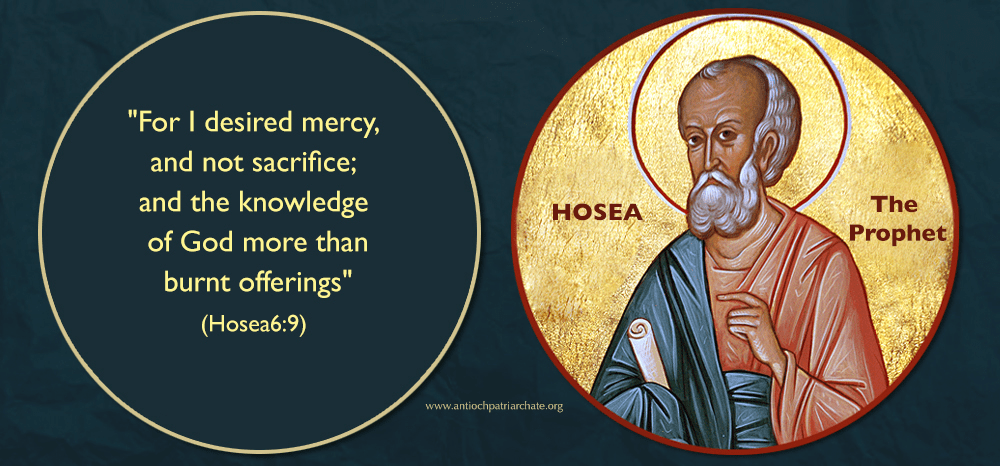
Hosea 6:1-10 – “I Want Mercy, Not Sacrifice”

“Come, let us return to the Lord.
He has torn us to pieces
    but he will heal us;
he has injured us
    but he will bind up our wounds.
After two days he will revive us;
    on the third day he will restore us,
    that we may live in his presence.
Let us acknowledge the Lord;
    let us press on to acknowledge him.
As surely as the sun rises,
    he will appear;
he will come to us like the winter rains,
    like the spring rains that water the earth.”

“What can I do with you, Ephraim?
    What can I do with you, Judah?
Your love is like the morning mist,
    like the early dew that disappears.
Therefore I cut you in pieces with my prophets,
    I killed you with the words of my mouth—
    then my judgments go forth like the sun.
For I desire mercy, not sacrifice,
    and acknowledgment of God rather than burnt offerings.
As at Adam, they have broken the covenant;
    they were unfaithful to me there.
Gilead is a city of evildoers,
    stained with footprints of blood.
As marauders lie in ambush for a victim,
    so do bands of priests;
they murder on the road to Shechem,
    carrying out their wicked schemes.
I have seen a horrible thing in Israel:
    There Ephraim is given to prostitution,
    Israel is defiled. (New International Version)

My favorite word in all of Holy Scripture is the Hebrew word חסד (“chesed” pronounced in English “kes-ed).  It is such a rich word that no one English word can capture its depth and import. 

So, chesed is translated in various ways across English translations of the Bible as:

  • Goodness (American Standard Version)
  • Faithful love (Common English Bible)
  • Loyalty (God’s Word Translation)
  • Constant love (Good News Translation)
  • Mercy (King James Version)
  • Love that lasts (The Message)
  • Faithfulness (New English Translation)
  • Loving-kindness (New Life Version)
  • Steadfast love (New Revised Standard Version)

Chesed is God’s committed, gracious, and loving covenant loyalty to people. The Lord’s very attributes are sheer Love.

Since chesed marks the character and activity of God, the Lord very much desires people to reflect this same stance toward one another. In other words, because God is merciful and kind, we, as people created in God’s image, are to be marked with this same character in all we do. 

In today’s Old Testament lesson, God is calling and wooing wayward people to return to a life of closeness with the Lord. God demonstrated chesed by not sending the people away, like a spouse outright divorcing an unfaithful partner. Instead, the Lord is committed to loving the Israelites even when they were unlovely.

At all times, the response God wants from people is not simply to go through the motions of outward worship. Ritual practices mean little if there is no heart behind them. The Lord longs for people to demonstrate both fidelity and fealty through mercy and a steadfast love to God and neighbor.

Both our work and our worship are to be infused with divine mercy. 

God deeply desires a close relationship with humanity. The Lord is deeply grieved when people whore after other gods to meet their needs for love and belonging. Hosea’s prophecy is an impassioned plea for all persons to find their true fulfillment and enjoyment in a committed loving divine/human union, like a marriage.

In Christian readings of Hosea’s prophecy, repentance means accepting God’s chesed through Jesus Christ.

The believer is to allow the character of God to rule and reign in their heart so that love and commitment come flowing out in words, actions, thoughts, and dispositions.

Mercy, in Christianity, finds its highest expression in the person and work of Jesus.

It is no wonder, then, that Jesus lifted Hosea’s prophecy as a treasured principle of operation when asked why he deliberately made connections with “questionable” people:

As Jesus continued on from there, he saw a man named Matthew sitting at a kiosk for collecting taxes. He said to him, “Follow me,” and he got up and followed him. As Jesus sat down to eat in Matthew’s house, many tax collectors and sinners joined Jesus and his disciples at the table.

But when the Pharisees saw this, they said to his disciples, “Why does your teacher eat with tax collectors and sinners?”

When Jesus heard it, he said, “Healthy people don’t need a doctor, but sick people do. Go and learn what this means: I want mercy and not sacrifice. I didn’t come to call righteous people, but sinners.” (Matthew 9:9-13, CEB)

And when confronted about “questionable” activities, Jesus appealed to the same source of Hosea’s prophecy:

“Look! Your disciples are doing something that is not right to do on the day of rest—a holy day.”

Jesus asked them, “Haven’t you read what David did when he and his men were hungry? Haven’t you read how he went into the house of God and ate  the bread of the presence? He and his men had no right to eat those loaves. Only the priests have that right. Or haven’t you read in Moses’ Teachings that on the day of rest—a holy day, the priests in the temple do things they shouldn’t on the day of rest yet remain innocent? I can guarantee that something  greater than the temple is here. If you had known what ‘I want mercy, not sacrifices’ means, you would not have condemned innocent people. (Matthew 12:2-7, GW)

One can never go wrong with mercy and grace. If in doubt between whether to judge another or show mercy, the Christian’s choice is clear.

Grace and love reconnects the disconnected. The heart of true Christian spirituality is a deep kinship with the divine. Whenever that relation is broken or severed, it is vital to restore it. The means of doing so is not judgment; it’s mercy.

Chesed is more than a word; it is a way of life.

God wants mercy. Grace is the Lord’s divine will. So, let us today receive the forgiveness of Jesus and devote ourselves to prayer and works of love which come from a heart profoundly touched by grace. 

May the result of our return to the Lord be healing of that which has been broken, and reconciled relationships with others.

Merciful and loving God, the One who shows amazing grace, forgive us for our wanderings away from the divine life. Return us, again, to the grace of Jesus Christ our Savior so that our hearts will be renewed and aflame with love for others. In the Name of the Father, Son, and Spirit, the Great Three in One. Amen.

Colossians 2:16-3:1 – Get Rid of the List

Do not let anyone judge you by what you eat or drink, or with regard to a religious festival, a New Moon celebration or a Sabbath day. These are a shadow of the things that were to come; the reality, however, is found in Christ. Do not let anyone who delights in false humility and the worship of angels disqualify you. Such a person also goes into great detail about what they have seen; they are puffed up with idle notions by their unspiritual mind. They have lost connection with the head, from whom the whole body, supported and held together by its ligaments and sinews, grows as God causes it to grow.

Since you died with Christ to the elemental spiritual forces of this world, why, as though you still belonged to the world, do you submit to its rules: “Do not handle! Do not taste! Do not touch!”? These rules, which have to do with things that are all destined to perish with use, are based on merely human commands and teachings. Such regulations indeed have an appearance of wisdom, with their self-imposed worship, their false humility and their harsh treatment of the body, but they lack any value in restraining sensual indulgence.

Since then, you have been raised with Christ, set your hearts on things above, where Christ is, seated at the right hand of God. (New International Version)

“Moral stupidity comes in two different forms: relativism and legalism. Relativism sees no principles, only people; legalism sees no people, only principles.” – Peter Kreeft

There was once a pastor who found the roads blocked one Sunday morning and was forced to skate on the river to get to church, which he did. When he arrived the elders of the church were horrified that their preacher had skated on the Lord’s day.

After the service they held a meeting where the pastor explained that it was either skate to church or not go at all. Finally, one elder asked, “Did you enjoy it?” When the preacher answered, “No,” the board decided all was good.

Nothing can choke the heart and soul out of true spirituality like legalism – a precise extra-biblical list of do’s and don’ts. For many folks, it seems easier to live by the list than to pursue the harder road of developing character qualities.

Christian discipleship involves growing into spiritual maturity and allowing a seasoned character to shape how we make decisions. We must patiently and consistently follow in the way of Jesus, which is the way of grace and of life.

The Apostle Paul spent a lot of his time and energy trying to keep the churches he established from slipping into a soul-less legalism.

Legalism is a compulsion to spell out every detail of how everyone is to live a godly life, going beyond the stated commands of Holy Scripture.

The problem with this approach to the Christian life is that godliness is merely an outward expression of our ability to hold to the list. This legalistic way feeds human pride and boasting, going against the inner heart values of genuine humility and thoughtful service to others.

Biblical teaching thus gets lost in trying to do everything right or perfect.

There are only two alternatives: Choose the way of life and set your heart on things above – or choose the way of destruction through the legalistic list.

The legalist is like a wolf in sheep’s clothing. We need to be wary of people who seem pious and sincere, yet who do not quite pass the smell test. After all, Satan himself, the Apostle Paul once said, masquerades as an angel of light, appearing righteous, yet is intent on deceiving many (2 Corinthians 11:13-15).

So, how do we recognize a legalistic wolf who spiritually and emotionally devours people by judging them according to a contrived list, instead of altruistically helping them with grace? 

Look at the fruit of the tree. Anyone who fails to uplift others will be seen by the rotten fruit of boasting and pride. A telltale sign of such a person is their lack of connection with any spiritual body of people or faith community.

Bellicose boasters and nit-picking legalists believe they are above others because of their expertise at keeping the list of do’s and don’ts. 

A bogus disciple will always be shown by their profound lack of grace, gentleness, and genuine humility. They inevitably advocate for holding to their brand of religion and keeping the unscriptural list. Steer clear of such persons.

A sobering reality is that many people can be deceived with a devil’s bargain: take the nice handy list and you will become godly; here are twelve principles to change your life; follow these rules, pray this prayer, give your money to this, and all will be well.

It is, however, a highway to the grave. The so called “fruit inspector” comes along and goes on to judge everyone according to the legalistic list.

So, get rid of the extra-biblical and even unbiblical list. Stop judging others on whatever someone has deemed the nasty nine sins to avoid or the terrible ten things that will send you to hell. Don’t waste your time or energy on such persons.

The legalist holding to a contrived list of don’ts is not honest about their struggles. Because the bald fact of list-living is that it cannot be fulfilled; it’s unreasonable. So, when we know we are not measuring up to the list, the temptation is to keep up appearances as if we are. 

List-living eschews showing any weakness or imperfection. The legalist’s self-talk says:

  • Always avoid admitting my sin to anyone because the list pronounces me a failure if I do. 
  • Don’t ever enter a deep and prolonged grief over my loss because the list says I need to stay strong. 
  • I cannot profess my doubts about God because the list says if I doubt, I am not a real Christian.
  • Just tell me what is on the list, and I will do it – even though I cannot.

Here is my response to legalistic list-living: To hell with the list! 

You were raised from death with Christ. So, live for what is in heaven, where Christ is sitting at the right hand of God.

Grace transforms hearts, turns lives around, and provides genuine joy and satisfaction – not list-keeping.

If grace is not the answer, we are not asking the right question.

The greatest anti-legalistic prayer we can pray is the tried and true ancient prayer of the Church:

“Lord Jesus Christ, Son of God, have mercy on me a sinner.”