Build It Now! (Haggai 1:1-15a)

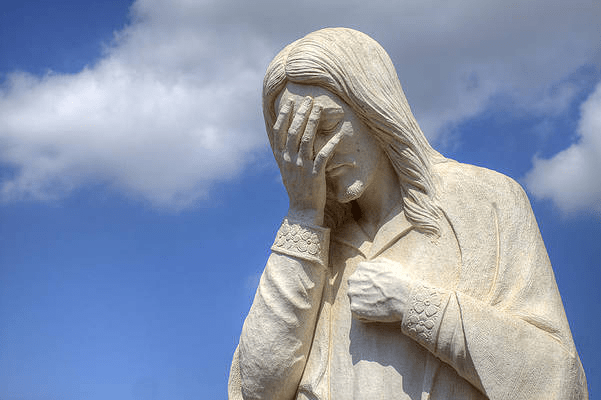
Statue of the prophet Haggai, by Giovanni Pisano, c.1290 C.E., Siena, Italy

In the second year of King Darius, on the first day of the sixth month, the word of the Lord came through the prophet Haggai to Zerubbabel son of Shealtiel, governor of Judah, and to Joshua son of Jozadak, the high priest:

This is what the Lord Almighty says: “These people say, ‘The time has not yet come to rebuild the Lord’s house.’”

Then the word of the Lord came through the prophet Haggai: “Is it a time for you yourselves to be living in your paneled houses, while this house remains a ruin?”

Now this is what the Lord Almighty says: “Give careful thought to your ways. You have planted much but harvested little. You eat, but never have enough. You drink, but never have your fill. You put on clothes but are not warm. You earn wages, only to put them in a purse with holes in it.”

This is what the Lord Almighty says: “Give careful thought to your ways. Go up into the mountains and bring down timber and build my house, so that I may take pleasure in it and be honored,” says the Lord. 

“You expected much, but see, it turned out to be little. What you brought home, I blew away. Why?” declares the Lord Almighty. “Because of my house, which remains a ruin, while each of you is busy with your own house. 

Therefore, because of you the heavens have withheld their dew and the earth its crops. I called for a drought on the fields and the mountains, on the grain, the new wine, the olive oil and everything else the ground produces, on people and livestock, and on all the labor of your hands.”

Then Zerubbabel son of Shealtiel, Joshua son of Jozadak, the high priest, and the whole remnant of the people obeyed the voice of the Lord their God and the message of the prophet Haggai, because the Lord their God had sent him. And the people feared the Lord.

Then Haggai, the Lord’s messenger, gave this message of the Lord to the people: “I am with you,” declares the Lord. So the Lord stirred up the spirit of Zerubbabel son of Shealtiel, governor of Judah, and the spirit of Joshua son of Jozadak, the high priest, and the spirit of the whole remnant of the people. They came and began to work on the house of the Lord Almighty, their God, on the twenty-fourth day of the sixth month. (New International Version)

Timing is everything.

There is a time to ponder and plan and there’s a time to move and act. If the time is ripe for action, then the lack of initiative is plain old procrastination. But how do you know when to act?

If the Lord says it’s time, well then, it’s time!

God’s people wouldn’t have described their inaction in rebuilding God’s house as dragging their feet. They perceived their inertia as a sensible delay.

Yet, the Lord saw the people’s approach as inexcusable enough to send a prophet with a specific message and call to action: Build the house now!

Let’s get a feel for why God’s call for immediacy comes when it does. In the ancient world, it had always been the practice of armies to assimilate conquered peoples into the culture of the conquering king. 

In the eighth century B.C.E., the Assyrian Empire conquered the northern kingdom of Israel. The Assyrians took most of the people into captivity, left the poorest of the people alone, and resettled the land with some of their own Assyrian people. The inevitable intermarriages resulted in their progeny being known as the Samaritans in the New Testament Gospels, as the Samaritans.

Two-hundred years after Assyria conquered Israel, Nebuchadnezzar besieged the southern kingdom of Judah and took over Jerusalem. He carried Daniel and all the other educated and professional people to Babylon. In the course of taking the city, Nebuchadnezzar tore down the wall and destroyed the temple that Solomon had made.

During the Babylonian exile, the Persians conquered Babylon and became rulers of a large geographical empire. Because the massive Persian Empire was in control of so many different kinds of people across such a vast territory, they were not able to operate as previous empires did by assimilation and resettlement. 

Instead, the Persians did something new and different: They encouraged and enabled their conquered peoples to keep their religion and their culture. The only caveat was that they had to give tribute and allegiance to the empire and pray for the king. This is why Nehemiah, Ezra, and Haggai were able to return to Jerusalem and given royal authority to rebuild the wall and the temple. 

But, from the git go, there was opposition to the rebuilding from the old Canaanite inhabitants of the land. After many years, the wall was rebuilt but the temple restoration bogged down. The people slowly became discouraged and lost enthusiasm to do the work. 

Understandably, the people got caught up in taking care of their own homes and just plain neglected working on the temple. Over time, they just forgot about the entire project. But God didn’t.

The prophet Haggai made it clear that the people’s mental distraction and physical neglect was taken as disrespect by the Lord. Haggai insisted that the reason the people were not experiencing blessing on their land was because they simply did not have their priorities straight. 

Thus, God sent the prophet Haggai to preach a sermon entitled: Build the house now! 

To the people’s credit, they responded to the call of God and started rebuilding God’s house. The work was completed. However, there seemed to be a problem. 

Rebuilding the Temple, by Gustave Doré, 1866

Moving into the rest of Haggai’s prophecy, the newly restored temple didn’t look anything like Solomon’s grand and glorious temple. Many of the older worshipers could still remember Solomon’s temple; to them, the rebuilt temple seemed like a bologna sandwich compared to the T-bone steak of the past. 

So, God sent Haggai again to encourage the people. The Lord will be with them. The restored temple may not look the same, but what makes the temple great is God’s glory.

An important takeaway from the prophecy of Haggai is that the Lord is a jealous God; God’s people are to worship the Lord with all of their heart, soul, mind, and strength. 

We also learn that the Lord is sovereign and supreme over all creation. God owns everything and will use it all to accomplish divine purposes on this earth. 

In addition, we see that God calls people to new work and fresh ministry. The Lord was behind the destruction of the old temple; and when the time was right, God called the people to build a new ministry.

And we learn something about ourselves, as well. God’s people need to hear and respond to God’s call. Haggai put a God-sized vision before the people; he helped them imagine what the new temple would be like – full of God’s glory.

God is doing a new thing. The Lord continues calling people to:

  • Seek first the kingdom of God. (Deuteronomy 4:29; Psalm 63:1; Matthew 6:33; Hebrews 11:6)
  • Love God with whole hearts. (Deuteronomy 6:5, 11:1-22, 19:9, 30:16-20; Matthew 22:37)
  • Love neighbor as we love ourselves. (Leviticus 19:18; Matthew 22:38; Romans 13:9; Galatians 5:14)
  • Make disciples of Christ from all nationalities. (Matthew 28:18-20)
  • Be witnesses to God’s glory in Christ. (Psalm 66:16; Acts 1:8; 2 Timothy 2:2)
  • Obey the Holy Spirit. (Acts 5:31-33; Romans 6:17; Hebrews 5:8-9)

It is good to remember and celebrate past ministries; and it is also good to throw ourselves into the new ministries which God calls us and to build them for God’s glory.

My friends, build it now.

Glory to you, O God, the One who is able to do far beyond all that we could ask or imagine by your divine power at work within us; glory to you, blessed God, in the church and in Christ Jesus for all generations, through the empowering Holy Spirit, forever and always. Amen.

Keep Your Conscience Clear (Acts 24:10-23)

When the governor motioned for him to speak, Paul replied:

“I know that for a number of years you have been a judge over this nation; so I gladly make my defense. You can easily verify that no more than twelve days ago I went up to Jerusalem to worship. My accusers did not find me arguing with anyone at the temple or stirring up a crowd in the synagogues or anywhere else in the city. And they cannot prove to you the charges they are now making against me. 

However, I admit that I worship the God of our ancestors as a follower of the Way, which they call a sect. I believe everything that is in accordance with the Law and that is written in the Prophets, and I have the same hope in God as these men themselves have, that there will be a resurrection of both the righteous and the wicked. So I strive always to keep my conscience clear before God and man.

After an absence of several years, I came to Jerusalem to bring my people gifts for the poor and to present offerings. I was ceremonially clean when they found me in the temple courts doing this. There was no crowd with me, nor was I involved in any disturbance. 

But there are some Jews from the province of Asia, who ought to be here before you and bring charges if they have anything against me. Or these who are here should state what crime they found in me when I stood before the Sanhedrin—unless it was this one thing I shouted as I stood in their presence: ‘It is concerning the resurrection of the dead that I am on trial before you today.’”

Then Felix, who was well acquainted with the Way, adjourned the proceedings. “When Lysias the commander comes,” he said, “I will decide your case.” He ordered the centurion to keep Paul under guard but to give him some freedom and permit his friends to take care of his needs. (New International Version)

Without exception, everyone has a conscience. It is our internal moral compass, an intangible guidance system.

Conscience is humanity’s hard-wired epistemic sense of knowing what and what not to do, beyond the five senses. The still small voice inside us continually gives discernment that transcends objective facts – even though we may not be able to articulate or explain why we know something is right or wrong.

Our conscience keeps us from being morally empty, bereft of direction, and aimless in this world. Paying attention to our conscience serves us quite well. The conscience is the angel on our shoulder, directing us to do and be better; it is the inner compunction to live a beautiful, good, and ethical life.

By allowing the conscience to chart for us a course forward, we can then avoid inaction in the face of stress, as well as immoral words and actions. The conscience tempers our inbred fight-or-flight syndrome so that we might respond wisely to adverse situations. 

The Apostle Paul, as was usual with him, was in a pickle. Yet, Paul never seemed to be shaken with circumstances which most of us would probably consider so distressing as to fall into despair.

In today’s New Testament lesson, Paul is in custody. While standing trial before Governor Felix, Paul used the opportunity to give a clear and rather relaxed testimony to his Christian faith. 

I suggest that the Apostle was able to give a cogent apologetic for his life and ministry – not because he was trying to get off the hook or because he thought it was his duty – but because of his well-attuned inner compass. That inner guidance system led him to say:

“I have committed myself to maintaining a clear conscience before God and with all people.” (Acts 24:16, CEB)

Statue of St. Paul in St. Peter’s Square, the Vatican, Rome

Living with an awareness of the conscience, and carefully listening to it, creates the ability to speak from that place of insight.

There’s no need to do all sorts of mental gymnastics or spin-doctoring. Although Paul gave a clear defense of his actions and attitudes, he did it without having an insecure defensiveness. Because of his conscience, he could articulate truth and steer clear of white lies and propping-up his ego.

I also suggest that the Apostle Paul’s effective engagement with others came from his God-given inner conscience. So, I wonder: 

  • How might my life be different if I shared the same concern as Paul to always have my conscience clear before both God and others? How might the world be different if this was a dedicated commitment?
  • What would happen if I sought to continually be in dialogue with my conscience and make decisions based on that connection? And what if I consistently brought before God the musings and inklings of my conscience?

The human conscience is not static but dynamic. It can be strong or weak. If it doesn’t get regular use, the conscience withers, eventually becomes calcified, and results in a hardening of the heart.

The following are just a few ways of gaining a healthy conscience and keeping it clear and clean:

Acknowledge

Make an acknowledgment of God. The Lord gave us an internal conscience of law and also an external code of law. They are both meant to operate together. The conscience needs to be formed from God’s revelation, that is, God’s written and natural laws; and then, we live life as God intends. 

The conscience is like a law written in the human heart. And it will show whether we are forgiven or condemned. (Romans 2:15, CEV)

“Conscience is like God’s herald and messenger; it does not command things on its own authority, but commands them as coming from God’s authority, like a herald when he proclaims the edict of the king. This is why conscience has binding force.”

St. Bonaventure

Let us draw near to God with a sincere heart and with the full assurance that faith brings, having our hearts sprinkled to cleanse us from a guilty conscience and having our bodies washed with pure water. (Hebrews 10:22, NIV)

Affirm

Let your own good deeds and the works of others be affirmed. Have realistic expectations. The lack of affirmation slowly and imperceptibly poisons the soul and infects the conscience.

“I give thanks to God, whom I serve with a clear conscience, as my ancestors did. I thank him as I remember you always in my prayers night and day.” (2 Timothy 1:3, GNT)

Ask

Petition God for help. Pray for divine resources to assist you. Divine wisdom guides human affairs. Divine authority governs human community. Divine love gives shape to the human conscience.

Pray for us. Our consciences are clear, and we always try to live right. (Hebrews 13:18, CEV)

Allow

Let other people into your life, whether Christian, or not. Sharing thoughts and ideas, feelings and emotions, concerns and celebrations, are all a path toward a healthier spirit, a better awareness of self and others, and a stronger conscience.

If someone who isn’t a believer asks you home for dinner, accept the invitation if you want to. Eat whatever is offered to you without raising questions of conscience. (But suppose someone tells you, “This meat was offered to an idol.” Don’t eat it, out of consideration for the conscience of the one who told you. It might not be a matter of conscience for you, but it is for the other person.). (1 Corinthians 10:27-28, NLT)

Acquire

Develop the necessary spiritual skill set of wisdom and holiness to feed the conscience. Let grace be the primary teacher.

We can say with confidence and a clear conscience that we have lived with a God-given holiness and sincerity in all our dealings. We have depended on God’s grace, not on our own human wisdom. That is how we have conducted ourselves before the world, and especially toward you. (2 Corinthians 1:12, NLT)

Pay attention to your conscience. Keep it clean and clear. It’s there to serve you well. So, let it.

Gracious God, you provide everything we need for life and godliness in this world. Help me to keep my conscience clear in all my words and actions; and keep it tender toward your will so that, through me, others might experience through the life-giving message of Jesus Christ, in the power of the Holy Spirit. Amen.

Take the Path of Peace (Zechariah 1:1-17)

Michelangelo’s depiction of the prophet Zechariah, Sistine Chapel, Rome

In the eighth month of the second year of Darius, the word of the Lord came to the prophet Zechariah son of Berekiah, the son of Iddo:

“The Lord was very angry with your ancestors. Therefore tell the people: This is what the Lord Almighty says: ‘Return to me,’ declares the Lord Almighty, ‘and I will return to you,’ says the Lord Almighty. Do not be like your ancestors, to whom the earlier prophets proclaimed: This is what the Lord Almighty says: ‘Turn from your evil ways and your evil practices.’ But they would not listen or pay attention to me, declares the Lord. Where are your ancestors now? And the prophets, do they live forever? But did not my words and my decrees, which I commanded my servants the prophets, overtake your ancestors?

“Then they repented and said, ‘The Lord Almighty has done to us what our ways and practices deserve, just as he determined to do.’”

On the twenty-fourth day of the eleventh month, the month of Shebat, in the second year of Darius, the word of the Lord came to the prophet Zechariah son of Berekiah, the son of Iddo.

During the night I had a vision, and there before me was a man mounted on a red horse. He was standing among the myrtle trees in a ravine. Behind him were red, brown and white horses.

I asked, “What are these, my lord?”

The angel who was talking with me answered, “I will show you what they are.”

Then the man standing among the myrtle trees explained, “They are the ones the Lord has sent to go throughout the earth.”

And they reported to the angel of the Lord who was standing among the myrtle trees, “We have gone throughout the earth and found the whole world at rest and in peace.”

Then the angel of the Lord said, “Lord Almighty, how long will you withhold mercy from Jerusalem and from the towns of Judah, which you have been angry with these seventy years?” So the Lord spoke kind and comforting words to the angel who talked with me.

Then the angel who was speaking to me said, “Proclaim this word: This is what the Lord Almighty says: ‘I am very jealous for Jerusalem and Zion, and I am very angry with the nations that feel secure. I was only a little angry, but they went too far with the punishment.’

“Therefore this is what the Lord says: ‘I will return to Jerusalem with mercy, and there my house will be rebuilt. And the measuring line will be stretched out over Jerusalem,’ declares the Lord Almighty.

“Proclaim further: This is what the Lord Almighty says: ‘My towns will again overflow with prosperity, and the Lord will again comfort Zion and choose Jerusalem.’” (New International Version)

God hulking-out isn’t something you want to see repeated, insisted the prophet.

Zechariah directed his message to the Jews returning from their exile in Babylon. He reminded them that their parents and forebears had been called to repent and return to the Lord. They didn’t. Hence, the Babylonian exile. Big hint from the prophet to the people: Don’t ever do that again. Things will get angry, large, and green if you do.

Zechariah’s generation was being given a chance: To live into God’s covenant and law; to hold fast onto their identity as God’s people.

The people listened to the prophet. They expressed their repentance and a desire to turn from past evil ways and embrace the ways of the Lord. And the returning exiles also acknowledged and accepted God’s judgment. The returning exiles understood that, as a people, they deserve the consequences to centuries of neglecting justice, mercy, and humility.

Every generation of believers must learn from the past. Not only do they need to receive the teachings and traditions of those who went before them, but each generation must also struggle with how to put that teaching and tradition into practice.

The past needs to be squarely faced and deliberately pulled into the present. That is the way a genuine hope is born, giving direction for the future. In other words, old words and ways from the past need new experiences in the present; only by doing this will there be guidance.

Bring in your kingdom so that your will is done on earth as it’s done in heaven. (Matthew 6:10, CEB)

Today’s Old Testament lesson includes the first of eight night visions from the prophet Zechariah. The gist of the first prophetic oracle is a message of assurance and comfort: God will restore. The Lord will renew.

Divine intervention is about to happen in the rebuilding of the temple – a physical example of the spiritual reality that is happening. Just as the ancient temple was being restored for new generations of worshipers, so the people were being renewed to be an example of piety and fidelity to God for millennia to come.

Peace and prosperity will again be realized.

Throughout Scripture, trees are a symbol of a thriving and flourishing life. The myrtle tree is a sign of God’s promise to bring new life, branching out to spread into the next generations. Like all trees, the myrtle needs plenty of moisture when young. Yet, it is distinctive in that the myrtle tree can tolerate drought, grow despite limited soil, and remain hardy when it becomes mature.

Your anger lasts a little while,
but your kindness lasts
    for a lifetime.
At night we may cry,
but when morning comes
    we will celebrate. (Psalm 30:5, CEV)

“Tolerate,” “grow,” and “remain” are anything but passive words. People are more than mere observers. “Repent” and “return” and “renew” are verbs. There is a great deal of activity to do. A divine/human cooperation needs to occur. On God’s end, even the angels get involved in the action. What’s happening here is both heavenly and earthly business.

Relational dynamics between God and God’s people are to be a dialogue and not a one-sided monologue. The Lord and the present generation are to demonstrate for future peoples how peace is actually realized and enjoyed.

The Vision of Zechariah, by Unknown artist, c.1300 C.E., Sicily

Like all biblical visions, Zechariah’s is not readily understandable. Nobody is sure about what the symbolism is behind the vision’s horses. Yet, I’ll venture to say that it’s the colors which are significant: red is the color of action; brown is a color of stability and fertility; and white represents purity and holiness. Red, brown, and white mixed together creates a beige color.

Beige is an earthy and dependable color. It’s an inherently welcoming and calming color, offering warmth and symbolizing harmony and comfort. Together, with the horses we have a representation of strength, stability, and structure. They are signs of peace and rest, of God’s shalom.

Spiritual wholeness, moral integrity, relational harmony, and settled peace don’t just magically happen. 

For the Christian, peace was bought at a price – the blood of Jesus. (Colossians 1:20)

Peace must be both passively received and actively pursued. (Ephesians 4:3)

Practices of peace need to be engrafted into our lives so that we might daily experience it. (Romans 14:13-15:7)

The name “Zechariah” is a Hebrew word meaning, “God remembered.” God has not forgotten divine promises. 

The time has come to take hold of the vision God had from the very beginning to walk with humanity in continual fellowship and happiness in the garden, a place of abundant growth, beauty, and health – a place of peace and rest.

The happiest, fully rested, and most peaceful people and nations on earth continually find a steady stream of joy in their families, their rituals/traditions, and their religion.

To find joy and happiness in life is to find peace and rest. And peace is something to be shared, to be passed onto others.

“The peace of Christ be with you.”

“And also with you.”

Such ritual words and practices are reminders of continually returning to the Lord and finding simplicity and satisfaction in Jesus.

In observing and celebrating the Lord’s Table, we find our penultimate remembrance of how peace was achieved, as well as our supreme participation in the triune God.

Perhaps, then, peace and prosperity will extend their tree-like branches over the earth and into the next generations.

Grace to you and peace from God our Father and the Lord Jesus Christ.

Peace before us,
Peace behind us,
Peace under our feet.

Peace within us,
Peace over us,
Let all around us be peace.

Christ before us,
Christ behind us,
Christ under our feet.

Christ within us,
Christ over us,
Let all around us be Christ. – a Navajo Prayer

A Parable about Faithfulness (Luke 19:11-27)

Parable of the Ten Minas, by Dutch painter Willem de Poorter (1608-1668)

The crowd was listening to everything Jesus said. And because he was nearing Jerusalem, he told them a story to correct the impression that the Kingdom of God would begin right away. 

He said, “A nobleman was called away to a distant empire to be crowned king and then return. Before he left, he called together ten of his servants and divided among them ten pounds of silver, saying, ‘Invest this for me while I am gone.’ But his people hated him and sent a delegation after him to say, ‘We do not want him to be our king.’

“After he was crowned king, he returned and called in the servants to whom he had given the money. He wanted to find out what their profits were. The first servant reported, ‘Master, I invested your money and made ten times the original amount!’

“‘Well done!’ the king exclaimed. ‘You are a good servant. You have been faithful with the little I entrusted to you, so you will be governor of ten cities as your reward.’

“The next servant reported, ‘Master, I invested your money and made five times the original amount.’

“‘Well done!’ the king said. ‘You will be governor over five cities.’

“But the third servant brought back only the original amount of money and said, ‘Master, I hid your money and kept it safe. I was afraid because you are a hard man to deal with, taking what isn’t yours and harvesting crops you didn’t plant.’

“‘You wicked servant!’ the king roared. ‘Your own words condemn you. If you knew that I’m a hard man who takes what isn’t mine and harvests crops I didn’t plant, why didn’t you deposit my money in the bank? At least I could have gotten some interest on it.’

“Then, turning to the others standing nearby, the king ordered, ‘Take the money from this servant, and give it to the one who has ten pounds.’

“‘But, master,’ they said, ‘he already has ten pounds!’

“‘Yes,’ the king replied, ‘and to those who use well what they are given, even more will be given. But from those who do nothing, even what little they have will be taken away. And as for these enemies of mine who didn’t want me to be their king—bring them in and execute them right here in front of me.’” (New Living Translation)

The great humanitarian issues of this world are not only individual concerns but are also systemic problems.

And the majority of those troubles are us climbing the wrong ladder. It’s a booger to get to the top and find out all that energy was expended for a worthless chamber pot full of $%&!.

So, whenever we examine Holy Scripture, especially the words of Jesus, it’s necessary to pay attention and hear both the responsibility of individuals and the accountability which human culture has to ensure a just society and equitable structural systems.

In other words, evil resides in both the individual human heart and in the world’s operating system. Corporations, communities, and churches not only have sinful persons within them; sin also resides in the very ways we about business, interactions, even worship.

Westerners tend to read a story, like today’s Gospel parable from Jesus, with individualist eyes. Yes, it is about individual servants; and it’s also about community and culture – and ultimately about the kingdom of God.

The cost of Christian discipleship is high, demanding both personal and communal faithfulness to Jesus Christ.

Christianity is concerned for all of life – not just the religious parts but all the parts – both body and soul, personal and communal, church and workplace, individual minds and institutional education, healthy emotional selves and healthy public discourse. It all matters to God.

Whoever’s in charge makes a big difference as to whether right and just systems are followed, or whether corrupt and oppressive operations are the chief mode of ruling.

To illustrate the contrast, Jesus told a parable about systemic evil and whether one will be faithful to that or some other way of operating.

In the parable, the nobleman becoming the king is a reference to an earthly ruler, not Jesus. Before this worldly prince takes off to obtain more authority, he summons ten of his servants and gives them each ten pounds, or coins.

As the sort of person who rules in standard worldly ways, the nobleman fully expects the servants to operate just as he himself would: collect unfair taxes, squeeze the poor of what little they have, and generally do whatever it takes to make a profit. This, of course, is why the story tells us that the general populace hate the guy in charge.

Parable of the Ten Minas, by Unknown 16th century artist

This is not a parable about rejecting the Messiah or God; it is about authority and government, economics and politics, systemic oppression and structural evil. It’s about where our faith and commitment is truly placed.

The ruler is quite pleased when the first and second servants faithfully invest in the politics and economics of his worldly kingdom. So, the servants are rewarded for abiding by the system.

However, if you buck the system, like the third servant did, you’ll get condemned. That servant knew the sort of ruler he was dealing with and the kind of cutthroat system which was in place. And he wanted nothing to do with it.

The third servant in the parable is unfaithful to the unjust ruler and oppressive system because he is faithful to another lord with a different kind of system. This servant was prepared to accept the consequences of his convictions and his inaction. In a way, he was practicing civil disobedience.

As servants under God’s rule and reign, we are not to play along with worldly systems of injustice and oppression. If we want to be faithful Christian disciples, then we must live into the words and ways of Jesus; we must be prepared to pay the price for our commitment to an alternative kingdom.

Everyone has faith. It’s just a matter of whom and what we place that faith in.

Perhaps Jesus had the words of his mother, Mary, in his mind when he told the story. She was willing to accept whatever happens in a complete commitment and faith in God:

“Here am I, the servant of the Lord; let it be with me according to your word.” (Luke 1:38, NRSV)

Jesus was unlike any earthly ruler. Christ operated very differently than any worldly government. He and his teaching were in stark contrast to others:

God will bless you people
who are poor.
    His kingdom belongs to you!

God will bless
    you hungry people.
You will have plenty
    to eat!
God will bless you people
who are now crying.
    You will laugh!

God will bless you when others hate you and won’t have anything to do with you. God will bless you when people insult you and say cruel things about you, all because you are a follower of the Son of Man…. So when this happens to you, be happy and jump for joy! You will have a great reward in heaven.

But you rich people
    are in for trouble.
You have already had
    an easy life!

You well-fed people
are in for trouble.
    You will go hungry!
You people
who are laughing now
    are in for trouble.
You are going to cry
    and weep!

You are in for trouble when everyone says good things about you. (Luke 6:20-26, CEV)

In order to embrace Christian ethics, worldly practices have got to be jettisoned. To make room for the good, the just, and the right, we must let go of any and all ways contrary to our Christian commitment of following Jesus.

Are you willing to be the third servant?

Gracious and sovereign Lord God of all, in your mercy, hear our prayers:

Help us to be understanding and forgiving of all those we encounter.

Show us how to serve one another, to offer love, care and support.

Guide all those who are called to lead and advocate in the world.

Inspire our leaders, teachers, doctors, social workers and counsellors to be bringers of hope in all situations.

Protect all those who carry peace to other nations. Bless the food, care and shelter they provide.

Comfort those who live with grief. Help them see the light of heaven.

Heal all the broken-hearted and those with broken bodies and spirits.

Embrace those in pain and physical suffering. May they feel your abiding and close presence.

Watch over all who feel isolated and alone. Calm their fears and lead them into peace and freedom.

Strengthen and encourage all those who seek to serve and protect the vulnerable.

Lead us to be generous with our time, possessions and money.

Lord, in your mercy, hear our prayers, and answer them according to your good grace and in your good time. Amen.