Evicting Complaints (Exodus 16:1-8)

On the fifteenth day of the second month after the Israelites had escaped from Egypt, they left Elim and started through the western edge of the Sinai Desert in the direction of Mount Sinai. There in the desert they started complaining to Moses and Aaron, “We wish the Lord had killed us in Egypt. When we lived there, we could at least sit down and eat all the bread and meat we wanted. But you have brought us out here into this desert, where we are going to starve.”

The Lord said to Moses, “I will send bread down from heaven like rain. Tell the people to go out each day and gather only enough for that day. That’s how I will see if they obey me. But on the sixth day of each week they must gather and cook twice as much.”

Moses and Aaron told the people, “This evening you will know that the Lord was the one who rescued you from Egypt. And in the morning you will see his glorious power, because he has heard your complaints against him. Why should you grumble to us? Who are we?”

Then Moses continued, “You will know it is the Lord when he gives you meat each evening and more than enough bread each morning. He is really the one you are complaining about, not us—we are nobodies—but the Lord has heard your complaints.” (Contemporary English Version)

Every person on planet earth knows what a complaint is. That’s because we’ve all complained about something and we’ve all been the brunt of someone else’s complaining. To handle grumblers, we need to first deal with our own complaining spirit. 

Early in the book of Genesis, Adam and Eve disobeyed God. That caused their attitudes to change. Whereas their original reflex responses in the Garden of Eden were to enjoy God and be open, their automatic emotional reflexes after the fall were to hide, blame, and guard themselves. 

Adam’s first response to God after his disobedience was to point the finger at Eve: “The woman you put here with me – she gave me some fruit from the tree, and I ate it.”  And Eve’s initial reflex attitude was to shift the blame, as well: “The serpent deceived me, and I ate” (Genesis 3).

Ever since, people have had an automatic attitude of blaming, quarreling, and complaining. The heart drifts toward complaint as if by some gravitational pull because grumbling seems a reasonable response to disappointing events.

Generally, complaints show up as an uninvited guest. You return home from a frustrating day to discover that complaint has moved into your guest room, unpacked its luggage, started a load of laundry, and is rooting through your fridge.

Even as you work to evict complaint—as you move its bags to the curb and change the locks on your doors—it somehow crawls back into the guest room window. Complaint is highly resistant to eviction. 

Before you know it, over time, complaint becomes familiar, even right. With every struggle, we become like the Israelites murmuring in the desert (Exodus 16-17). Although God wants to prepare our faith for works of service in the world, we are hunkered down with complaint, watching TV together, and grumbling through every show and each conversation.

We can discourage complaint’s residency in our lives by inviting another guest to move in with us. That new guest is a prayerful attitude of trust and gratitude. When we choose to trust God and give thanks in the face of deep disappointment, complaint has less space to maneuver.

While attempting to unpack for an extended stay, complaint discovers that trust and gratitude have taken all the drawers in the guest room and already occupy the empty seat at the supper table. Faith and gratitude evict complaint because faith and a grumbling spirit are not able to live in the same house together. One inevitably pushes the other one out.

The ancient Israelites experienced a miraculous deliverance from harsh slavery in Egypt. The Lord parted the Red Sea so that they could walk across on dry ground and escape the Egyptian army’s pursuit. It’s easy to praise God when great things happen, and the Israelites had a whopper of a praise and worship service after that deliverance. Yet it’s quite another thing to praise and trust God when trouble happens – and when it keeps happening over and over again. 

Immediately after the praise and worship, Moses led the people into the desert. There was no water. God deliberately led the people into a difficult situation to test their faith. The Israelites quickly forgot the blessings and began grumbling about their situation. 

Their reflex response was to complain and ignore God’s direct commands. Maybe they did so because they spent four-hundred years of slavery in Egypt, and complaint had made such a home with them that it was second nature to murmur about their situation.

I keep a small c-clamp in my office to remind me that I am not in control, but God is. It isn’t my job to hold the universe together. The c-clamp also reminds me that I need to keep a clamp on my tongue when it comes to grumbling and complaining. Sins of the tongue are some of the most dominant forms of disobedience to God throughout Holy Scripture. 

All kinds of animals, birds, reptiles, and sea creatures can be tamed and have been tamed. But our tongues get out of control. They are restless and evil, and always spreading deadly poison. (James 3:7-8, CEV)

I wonder, can any of us go 24 hours without complaining about something or someone? 

Those who cannot answer “yes” must recognize that’s a real problem. If you cannot go 24 hours without drinking liquor, you are addicted to alcohol. And if you cannot go 24 hours without grumbling about something or someone, then you have lost control over your tongue and you are addicted to murmuring and have an adulterous relationship with complaint.

We must invite everlasting life to take up permanent residence. We need to evict the squatter of complaint. 

God is with us. Difficult circumstances, trouble, hard situations, problem people, and the seeming impossibility that things will not change doesn’t mean God moved out of your house. Instead, it’s evidence that the Lord wants us to exercise our faith.

Let God do it.

O God:
Give us all strength to live another day without grumbling, arguing, or complaining;
Let us not lose faith in other people and withdraw from them, or you, out of spite;
Keep our hearts tender in spite of the ingratitude, treachery, or meanness around us;
Help us to maintain purity of heart, and to live in faith and confidence, so that failure cannot dishearten us;
Open wide our spiritual eyes so that we may see the good in all things;
Inspire us with the spirit of joy and gladness;
and make us worthy and competent servants to suffering souls;

On Mercy and Against Condemnation (John 7:53-8:11)

The woman caught in adultery, by Chinese artist He Qi

[The earliest manuscripts and many other ancient witnesses do not have John 7:53—8:11. A few manuscripts include these verses, wholly or in part, after John 7:36, John 21:25, Luke 21:38 or Luke 24:53.]

Then they all went home, but Jesus went to the Mount of Olives.

At dawn he appeared again in the temple courts, where all the people gathered around him, and he sat down to teach them. The teachers of the law and the Pharisees brought in a woman caught in adultery. They made her stand before the group and said to Jesus, “Teacher, this woman was caught in the act of adultery. In the Law Moses commanded us to stone such women. Now what do you say?” They were using this question as a trap, in order to have a basis for accusing him.

But Jesus bent down and started to write on the ground with his finger. When they kept on questioning him, he straightened up and said to them, “Let any one of you who is without sin be the first to throw a stone at her.” Again he stooped down and wrote on the ground.

At this, those who heard began to go away one at a time, the older ones first, until only Jesus was left, with the woman still standing there. Jesus straightened up and asked her, “Woman, where are they? Has no one condemned you?”

“No one, sir,” she said.

“Then neither do I condemn you,” Jesus declared. “Go now and leave your life of sin.” (New International Version)

“Do you ever wonder what the greatest gift is that has ever been given? It is this: mercy. If you wonder what this means, practice mercy and your questions will fade. Live into mercy and you will become what you love. For love unites us in our loving, not in our being. So give yourself to love and love yourself in giving. The rest will follow of its own.”

Meister Eckhart (1260–1328, C.E.)

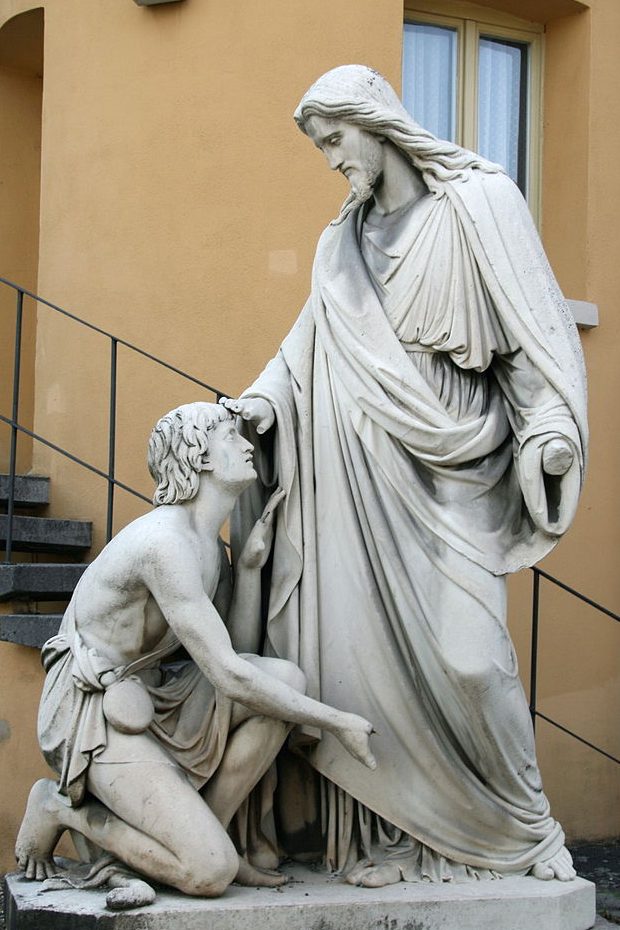
Mercy is scandalous. I wish it weren’t. It seems crazy that this is the case. But here we are, living in an unmerciful world. And even more absurd is that many religious leaders want nothing to do with mercy. The leaders in Christ’s day were trying to get Jesus to depart from his normal routines of grace so that he would appear fickle, unsteady, and weak.

The religious leaders got together and decided to put a woman forward who was clearly a sinner, caught in the act. What to do with her? they asked Jesus. They were, of course, trying to trap him. On the one hand, if Jesus didn’t condemn her, the leaders could say Christ was not upholding the Law. And, on the other hand, if Christ acquiesced in killing the adulterous woman, then the leaders could say that Jesus was inconsistent and unreliable.

The response of Jesus was to stoop down and say nothing. I believe Christ was demonstrating how utterly unworthy the religious leaders were to be heard on the subject. I don’t think there’s anything to conjecture about writing in the sand. It was like taking the physical posture of turning his back on them or putting up a hand, as if he isn’t going to watch the silly circus scene that’s happening.

Jesus wasn’t about to be deterred from his ministry of mercy, from preaching grace, and from hobnobbing with “sinners.” But, since the religious leaders kept up their questioning like a pack of obnoxious yippee dogs, Jesus straightened up and decided to deal with this unmerciful display happening in front of him.

He simply stated that if they want judgment, not mercy, then the one who is without any sin ought to throw the first stone to kill the woman and execute judgment upon her. If innocence is so all-fired important, then it will take an innocent person to punish the guilty.

Whoever accuses another person ought to first look in the mirror to see if there is any innocence reflecting back. And the stark truth is that any old Tom, Dick, or Harry is not qualified to level judgment on another and condemn them. Christ is unmasking the hypocrite who flatter themselves with the supposed high ground of their innocence.

In reality, they are excessively severe and harsh, spiritual felons who have no right to censure others. There is a place for loving correction and appropriate judgment. However, there is never a place in the kingdom of God for eliminating mercy and punishing others with either our hands or our tongues.

Although the wicked and hypocritical religious leaders intended to entrap Jesus by their unholy shenanigans, the tables were quickly turned and their true shame was exposed for what it is – being so darned unmerciful and unloving. Their own guilt is proved by walking away from the scene.

No one has the right to be a jerk. And it is definitely not okay for any person, of all things, to tempt Jesus Christ! And yet, too many religious folk through the centuries have done just that.

None of this means that sin is okay and we can do whatever we want. No, Christ calls us to go and sin no more. Mercy frees us to do just that. Mercy is the key which unlocks the door of freedom and allows us to leave one room for another, to arise from the dark basement of disobedience and despair and enter the bright living room of forgiveness, grace, and life.

Let us then imbibe mercy as the elixir of life – because it is. The world cannot survive without mercy.

We are not the arbiters of who can or cannot have mercy. God said:

“I will have mercy on whom I will have mercy, and I will have compassion on whom I will have compassion.” (Exodus 33:19, NIV)

The Lord has always been characterized as merciful:

Remember, Lord, your great mercy and love,
    for they are from of old.
Do not remember the sins of my youth
    and my rebellious ways;
according to your love remember me,
    for you, Lord, are good. (Psalm 25:6-7, NIV)

Mercy is of high value to God, who said:

“For I desire mercy, not sacrifice, and acknowledgment of God rather than burnt offerings.”

Hosea 6:6, NIV

Because God is merciful, the Lord calls people to show mercy, as well:

He has shown you, O mortal, what is good. And what does the Lord require of you? To act justly and to love mercy and to walk humbly with your God. (Micah 6:8, NIV)

“Then the master called the servant in. ‘You wicked servant,’ he said, ‘I canceled all that debt of yours because you begged me to. Shouldn’t you have had mercy on your fellow servant just as I had on you?’” (Matthew 18:32-33, NIV)

Speak and act as those who are going to be judged by the law that gives freedom, because judgment without mercy will be shown to anyone who has not been merciful. Mercy triumphs over judgment. (James 2:12-13, NIV)

May the gracious and almighty God have mercy on you and forgive you all your sins through our Lord Jesus Christ. Amen.

Making Everything New (Isaiah 65:17-25)

Creator: CharlieAJA | Copyright: CharlieAJA

“Look! I am creating new heavens and a new earth,
    and no one will even think about the old ones anymore.
Be glad; rejoice forever in my creation!
    And look! I will create Jerusalem as a place of happiness.
    Her people will be a source of joy.
I will rejoice over Jerusalem
    and delight in my people.
And the sound of weeping and crying
    will be heard in it no more.

“No longer will babies die when only a few days old.
    No longer will adults die before they have lived a full life.
No longer will people be considered old at one hundred!
    Only the cursed will die that young!
In those days people will live in the houses they build
    and eat the fruit of their own vineyards.
Unlike the past, invaders will not take their houses
    and confiscate their vineyards.
For my people will live as long as trees,
    and my chosen ones will have time to enjoy their hard-won gains.
They will not work in vain,
    and their children will not be doomed to misfortune.
For they are people blessed by the Lord,
    and their children, too, will be blessed.
I will answer them before they even call to me.
    While they are still talking about their needs,
    I will go ahead and answer their prayers!
The wolf and the lamb will feed together.
    The lion will eat hay like a cow.
    But the snakes will eat dust.
In those days no one will be hurt or destroyed on my holy mountain.
    I, the Lord, have spoken!” (New Living Translation)

I long for better days. Perhaps you do, as well. Day after day I see the physical and emotional suffering of others. I hear of the many needs of people in my community and around the world. And I face my own personal experiences of loss, grief, disease, death, limitations, etc. We all do. We inhabit a planet full of people in want, families in crisis, communities in pain, institutions in decline, and nations in conflict.

Yet, thank God, it won’t be like this forever. There are days coming which many people could never even dream or conceive of – days of unimaginable blessing, peace, and rest. This is anticipatory joy.

The coming newness will be as large and capacious as God is. Although the old heavens have had controversy and rebellion, and the old earth is burned over with violence, the new realm of God shall be free of sin, death, and evil. It will be governed with unending peace, justice, righteousness, and faithfulness.

Stability and order will oversee long life. No more will there be waking up to mass shootings, overnight murders, theft, brutality, coups, wars, and unrest. Life itself shall thrive, and will not be continually at risk. Quality of life will be the rule, not the exception.

Economic security will be ensconced with no fear of losing jobs or being taken advantage of – no phishing emails, no scam artists, no religious manipulators – a person shall reap the full harvest of their labor. The land and its people will experience continual blessing, and no longer live under a curse. The threat of disaster won’t hang over everyone’s head.

Children will be protected and free from harm. Whereas they are vulnerable to a host of the world’s evils, in God’s new heaven and earth, every year is the year of the child. They will neither be exploited nor expected to be adults before their time.

In short, the coming newness will be a true egalitarian society in which everyone possesses what they need and contributes fully to the community and common good of all. It’s more than individual blessing; its public practices and policies of blessing for the entire community.

Civil peace and protection, economic viability and development, and social stability and security need more than human ingenuity and attention – they need God’s providential care and pure holiness to be realized on a real and practical level.

Accessibility to God is a must. Otherwise, we’re just building structures that will fall and programs which shall fizzle and be forgotten. According to the New Testament, such access has been granted.

For he [Christ] is our peace; in his flesh he has made both into one and has broken down the dividing wall, that is, the hostility between us, abolishing the law with its commandments and ordinances, that he might create in himself one new humanity in place of the two, thus making peace, and might reconcile both to God in one body through the cross, thus putting to death that hostility through it. So he came and proclaimed peace to you who were far off and peace to those who were near, for through him both of us have access in one Spirit to the Father. (Ephesians 2:14-18, NRSV)

And so,

Let us therefore approach the throne of grace with boldness, so that we may receive mercy and find grace to help in time of need. (Hebrews 4:16, NRSV)

Present circumstances may be difficult; current situations might be hard; a sense of being overwhelmed could be our experience, right now – yet our present difficulties and current realities cannot overwhelm God’s new and upcoming heaven and earth. Our daring faith sees beyond the now to what will be.

For our slight, momentary affliction is producing for us an eternal weight of glory beyond all measure.

2 Corinthians 4:17, NRSV

Then I saw a new heaven and a new earth, for the first heaven and the first earth had passed away, and the sea was no more. And I saw the holy city, the new Jerusalem, coming down out of heaven from God, prepared as a bride adorned for her husband. And I heard a loud voice from the throne saying,

“See, the home of God is among mortals.
He will dwell with them;
they will be his peoples,
and God himself will be with them and be their God;
he will wipe every tear from their eyes.
Death will be no more;
mourning and crying and pain will be no more,
for the first things have passed away.”

And the one who was seated on the throne said, “See, I am making all things new.” Also he said, “Write this, for these words are trustworthy and true.” (Revelation 21:1-5, NRSV)

Amen.

Impatience and Grumbling Are Poisonous (Numbers 21:4-9)

Moses and the Serpent on the Rod

The Israelites left Mount Hor and went on the road toward the Red Sea, in order to go around the country of Edom. But the people became impatient on the way and grumbled at God and Moses. They said, “Why did you bring us out of Egypt to die in this desert? There is no bread and no water, and we hate this terrible food!”

So the Lord sent them poisonous snakes; they bit the people, and many of the Israelites died. The people came to Moses and said, “We sinned when we grumbled at you and the Lord. Pray that the Lord will take away these snakes.” So Moses prayed for the people.

The Lord said to Moses, “Make a bronze snake, and put it on a pole. When anyone who is bitten looks at it, that person will live.” So Moses made a bronze snake and put it on a pole. Then when a snake bit anyone, that person looked at the bronze snake and lived. (New Century Version)

Impatience and irritability. Grumbling and complaining. Show me a person with ants-in-their-pants and I will show you a person who bellyaches and squawks like an old chicken. The antsy person sticks their hand in the glove of criticism, loudly griping about missed expectations for all to hear. Little do they realize that venomous snakes are slithering toward them, attracted by the continual vibrations of complaint.

The ancient Israelites were miraculously delivered from Egyptian bondage by the mighty hand of God. But the celebration soon turned sour. Millions of people were out in the desert, discovering they had no food or water.

There is no account of the people using their spiritual connection with God to ask for help. Instead, their reflexive response was to grumble against God and God’s appointed leader Moses.

God had enough of their constant complaints. The Lord had repeatedly shown mercy and committed love to the people over-and-over again. Yet, they kept putting on their grumpy faces any time something didn’t go their way.

God kept showing patience toward the people, but the people kept demonstrating impatience toward God.

A mosaic of the serpent in the desert in All Saints Church, London, England, by Matthew Digby Wyatt (1820-1877)

If you stop and think about the pathology of our own impatience and complaining (which we all do – come on, admit it) you’ll likely discover that at the heart of it all is a picture in your mind of how you think circumstances ought to go for you to be happy. 

The Israelites expected a nice clean break from Egypt with a smooth transition into the Promised Land. They didn’t sign up for hard circumstances and a bunch of adversity and trouble getting there.

We aren’t so different. Believers go to faith gatherings expecting to be fed and encouraged. Students expect that school will be enjoyable and that they’ll get a good paying job after graduation. Employees expect to go to work and have healthy working relationships and a good boss. Parents expect their kids to listen and obey. You expect your friend or spouse to give you focused attention, the weather to be better, the drivers on the road to be respectful, the little plastic things on the end of your shoelaces to last for the life of your shoes….

And it doesn’t happen, or at least fails to go as planned. So, what happens when all those expectations aren’t realized? 

In a perfect world, we would always respond in a reasoned, wise, and healthy manner. But if we’re feeling like we’re in an emotional place of insecurity out in the desert, our response is more likely to be an impatient and complaint-filled litany about how things are all screwed up.

A great deal of disobedience, bad behavior, angry speech, and poor decision-making has its origins in impatience.

The minute you become impatient, take a long deep breath before you make your next mental decision. Check-in with yourself. Be mindful of what your real expectations are for the circumstance or person in the present moment of becoming upset. Make the decision, from the very beginning, not to complain or argue. Instead, choose to say what you want without grumbling.

It is truly possible to stand for holiness, live for righteousness, and uphold the words and ways of Jesus without being a jerk about it through impatient sighs, annoying facial expressions, and terse words of carping at another person who is made in God’s image.

Monitor yourself throughout the day today. Notice the times you become annoyed. Stop and take a minute to analyze what you are expecting to unfold throughout the day. Instead of grumbling, ask God to strengthen your faith through your upcoming events and encounters. 

God is there to help you, and not to pick on you. If you find yourself having made a poor decision and are suffering the consequences of it, the way of dealing with it isn’t to avoid it. One of the reasons God instructed Moses to make a snake is to clearly demonstrate to the people that they must go through their problems and not try and get around them.

Fortunately, in Christianity, Jesus becomes our bronze snake of deliverance:

In the same way that Moses lifted the serpent in the desert so people could have something to see and then believe, it is necessary for the Son of Man to be lifted up—and everyone who looks up to him, trusting and expectant, will gain a real life, eternal life. (John 3:14-15, MSG)

Holy God, your patience is incredible in the face of human impatience. Yet, your boundaries are firm, and you will not put up with our petulant ways forever. Help me to live into the model of your Son, the Lord Jesus, who with you and the Holy Spirit are attentive to come alongside me to your own glory and honor. Amen.