Love and Obedience (Revelation 3:7-13)

“Write this letter to the angel of the church in Philadelphia.

This is the message from the one who is holy and true,
    the one who has the key of David.
What he opens, no one can close;
    and what he closes, no one can open:

“I know all the things you do, and I have opened a door for you that no one can close. You have little strength, yet you obeyed my word and did not deny me. Look, I will force those who belong to Satan’s synagogue—those liars who say they are Jews but are not—to come and bow down at your feet. They will acknowledge that you are the ones I love.

“Because you have obeyed my command to persevere, I will protect you from the great time of testing that will come upon the whole world to test those who belong to this world. I am coming soon. Hold on to what you have, so that no one will take away your crown. All who are victorious will become pillars in the Temple of my God, and they will never have to leave it. And I will write on them the name of my God, and they will be citizens in the city of my God—the new Jerusalem that comes down from heaven from my God. And I will also write on them my new name.

“Anyone with ears to hear must listen to the Spirit and understand what he is saying to the churches. (New Living Translation)

In 1983, Chuck Colson, a former White House Counsel and founder of Prison Fellowship, wrote a timely and influential book entitled Loving God. In it, he presented a simple yet biblical premise concerning the life of every believer in Jesus: The way to love God is to obey God. 

Every door that opens, hinges on our listening to God, and then obeying what the Lord says to do. This is how we show our love for God.

Jesus himself communicated to the church at Philadelphia (not Pennsylvania, but ancient Asia Minor, now present-day Turkey) affirming their faithful obedience of the message. Because of their steadfast observance of the gospel, the Philadelphian believers would be protected and loved by Jesus. 

The church at Philadelphia did much more than offer a confession of loving God – they affirmed their confession through a steadfast loving obedience to Jesus. 

In some Christian traditions, this is described as “living into our baptism.”  It’s one thing to experience the waters of baptism through being set apart by the Holy Spirit for a relationship with God in the person and finished work of Jesus; and it’s quite another thing to “live into” this reality by learning and listening to God’s Word, and then dutifully obeying it.

Humans are complex creatures in their psychology, sociology, and history. However, there is at least one simple straightforward biblical truth we all can live into: To love God is to obey God. 

Therefore, it is quite necessary for us to spend extended times reading and knowing our Bibles, so that we can adhere and hold fast to what it says. 

“It is not what we do that matters, but what a sovereign God chooses to do through us. God doesn’t want our success; He wants us. He doesn’t demand our achievements; He demands our obedience. The Kingdom of God is a kingdom of paradox, where through the ugly defeat of a cross, a holy God is utterly glorified. Victory comes through defeat; healing through brokenness; finding self through losing self.”

Charles Colson, Loving God

When we truly love someone, we want to do what they say, to fulfill their wishes – whatever those desires are. And then, when we do it, there is joy in accomplishing it. We don’t think about how much it costs, or all the work that goes into it. Instead, we say to ourselves, “This person is worth it. I’m glad to do it.”

This is why love is at the center of all true obedience to God. Those without love eventually give up, fall away, and fail to persevere through the difficulties of doing the will of God. But those enamored with love for God consider it a privilege to endure suffering for the sake of Jesus Christ.

Just yesterday I met with a dear woman in the hospital who had endured many hard things in her life. She relayed all of this to me with a sincere smile – because she is so thankful for God’s grace in her life. The woman’s face was bright with the love of God in her life; and she was profoundly grateful that the Lord saw fit to send me to see her.

My friends, how our world would be so much different and better, if we Christians would but bask in the love of God through Jesus Christ our Savior and Lord! We have quite enough Christians in this world who appear as if they were baptized – not in the gracious water of life – but in the sour vinegar of pickle juice. They tend to only obey out of duty, and do so with the grumpy frown which no one wants to be around.

This old fallen world needs us – our love for God and our love for one another – a love which informs and guides our every word and action. Hard things become easy with the presence of love, which the patriarch Jacob knew so well:

Jacob worked seven years for Laban, but the time seemed like only a few days, because he loved Rachel so much. (Genesis 29:20, CEV)

People of God, we can do hard things. We can do them because of love.

What does the Lord your God ask of you? Only this: to revere the Lord your God by walking in all his ways, by loving him, by serving the Lord your God with all your heart and being, and by keeping the Lord’s commandments and his regulations that I’m commanding you right now. It’s for your own good! (Deuteronomy 10:12-13, CEB)

May it be so, to the glory of God, and for the blessing of the world, as well as our own lives.

Gracious God, thank you for the message of good news that in Jesus Christ I have forgiveness of sins. Help me to hold onto this gospel through all the vicissitudes of life so that obedience springs from my heart in all things by the power of the Holy Spirit. Amen.

Naming and Forsaking Evil (Psalm 83:1-4, 13-18)

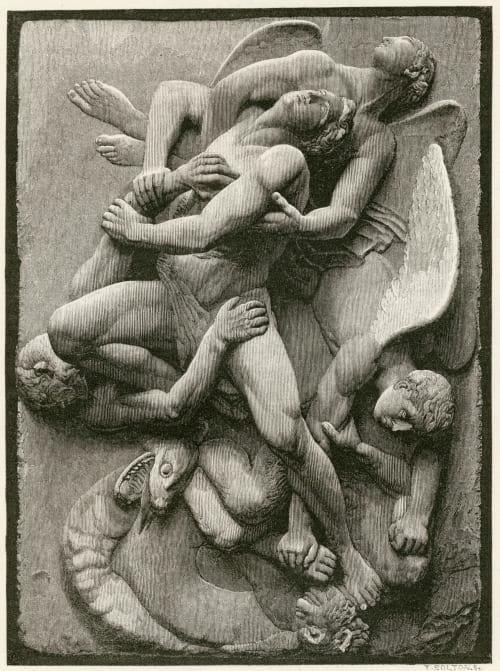
Deliver Us From Evil, by John Flaxman (1755-1826)

God, don’t shut me out;
    don’t give me the silent treatment, O God.
Your enemies are out there whooping it up,
    the God-haters are living it up;
They’re plotting to do your people in,
    conspiring to rob you of your precious ones.
“Let’s wipe this nation from the face of the earth,”
    they say; “scratch Israel’s name off the books.”
And now they’re putting their heads together,
    making plans to get rid of you….

My God! I’ve had it with them!
    Blow them away!
Tumbleweeds in the desert waste,
    charred sticks in the burned-over ground.
Knock the breath right out of them, so they’re gasping
    for breath, gasping, “God.”
Bring them to the end of their rope,
    and leave them there dangling, helpless.
Then they’ll learn your name: “God,”
    the one and only High God on earth. (The Message)

The psalms are the church’s prayer book. Many of the psalms are laments; and many of them are worshipful songs of praise. And there are also the “imprecatory” (pronounced im-PRECK-a-tory) psalms. To “imprecate” means to invoke evil upon someone; it is to pronounce a curse. 

The reason for the imprecatory psalm is that it is not any person’s place to engage in revenge or retaliation. Instead, for people who are genuinely caught in the crosshairs of evil and have sinful persons dogging them, prayer is their most effective recourse; an appeal to God is their best chance at survival and hope.

Sometimes you have to tell it like it is. There’s a time to do your best in putting up a good face and dealing with people who never stop gossiping, slandering, and trying to get their way. But there is also a time to call such behavior “evil” and cry out to God for help.

There are a lot of folks who consider imprecatory psalms a problem because of their detailed expressions of imprecation, of cursing. Yet, such psalms refuse to put a positive spin on malevolent motives, wicked words, and destructive actions.

Desperate people utter desperate prayers. Their unflinching sense of injustice will not allow them to sugarcoat the villainous plans of corrupt people.

Evil is never toppled with tepid prayers from wimpy worshipers. Rather, nefarious agendas are thwarted in the teeth of specific, focused, and intense prayers directed with spiritual precision and passion to the very core of diabolical forces.

We need not be shy about being real with God, even with praying imprecatory prayers. There really are people in this world, maybe even in your own life, that have malicious intent against you or others. Our job is not personal revenge, but to entrust ourselves to the God who fights for the poor, the oppressed, and the needy against the arrogant and the powerful. Let your prayers, then, reflect your life.

Along with psalms of praise lifted during times of celebration, so imprecatory psalms are not to be ignored but need to be uttered equally loud as prayers to almighty God in seasons of desperate evil.

If you have a gut feeling deep down that wicked people are running amok, then use this psalm as a prayer against the darkness which seeks to envelop the earth.

Jesus Christ will build his church and the gates of hell shall not overcome it (Matthew 16:18). The picture Jesus portrayed is one of faithful believers equipped with righteousness and justice storming the gates of hell, not shying away from it. Baked within the Lord’s words were the promise that evil atrocities will not have the day – that God’s people will not be destroyed or overwhelmed because of demonic and satanic power.

There is a time to flee and then there is a time to engage. I am suggesting that the chief way of mitigating evil is to punch it in the mouth with imprecatory psalms prayed with righteous flavor and focused directly against the powers of this present darkness. Why pray, out of all the things we could do, in order to deal with the evil of this world?…

For we do not wrestle against flesh and blood, but against principalities, against powers, against the rulers of the darkness of this age, against spiritual hosts of wickedness in the heavenly places. (Ephesians 6:12, NKJV)

Spiritual problems require spiritual implements to solve. And the tool of imprecatory psalms is a major way of pushing back the dark forces of this world, as well as the means of spiritual assertiveness against all forms of heinous acts and acerbic words from depraved people and evil systems.

God’s wrath is an expression of God’s love – because God is not okay with evil taking root in the lives and institutions of humanity. Prayer is our privilege of coming to the God who upholds justice and righteousness. For if God is for us, who can be against us?

Almighty God, hear me in the day of my trouble and send help from your holy sanctuary and strengthen my faith. Do not let me amble down the path of temptation, but deliver me from the evil one.

Holy Spirit, breathe your enablement into me and inspire me with a passion for goodness, truth, justice, and righteousness.

Lord Jesus be present with me in your risen power and protect me from harm and from everything that hinders your healing presence in this world. You overcame the forces of Satan, redeemed the world, then ascended to the Father.

Blessed Holy Trinity – Father, Son, and Sprit – the God whom I serve: May you be with me and within me; before me and behind me; on my right and on my left; above me and beneath me; and around me always, for the sake of your glory. Amen.

Sensing the Impossible (Exodus 3:1-15)

The Burning Bush, by Yoram Raanan

Now Moses was tending the flock of Jethro his father-in-law, the priest of Midian, and he led the flock to the far side of the wilderness and came to Horeb, the mountain of God. There the angel of the Lord appeared to him in flames of fire from within a bush. Moses saw that though the bush was on fire it did not burn up. So Moses thought, “I will go over and see this strange sight—why the bush does not burn up.”

When the Lord saw that he had gone over to look, God called to him from within the bush, “Moses! Moses!”

And Moses said, “Here I am.”

“Do not come any closer,” God said. “Take off your sandals, for the place where you are standing is holy ground.” Then he said, “I am the God of your father, the God of Abraham, the God of Isaac and the God of Jacob.” At this, Moses hid his face, because he was afraid to look at God.

The Lord said, “I have indeed seen the misery of my people in Egypt. I have heard them crying out because of their slave drivers, and I am concerned about their suffering. So I have come down to rescue them from the hand of the Egyptians and to bring them up out of that land into a good and spacious land, a land flowing with milk and honey—the home of the Canaanites, Hittites, Amorites, Perizzites, Hivites and Jebusites. And now the cry of the Israelites has reached me, and I have seen the way the Egyptians are oppressing them. So now, go. I am sending you to Pharaoh to bring my people the Israelites out of Egypt.”

But Moses said to God, “Who am I that I should go to Pharaoh and bring the Israelites out of Egypt?”

And God said, “I will be with you. And this will be the sign to you that it is I who have sent you: When you have brought the people out of Egypt, you will worship God on this mountain.”

Moses said to God, “Suppose I go to the Israelites and say to them, ‘The God of your fathers has sent me to you,’ and they ask me, ‘What is his name?’ Then what shall I tell them?”

God said to Moses, “I am who I am. This is what you are to say to the Israelites: ‘I am has sent me to you.’”

God also said to Moses, “Say to the Israelites, ‘The Lord, the God of your fathers—the God of Abraham, the God of Isaac and the God of Jacob—has sent me to you.’

“This is my name forever,
    the name you shall call me
    from generation to generation. (New International Version)

Moses with the Burning Bush, by Marc Chagall, 1966

The burning bush is one of those iconic objects and familiar stories in Holy Scripture. The experience of Moses changed both his life and the lives of all the Israelites then and now.

Having spent the first forty years of his life as a darling in the Egyptian court, then the next forty years far from that life on the backside of the desert with a bunch of sheep, it is an understatement to say Moses did not expect or ever envisioned encountering God in a burning bush. The impossible has no possibility…. Or, does it?

That incredible encounter engaged the senses of Moses:

  • the paradoxical sight of seeing fire in a bush that isn’t burning up
  • the smells of sheep, the outdoors, and perhaps, even of fire
  • hearing the call of God from within the bush
  • spiritually and emotionally tasting the attentive justice of God
  • removing the sandals to touch and feel the grounding of sacred space

The story comments on the senses of God, as well. Even though God is Spirit and is worshiped as such, God is alive with his own sensations:

  • seeing the approach of Moses, and the misery of the Israelites
  • the smell of injustice wafting into God’s nostrils with a stench that brought a strong divine reaction
  • hearing the cries of suffering
  • anticipating the savory taste of showing mercy and justice together
  • touching Moses in such a profound way that he and the Israelites would never be the same

Through it all, the close identification between God and God’s people is expressed. The Lord feels the humiliation and pain of the Israelites and vows to uproot them from the Egyptian factory farm of slavery and plant them firmly into rich Promised Land soil. And what God promises to do, God has the authority and power to make good on.

An impossible situation, Moses thinks. How can hundreds of years of backbreaking bondage to a national force so mighty that nothing can be done about it, be broken? Who am I, Moses, to face such odds?

Ah, but God specializes in systems of oppression and miserable people. It is the Lord’s abilities which conquer the mightiest of foes and can extend mercy to the lowest and the least powerful. The entire situation is ripe for divine intervention and supernatural wonders to occur.

God will make a way where there seems to be no way. God works in ways which transcend our senses.

  • Where we are blind, God gives sight
  • Where we are deaf, God opens our ears with the sound of justice
  • When our taste buds are shot with the gruel of poverty, God causes our tongues to dance with the zest of mercy
  • When our nerve endings are raw from cruel bondage, God touches us with freedom
  • Where our nostrils have become accustomed to the smell of death, God’s aroma of life awakens us to new hope

My friends, I believe with all my heart that you already intuitively know deep in your spirit that the impossible is possible with God. It is never a question of God’s ability, but of God’s timing. God is able – and the Lord works the impossible in its proper time so that justice and mercy will have their full effect.

God of the impossible: I believe. Help me in my unbelief.

God of mercy: I receive. Help me in my denial.

God of justice: I accept. Help me in my rejection.

God of all time: I endure. Help me in my impatience.

God of All: I submit. Help me in my rebellion.

God of power and of might: I trust. Help me in my distrust.

God of our Lord Jesus Christ: I follow. Help me in my wandering.

God of the nations: Yes, you know that I love you. Yes, Lord, you know I love you. Lord, you know all things, and you know that I love you. So, yes, I will answer your call to go. Help me in my sending. Amen.

Reframe the Situation (Exodus 4:1-9)

But Moses protested again, “What if they won’t believe me or listen to me? What if they say, ‘The Lord never appeared to you’?”

Then the Lord asked him, “What is that in your hand?”

“A shepherd’s staff,” Moses replied.

“Throw it down on the ground,” the Lord told him. So Moses threw down the staff, and it turned into a snake! Moses jumped back.

Then the Lord told him, “Reach out and grab its tail.” So Moses reached out and grabbed it, and it turned back into a shepherd’s staff in his hand.

“Perform this sign,” the Lord told him. “Then they will believe that the Lord, the God of their ancestors—the God of Abraham, the God of Isaac, and the God of Jacob—really has appeared to you.”

Then the Lord said to Moses, “Now put your hand inside your cloak.” So Moses put his hand inside his cloak, and when he took it out again, his hand was white as snow with a severe skin disease. “Now put your hand back into your cloak,” the Lord said. So Moses put his hand back in, and when he took it out again, it was as healthy as the rest of his body.

The Lord said to Moses, “If they do not believe you and are not convinced by the first miraculous sign, they will be convinced by the second sign. And if they don’t believe you or listen to you even after these two signs, then take some water from the Nile River and pour it out on the dry ground. When you do, the water from the Nile will turn to blood on the ground.” (New Living Translation)

“When we are no longer able to change a situation, we are challenged to change ourselves.”

Victor Frankl

Moses needed a big-time reframing of his situation.

Reframing is a way to help see a situation from a different perspective.

For example, Moses seemed to say to himself, “I’m going to do horrible at communicating to the Israelites that God appeared to me. They’re never going to believe me that I saw God in a burning bush!”

Instead, Moses could reframe the circumstance by saying, “I saw God. I know God is going to deliver the Israelites from their slavery to the Egyptians. I’ve been thinking about this in the backside of the desert for the past 40 years. And God’s got my back to use me here. So, I’ve got this. I can do this!”

But, of course, Moses didn’t say that. He needed a reframing from God that came from some powerful illustrations of the Lord’s ability to change things.

The big reframe for Moses was this: If God can change a staff into a snake, and then turn it back again; and if God can change my hand to be white with leprosy, then turn it back to a healthy hand; then God can certainly change the minds and hearts of the Israelites to accept that I am the Lord’s chosen deliverer from Egyptian bondage.

Whenever we put the onus on our abilities, or lack thereof, in order to alter a situation, then we are likely to have little confidence and a negative outlook.

Yet, when we can do some reframing, and rightly put the emphasis on God’s power and God’s promise, then our faith is placed rightly and we can step forward with courage, knowing it’s ultimately about God, not me.

Moses contends with God about facing the Israelites and convincing them he’s the deliverer. He sees himself as a tongue-tied hick who is only good for moving sheep around. And yet, all these millennia later, we now remember Moses as the one who boldly and repeatedly spoke to Pharaoh and moved an entire nation from Egypt to the Promised Land.

The Lord helped reframe the situation for Moses. Instead of a backward shepherd who was no good at talking, Moses was a magnificently resilient person who was able to reinvent his life multiple times and thrive in each new situation.

Moses survived a murderous decree as a baby, grew up in the Egyptian court, moved to Midian in a completely different existence, and then became perhaps the greatest leader in Jewish history. All of that is the very definition of resilience.

I am willing to surmise that you also need some reframing of your circumstance or even your life. After all, you’ve made it this far in life, and you’re still here. That means you have some significant things going for you. No matter the situation you find yourself in, it’s likely that a good reframe may be needed.

In his book, From Death Camp to Existentialism, Victor Frankl writes of being in a Nazi concentration camp for three years. Everything was taken from him. Frankl’s wife, family, and most of his fellow inmates died. Yet, he survived. And, after the war, he became one of the great psychological healers of our time.

Victor Frankl kept reframing his horrible situation and using his mind for worthy purposes. He survived by using his suffering to help others find hope, to know that no other person or nation can steal his mind from him. Frankl could continually choose his attitude and mindset, irrespective of the circumstances.

“Everything can be taken from a man but one thing: the last of the human freedoms—to choose one’s attitude in any given set of circumstances, to choose one’s own way.”

Victor Frankl

There are always opportunities to experience life more fully, to become a more integrated and whole person, and to transform what seems daunting into a chance to improve one’s life or the lives of others.

Reframing is neither denial nor positive thinking. Rather, it is an invitation in learning to trust God, in the presence, promise, and power of the divine.

We all discover, like Moses, that life can turn out very differently than we might expect. And along the way, we also find that we reinvent ourselves more than once; and that we are transformed by the seasons of life which we all must pass through.

When we learn to trust the Lord, evermore with each and every adverse situation, we are less likely to be controlled or overcome by moods of pessimism, hopelessness, or resentment. Our prevailing attitude becomes optimistic, as our faith is exercised and proven in the difficult trials of life.

Through his several encounters with God – and then with the people and with Pharaoh – Moses found resources he didn’t know he had. By experiencing a reframe of his life, Moses became the sort of person and leader that we are still talking about 3,500 years later.

So, don’t close your heart and mind to the adversity in front of you. That only leads to bitterness and unhappiness. Instead, open yourself to God and trust the spiritual reality and resources you possess.