Luke 11:14-23

            Watching the Green Bay Packers on television does not make one a professional football player.  Sitting in church does not mean someone is a Christian.  In responding to some critics among him about doing the work of casting out demons, Jesus summarized his actions and the actions of others in this way:  “Whoever is not with me is against me, and whoever does not gather with me scatters.”
 
            Jesus was all about the kingdom of God breaking-in to this fallen world and transforming everything.  That meant the kingdom of darkness was going to be pushed back.  Participating with Jesus in his kingdom enterprise is a watershed test of whether someone is genuinely following God or not.  There are a million armchair quarterbacks who will freely give their advice and opinion about how things should have gone and what those playing ought to be doing.  Jesus was and is calling people out to get off their butts and follow him.  Only watching him is to be against him, not for him.
 
            Faith is not a checklist of beliefs to adhere, but a dynamic living participation with Jesus in his plans and purposes for the world.  Leave the critical spirit, haughty attitude, and selfish expectations in the stands.  Get on the playing field.  To simply have our hands in our pockets is to actually work against Jesus.  Are you willing to gather with Jesus?  How does God want to you to serve?  Are you only a fan of Jesus?  Do you play armchair preacher on Monday morning?  The kingdom of God has come upon us.  Allow that reality to sink deep into our lives.


            Mighty God, Jesus is the strong man who has bound Satan and is ushering in a new kingdom.  Let me be a part of what you are doing in this world so that my faith is confirmed, strengthened, and used for your purposes.  Amen.

Faith in Jesus Changes Everything


Having done my share of weddings, I can tell you that something always goes awry and not according to plan.  Sometimes it is a big thing, sometimes a small thing.  I have had best men forget rings, bridesmaids faint, sound systems go out, and, both grooms and brides either laugh or cry so much that they can’t say their vows.  And then there is the reception.  I have been at receptions where we had to wait two hours for the food to be ready, places where different food had to be served than planned, and situations where there was no alcohol and circumstances where there was probably too much alcohol.
 
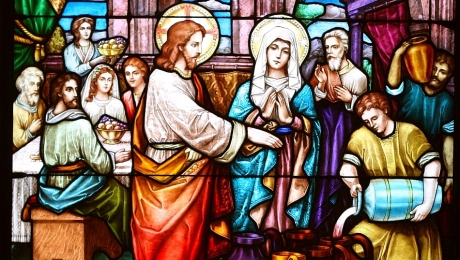
            Back in Christ’s day, a wedding ceremony lasted a full week with a feast at the groom’s home.  Running out of wine constituted a real social crisis.  Sometimes we forget that Jesus attended weddings and participated in gladness, celebration, and joy (John 2:1-11).  God is not always some dour upset divine Being who has no place for a party.  When a person places his/her faith in Christ, it does not necessarily mean taking vows of chastity, poverty, and going without the enjoyable things of this created world.  In fact, it makes complete sense that Christians above all other people would be people of deep faith and lots of celebration.
 
            Since Christians have been liberated from the fear of death; since they have meaning and purpose to life; since they are forgiven and made right by Christ, justified by him, there really ought to be a preoccupation with parties, banquets, feasts, and general merriment.  Christians ought to attract people to the church quite literally by the fun there is in being a Christian.
 
            If that piques your interest, and you are finding that your church experience is not always an enjoyable one, then pay attention to three important observations about faith in Jesus from the miracle of the wedding at Cana.
 
1.      Nobody looked for Jesus until the wine was gone.
 
            Old wine is still wine, and it was enough to keep the guests from seeking Jesus.  Many people do not pursue faith in Jesus until the old something runs out.  Those old attitudes, actions, habits, hurts, insecurities, and information are what we rely on and return to when things are rough.  But those old things can get in the way of faith in Jesus.  Sometimes the old just has to completely dry up and go away until we are truly open to Jesus.
 
            There are times when God allows all the old friends, old reliance, and old habits to run out so that there is no possible way of going back to it.  In order to embrace a new and living faith in Jesus Christ, the past trust in certain ways of doing things must go away.  This is why people most often come to faith in Christ in a time of crisis or trouble.  The rug has been pulled out from underneath them and they have no one and nowhere to look.  Sometimes, until the old is stripped away we cannot see the new possibilities of a fresh faith in Jesus.
 
2.      Obedience has to be mixed with faith.
 
            If we want Jesus to move in our churches, then we must do what he says.  Jesus commanded the servants at the wedding in Cana to fill the jars with water.  Fill them with water.  Without knowing the end of the story, this makes no sense at all.  But obeying Jesus was important because without it there is no miracle.  We really need to quit looking at what we have lost and no longer possess, and look to Jesus, giving him what we do have.  Jesus can do something with whatever we give him.  If it is only water, then he can turn water into wine.
 
            It is easy to become discouraged.  But sometimes only a few people who do what Jesus says, is enough.  They might not have much, but they bring what they have, and they end up seeing God’s glory.  We can trust Jesus by doing something simple:  give him what you have instead of wishing you had something more or different.
 
            Jesus did not explain himself.  He did not lay out his goals and strategy to the people.  Jesus just told the servants to fill the jars with water.  If you are a person of simple prayer, offer your prayers to Jesus and watch what he can do with them.  If you are a simple servant, give your service to Jesus and let him transform it into the miraculous. 


3.      The response of the disciples is that they believed.
 
            The disciples put their faith in Jesus.  Here is thought to think about:  maybe faith is kindled through parties and food more than it is through abstaining from stuff.  Perhaps the kingdom of God is marked predominantly by radical hospitality because it may illicit faith in people more than anything else.  Maybe the party-planning fun-loving playful otters in the church are the ones to take the lead in showing us the way to faith in Jesus.  Maybe eating and drinking with people is the avenue of showing Jesus to others.
 
            Faith is not a static one-time event.  Rather, faith is a process of getting to know Jesus, like having an easy conversation with him across the table.  Like an ever-deepening friendship, being in the company of Jesus can bring us great joy and gladness.


            Church ministry is meant to be enjoyable and liberating; it is not meant to be overly austere and difficult.  We are to delight in the good gifts that God has provided.  The miraculous sign of the wedding feast points to God’s grace.  Jesus is the source of every good thing; faith in him changes everything.  Since Jesus is here, God is with us.  Because God is present, let the party begin!

Jeremiah 3:1-5

            We all have needs.  As human beings, each one of us has some deep hunger for love, intimacy, attention, affirmation, and encouragement.  When these needs are met within gracious and loving relationships, especially in the marital bond, then there is genuine happiness and flourishing.  But when our deep wants go unmet over a stretch of time, smiles are replaced with furrowed brows and confident strides give way to slumped shoulders.
 
            We feel deeply and are moved at the visceral level of our being because we are made in the image and likeness of God – a God who himself feels and has great emotion.  Perhaps we too often think of God as some disembodied ethereal brain who has no feeling.  I would hope that today’s Old Testament lesson would put a collar on such notions.  God entered into a loving covenant relationship with Israel.  Yet, over time, the Jews looked for their relational, emotional, and spiritual needs to be met in other gods other than the One true God.  And it pained God.
 
            God felt quite deeply about this turning away from him.  The Lord responded to his people like a jilted lover who is agonized by their acting the part of a whore – looking for their needs to be satisfied elsewhere.  It seems to me that God is so profoundly hurt because he knows that our deepest and greatest needs can only really be met through him.  We unequivocally need God.
 
            To put it in the stark terms of Jeremiah’s prophecy:  Are we playing the part of a whore, running after all kinds of other relationships and things that we wrongheadedly believe will meet the needs of our lives?  Do we sell ourselves to others in order to make a living?  Have we sought other lovers and forsaken our first love of Jesus?  It behooves us all to connect with our longings and needs, and allow the God who delights to meet those needs into the core of our being.


            Jealous God, you are zealous for your presence to be known in the lives of all your creatures.  Help me to know the deepest needs of my life.  May I find in you the desire of my heart and let you fill me with your infinite grace, love, mercy, and attention so that I will know true peace and joy, to the glory of Jesus Christ.  Amen.

1 Kings 1:1-30

            A person’s impending death can bring out a lot of different behaviors in the people around the dying.  Death really ought to teach us how to live, how to face our limitations, and how to accept the inevitable.  Notice some of the responses of various people in today’s Old Testament lesson concerning the last days of the aged King David.
 
            The servants of David treat the king’s declining health as some sort of problem to be solved in order to avoid or put off his death.  Maybe David would be aroused through giving him a beautiful virgin, and he would get back to his old kingly self.  David’s son, Adonijah, on the other hand, has just the opposite response; he is impatient to see his father die so that he can pursue his own kingly aspirations.  Bathsheba, one of David’s wives and the mother of Solomon, wants to make sure her son becomes king.  It seems David is just a pawn who can help her negotiate a difficult situation.  Finally, there is Abishag, the young woman who was with David in his final days.  It is interesting that we do not have recorded a single word of what she said.  She merely serves as a witness to David’s deteriorating health. 
 
            Out of these different people, it is Abishag that perhaps teaches us more about death than anyone else.  She was simply present and served the king; Abishag was like the ancient version of a hospice volunteer.  When faced with the eventual death of a friend or family member, to be present, to listen, and to serve are likely the best forms of dealing with the situation.
 
            The Lord Jesus faced death.  He didn’t try to avoid it; he wasn’t impatient to get it over with; and, it was not a difficulty to stoically endure.  His death is our life.  Christ’s death has brought meaning to both life and to our eventual death.


            Gracious Lord Jesus, you faced the agony of death so that I could have life.  Thank you for your sacrifice, and for giving my life meaning and purpose.  May I live for you in life and in death.  Amen.