Philippians 3:2-12

            I am in the position, as a pastor, of interacting with a wide variety of people.  No matter the age, the station in life, the family background, or the socio/economic situation, the biggest thing I see most people struggle with is letting go of something.  We, as human beings, have this nasty tendency to hold onto things we really need to let go of, and I’m not just talking about hoarders.  We hold onto our anger and nurse it as a grudge; we hold onto our past, as if our pedigree, of lack of it, has to be constantly brought up; we hold onto our bad habits of poor sleep patterns, unhealthy eating, and no time with God to the point that our bodies and our souls break; and, we hold onto our church traditions and our theological thinking with such ferocity that no one can pry them from our cold dead hearts.
 
            If this New Testament lesson from the Apostle Paul tells us anything today it is this:  For God’s sake, let it go!  “Whatever gain I had, I counted as loss for the sake of Christ.  Indeed, I count everything as loss because of the surpassing worth of knowing Christ Jesus my Lord.”  Paul died to his anger, his past religious zeal, his former theological thinking, his Jewish pedigree, and, quite frankly, everything.  He did it so that he could gain Jesus because Jesus was the highest value for Paul – so valuable that he was willing to die to his former life in order to embrace Christ.
 
            In this season of Lent we are to not only give up chocolate, or fast once a week, or take a break from social media; we are to die.  There cannot be new life without a death.  The death we need is to let go of all the emotional baggage, spiritual crud, and materialistic strivings that have played a more prominent role in our lives than knowing Jesus Christ, and him crucified.  What am I giving up for Lent?  I am going to follow Paul’s example and give up my life.  Will you join me?


            Blessed Lord Jesus, you are the ultimate value in life.  Help me to beware of people who would seek to draw me away and deplete my soul from this highest priority of knowing you.  I want to know you, the power of your resurrection, and the fellowship of sharing in your sufferings so that I can be more like you.  Amen.

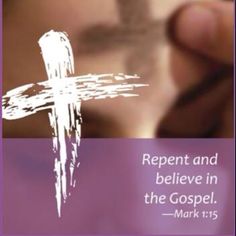
Lent and Repentance


            The Christian season of Lent encompasses the forty days before Easter.  This year it’s from February 10 (Ash Wednesday) to March 27 (Easter), 2016.  Lent is a season of the Christian Year where believers focus on simple living, prayer, and fasting in order to grow closer to God.  At the baptism of our Lord the sky opened and the Spirit of God, which looked like a dove, descended and landed on Jesus.  A voice from heaven said, “This is my Son, My Beloved, with whom I am pleased.” Jesus was then sent into the wilderness by the Spirit where he fasted and prayed for forty days (Matthew 4:1-11). During his time in the desert Jesus was tempted by Satan and found clarity and strength to resist temptation. Afterward, he was ready to begin his ministry.
 
            Lent is the ideal time of year to repent — to return to God and re-focus our lives to be more in line with Jesus. It’s like a forty-day trial run in changing your lifestyle and letting God change your heart.  Repentance is the key that unlocks the soul’s ability to connect with God.  To repent means to turn around, to stop going in one direction and start going in another one.  It is repentance that makes all the difference in the orientation of our souls in this life.
 
            Certainly, no one can really judge the heart of another.  Only God can rightly do that.  Yet, the New Testament lets us in on how to truly measure the sincerity of one’s repentance (2 Corinthians 7:2-12).  Worldly sorrow or grief does not lead to repentance, but only separation and death.  The person with worldly sorrow beats himself up but never really changes direction.  Like Judas Iscariot of old, he just metaphorically hangs himself instead of admitting his guilt to Jesus. 
 
            But godly sorrow leads to repentance, a real change of direction.  And here is the evidence from the Scriptures of the genuineness of the change:  owning up to the problem/sin; an eagerness to make things right; indignation over what has been done or said; seeing that there is more pain in avoiding the problem than there is in confronting it; a desire and energy to do what is best for the person whom we have wronged; and, a willingness to accept whatever consequences that might result from the offense.
 
            Crying and tears might occur and can even be necessary, but they can also be a cheap form of avoiding true repentance and might only be worldly sorrow.  Instead, there must be solid action that changes direction and seeks to rectify offenses, as much as it is within our control to do so.  Deliverance from the power of sin can only come through repentance.  There are no shortcuts or easy routes to the soul’s orientation to practical godliness.  There is nothing romantic about repentance; it is typically messy, usually ugly, and often painful.  Yet, there must be suffering before glory.  Trying to take repentance out of the equation is to eviscerate the Christian life and leave our souls vacuous and empty.
 
            Sometimes we do not even know we need to repent because we get caught up in the drama of school, relationships, family, and work. Our lives are filled with distractions that take us away from living a life with Christ. We might try to fill the emptiness inside us with mindless web-surfing, meaningless chatter, too many activities or other stuff that just keeps us busy without thinking too much. We run away from real life and from God.  But when we intentionally create a plan to connect with God, his Spirit begins to reveal the need for repentance.  That plan during Lent ought to include some form of fasting, prayer, and service.  For example, you could take the Christmas cards you received and pray for one of the people/families each day in the forty days, instead of eating the candy bar or drinking the soda; and, then send them a note of encouragement.  Or, get up ten minutes earlier than usual and spend those minutes in silence and prayer.


            To choose nothing is to give into worldly sorrow and feel guilty.  To choose something, whatever that something is, is to anticipate that God will work in your soul to thaw it out, warm it up, and form it to better discover Jesus Christ.

Job 1:1-22

            Much of life is a mystery.  We do not know why some things happen.  From our puny human perspective, they just do, and that is all we can say about it.  There are times in Scripture, however, when the veil between heaven and earth is peeled back long enough for us to catch a glimpse of mystery.  Today’s Old Testament lesson is such a story. 
 
            Job was a wealthy man and had everything that this earthly life could offer.  And he was a pious godly person of faith.  It was commonly understood that those two things always went together.  So, when we see behind the curtain and are privy to a conversation between God and Satan, the devil himself points this out – that Job only praises God because of how good he has it.  Even with this understanding of what was behind Job’s misery, we still see the mysterious God allowing Satan to operate with only God-knows reasons why.
 
            When calamity strikes; when bad news causes us to slump in our chairs; when adversity hits unexpectedly; when trouble smacks us upside our life like a sledgehammer, it is only human to begin wondering what we did wrong or what we did to bring on such a terrible set of circumstances.  But the truth is:  we just don’t always know.  But what we do know is Job’s incredible response to the mystery of God.  “The LORD gave, and the LORD has taken away; blessed be the name of the LORD.”  Rather than spending all of our emotional energy trying to figure out an answer to our “why” questions, perhaps the more sage response is to confess our faith in a radical trust of God.  Using these actual words from Job would be a necessary start to navigating the troubled waters of evil which swirl around us, even if we have to say them over and over again to believe them.


            God Almighty, every good thing I have in my life has come from you.  It is your prerogative whether I continue to have those things, or not.  Whatever happens, whether it causes heartbreak or happiness, is completely known to you.  I trust that you know what you are doing, and I completely throw myself upon your mercy through Jesus Christ, my Savior.  Amen.

Psalm 17

            This is one of David’s personal psalms of lament.  It is a prayer forged in the midst of adversaries who sought his life.  The psalm is a plea uttered with the hope that God would indeed vindicate him and subdue those who wanted to harm him.  It is a lament that wickedness exists and often gets its way; it is a grieving over the constant threats that swirled around David.
 
            It was David’s prayer that with all the heartless and arrogant violence that was continually in his life that God would keep him as the apple of his eye, and hide him in the shadow of his wings.  Indeed, perhaps no better prayer could be said in those times when there are people who make untrue accusations and only wish harm to be done to you:  “Keep me as the apple your eye; hide me in the shadow of your wings.”  It is in the times when angry simpletons spew their worst that we need to confidently know that the God watches over his people with affection and cares for them as a mother hen protects her chicks.
 
            You and I are precious to God.  We can run to him when there is trouble.  The Lord is a benevolent God showing firm commitment to those who seek truth, loving actions, and merciful words.  When going through a difficult time in which another or others accuse you of wrongdoing and you know you are innocent, the proper prescription is to pray this very psalm repeatedly at night before bed.  For we all know that sleep can be elusive and hard to come by in such circumstances.  Perhaps, along with David, you will be able to say:  “As for me, I shall behold your face in righteousness; when I awake, I shall be satisfied with your likeness.”


            Arise, O LORD!  Deliver my soul from the wicked and subdue them!  I seek refuge in you, O Savior; show me your steadfast love as I cry out to you for help.  Incline your ear to hear me, and answer when I call through the name of Jesus Christ in the power of the Holy Spirit.  Amen.