Matthew 1:1-17

            If you looked up these verses, you might wonder if you’ve got the right text.  Is there really a genealogy in the lectionary?  Am I really going to get something out of this?  Yep, you are.  All of God’s Holy Scripture drips with grace, and the opening genealogy in Matthew is no exception.  At the heart of Matthew’s gospel is a presentation of Jesus and his teaching that centers on the kingdom of God with Jesus as King, the one whom is the fulfillment of all the Old Testament promises.  So, then, the genealogy is not just a chronicle of Christ’s lineage, but is a theological statement made by Matthew that Jesus is the promised Messiah.
 
            The genealogy includes four women in the lineage of Jesus:  Tamar, Rahab, Ruth, and Bathsheba.  Just so you know, women are central to the kingdom of God.  They may not have been important to ancient kings, but to King Jesus they play a significant role.  All four of these women were Gentiles.  King Jesus operates differently.  No matter your gender, your race, or your past (all four had a dubious sexual history), the kingdom of God is for everyone, and is not an exclusive club.  If God can use scandalous Gentile women to accomplish his purposes, who are you or I to tell God whom he can use and whom he can’t use?
 
            God acted in history by sending Jesus, the rightful king of the universe.  He is the Anointed One, sent to restore people to God.  He himself is our peace and our hope.  The kingdom of God operates on grace, and not in typical power position fashion of imposing self-serving agendas.  No matter our past or station in life, grace trumps it all.  Jesus is the One whom makes all the difference.  He is the rightful king.  And he uses his power to save and deliver people from sin, death, and hell.


            Merciful God, thank you for sending your Son, the Lord Jesus, to save, redeem, and love humanity, including myself.  Help me to walk in his steps of grace every day, in the power of the Holy Spirit.  Amen.

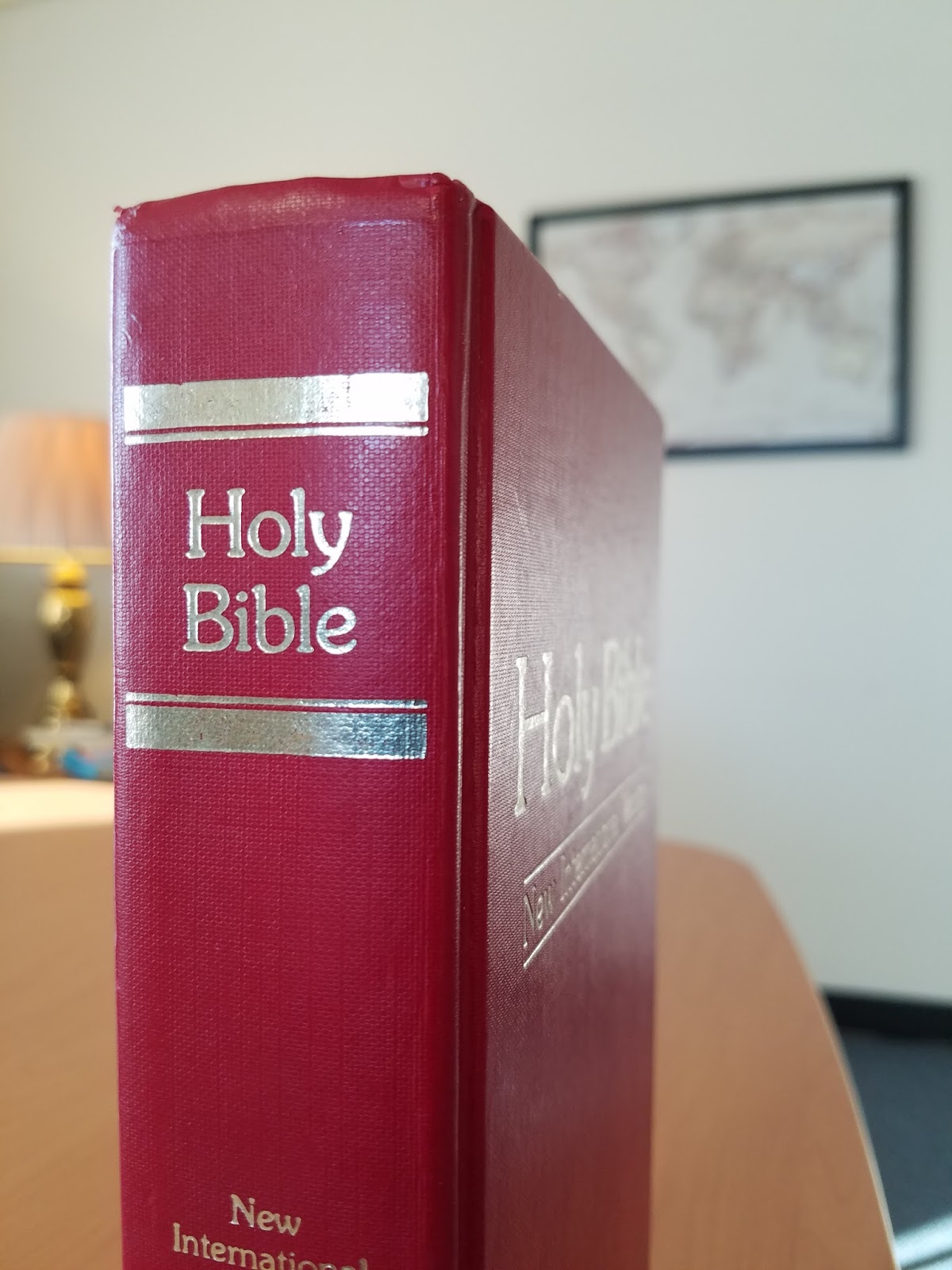
Why I Read the Bible Every Day


            My earliest memories of the Bible are in the church in which I grew up.  I remember Bible stories from Sunday School and the pastor talking about particular verses from the Bible while I sat in our regular family pew at church.  But I really have no recall of ever having read the Bible for myself.  It wasn’t until my late teen years that I took up the task of reading the Scriptures.  And, I have to tell you, it absolutely changed my life.  I found that many of the stories I heard as a kid were a lot juicier than I realized.  I also discovered that there were simply a lot of things in the Bible that I didn’t know even existed.  But maybe the most profound breakthrough for me was plowing through all four Gospels and seeing the life and teaching of Jesus.  My adoration and appreciation of Christ rose exponentially after watching him in action throughout Matthew, Mark, Luke, and John.
 
            I was so impressed with reading the Gospels that I moved into the rest of the New Testament.  Then, I went back to the Old Testament and read it all.  In a matter of months I had read the entire Bible.  But what I then discerned is that, although I had read the whole Bible, I had more questions than when I started.  There was just far too much I didn’t understand about it.  So, I read the whole thing again… then again… and again… somewhere along the line I’ve lost count of how many times I have read the Bible – I estimate that I’ve read the New Testament around four-hundred times and the Old Testament about two hundred.  And I still have so much more to learn, discover, and unearth in this richest of books.
 
            Maybe all that reading of the Bible seems over the top.  I assure you, it isn’t.  Why in the world would I spend so much of my life in plain straightforward reading of the Scriptures?  Let me offer several reasons:
 
I cannot lay hold of God’s promises if I don’t know what they are.  Living from a place of faith and calm in the midst of uncertainty and unrest doesn’t just happen.  It comes from knowing the words of Scripture and applying them to everyday life.  The promises of Scripture are like an asthmatic’s inhaler, enabling us to slow down and take a deep breath.
 
I cannot be like Jesus if I don’t know him very well.  Reading Scripture about Jesus is like eating food. I have to do it regularly.  It nourishes me for the day. Bible reading is stored energy, stockpiled emotional and psychological capital.  I can speak and act like Jesus throughout the day by making moment-by-moment withdrawals from that vast reservoir of stored Scripture knowledge.
 
I cannot be wise if I am not connected to wisdom literature.  By nature we are all ignorant and have to learn through humility and experience what is wise, just, and good. But over time we can shed folly and become wise. I cannot do it on my own. I need a word from God each and every day to face life’s challenges, its ups-and-downs, as well as its mediocrity and mundane nature.  Every day the Bible tweaks my life and prompts fresh mid-course corrections.
 
I need to see God for who He is, and not what I think He is.  Everyone has an idea about God.  But I believe the Christian Scriptures tell me who God really is in all of his attributes, character, and sovereignty.  God is pretty big – so big that I can read the Bible for a lifetime and still get to know more about him. I read my Bible in order to sharpen my vision of God and to think more accurately about all that matters most in this life.
 
I need to see the Church for what it is, and not what I think it is.  Everybody and their dog have an opinion about how church should be and operate.  But I must take my cues from the Bible about what is most important about the church and what it should be doing.  I read the Bible in order to better know and understand who God’s people really are, and what they ought to be doing in this world.
 
I need God.  Reading the Bible is a personal experience — an actual encounter with the author. Daily Bible reading requires routine and structure, but it is not mechanical—just as a body requires a bony skeleton, but it is not the skeleton that gives it life. We do with the Bible what the Psalms guide us in doing—adore God, thank him, complain to him, wrestle with him, express perplexity to him, etc.  Without God I am lost.  Which is why, apart from Scripture, I am lost.


            Reading the Bible is an investment of time, energy, reflection, meditation, and prayer.  Struggling through its contents can change your life.  It did mine.  One of the most important decisions you could ever make is to read the entire Bible from Genesis to Revelation because it is God’s Word that reveals to us the God whom we serve.  

Galatians 4:21-5:1

            There can be something oddly comforting about law.  Having clear black-and-white no-nonsense rules can give a sense of security.  You always know where you stand.  You’re either in or out, pure or sinful.  Yet, here’s the deal on the law:  it is meant for the immature; it is designed as a guide to lead us to maturity.  If we live by law, we are bound by law.  Law can only take us so far in our walk with God.  Slavish commitment to rules must, at some point, give way to the greater virtue of grace. 
 
            The Galatian church wanted a religion they could hold in their hands.  But Paul was dogged on his devotion to a life of grace:  “Christ has set us free!  This means we are really free.  Now hold on to your freedom and don’t ever become slaves of the Law again.”  We are free to live in such a way that brings grace, love, and hope to others.  We are free to bask in the forgiveness we possess in Christ.  If our Christianity is reduced to some sort of point system and following the rules, then we have missed the point of the law to begin with – that it is meant to lead us to Christ and it must, at some point, give way to the larger law of love.
 
            Yes, the law has its place.  But we are perpetual slaves if we never outgrow it and move into freedom.  This is not an anything goes kind of life; it is a life attuned to the Spirit, and aware of living for Jesus through the fruit of the Spirit.  It doesn’t break laws; it fulfills them.  All Christians must grow up and become spiritual adults.  That means leaving childish ways of the law behind and embracing the freedom of the Spirit.  So, where are you in your Christian life?


            Gracious God, you have sent your Son, the Lord Jesus, to fulfill all the demands of the Law.  Help me so to live for Christ through the Spirit that I ooze his love, grace, and truth in all I do and say.  Amen.

Galatians 4:8-20

           I wonder if any one of us could say, with the same confidence as Paul, this statement:  “I beg you to be like me.”  Paul was a committed follower of Jesus – so much so that he ached and longed for others to embrace a life of grace, just as he had.  “My children, I am in terrible pain until Christ may be seen living in you.”  Paul was referring to the same pain as childbirth.  In other words, he was laboring and working hard to give spiritual birth to those that would become like Jesus.
 
            If you are a person who has experienced a transformed life in Jesus, as if you have been born again by grace through the Spirit, then you likely feel and resonate with the travail of Paul.  Knowing the elixir of grace, you want everyone to drink it in and be inebriated with its effects.  You want it so bad that it hurts.  You desire it to the point of exclaiming, “I beg you to be like me!”
 
            You may be spending the upcoming Christmas with some family or friends that are strangers to grace.  Either they are stuck in the clutches of the law and are complete stick-in-the-muds because of it, or they simply do not know what they are missing.  Either way, let’s together offer our passionate prayers to God for the grace of Jesus to overwhelm us all.  Like old Ebenezer Scrooge, perhaps grace will change everything.


            Gracious God, may you weave your way into the lives of those who need you the most, so that mercy will be more than a theological idea.  Work in me in such a way that I can stand with Paul and encourage others to be like me.  Amen.