I'm just a common ordinary pastor, chaplain, father, grandfather, and dog owner who loves the smell of a genuine leather Bible and the aroma of its message. I'm on a quest to track down the best Bibles, how to best read and use them, and to discover the encouragement inside.
The Word was first, the Word present to God, God present to the Word. The Word was God, in readiness for God from day one.
Everything was created through him; nothing—not one thing!— came into being without him. What came into existence was Life, and the Life was Light to live by. The Life-Light blazed out of the darkness; the darkness couldn’t put it out.
There once was a man, his name John, sent by God to point out the way to the Life-Light. He came to show everyone where to look, who to believe in. John was not himself the Light; he was there to show the way to the Light.
The Life-Light was the real thing: Every person entering Life he brings into Light. He was in the world, the world was there through him, and yet the world didn’t even notice. He came to his own people, but they didn’t want him. But whoever did want him, who believed he was who he claimed and would do what he said, He made to be their true selves, their child-of-God selves. These are the God-begotten, not blood-begotten, not flesh-begotten, not sex-begotten.
The Word became flesh and blood, and moved into the neighborhood. We saw the glory with our own eyes, the one-of-a-kind glory, like Father, like Son, Generous inside and out, true from start to finish. (MSG)
Merry Christmas! Glory to God in the highest, and on earth peace, goodwill toward humanity! Today we celebrate the mystery of the incarnation – the unfathomable miracle of God becoming human – all for us and for our salvation.
The beginning of the Apostle John’s Gospel is an astounding passage of Scripture. These are verses to slowly and worshipfully read through because it is a theologically rich, lovingly beautiful, and missionally sensitive piece of Holy Scripture.
The high and holy God has chosen to come and reveal true divinity to us in the person of Jesus. We know God through Christ. We learn what God is like through Jesus. God graciously condescended to us, bent down to communicate in ways we can understand and discern, through the Lord Jesus.
The God which Christians worship and serve is an over-the-top gracious and generous God. This is a God who has gone to incredible lengths in restoring lost humanity. Since God has bridged the great chasm between heaven and earth, we have hope, joy, peace, and faith. With God in the neighborhood, divine love becomes our motivation to reach out in compassionate service. People matter to God. We matter so much that God cared enough to be born.
Luke 1:26-38 tells us what led to the observance of Christmas Eve, the holy night for Christians everywhere. Nothing is outside the power of God to accomplish the impossible. Click the videos below and we will remember and observe the coming of the Christ child…
Josh Groban – O Holy Night
Silent Night – Concordia Christmas Concerts, 2016
May the joy of the angels, the eagerness of the shepherds, the perseverance of the Magi, the obedience of Joseph and Mary, and the peace of the Christ child be yours this Christmas. And the blessing of God almighty, the Father, the Son, and the Holy Spirit, be upon you and remain with you always. Amen.
In the sixth month, God sent the angel Gabriel to Nazareth, a town in Galilee, to a virgin pledged to be married to a man named Joseph, a descendant of David. The virgin’s name was Mary. The angel went to her and said, “Greetings, you who are highly favored! The Lord is with you.”
Mary was greatly troubled at his words and wondered what kind of greeting this might be. But the angel said to her, “Do not be afraid, Mary, you have found favor with God. You will be with child and give birth to a son, and you are to give him the name Jesus. He will be great and will be called the Son of the Most High. The Lord God will give him the throne of his father David, and he will reign over the house of Jacob forever; his kingdom will never end.”
“How will this be,” Mary asked the angel, “since I am a virgin?”
The angel answered, “The Holy Spirit will come upon you, and the power of the Most High will overshadow you. So, the holy one to be born will be called the Son of God. Even Elizabeth your relative is going to have a child in her old age, and she who was said to be barren is in her sixth month. For nothing is impossible with God.”
“I am the Lord’s servant,” Mary answered. “May it be to me as you have said.” Then the angel left her. (Luke 1:26-38, NIV)
Most of life is lived in the mundane, even in a time of pandemic. For the most part our everyday lives involve going about our business and dealing with the daily grind. That is because we are common ordinary people. So, we can especially relate to Mary because she is quite plain.
To put Mary’s life in our contemporary vernacular, at the time of this encounter with the angel, she is of junior high age but has never attended school. She wears mostly clothes from Goodwill, and occasionally can get some from Wal-Mart. She cannot read because girls of her day rarely did. Her parents make all the decisions that affect her life, including the one that she should be married to an older man named Joseph. We do not know if she even liked him. She lives in a small town that most people cannot point to on a map.
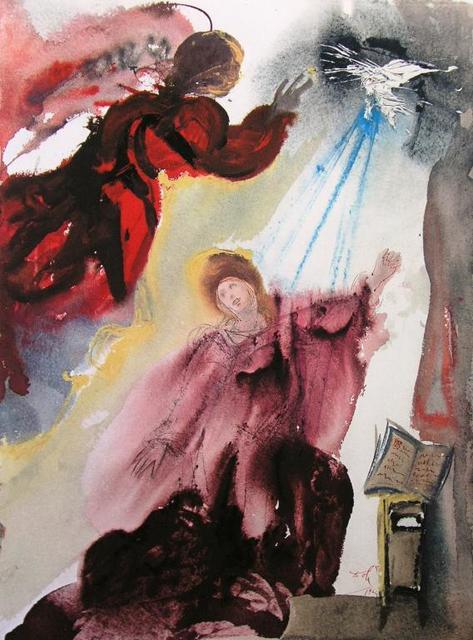
One night, into the bedroom of this young girl comes the brightly beaming divine messenger Gabriel whose name means, “God has shown himself mighty.” Mary stands there in her ratty old flannel nightgown, her life very quickly moving from the ordinary to the extraordinary. The juxtaposition could not be more pronounced: a mighty angel and a plain teen-ager; a messenger of the Most High God and a girl barely past puberty; a holy angelic light which beams in a simple candlelit bedroom; an awesome power encountering complete vulnerability.
Annunciation by Mexican painter Angel Zárraga (1886-1946)
Mary, compared to Gabriel, is defenseless, fragile, and overwhelmed. She is in way over her head. That is why we can relate to her. We can get our human arms around Mary. She is like us. She has faced life with little power to make it turn out the way she planned. Forces beyond her have rearranged her life and altered it forever. She is the Matron Saint of the Ordinary. We can totally understand why Mary responds the way she does.
Mary’s initial reaction was to be “greatly troubled.” She was disturbed and shaking in her hand-me-down slippers. The angel confidently told Mary that she had found favor with God. In other words, Mary was literally “graced” by God. The situation was not that Mary had some extreme spirituality, but that God simply chose her to be the mother of Jesus. And Mary needed to come to grips with what was happening to her. This was well beyond anything she could have expected. Becoming pregnant with the Savior of the world was not even remotely on her radar.
Mary immediately sensed the crazy disconnect between what was being told to her and who she was. After all, she was a plain ordinary girl from the hick town of Nazareth and was being told that she would raise a king. Maybe somebody in heaven screwed up. Maybe Gabriel got the wrong girl. Maybe his Google map sent Gabriel on a wild goose chase. Relating to Mary, we can totally understand that she would question how in the world all this was going to happen. Not only is Mary ordinary and far from royalty, but she is also very much a virgin. Nothing about any of this made any sense.
But the angel let Mary know that God specializes in the impossible. English translators chose to phrase the original rendering of Gabriel’s words as “for nothing is impossible with God.” I rather prefer the more literal translation which is “for there is nothing outside of God’s power.” To me, that is beautiful. There is nowhere we can go, no place on earth, no situation whatsoever that is beyond God’s ability and reach to affect divine power.
We do not always get straightforward answers to our questions about God, but Mary asked a question and got a straight answer: She really can be pregnant with Jesus because the Holy Spirit will come upon her, will overshadow her with power. If the story were to end there it would be a great story. But to me the most astonishing part of the narrative is Mary’s response to what was happening to her.
Mary believed the message and submitted herself completely to God’s will. I think we would completely understand if Mary simply said in her ordinary way that she was not prepared for this. We would totally “get it” if Mary pushed back on what the angel said to her. We could relate if Mary just dismissed the angel’s presence, like Scrooge in the Christmas Carol, as if Gabriel were just “an undigested bit of beef, a blot of mustard, a crumb of cheese, a fragment of an underdone potato. There’s more of gravy than of grave about you, whatever you are!”
Yet, Mary not only believed; she also humbly submitted herself to what was happening. And this is what I believe we need to relate to most about Mary – not her being just a plain ordinary person in a non-descript village but stepping up to the calling she received. We, too, have received a calling in our lives. We, too, have been given the power of the Holy Spirit. We, too, are ordinary people who have been given a very extraordinary task.
Our response today can be the same as Mary: “I am the Lord’s servant; may it be to me as you have said.” The Church is pregnant with possibilities because of the Holy Spirit. We know the end of Mary’s story. She gave birth to Jesus. She raised him in her plain ordinary way. She watched him grow up. She saw him embark on his ministry to proclaim the kingdom of God has become near. Mary did not always understand what Jesus said or what he was doing. And she experienced every mother’s nightmare in seeing her beloved son killed in a terribly gruesome manner right in front of her eyes.
Yet, just as the Holy Spirit was with the birth of Jesus, so the Spirit was with Jesus at his resurrection from the dead. Jesus lived an ordinary life in a very extraordinary way. Furthermore, today Jesus invites us to do the same. Because Christ accomplished his mission of saving people from their sins and establishing a kingdom that will never end, he has given us the same Holy Spirit to follow him forever and call other people to follow him, too.
To trust and obey is God’s only way to live into the life of Jesus. The Christian life may often be difficult, but it is not complicated. It is rather simple, just like Mary. Mary responded to God’s revelation with faith, choosing to fully participate in what God was doing. “I am the Lord’s servant” is our confession, as well. Along with Mary we declare, “May it be to me as you have said.”
Stained glass window of Hannah offering her son Samuel to the Lord by Phil Watkins
Then Hannah prayed:
My heart rejoices in the Lord. My strength rises up in the Lord! My mouth mocks my enemies because I rejoice in your deliverance. No one is holy like the Lord— no, no one except you! There is no rock like our God!
Don’t go on and on, talking so proudly, spouting arrogance from your mouth, because the Lord is the God who knows, and he weighs every act.
The bows of mighty warriors are shattered, but those who were stumbling now dress themselves in power! Those who were filled full now sell themselves for bread, but the ones who were starving are now fat from food! The woman who was barren has birthed seven children, but the mother with many sons has lost them all! The Lord! He brings death, gives life, takes down to the grave, and raises up! The Lord! He makes poor, gives wealth, brings low, but also lifts up high! God raises the poor from the dust, lifts up the needy from the garbage pile. God sits them with officials, gives them the seat of honor! The pillars of the earth belong to the Lord; he set the world on top of them! God guards the feet of his faithful ones, but the wicked die in darkness because no one succeeds by strength alone.
The Lord! His enemies are terrified! God thunders against them from heaven! The Lord! He judges the far corners of the earth!
May God give strength to his king and raise high the strength of his anointed one. (CEB)
This is the song of Hannah, a woman unable to conceive children and then offered a heartfelt petition to God for a child. Her prayer was answered. A thousand years later, Mary took this same song, reworked it, and personalized it, to voice and sing her own praise to God. (Luke 1:46-55)
Hannah dared to hope. It might seem from the perspective of one who has never struggled with being childless that offering a prayer for children is easy. However, when hope has been dashed and all seems impossible, putting oneself out there to ask, even to beg, is downright hard. In a fear of having what little hope remains be crushed, it is far easier to stay away from God and keep the prayers to oneself.
Hannah actively sought divine help and risked praying and emoting. The Lord heard. Hannah’s weeping turned to singing. And, like Mary’s Magnificat, Hannah quickly moved from her own experience to the experiences of people everywhere. In short, Hannah focused on the God of the impossible and the divine accessibility which exists when we become vulnerable and put ourselves out there in risky hope.
The great reversal of Hannah’s condition from barren to fertile gives hope for the weak to become strong, the hungry to be filled, and the lost to be found. In a world in which God is Sovereign, nothing needs to stay the same – nothing is carved in stone.
Since no part of our existence as humans is outside the purview of God, there is always the possibility of change, of a reversal of fortunes.
The underdog has a champion with God. The misfits, the exploited, and the downtrodden – those who cannot lift themselves or pull themselves up by their bootstraps – are precisely the persons whom the Lord raises up. God’s providential care shall oversee them, and justice will be dispensed with perfect equity.
It is one thing to hope; it is another thing altogether in daring to hope against all odds and while others poo-poo your dreams. Godly hope is not wishful thinking but a confident expectation that God will show up and be gracious, merciful, and kind.
The place of crying and weeping is important because it is our tears which find a better way. Anyone can offer cheap praise but the person who sits with their sadness and feels the heart-wrenching agony of a hope unfulfilled is the one who is able to give genuine praise and to sing with authenticity. Since their hope was planted and watered with tears, their joy in the harvest is abundant and plenteous.
As we move to the expectant close of Advent and realize the Christmas hope fulfilled, allow the daring hope of Mary and Hannah to conceive a fresh hope in your own life so that you will give birth to new life.
God of hope, in these times of change, helplessness, and uncertainty give us courage to overcome our fears, and help us to build a future in which all may prosper and share together, through Jesus Christ our Lord. Amen.