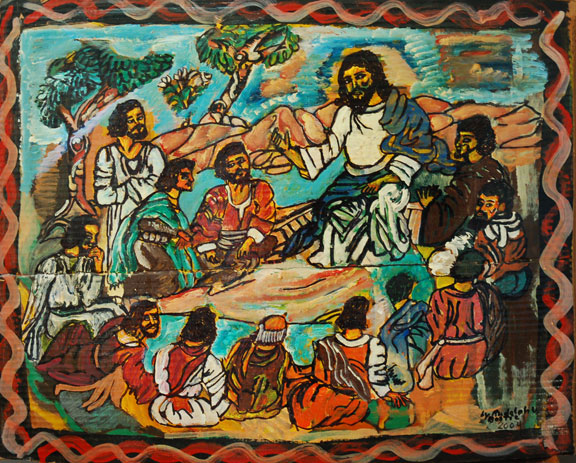
Matthew 6:25-33 – Do Not Worry

“Therefore, I tell you, do not worry about your life, what you will eat or drink; or about your body, what you will wear. Is not life more than food, and the body more than clothes? Look at the birds of the air; they do not sow or reap or store away in barns, and yet your heavenly Father feeds them. Are you not much more valuable than they? Can any one of you by worrying add a single hour to your life?

“And why do you worry about clothes? See how the flowers of the field grow. They do not labor or spin. Yet I tell you that not even Solomon in all his splendor was dressed like one of these. If that is how God clothes the grass of the field, which is here today and tomorrow is thrown into the fire, will he not much more clothe you—you of little faith? So do not worry, saying, ‘What shall we eat?’ or ‘What shall we drink?’ or ‘What shall we wear?’ For the pagans run after all these things, and your heavenly Father knows that you need them. But seek first his kingdom and his righteousness, and all these things will be given to you as well.” (New International Version)

Jesus cares both about what we do, and why we do it. That’s because he cares about our whole selves – our physical needs and our emotional/spiritual needs. In our anxiety about the future, Jesus guides us toward a non-anxious presence for our daily lives.

We all know what worry is. It’s that unsettling feeling in the pit of your gut about what’s going to happen tomorrow. Whenever we worry, we display an inability to see beyond our own little world. Worry bogs us down and saps our faith. Our worry is significant enough to warrant Jesus repeating the command to not worry six times. And he gives six reasons why:

Life is more than food and clothes.

When we are beset with worry, we need a big picture view of what’s going on. Being overly concerned about how the necessities of life are going to be met, we need a reminder that God cares for life itself, including us. If God cares about life, which is so valuable, he will sustain us with what we need to live that life.

God cares for the birds in creation. 

People are the apex of God’s creation. And, since God cares for every other creature on this earth, and sustains their lives, God will certainly care for us, as well.

Worry begins to melt and be replaced by faith, not when we try and work up feelings of trust, but when we take the time to observe creation – watching the birds and seeing how God takes care of them. Birds don’t worry; they just enjoy God’s providence. Birds work hard, but they aren’t farmers who plant and harvest. Yet, God sustains them. So, if God will provide for small creatures that don’t plan to avoid starvation, how much more will God sustain you!?

Worry accomplishes nothing. 

Worry is like a rocking chair; it gives you something to do but doesn’t get you anywhere. Worry is simply unhelpful.

Don’t worry about the world coming to an end today. It is already tomorrow in Australia.

Charles M. Schulz

God cares for the flowers and grass in creation. 

God clothes the flowers better than we ever could dress ourselves (which is what my daughters have told me for years). Jesus specifically identifies flowers and grass because they illustrate a short and precarious lifespan. Christ’s logic is from the lesser to the greater: If God cares for something as fragile and temporary as flowers and grass, how much more will God care for you?

Jesus links worry with a small faith. We have expectations in life about how things ought to go. If those expectations are grounded in God’s promises, then whenever adverse circumstances come, we will likely respond with peace and trust. However, if we are anticipating the future to turn out a particular way, then the worry sets in. 

While we worry, we begin taking matters into our own hands. If the situation goes against our expectations, then we start to question if God is good or not, or if the Lord really has our best interests at mind. We must not tether ourselves to a specific outcome, rather, we need to rely on God’s care for us, no matter what the outcome will be.

Your heavenly Father knows your needs. 

Unlike the ancient pagan deities who were aloof, fickle, and did not pay much attention to people, God is always watching us, always attentive, always knowing our every need. Pagan worshipers keep worrying about whether the gods will really care, or not.

However, with God there is no need for worry because we know the Lord has our backs and is trustworthy. Just as my girls used to jump from the stairway in a leap of faith because they knew for sure Dad was going to catch them, so also your heavenly Father is a reliable God.

The necessities of life will be given to you. 

God’s business is to provide for our necessities; our business is to seek first God’s kingdom and God’s righteousness. 

The verb form of “seek” is a continuous action of seeking. We are to daily seek God’s kingdom and submit to Christ’s lordship. We are to continually pray for God’s kingdom to come and bring all the world under the gracious authority of Christ.

We need to keep seeking social, political, cultural, institutional, and ecclesiastical reform because God cares about it all coming under Christ’s lordship. Continually seeking God’s kingdom means we dethrone wealth and possessions as our first pursuits, and instead seek heavenly treasure as defined by Jesus.

We are to continually seek God’s righteousness by seeking peace where there is discord; forgiveness when others sin against us; mercy instead of judgment; right relations with people in our family, at work, in the neighborhood, and in the church. 

The will of God is clearly stated: Seek first the kingdom of God and God’s righteousness.

Conclusion

If we are busy with kingdom business, there is then no room for worry. Anxious fretting sets in whenever we are diverted from seeking the kingdom. There’s no need for worry about tomorrow because I am busy today doing God’s will.

So, how then do we overcome worry?

  1. Confess and renounce worry. Call worry for what it is: a lack of faith.
  2. Observe creation. Take regular walks in nature. See all the flora and fauna around you. Perceive how God cares for all of it – and you.
  3. Get to know the God of the Bible. Spending time with God increases our faith and reliance upon the Lord. Knowing that he is trustworthy, increases our faith. Engaging in the spiritual practices of prayer, giving, and fasting build our trust in God.
  4. Seek first God’s kingdom and righteousness. Busy yourself with kingdom pursuits, instead of worry.

May God’s blessing rest on you, as you value what Jesus values, and as you seek the Lord with all your heart, soul, mind, and strength.

John 16:25-33 – I Have Overcome the World

“Though I have been speaking figuratively, a time is coming when I will no longer use this kind of language but will tell you plainly about my Father. In that day you will ask in my name. I am not saying that I will ask the Father on your behalf. No, the Father himself loves you because you have loved me and have believed that I came from God. I came from the Father and entered the world; now I am leaving the world and going back to the Father.”

Then Jesus’ disciples said, “Now you are speaking clearly and without figures of speech. Now we can see that you know all things and that you do not even need to have anyone ask you questions. This makes us believe that you came from God.”

“Do you now believe?” Jesus replied. “A time is coming and in fact has come when you will be scattered, each to your own home. You will leave me all alone. Yet I am not alone, for my Father is with me.

“I have told you these things, so that in me you may have peace. In this world you will have trouble. But take heart! I have overcome the world.” (New International Version)

Imagine you are with Jesus in the Upper Room celebrating Passover. And your Lord tells you he is leaving – going back to the Father. After three years of hard and incredible ministry, there is palpable grief in the room. It’s as if you got sucker-punched. You want this time with Jesus to never end….

Jesus Christ, Son of God, Son of Man, Savior of the world, does not forget you. The Lord is concerned and careful to provide wonderful words of assurance: Father God loves you. I give you my peace. I have overcome the world.

Whenever we encounter trouble; in those times when grief seems to be swallowing us whole; and when all is dark and we cannot see our hand in front of our face – it is in these moments the Lord comes alongside us and communicates a loving divine presence which grants us the peace of settled rest, even if and especially when our troubling situations do not change.

If you have had a life largely free of struggle, the privilege of knowing where your next meal is coming from, and the assurance of having your most basic needs met, then understand many people throughout the world know nothing of this experience.

However, this doesn’t necessarily mean those needy persons are unhappy, discontent, or bitter. Love and peace are neither bound nor limited by adverse circumstances. In fact, we know love and peace in a much deeper way whenever we have been hated and in conflict. That’s because love thrives and flourishes in an environment of hate; and peace takes root more surely where there is disharmony and misunderstanding.

If everything always goes our way, how then would we know the Lord’s great grace to us? How would we ever know God as Provider unless we were in want? How would we know Christ as the Healer unless we were broken? How could we ever know resurrection unless there was a crucifixion?

Jesus specializes in the improbable and the impossible, in landing on the Island of Misfit Toys and airlifting the discarded to be a gift to the world. You see, this is precisely how we overcome the world: We love and serve, just as our Lord did. Since he overcame, we walk in his footsteps.

The acquisition and presence of peace is anything but passive. Peace has been achieved through a bloody cross and settles within the spirit through an active pursuit of harmony, wholeness, integrity, and love.

Now that we have been put right with God through faith, we have peace with God through our Lord Jesus Christ. He has brought us by faith into this experience of God’s grace, in which we now live. And so, we boast of the hope we have of sharing God’s glory! We also boast of our troubles, because we know that trouble produces endurance, endurance brings God’s approval, and his approval creates hope. (Romans 5:1-4, GNT)

For the kingdom of God is not food and drink but righteousness and peace and joy in the Holy Spirit. The one who thus serves Christ is acceptable to God and has human approval. Let us then pursue what makes for peace and for mutual upbuilding. (Romans 14:17-19, NRSV)

God’s peace and love is free, but it is not cheap. It is obtained smack in the middle of worldly troubles.

May the peace of God be with you, my friends.

Almighty and everlasting God, you are the fountain of all peace, spiritual and temporal. We humbly pray, in your great goodness grant us that peace which the world cannot give, that we may ever live in your fear, obedient to your commandments, to the end that you may deliver us from all our enemies, through your dear Son, Jesus Christ, our Lord. Amen.

Psalm 63 – I Will

You are my God. I worship you.
    In my heart, I long for you,
    as I would long for a stream
    in a scorching desert.

I have seen your power
and your glory
    in the place of worship.
Your love means more
than life to me,
    and I praise you.
As long as I live,
    I will pray to you.
I will sing joyful praises
and be filled with excitement
    like a guest at a banquet.

I think about you
    before I go to sleep,
    and my thoughts turn to you
    during the night.
You have helped me,
    and I sing happy songs
    in the shadow of your wings.
I stay close to you,
    and your powerful arm
    supports me.

All who want to kill me
    will end up in the ground.
Swords will run them through,
    and wild dogs will eat them.

Because of you, our God,
    the king will celebrate
with your faithful followers,
    but liars will be silent. (Contemporary English Version)

Regulars to this blog know that I believe the Old Testament Psalms to be a vast untapped resource of devotion and prayer for many Christians. The biblical psalms provide believers with words for prayer, song, and thought so that we might remain close and connected to the Lord.

I Will Worship

Worship involves gratitude to God for God’s inherent love; and praise to God for divine works done in the world.

God’s people, gathered together for worship, affords a wonderful opportunity to express gratitude and praise, as well as listen to the stories of others who have experienced the gracious works of God in their lives.

Therefore, both personal and corporate worship is needed. Personal worship, even if engaged daily, will inevitably lead to a truncated understanding of God and God’s Law without corporate worship – because we need the encouragement and the accountability of others for mature spiritual growth. In addition, to only participate in corporate worship, without attending to daily personal worship, leads to a bifurcation between Sunday and our Monday-Friday workaday existence.

Worship isn’t so much an event, as it is a life. So, it makes sense to have healthy rhythms of personal and corporate worship which enable us to glorify God in our neighborhoods, families, workplaces, and faith communities.

I Will Pray

In those dark times when we don’t know what to pray, how to lament, or what to say to God; in the joyful times when we want to proclaim praise, give thanks, or express our blessings and longings; in every season of our lives the psalms help give voice to our relationship with the God of all creation.

Today’s psalm was originally uttered to God when David was roaming in the wilderness avoiding King Saul’s malevolent intent. David prayerfully expressed his yearning, desire, and hope to connect with God and be guided by the Lord, step by step. David praised God in an awkward and adverse circumstance, longing to be satisfied with spiritual food and drink.

I Will Sing

Just as we are to pray the psalms, we are to also speak the psalms out loud with singing. The Psalter Hymnal of old, as well as many contemporary praise and worship songs, are words from the psalms, meant to help, encourage, and give voice to our own current experiences.  

Inspired by the psalms, take a few minutes today to sing and/or listen to songs such as, “God You Are My God” by Michael W. Smith, or check out a compilation of music from the psalms, like, “The Psalms Project,” which aims to put all 150 psalms to music. Maybe even craft your own tune to today’s psalm and sing it to the Lord.

I Will Think

Specifically, the psalmist mentions thinking about the Lord before retiring for sleep, as well as turning to God when awake during the night.

In today’s modern (and postmodern) society, anxiety and racing thoughts are ubiquitous – the result of overthinking and fixating on particular troubling thoughts. Contemplating God through reflecting on the psalms can be a way of taming the out-of-control thinking, while positively engrafting sound theology into the inner workings of our brains.

There’s a reason why the daily lectionary has a reading from the psalms every day. It is one of the best sources for practical spirituality and heartfelt worship, as well as transforming the way we think.

I Will Stay Close

Whatever we do, whatever we say, and wherever we go, let the psalms help form and shape within you a profound spirituality which helps foster a deeper connection with the God we long to know more and more. 

May our celebrations be raucous and robust because the God of the psalms has showed up and given grace and mercy to our troubling circumstances.

Soli Deo Gloria

2 Kings 23:15-25 – Repent, Renew, and Reform

The Book of the Law, Read to King Josiah by Dutch artist Maerten van Heemskerck, c.1569

The king smashed all the altars to smithereens—the altar on the roof shrine of Ahaz, the various altars the kings of Judah had made, the altars of Manasseh that littered the courtyard of The Temple—he smashed them all, pulverized the fragments, and scattered their dust in the Valley of Kidron. The king proceeded to make a clean sweep of all the sex-and-religion shrines that had proliferated east of Jerusalem on the south slope of Abomination Hill, the ones Solomon king of Israel had built to the obscene Sidonian sex goddess Ashtoreth, to Chemosh the dirty-old-god of the Moabites, and to Milcom the depraved god of the Ammonites. He tore apart the altars, chopped down the phallic Asherah-poles, and scattered old bones over the sites. Next, he took care of the altar at the shrine in Bethel that Jeroboam son of Nebat had built—the same Jeroboam who had led Israel into a life of sin. He tore apart the altar, burned down the shrine leaving it in ashes, and then lit fire to the phallic Asherah-pole.

As Josiah looked over the scene, he noticed the tombs on the hillside. He ordered the bones removed from the tombs and had them cremated on the ruined altars, desacralizing the evil altars. This was a fulfillment of the word of God spoken by the Holy Man years before when Jeroboam had stood by the altar at the sacred convocation.

Then the king said, “And that memorial stone—whose is that?”

The men from the city said, “That’s the grave of the Holy Man who spoke the message against the altar at Bethel that you have just fulfilled.”

Josiah said, “Don’t trouble his bones.” So, they left his bones undisturbed, along with the bones of the prophet from Samaria.

But Josiah hadn’t finished. He now moved through all the towns of Samaria where the kings of Israel had built neighborhood sex-and-religion shrines, shrines that had so angered God. He tore the shrines down and left them in ruins—just as at Bethel. He killed all the priests who had conducted the sacrifices and cremated them on their own altars, thus desacralizing the altars. Only then did Josiah return to Jerusalem.

The king now commanded the people, “Celebrate the Passover to God, your God, exactly as directed in this Book of the Covenant.”

This commanded Passover had not been celebrated since the days that the judges judged Israel—none of the kings of Israel and Judah had celebrated it. But in the eighteenth year of the rule of King Josiah this very Passover was celebrated to God in Jerusalem.

Josiah scrubbed the place clean and trashed spirit-mediums, sorcerers, domestic gods, and carved figures—all the vast accumulation of foul and obscene relics and images on display everywhere you looked in Judah and Jerusalem. Josiah did this in obedience to the words of God’s Revelation written in the book that Hilkiah the priest found in The Temple of God.

There was no king to compare with Josiah—neither before nor after—a king who turned in total and repentant obedience to God, heart and mind and strength, following the instructions revealed to and written by Moses. The world would never again see a king like Josiah. (The Message)

The Book of the Law Found, Unknown artist, 1913

To say that King Josiah cleaned house is a significant understatement. Having found the Book of the Law, which was lost for generations deep within the temple, Josiah took its words to heart and set about a campaign of reformation like no king before him. 

Indeed, Josiah was determined to restore and implement the Law in the life of the nation of Judah. His zeal knew no bounds. Josiah was doggedly relentless and actively radical in returning the Jews to the true worship of Yahweh.

Josiah did more than reinstitute the Passover and other festivals of the Lord. The king first upended the alternative pagan worship which had become embedded in Judah like a death-dealing cancer. Josiah surgically removed it with ruthless precision. 

King Josiah made ashes out of Asherah poles; put pagan priests out of business permanently; and did away with everything contrary to the worship of the One true God, including spiritual mediums, household gods, and sacrificial high places. In order to turn his heart fully to God, he did away with all competing gods.

Repentance, renewal, and reformation requires a two-fold process: 1) Turning away from what is false; and 2) Turning toward what is true.

Turning from spiritually unhealthy ways of living – without turning to God – is merely a half repentance. Furthermore, turning to God – without turning one’s back on damaging lifestyles – is a form of denial and is dangerous. 

We are to put off the old clothes of spiritual insensitivity and social injustice. We are to put on the new clothes of righteousness and peace. We are to forsake the old inner person of shame in order to embrace the new life of freedom and joy. 

There needs to be a radical removal of sin, so as to replace it with what is just and right. And, keep in mind, that none of this is pretty or romantic. Repentance and renewal is a messy ugly process of dispelling darkness and letting light shine. It is not for the faint of heart.

Where to begin? Make a fierce, brutally honest spiritual inventory of your life. No one can turn from something they are not really aware of. So, create in your schedule some time in the week to connect with God and do the following: 

  • Identify some areas for change, then list the obstacles to turning away from them (e.g., fear, despair, financial repercussions, etc.). Face those obstacles honestly and forthrightly. 
  • Form a rudimentary plan to forsake the old ways and embrace new paths of righteousness. This is only a beginning. Let God take that process and direct it in redemptive and purifying ways.

Holy God, you are jealous for your own glory. Today, I decide to identify and put away all that is contrary to your righteousness and will for my life. And I choose to turn to you with all my heart. In body, soul, and spirit I belong to you. Amen.