I'm just a common ordinary pastor, chaplain, father, grandfather, and dog owner who loves the smell of a genuine leather Bible and the aroma of its message. I'm on a quest to track down the best Bibles, how to best read and use them, and to discover the encouragement inside.
Blessed is the one who comes in the name of the Lord. We bless you from the house of the Lord. The Lord is God, and he has given us light. Bind the festal procession with branches, up to the horns of the altar.
You are my God, and I will give thanks to you; you are my God, I will extol you.
O give thanks to the Lord, for he is good, for his steadfast love endures forever. (New Revised Standard Version)
Today, take some meditative time to connect with the Lord. Allow yourself some space and grace to meaningfully get in touch with God and your own deep spirituality.
Make yourself comfortable… either sit down, stand outdoors, or recline in your favorite easy chair…. whatever posture helps you relax and relate to God.
Take several deep breaths in and out…
Give yourself permission right now to focus on your relationship with the Lord…
Make God and you a priority…
There is nowhere else you need to be…
You are deserving of this time…
If you get distracted by a thought or sound, simply acknowledge that it occurred and release it. Do not allow it to take you away from this time. For the next several minutes, focus on you and your God….
Imagine you are a kernel of corn, snuggled in the ground…
Although you are small, the Lord has given you everything you need within yourself to become a tall stalk with many ears of corn…
Breathe in, feeling your lungs expand as you inhale… and as you breathe out and exhale, stretch your arms slowly over your head, as if you are breaking the ground…
Slowly bring your arms down…
Lift your face toward heaven…
Imagine feeling the warmth of the sun and the light of God upon you… basking in the Lord’s grace for you…
Feel the refreshment of a gentle rain from heaven falling on you… giving you God’s steadfast love…
Sense your created self and all the potential within coming out… growing… lifting toward the immense sky of the Lord’s favor…
See yourself standing as a nine-foot tall stalk with multiple ears of corn…
Bask in the reality that you are a gift to a hungry world… that you are blessed to be on this earth, and to be a blessing to many… know that you are enough and express your gratitude to God using the following practice:
Look around you. Identify and name:
5 things you see…
4 things you feel…
3 things you hear…
2 things you smell…
1 thing you taste…
Express your thanks to the Lord for each of those things you identified.
End your time by slowly saying out loud with flavor:
You are my God, and I will give thanks to you; you are my God, I will extol you.
O give thanks to the Lord, for he is good, for his steadfast love endures forever.
Join together in following my example, brothers and sisters, and just as you have us as a model, keep your eyes on those who live as we do. For, as I have often told you before and now tell you again even with tears, many live as enemies of the cross of Christ. Their destiny is destruction, their god is their stomach, and their glory is in their shame. Their mind is set on earthly things. But our citizenship is in heaven. And we eagerly await a Savior from there, the Lord Jesus Christ. (New International Version)
Who do you imitate? What examples do you follow? How are you influenced by others?
Good Examples Are Virtuous
Because we are social creatures, we mimic and then pass on things we learn from others. So, it’s imperative we learn from people who demonstrate the values and ideals we aspire to possess ourselves.
In the people we listen to, either virtually or in person, as well as the authors we read, we are to live according to an example of virtue, sacrifice, and commitment.
We must imitate those Christian leaders who have a proven character in persevering in faith in the face of pain and suffering and have done it with great humility.
This does not necessarily mean we emulate those who eruditely speak the Word of God, have superior gifts and abilities, and enjoy success in ministry. It does mean, however, we ought to imitate, and have as mentors, those persons who imitate Christ.
We can leave behind and ignore those who are self-promoting peacocks, concerned with pursuing admiration and praise. Let’s, instead, mimic those who have proved themselves in hardship.
A Christian leader who has not undergone fiery trials and been purged of sinful pride are more easily seduced by their own importance. However, leaders who have seen their share of hard circumstances, pain, and suffering, and have come through it loving God and serving others out of grace and humility, are leaders worth imitating. They will likely serve well as good models of faith and ministry.
Good Examples Are In Community
Please notice there is more in today’s New Testament lesson than individually following a good example; we are to join with others in doing so. Community is needed for proper spiritual mimicking to take place.
Watch what God does, and then you do it, like children who learn proper behavior from their parents. Mostly what God does is love you. Keep company with him and learn a life of love. Observe how Christ loved us. His love was not cautious but extravagant. He didn’t love in order to get something from us but to give everything of himself to us. Love like that.
Ephesians 5:1-2, MSG
This is why the Apostle Paul wrote a letter telling Titus to ensure that he was being an example within the church community – and why he gave detailed instructions on virtue to make sure the older saints of God were teaching and mentoring the younger generations with a good example to show them. (Titus 1:5, 2:1-4, 3:1-2)
Following an example doesn’t take place in isolation. Like a duckling, we need to be with other ducklings following Mama Duck. Otherwise, we are at risk of getting lost and losing our faith, maybe even our lives.
Be a Good Example
It is also good to consider the kind of example we ourselves are displaying for others. In all our words and behaviors, whether we recognize it or not, we are modeling what is genuinely important to us. And sometimes what we do not say, or choose not to do, says as much or more about our character, beliefs, and ethics.
Our character is revealed in the way we treat people. How we treat those who cannot give something back to us tells more about our character than how we treat people we think are important.
People who are honest, kind, and fair – only when there’s something to gain – shouldn’t be confused with people of real character who demonstrate virtuous qualities habitually, under every circumstance. Individuals and groups of people are never to be handled as things or mechanisms to get what we want and achieve our goals.
Character is also revealed in the way we deal with the pressures and temptations which come our way. If we are one way whenever situations are going well, and then another way when things go sideways, it reveals something of our inner self.
Doing the right thing, whether someone is watching, or not, is always a hallmark of a good example.
It takes a lot of confidence in our way of life to say to another, like the Apostle Paul did, “follow my example.” If we have learned with humility and curiosity the words and ways of Jesus, and lovingly put them into practice, then we can be emboldened to mentor others in the faith and demonstrate for them what laboring for justice, righteousness, holiness, and godliness looks like in this fallen world.
Good Examples Together
More than ever, we need a cadre of solidly committed folks who have been mentored well in the ways of grace to serve as a beacon of light in the darkness of this world’s besetting sins of structural racism, hedonistic consumerism, discriminatory ageism, oppressive patriarchalism, biased hierarchism, disparity classism, religious anarchism, and a hundred other “isms” which keep people from flourishing in this life as God intended.
It is vital we learn from and emulate others who have a proven track record of promoting the common good of all persons. And it is equally important we become part of the ranks of those who are good examples of citizens in God’s benevolent and ethical kingdom.
Lord God, help me as your disciple to follow you in every thought, word, and deed. Give me a heart of faith and obedience so that I will live with confidence in the example and in the way of Jesus. Enable me to recognize your good and perfect will, even when it may seem nonsensical to me. I want to follow you all the days of my life. Please give me the strength to do so in the strength of your Holy Spirit. Amen.
The Lord is my light and my salvation; whom shall I fear? The Lord is the stronghold of my life; of whom shall I be afraid?
When evildoers assail me to devour my flesh— my adversaries and foes— they shall stumble and fall.
Though an army encamp against me, my heart shall not fear; though war rise up against me, yet I will be confident.
One thing I asked of the Lord, that will I seek after: to live in the house of the Lord all the days of my life, to behold the beauty of the Lord, and to inquire in his temple.
For he will hide me in his shelter in the day of trouble; he will conceal me under the cover of his tent; he will set me high on a rock.
Now my head is lifted up above my enemies all around me, and I will offer in his tent sacrifices with shouts of joy; I will sing and make melody to the Lord.
Hear, O Lord, when I cry aloud, be gracious to me and answer me! “Come,” my heart says, “seek his face!” Your face, Lord, do I seek. Do not hide your face from me.
Do not turn your servant away in anger, you who have been my help. Do not cast me off, do not forsake me, O God of my salvation! If my father and mother forsake me, the Lord will take me up.
Teach me your way, O Lord, and lead me on a level path because of my enemies. Do not give me up to the will of my adversaries, for false witnesses have risen against me, and they are breathing out violence.
I believe that I shall see the goodness of the Lord in the land of the living. Wait for the Lord; be strong and let your heart take courage; wait for the Lord! (New Revised Standard Version)
“The key to everything is patience. You get the chicken by hatching the egg, not by smashing it.”
Arnold H. Glasow
The Christian season of Lent is a time of waiting…. Believers patiently wait for Easter and the resurrection of the Lord. But there must be a crucifixion before there is a resurrection. There must be suffering before there is glory. Truncating the process of spiritual development, including the hard circumstances of life, will stunt our growth.
So, we need to wait for the Lord….
But, dang it, waiting is hard! Patience is especially difficult whenever we are experiencing hardship and difficulty. We already know that praying for patience is problematic; we end up getting plenty of opportunities to exercise patience and may feel like we’re worse off than before. So, what do we do?
The way to wait patiently is through hope. And hope is a reality which needs to be continually fortified.
Whatever we long to see realized…
the return of a wayward son or daughter…
revitalization and revival within the church…
courage to face the high wall of adversity…
protection and deliverance from mean-spirited people…
an end to pandemic…
freedom from racism and injustice…
healing from chronic pain…
enough finances to make our budget budge…
whatever the situation we long for, patience is to be our breakfast every morning to help us through each day, living one day at a time, putting one foot forward.
Apart from patience, faith, and hope in God, we will lose our spiritual zeal and settle for a mediocre existence with tepid relationships and lukewarm engagement of the world.
God desires more for us…
than simply having a marriage in which two people only exist under the same roof…
for church to be more than buildings, budgets, and butts in the pews…
for our work to be more than a necessary evil to make a living…
for our lives to be more than fear, worry, and anxiety…
for much more than broken dreams, messed up relationships, and situations gone sideways.
The confident expectation of hope neither eliminates trouble from our lives nor magically makes everything better.
Deep faith, like the psalmist expressed, does not change or alter reality – but it does change us.
The way in which we view and handle our troubles is understood differently through the filter of faith and the lens of hope.
The mammoth adversity in our lives is no longer feared because of settled trust in God; the danger which lurks about has no teeth to hold us when we are secure in the Lord.
The actions believers take toward God amidst the fallen nature of this world are to wait and hope, to be strong and take courage. It is precisely when we are totally discombobulated that faith and confident expectation kick in and take effect.
Our faith leads us to confess:
I believe the Lord is the Light which keeps me safe and illumines my path.
I believe the Lord is my Fortress, a castle to protect me.
I believe the Lord is an Army surrounding me, defending my life.
I believe the Lord is the Rock of my salvation, keeping me secure.
I believe the Lord is a Parent who holds me close and does not let go.
I believe the Lord is the right and good Judge, always extending grace and mercy to me.
I believe the Lord is Healer, oftentimes healing me from the need to be healed.
Therefore:
I have confidence and courage to engage the world, knowing God has my back.
I have confidence God will handle malevolent persons, systemic evil, and sinister forces on my behalf.
I have confidence I can approach God, since God’s character is always gracious and loving.
I have confidence to pray with authority, understanding God is the Sovereign of the universe.
I have confidence better days are ahead, that the Christ is soon coming.
I have confidence God bends to attentively listen to me praying.
I have confidence God is neither angry at me nor hidden from me.
I have confidence God shall lead me, guide me, and teach me in the way I ought to go.
I have confidence knowing that God has my best interests in mind.
Rather than losing heart, we can be strengthened with solid theology. Making daily affirmations of faith, persevering in hope, and performing small acts of love are our daily tasks while we wait and watch….
Almighty and everlasting God, the One who sees, knows, and protects, by the power of your Holy Spirit, you are refining us, purifying our discipleship, pulling us into following Jesus in this scary new world of uncertainty. Grant us mercy and grace to trust you more deeply, for the only secure place is with you, our light and our salvation, the stronghold of our life. We pray in the name of Jesus, the first-born of your new creation, and our hope, our life. Amen.
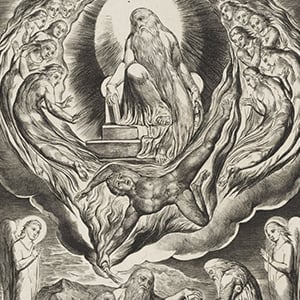
Satan Going Forth from the Presence of the Lord by William Blake, 1825
In the land of Uz there lived a man whose name was Job. This man was blameless and upright; he feared God and shunned evil. He had seven sons and three daughters, and he owned seven thousand sheep, three thousand camels, five hundred yoke of oxen and five hundred donkeys, and had a large number of servants. He was the greatest man among all the people of the East.
His sons used to hold feasts in their homes on their birthdays, and they would invite their three sisters to eat and drink with them. When a period of feasting had run its course, Job would arrange for them to be purified. Early in the morning he would sacrifice a burnt offering for each of them, thinking, “Perhaps my children have sinned and cursed God in their hearts.” This was Job’s regular custom.
One day the angels came to present themselves before the Lord, and Satan also came with them. The Lord said to Satan, “Where have you come from?”
Satan answered the Lord, “From roaming throughout the earth, going back and forth on it.”
Then the Lord said to Satan, “Have you considered my servant Job? There is no one on earth like him; he is blameless and upright, a man who fears God and shuns evil.”
“Does Job fear God for nothing?” Satan replied.“Have you not put a hedge around him and his household and everything he has? You have blessed the work of his hands, so that his flocks and herds are spread throughout the land. But now stretch out your hand and strike everything he has, and he will surely curse you to your face.”
The Lord said to Satan, “Very well, then, everything he has is in your power, but on the man himself do not lay a finger.”
Then Satan went out from the presence of the Lord.
One day when Job’s sons and daughters were feasting and drinking wine at the oldest brother’s house, a messenger came to Job and said, “The oxen were plowing and the donkeys were grazing nearby, and the Sabeans attacked and made off with them. They put the servants to the sword, and I am the only one who has escaped to tell you!”
While he was still speaking, another messenger came and said, “The fire of God fell from the heavens and burned up the sheep and the servants, and I am the only one who has escaped to tell you!”
While he was still speaking, another messenger came and said, “The Chaldeans formed three raiding parties and swept down on your camels and made off with them. They put the servants to the sword, and I am the only one who has escaped to tell you!”
While he was still speaking, yet another messenger came and said, “Your sons and daughters were feasting and drinking wine at the oldest brother’s house, when suddenly a mighty wind swept in from the desert and struck the four corners of the house. It collapsed on them, and they are dead, and I am the only one who has escaped to tell you!”
At this, Job got up and tore his robe and shaved his head. Then he fell to the ground in worship and said:
“Naked I came from my mother’s womb, and naked I will depart. The Lord gave and the Lord has taken away; may the name of the Lord be praised.”
In all this, Job did not sin by charging God with wrongdoing. (New International Version)
Much of life is a mystery. We simply do not know why some things happen. And it’s likely we won’t have answers to many of our vexing questions, this side of heaven. From our limited human perspective, **** happens, and that’s about all we can say about it.
There are times in Holy Scripture, however, when the veil between heaven and earth is peeled back long enough for us to catch a glimpse of mystery. Today’s Old Testament lesson is such a story.
Job was a wealthy man and had everything this earthly life could offer. What’s more, he was a pious godly person of faith. It was commonly understood that those two things always went together. So, when we see behind the curtain and are privy to a conversation between God and Satan, the devil himself points this out – that Job only praises God because of how good he has it. Even with this understanding of what was behind Job’s misery, we still see the mysterious God allowing Satan to operate with only God-knows reasons why.
Whenever calamity strikes, or bad news causes us to slump in our chairs, or adversity hits unexpectedly, or trouble smacks us upside our life like a sledgehammer, it’s only human to begin wondering what we did wrong or what we did to bring on such a terrible set of circumstances.
But the truth is this: We just don’t always know.
Yes, I fully understand that statement is hard to swallow; it even sucks. For example, no amount of understanding why my grandson has a rare form of epilepsy will make the pain go away. All my wonderings about his future isn’t going to help my daughter. It’s an impossible emotional place to be. It’s sad and it’s frustrating.
Yet, there is a better way.
Although there is so much we don’t know, we do know Job’s inconceivable response to the mystery of God. He made an incredible confession of faith, despite the most awful of circumstances. Job made the affirmation:
“When I was born into this world, I was naked and had nothing. When I die and leave this world, I will be naked and have nothing. The Lord gives, and the Lord takes away. Praise the name of the Lord!”
Job 1:21, ERV
Rather than spending all of our emotional energy trying to figure out an answer to our “why” questions, perhaps the more sage response is to confess our faith in a radical trust of God.
Using these actual words from Job can be a necessary start to navigating the troubled waters of evil which swirl around us, even if we have to say them over and over again to believe them.
I know I do.
Almighty God, every good thing I have in my life comes from you. It is your prerogative whether I continue to have those things, or not. Whatever happens, whether it causes heartbreak or happiness, is completely known to you. I trust that you know what you are doing, and I completely throw myself upon your mercy through Jesus Christ, my Savior. Amen.