

The entire family got up early the next morning and went to worship the Lord once more. Then they returned home to Ramah. When Elkanah slept with Hannah, the Lord remembered her plea, and in due time she gave birth to a son. She named him Samuel, for she said, “I asked the Lord for him.”
The next year Elkanah and his family went on their annual trip to offer a sacrifice to the Lord and to keep his vow. But Hannah did not go. She told her husband, “Wait until the boy is weaned. Then I will take him to the Tabernacle and leave him there with the Lord permanently.”
“Whatever you think is best,” Elkanah agreed. “Stay here for now, and may the Lord help you keep your promise.” So she stayed home and nursed the boy until he was weaned.
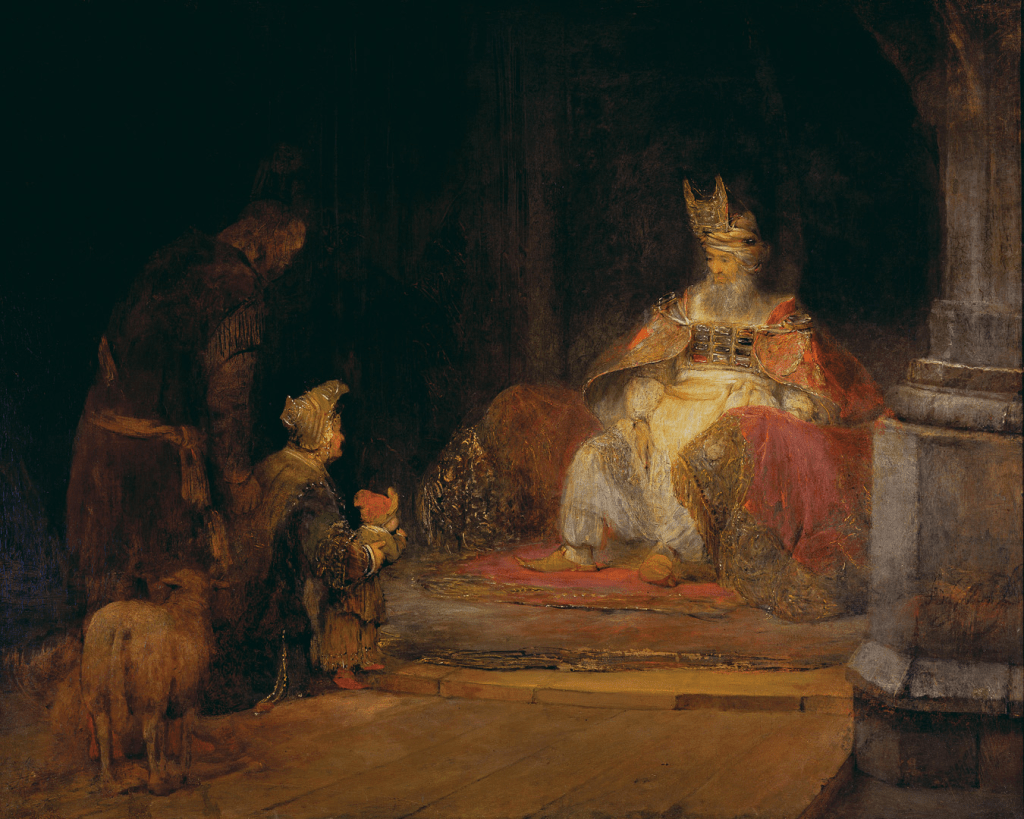
When the child was weaned, Hannah took him to the Tabernacle in Shiloh. They brought along a three-year-old bull for the sacrifice and a basket of flour and some wine. After sacrificing the bull, they brought the boy to Eli. “Sir, do you remember me?” Hannah asked. “I am the very woman who stood here several years ago praying to the Lord. I asked the Lord to give me this boy, and he has granted my request. (New Living Translation)
Hannah had no children. In an era of patriarchy and polygamy, she had to put up with a rival wife verbally attacking her – not to mention a husband who seemed somewhat clueless to what was going on.
The piety of Hannah was unmatched. When worshiping the Lord in the tabernacle at Shiloh, Hannah offered a heartfelt prayer to God. She not only asked for help in her distressing situation, but also promised that if the Lord would give her a son, she would return to the Giver; thus, making the child a double gift to both herself and God.
God listened to Hannah and remembered her. Through her pregnancy and birth of a son, there is even more going on than displaying the Lord’s power over infertility. In taking divine initiative to do what Hannah asked, God demonstrated care and vindication for one of the least valued members of an ancient society that looked askance on infertile women.

In the patriarchal society, Hannah’s husband, Elkanah, could have nullified her vow to the Lord. But he allowed her promise to stand, and even encouraged it. Perhaps this was yet another sort of miracle, to have a husband move the great distance from unaware and aloof to aware and connected.
Hannah and Elkanah went to Shiloh, and back to the old priest Eli, not only making a typical animal sacrifice, but also offering their son, in fulfillment of Hannah’s vow to the Lord. Hannah very much took her vow to God seriously.
As you enter the house of God, keep your ears open and your mouth shut. It is evil to make mindless offerings to God. Don’t make rash promises, and don’t be hasty in bringing matters before God. After all, God is in heaven, and you are here on earth. So let your words be few.
Too much activity gives you restless dreams; too many words make you a fool.
When you make a promise to God, don’t delay in following through, for God takes no pleasure in fools. Keep all the promises you make to him. It is better to say nothing than to make a promise and not keep it. Don’t let your mouth make you sin. And don’t defend yourself by telling the Temple messenger that the promise you made was a mistake. That would make God angry, and he might wipe out everything you have achieved.
Talk is cheap, like daydreams and other useless activities. Fear God instead. (Ecclesiastes 5:1-7, NLT)
Any sort of commitment we express to God, no matter what, is to be taken seriously. Making vows to the Lord isn’t simply a way of helping us feel good about our relationship to God; rather, vows have important implications for our daily life and decisions.
What’s more, vows are not bribes. We don’t make deals with God. That’s because we have nothing to offer in any sort of human understanding of contractual obligations. A vow is a promise, a commitment to follow through with something. And the Lord will hold us accountable to our promises.
Hannah offered her son willingly and gladly to the Lord, and not begrudgingly. In fact, this may have been her thought all along to dedicate a child to God. In other words, giving up her son was not a sorrowful grief but a deep joy. Hannah raised the boy until he was weaned – which was likely, in that day and age, around 3 or 4 years old.
It’s quite possible that Hannah spent those formative years preparing her son for a life of service and doing all she could to help him get a good beginning in the Lord’s Tabernacle.
The biblical character of Hannah has a lot to teach us in our own journey of faith. She was completely devoted to God, found ways to honor and obey God, made a carefully crafted vow to God, persevered and never lost sight of what was important, and did it all with a spirit of obedience, initiative, spunk, gratitude, and gladness.
Hannah was motivated, principled, and sincere. Her good intentions developed into a focused vow, and she organized her life around her promise to God. Hannah did not overpromise or act impulsively; she knew what she was doing. And we have no record of her putting it all in her rival’s face.
God isn’t looking for grand ornate vows from us. The Lord just wants us to live obediently, with a good attitude, and follow through on our expressed commitments. And that’s one of the simplest paths to living a joyful and satisfied life.
Gracious and holy God, who creates, saves, blesses, and sustains us, these things we promise for this day and forevermore:
Never again shall we see another person as an enemy.
Never again shall we place our hope in power.
Never again shall we use violence against another person.
Never again shall we build walls to keep others out.
Never again shall we raise our hand in anger against others.
Never again shall we rob others of their dignity.
Never again shall we treat people differently based on the color of their skin or ethnicity.
Never again shall we take from others what is rightfully theirs.
Never again shall we make judgments about another’s gender identity.
Never again shall we blame another person or group for our own failings.
Never again shall we forget that we are all brothers and sisters.
Never again shall we refuse to listen to one another’s stories.
Never again shall we forget to love others as you love us.
Never again shall we forget that we belong to you.
Never again shall we forget to see ourselves caretakers of your whole creation.
Never again, Creator, shall we forget that you made us as we are, all colors,
shapes and sizes, and said, “Wow! Look at that. Now that is good!” Amen.

 Rev. Tim Ehrhardt