Encountering God (Exodus 19:9-25)

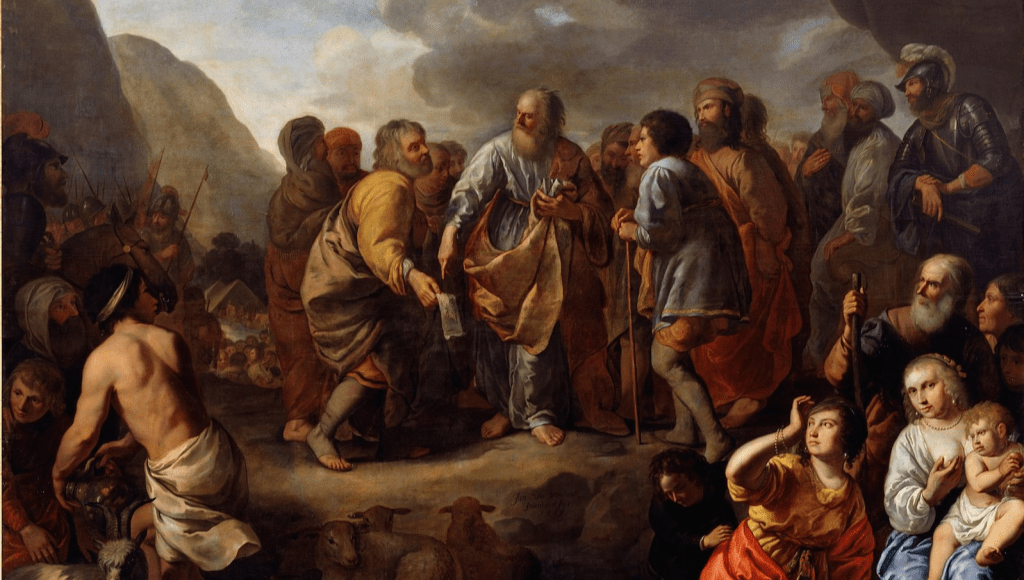
Israel at Mount Sinai, by Jan Luijken (1649–1712)

Then the Lord said to Moses, “I will come to you in a thick cloud, Moses, so the people themselves can hear me when I speak with you. Then they will always trust you.”

Moses told the Lord what the people had said. Then the Lord told Moses, “Go down and prepare the people for my arrival. Consecrate them today and tomorrow, and have them wash their clothing. Be sure they are ready on the third day, for on that day the Lord will come down on Mount Sinai as all the people watch. Mark off a boundary all around the mountain. Warn the people, ‘Be careful! Do not go up on the mountain or even touch its boundaries. Anyone who touches the mountain will certainly be put to death. No hand may touch the person or animal that crosses the boundary; instead, stone them or shoot them with arrows. They must be put to death.’ However, when the ram’s horn sounds a long blast, then the people may go up on the mountain.”

So Moses went down to the people. He consecrated them for worship, and they washed their clothes. He told them, “Get ready for the third day, and until then abstain from having sexual intercourse.”

On the morning of the third day, thunder roared and lightning flashed, and a dense cloud came down on the mountain. There was a long, loud blast from a ram’s horn, and all the people trembled. Moses led them out from the camp to meet with God, and they stood at the foot of the mountain. All of Mount Sinai was covered with smoke because the Lord had descended on it in the form of fire. The smoke billowed into the sky like smoke from a brick kiln, and the whole mountain shook violently. As the blast of the ram’s horn grew louder and louder, Moses spoke, and God thundered his reply. The Lord came down on the top of Mount Sinai and called Moses to the top of the mountain. So Moses climbed the mountain.

Then the Lord told Moses, “Go back down and warn the people not to break through the boundaries to see the Lord, or they will die. Even the priests who regularly come near to the Lord must purify themselves so that the Lord does not break out and destroy them.”

“But Lord,” Moses protested, “the people cannot come up to Mount Sinai. You already warned us. You told me, ‘Mark off a boundary all around the mountain to set it apart as holy.’”

But the Lord said, “Go down and bring Aaron back up with you. In the meantime, do not let the priests or the people break through to approach the Lord, or he will break out and destroy them.”

So Moses went down to the people and told them what the Lord had said. (New Living Translation)
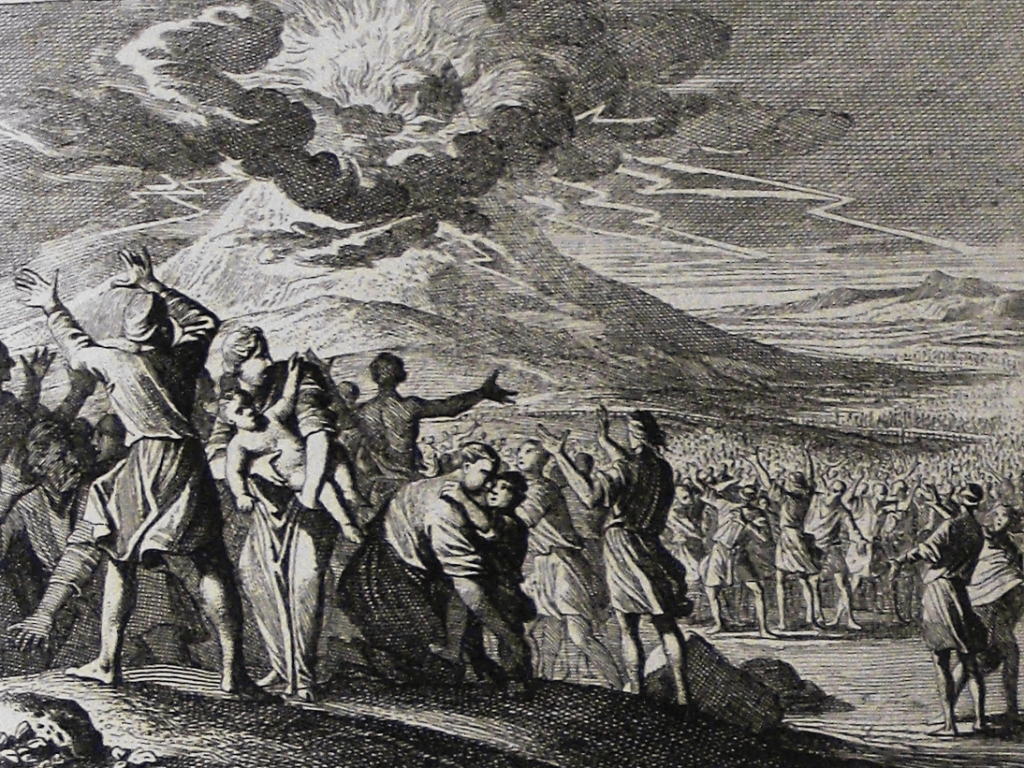
Moses receives the Ten Commandments, by Caspar Luijken (1672-1708)

There’s a lot of drama surrounding today’s Old Testament story. That’s because it’s a big deal when an announcement comes that God is about to show up, speak to the people, and be with them. This is definitely not the stuff of daily mundane life.

The Mount Sinai event is one of the most remembered and talked about events in the Old Testament. This encounter establishes that the presence of the Lord is with Moses, thereby giving him authority over the people. It authenticates the leadership of Moses up to this point – in leading the people out of Egyptian slavery and to the Promised Land.

The presence of God with the people, demonstrated in Moses the leader, assures the Israelites of protection against dangers from other nations and peoples. The divine presence of the Lord will be seen preeminently in the giving of the Law. God’s very Word is encapsulated in the commands and instructions given to Moses on the mountain.

Although the scene on Mount Sinai appears dark, serious, and even scary, it nonetheless is a gift of God’s self-revelation to the people. The Law is a wonderful and gracious provision for Israel. The Lord is providing necessary guidance for living, direction in shaping successful spiritual lives, and the opportunity for obedience to a life-giving system of laws.

If the Israelites hear and obey the Lord, they will be God’s special and treasured people – a nation of priests, a people set apart to be a light for the world.

So, preparations were made for God to enter. The Lord is truly awesome and holy, and so, certain boundaries needed to be established so that the people would be safe and not overcome by such immense light and power. The mountain shakes in anticipation of the divine arrival; the shofar (ram’s horn) is heard, signaling the imminent entrance of God.

The people are assembled by Moses. God descends in the fire, which accompanies the Lord’s presence. Yahweh has come to Israel. The way is now prepared for God’s revelation to be given to Moses in Israel’s hearing. It is an awesome sight and experience.

Perhaps your own days on this earth seem very ho-hum compared to the mountain encounter of Moses and God. You may even feel as if your prayers are puny and don’t get beyond the ceiling of your house. Yet, there is always and continually an opportunity to meet with this very same God, without all the pomp and scariness.

Every single day we have the gracious and wonderful opportunity of opening the book containing a good and merciful God’s self-revelation, and reading gracious words of life to live by. We have guidance for our earthly journey; there is direction for our needy souls.

Your word is a lamp to guide my feet
    and a light for my path. (Psalm 119:105, NLT)

All Scripture is inspired by God and is useful to teach us what is true and to make us realize what is wrong in our lives. It corrects us when we are wrong and teaches us to do what is right. God uses it to prepare and equip his people to do every good work. (2 Timothy 3:16-17, NLT)

Blessed Lord, who caused all Holy Scriptures to be written for our learning: Grant us so to hear them, read, mark, learn and inwardly digest them, so that we may embrace and ever hold fast the blessed hope of everlasting life, which you have given us in our Savior Jesus Christ; who lives and reigns with you and the Holy Spirit, one God, forever and ever. Amen.

Organizational Leadership (Exodus 18:13-27)

Jethro and Moses, by James Tissot, c.1898

The next day Moses took his seat to serve as judge for the people, and they stood around him from morning till evening. When his father-in-law saw all that Moses was doing for the people, he said, “What is this you are doing for the people? Why do you alone sit as judge, while all these people stand around you from morning till evening?”

Moses answered him, “Because the people come to me to seek God’s will. Whenever they have a dispute, it is brought to me, and I decide between the parties and inform them of God’s decrees and instructions.”

Moses’ father-in-law replied, “What you are doing is not good. You and these people who come to you will only wear yourselves out. The work is too heavy for you; you cannot handle it alone. Listen now to me and I will give you some advice, and may God be with you. You must be the people’s representative before God and bring their disputes to him. Teach them his decrees and instructions, and show them the way they are to live and how they are to behave. But select capable men from all the people—men who fear God, trustworthy men who hate dishonest gain—and appoint them as officials over thousands, hundreds, fifties and tens. Have them serve as judges for the people at all times, but have them bring every difficult case to you; the simple cases they can decide themselves. That will make your load lighter because they will share it with you.If you do this and God so commands, you will be able to stand the strain, and all these people will go home satisfied.”

Moses listened to his father-in-law and did everything he said. He chose capable men from all Israel and made them leaders of the people, officials over thousands, hundreds, fifties and tens. They served as judges for the people at all times. The difficult cases they brought to Moses, but the simple ones they decided themselves.

Then Moses sent his father-in-law on his way, and Jethro returned to his own country. (New International Version)

I’ll be the first to say that administration is not my gift – much like I think Moses would have said. So, wading out into the ocean of organizational theory might be a bit like a pastoral walking-the-plank for me. Yet, on the other hand, I have found myself time and again in leadership situations where significant organizational change is needed.  

Maybe God has a sense of humor, or maybe the Lord just wants to use somebody who recognizes he isn’t going to get anything done on the organizational level without a lot of divine intervention. Because of this, I like the K.I.S.S. approach to organizing a group of people (Keep It Simple Stupid). For me, that means sticking with a results-oriented organizational system as opposed to task-oriented organization.

In a task-oriented system, everything lives or dies with the “To Do” list. The focus is accomplishing a few core functions. For example, as a church pastor it might mean preparing sermons, visiting shut-ins, and attending meetings. As a hospital chaplain it could mean serving communion to patients, and listening to complaints from cranky staff persons. For an Administrator it might involve overseeing a sizable budget, leading several committee meetings, and keeping track of the organization’s numbers.

With task-oriented organization, church members feel good about attending worship services and putting money in the offering plate. The problem? People are unlikely to see a need for change and a transformation of the heart because these few tasks are simply what they do. It’s a sort of spiritual cruise-control, driving the car of mediocrity.  

Jethro advising Moses, by Jan Gerritsz van Bronckhorst (1603-1661)

Meetings and church services within the task-oriented system tend to be ends in themselves (frustrating and boring!) because the meeting itself is just something that gets scratched off the to do list. Churches that have a hard time making decisions are probably stuck in the task-oriented mode, because there is no over-arching framework from which to decide anything.  

So, people entrench themselves in positions based in personal preferences. It’s the world of heated conversations and worship wars. If motivation and morale is dependent on people getting their way, no one is likely to be happy. The great need for a task-oriented church is a big picture vision that seeks results.

The results-oriented organization focuses on achieving some desired outcomes. This is the kind of organization that Jethro was thinking of when he observed Moses engaged in the endless task orientation of hearing people’s cases.

Tasks and functions are not ends in themselves, but will continually change in order to accomplish the results we want. This is a church or organization oriented around mission.  

Jesus came to this earth to accomplish the salvation of the world. He was on a mission of love – intent on extending grace to lost sinners. In this setting, decision-making becomes exciting. A group of people come up with ideas and tasks about loving people and reaching them with the grace we have received from God.  

A results orientation has personal preferences taking a back seat to the great needs of the community. There is freedom to experiment and imagine together, instead of guilt for not getting something crossed off the “To Do” list.

In truth, I like to create lists; it feels good when everything is scratched off the list at the end of the day. But I make sure that those things are a means to an end, and not the end itself.  

By orienting my ministry around mission (God’s, not mine) I am able to create tasks and functions that contribute to seeing the kingdom of God break into the church and the world. So, here are two K.I.S.S. questions for every leadership team:  

What result(s) would you like to see in your church?  

What kind of tasks will help you get the results you want?

Jesus is building his church, and the gates of hell will not overtake it. We can participate, change, grow, live, and learn, without fear of screwing up the church and making it more complicated than it is. Why? Because Jesus is the One building it.

All we need is a bit of grace with each other to step out by faith and make a difference by focusing and planning for some worthy, good, and just outcomes.

Almighty God, we pray for leaders everywhere in every place, that you will guide them in the ways of freedom, justice, and truth, so that all persons may live in peace. Lord, in your mercy, hear our prayer. Amen.

Facing Our Sadness (Psalm 42)

As a deer longs for a stream of cool water,
    so I long for you, O God.
I thirst for you, the living God.
    When can I go and worship in your presence?
Day and night I cry,
    and tears are my only food;
all the time my enemies ask me,
    “Where is your God?”

My heart breaks when I remember the past,
    when I went with the crowds to the house of God
    and led them as they walked along,
    a happy crowd, singing and shouting praise to God.
Why am I so sad?
    Why am I so troubled?
I will put my hope in God,
    and once again I will praise him,
    my savior and my God.

Here in exile my heart is breaking,
    and so I turn my thoughts to him.
He has sent waves of sorrow over my soul;
    chaos roars at me like a flood,
    like waterfalls thundering down to the Jordan
    from Mount Hermon and Mount Mizar.
May the Lord show his constant love during the day,
    so that I may have a song at night,
    a prayer to the God of my life.

To God, my defender, I say,
    “Why have you forgotten me?
Why must I go on suffering
    from the cruelty of my enemies?”
I am crushed by their insults,
    as they keep on asking me,
    “Where is your God?”

Why am I so sad?
    Why am I so troubled?
I will put my hope in God,
    and once again I will praise him,
    my savior and my God. (Good News Translation)

Sadness. Every human on planet earth knows the feeling. Since we are emotional creatures, profound sadness – even to the point of depression and/or despondency – will happen.

Despite the universal nature of discouragement and tears, many Christians buck the sadness. Far too many believers focus so exclusively on victory in Jesus through his resurrection, ascension, and glorification that they use religion as their denial when unwanted emotions like sadness come banging at the doorstep of their soul.

So, I most emphatically say: Depression is not sin. To be discouraged is not the Enemy. Experiencing sadness is neither wrong nor selfish. Quite the opposite, in fact.

It is necessary to sit with our emotions and feel the breadth and depth of them. Both our spiritual and emotional health come through an awareness and robust engagement with our feelings. To refuse to feel is to put the stiff arm to God.

The psalmist does anything but deny his feelings. He brings them before the Lord and spreads them out before the Divine. Why am I discouraged? Why am I restless? Why the sadness? Could it be that God has forgotten me? Where is the Lord? Is God angry with me? Are my troubles the result of divine wrath?

To blandly say we have never uttered or thought such questions is a telltale sign of denial. The bottom line for many folks is that they do not want to feel these emotions because it complicates their lives. Besides, discouragement and sadness hurt. “Why feel,” we reason, “when it only brings pain?”

Oh my, the avoidance of pain. And there is no pain quite like emotional and spiritual pain. Much like an open wound which needs a liberal application of painful peroxide, our spiritual wounds must sting with the salve of emotional feeling. Healing is neither cheap, easy, nor painless. It typically hurts like hell.

The psalmist’s own pain revolved around feelings of alienation from God, being cut off from fellow worshipers, and harassed by others around him. Understandably, he experienced despondency and loneliness. The psalmist wondered if anyone, including God, even cared what he was going through. In other words, he is desperate for God to show up.

Here’s a simple observation about this psalm: The psalmist did not get any answers to the several questions he posed. He even repeated them, to no avail. The only form of comfort the psalmist received was to remember what God had done in the past. Somehow, someway, this will help with the difficulties of the present.

There are times in life when we must recall what we know about God, ourselves, and others. If the Lord has delivered in the past, God can do it again. If others helped before, perhaps they will be present in the here and now. And just maybe, even likely, you and I will discover a resilient spirit within. We already possess everything we need to not only survive but to grow and thrive in life.

Hope arises from holding the big picture of the past, present, and future together at the same time. When present circumstances are difficult, and it appears we are about to be swallowed up into the now, we must hold the past and future along with it, in careful tension. Then, we shall find the enablement to keep going.

Trust in the future, and a confident expectation of hope is born from the trustworthiness of the past. A prayerful song in our heart will carry us through till our hope is realized.

Almighty and merciful God, you heal the broken-hearted, and turn the sadness of the sorrowful to joy. Let your fatherly goodness be upon all whom you have made. Remember in pity all those who are this day destitute, homeless, elderly, infirm, or forgotten. Bless the multitude of your poor. Lift up those who are cast down.

Mightily befriend innocent sufferers and sanctify to them the endurance of their wrongs. Cheer with hope all who are discouraged and downcast, and by your heavenly grace preserve from falling those whose poverty tempts them to sin. Though they are troubled on every side, suffer them not to be distressed; though they are perplexed, save them from despair. Grant this, O Lord, for the love of him who for our sakes became poor, your Son our Savior Jesus Christ.

Remember and Learn (Psalm 78:1-4, 12-16)

My people, hear my teaching;
    listen to the words of my mouth.
I will open my mouth with a parable;
    I will utter hidden things, things from of old—
things we have heard and known,
    things our ancestors have told us.
We will not hide them from their descendants;
    we will tell the next generation
the praiseworthy deeds of the Lord,
    his power, and the wonders he has done….

He did miracles in the sight of their ancestors
    in the land of Egypt, in the region of Zoan.
He divided the sea and led them through;
    he made the water stand up like a wall.
He guided them with the cloud by day
    and with light from the fire all night.
He split the rocks in the wilderness
    and gave them water as abundant as the seas;
he brought streams out of a rocky crag
    and made water flow down like rivers. (New International Version)

Every day I read in the biblical psalms. There are two reasons I do this. First, the psalms are the church’s prayer book. They are more than reading material; the psalms are designed to be owned by us as prayers. And second, I need their reminders – a lot!

Remembering is a major theme throughout the entirety of Holy Scripture. It’s just part of the human condition, fallen and forgetful as we are, to lose sight of what has taken place in the past. Today’s psalm invites us to seek the Lord through remembering all the good and wonderful works he has done.

For Israel, remembering meant continually having the events of Passover in front of them. God redeemed the ancient Israelites out of Egyptian slavery and into a good Promised Land. They were to never forget God’s miracle through the Red Sea, God’s protection over them from other nations, and God’s provision of food and necessities in the desert.

We are to remember because we are made in God’s image and likeness. God remembers. God has an ongoing reminder in a divine day timer – Fulfill the promises I made and keep the covenant I initiated with the people, even when they’re stinkers and forget who I am and what they are supposed to be about.

As old as God is, there is no danger of the Lord getting some sort of divine dementia. God doesn’t forget. The Lord always keeps promises made to people.

For the Christian, all God’s promises are remembered and fulfilled in the person and work of Jesus Christ. Deliverance from sin, death, and hell; the gift of the Holy Spirit; and ongoing presence and provision are given to us graciously and freely by the God who loves and cares for people.

For Christians, remembering means coming to the Lord’s Table, entering the once for all loving sacrifice of Christ on our behalf.

We remember the past action of the cross – the once for all sacrifice of Jesus for all the world.

We are mindful of Christ’s continuing presence now in the person of the Holy Spirit.

And remembering these things helps us to look forward with confidence when the Lord shall return and we will eat with him at a grand heavenly banquet table.

One of the reasons I write and journal about my life and Scripture is to remember. Sometimes I forget. There are times when I’m overwhelmed with life and it feels as if God has forgotten me. In such times, I look back into my journal and see what God has done.

And I peer into the psalms and see that the Creator God is active in the big, created world, always attentive to working what is just, right, and good – bending twisted circumstances and evil machinations back toward the great arc of love.

Psalm 78 is designed to recall historical events for the theological education of ourselves and the next generation. Through passing on eventful stories from the past to future generations, God’s people continue to remember and realize the incredible action of God in the world.

In recalling stories of care and deliverance, God’s commandments are kept. Putting trust in the powerful and benevolent God of all brings assurance and encouragement.

Using the psalms as a means of recollecting past events is a wise way of edifying God’s people and living into the command of the Law. As the Israelites were about to enter the Promised Land, Moses restated the Law for them, and then said:

These are the commands, decrees and laws the Lord your God directed me to teach you to observe in the land that you are crossing the Jordan to possess, so that you, your children and their children after them may fear the Lord your God as long as you live by keeping all his decrees and commands that I give you, and so that you may enjoy long life. Hear, Israel, and be careful to obey so that it may go well with you and that you may increase greatly in a land flowing with milk and honey, just as the Lord, the God of your ancestors, promised you.

Hear, O Israel: The Lord our God, the Lord is one. Love the Lord your God with all your heart and with all your soul and with all your strength. These commandments that I give you today are to be on your hearts. Impress them on your children. Talk about them when you sit at home and when you walk along the road, when you lie down and when you get up. Tie them as symbols on your hands and bind them on your foreheads. Write them on the doorframes of your houses and on your gates.

When the Lord your God brings you into the land he swore to your fathers, to Abraham, Isaac and Jacob, to give you—a land with large, flourishing cities you did not build, houses filled with all kinds of good things you did not provide, wells you did not dig, and vineyards and olive groves you did not plant—then when you eat and are satisfied, be careful that you do not forget the Lord, who brought you out of Egypt, out of the land of slavery. (Deuteronomy 6:1-12, NIV)

Since psalms are meant to be recited repeatedly throughout one’s spiritual life, doing so inoculates worshipers from faithless rebellion; and it counteracts the temptation toward trusting in idols. It’s a preservative which gives life, purpose, and wholeness.

Regular spiritual consumption of the psalms provides a pattern of instruction which molds and maintains the soul so that, when hard situations arise, the supports are there to hold us up under the adversity.

The life that is truly life – and the life of those who will come after us – happens through intentional remembrance and learning. Today’s psalm is a fitting invitation to set our hope in God, remember God’s wonderful works, and keep God’s commands.

O God and Father of our Lord Jesus Christ:
Give me strength to live another day;
Let me not turn coward before its difficulties or prove recreant to its duties;
Let me not lose faith in other people;
Keep me sweet and sound of heart, in spite of ingratitude, treachery, or meanness;
Preserve me from minding little stings or giving them;
Help me to keep my heart clean, and to live so honestly and fearlessly that no outward failure can dishearten me or take away the joy of conscious integrity;
Open wide the eyes of my soul that I may see good in all things;
Grant me this day some new vision of your truth;
Inspire me with the spirit of joy and gladness;
and make me the cup of strength to suffering souls;
in the name of our Deliverer, Jesus Christ, in the power of the Holy Spirit. Amen.