Facing Racism (Numbers 12:1-9)

Moses and his wife Zipporah, by Flemish painter Jacob Jordaens, c.1650

When they were in Hazeroth, Miriam and Aaron criticized Moses on account of the Cushite woman whom he had married—for he had married a Cushite woman. They said, “Has the Lord spoken only through Moses? Hasn’t he also spoken through us?” The Lord heard it. Now the man Moses was humble, more so than anyone on earth.

Immediately, the Lord said to Moses, Aaron, and Miriam, “You three go out to the meeting tent.” So the three of them went out. Then the Lord descended in a column of cloud, stood at the entrance of the tent, and called to Aaron and Miriam. The two of them came forward. He said, “Listen to my words: If there is a prophet of the Lord among you, I make myself known to him in visions. I speak to him in dreams. But not with my servant Moses. He has proved to be reliable with all my household. I speak with him face-to-face, visibly, not in riddles. He sees the Lord’s form. So why aren’t you afraid to criticize my servant Moses?” The Lord’s anger blazed against them, and they went back. (Common English Bible)

I have three observations about today’s Old Testament lesson I want us to notice and lift-up, because they are crucial considerations for us in our present world.

First, the older siblings of Moses – Miriam the eldest and Aaron the other brother – had a problem with their sister-in-law (whose name was Zipporah). She was a Cushite. Cush was an ancient country which encompassed present day northern Sudan and much of Ethiopia in Africa. In other words, Zipporah was black, and Miriam and Aaron were critical of their little brother for marrying her.

Second, although having a black sister-in-law was the real issue, Miriam and Aaron confronted Moses not about this, but went after him concerning his role as a prophet. In other words, the siblings engaged in the age-old practice of ostensibly presenting a concern which was not really the matter on their hearts.

Third, the omniscient God knew what was happening. God was fully cognizant of Miriam and Aaron’s cloak-and-dagger attack at Zipporah through her husband Moses. The Lord was incensed with this coup attempt because it was unjust, unfair, ungodly, and frankly, racist. And so, the text states that God, with divine anger aroused, “immediately” addressed the situation.

Racism is insidious. It tends to get expressed most often through the methods similar to those used by Miriam and Aaron by criticizing another somewhat related issue. So, I offer the following questions with as much humility from Moses I can muster:

  • Are we aware of our own inheritance of centuries, and even millennia, of dominance language which keeps other human beings docile and subservient to another’s authority?
  • Have we chosen to challenge points of order and procedure in the attempt to marginalize certain persons?
  • Are we detached from our own needs, and so, unable to listen well?
  • Is there secret fear in our hearts, believing that we must maintain our hegemony, or else there will be chaos?
  • Is the goal for others to become like us, as if we were the Borg who talk about how resisting us is futile?
  • Are we willing to do the hard work of pulling out our own roots of racial segregation and injustice?
  • Do we want cheap diversity or true solidarity?
  • Will we work toward creating a new liberated humanity, championing equity in all things for all people, instead of attempting to sanitize existing systems?

For far too long, too many individuals, institutions, and even faith communities, have relied upon individualism and anti-structuralism; and it has not served us well in addressing our contemporary problems. Individualism sees only individual racist words and actions and is blind to systemic issues. It views social problems as merely a reflection of broken relationships, and, so, again, makes it impossible to see the systemic nature of our racialized society.

Anti-structuralism (not addressing racism as an organizing structure) is the assumption that racism is only individual racial prejudice and hatred. Thus, the approach in dealing with racism is to always be on the lookout for “bad racists.” This avenue, however, diverts attention from upholding biblical justice, forming policies of liberation, and establishing equitable care and opportunity for the common good of all persons.

As a historian, I tend to view things through historical lenses. So, I resonate deeply with the late twentieth-century essayist James Baldwin when he said, “White people are still trapped in a history which they do not understand; and until they understand it, they cannot be released from it.”

I want my history to be with Moses and freedom. I want God to show up and put racism to an end. I want to be part of the solution, and not the problem. I want justice and fairness to flow like a river that never runs dry.

Lord, Jesus Christ, you reached across ethnic boundaries between Samaritans, Romans, and Jews. In your earthly ministry you offered fresh sight to the blind and freedom to captives. Gracious Savior, help us to break down walls and barriers in our community; enable us to see the reality of racism and bigotry; and free us to challenge and uproot it from ourselves, our faith communities, our society, and our world. Amen.

Consider Your Reputation (Revelation 18:1-10, 19-20)

After this I saw another angel coming down from heaven. He had great authority, and the earth was illuminated by his splendor. With a mighty voice he shouted:

“‘Fallen! Fallen is Babylon the Great!’
    She has become a dwelling for demons
and a haunt for every impure spirit,
    a haunt for every unclean bird,
    a haunt for every unclean and detestable animal.
For all the nations have drunk
    the maddening wine of her adulteries.
The kings of the earth committed adultery with her,
    and the merchants of the earth grew rich from her excessive luxuries.”

Then I heard another voice from heaven say:

“‘Come out of her, my people,’
    so that you will not share in her sins,
    so that you will not receive any of her plagues;
for her sins are piled up to heaven,
    and God has remembered her crimes.
Give back to her as she has given;
    pay her back double for what she has done.
    Pour her a double portion from her own cup.
Give her as much torment and grief
    as the glory and luxury she gave herself.
In her heart she boasts,
    ‘I sit enthroned as queen.
I am not a widow;
    I will never mourn.’
Therefore in one day her plagues will overtake her:
    death, mourning and famine.
She will be consumed by fire,
    for mighty is the Lord God who judges her.

“When the kings of the earth who committed adultery with her and shared her luxury see the smoke of her burning, they will weep and mourn over her. Terrified at her torment, they will stand far off and cry:

“‘Woe! Woe to you, great city,
    you mighty city of Babylon!
In one hour your doom has come!…’

They will throw dust on their heads, and with weeping and mourning cry out:

“‘Woe! Woe to you, great city,
    where all who had ships on the sea
    became rich through her wealth!
In one hour she has been brought to ruin!’

“Rejoice over her, you heavens!
    Rejoice, you people of God!
    Rejoice, apostles and prophets!
For God has judged her
    with the judgment she imposed on you.” (New International Version)

Much of the book of Revelation, also known as The Apocalypse of John, is related in symbolic language. The Apostle John had a vision – much like a dream – and saw things that were to come. Like the prophet Ezekiel, experiencing a vision from the Lord is hard to put into words once you’ve experienced it.

John sees and hears the fall of Babylon, that is, the city of Rome. He heard the angel proclaim the empire’s utter desolation and saw what the city would lose. It’s bad news for Rome but good news for the rest of the earth. Drunkenness and sexual immorality are metaphors for the Roman Empire’s crime of acquiring wealth and luxury on the backs of others through imperialism.

What’s more, Rome deceived the nations by causing them to think and believe this economic and religious imperialism was right, good, and needed. So, other city states and nations went to bed with them in this impure and unholy cause. Therefore, divine judgment was coming.

The Fall of Babylon, 15th century artwork

The Apostle John wanted his readers to make a clean break with the Roman Empire and everything it represents. Rome had a “good” reputation with many of the conquered and colonized peoples in the Empire. But, in reality, they had spread evil and encouraged others in their immorality. There was an awfully dark underbelly to Rome’s power and authority that the people of God were invited to see and repudiate.

The issue of reputation is an important one, because how we come across to others might be different than who we actually are.

One day at a parent-teacher conference, many years ago when my middle daughter was in second grade, the teacher told my wife and I about the class reading some Winnie the Pooh books. The kids were to talk about which Pooh character they liked the most and why. Since my sweet daughter is an outgoing and bouncy person, I was certain that she had said that Tigger was her favorite. But instead, she told the teacher her favorite was Eeyore, “because Eeyore reminds me of my Daddy.”

Ouch. I wasn’t ready for that one. Yet, as I thought about my daughter’s answer, I began to see that since I was working as a factory supervisor, going to graduate school at night, and being a part-time church pastor, I was continually drained and tired. So, my daughter experienced me as if I was Eeyore loping about the house with a pinned-on tail.  

Before that parent-teacher conference encounter, I never would have described myself as my daughter did. Obviously, my reputation did not match my self-perception – which leads me to ask a question for you to struggle with: What is your reputation with others? 

The question is not: What do you think your reputation is? That’s because the only way to know your reputation is to interact with other people. And their answers may be very different than what you think they might be.

If there is a clear disconnect between what someone or some group says about you, and what you think is true about you, then please do not dismiss their thoughts or opinions. You may not like what they say, but we need to weigh the words and glean as much wisdom as we can from them.  

Also, if it is a negative perception, or truly off the mark, use the information to help inspire you toward change. And if there are things that you know need changing, think about what kind of reputation you want to have and begin setting some goals for achieving what you want. Begin with the results you want, and then focus on the small steps you can do to gain what you are after.

There is yet one more critical question to ask, and the way you answer it requires the utmost honesty and vulnerability: What is your reputation with God?

As with others, your approach is to be the same, that is, ask God what God thinks about you. Read Holy Scripture and spend time with the Lord. No individual believer or faith community can ever hope to glorify God and have effective ministry unless they are genuine and urgent about where they stand before God and what their reputation is with people outside of church.

Let’s not assume that others do or should think highly of us, of Christians, or of the Church. Ask the questions of reputation. Use them to spawn the kind of interaction that is needed to help address what God wants for your life. 

I did not want to be Eeyore, so I reassessed my use of time so that I could be more fully present to my family. What will it mean for you?

Blessed Holy Spirit, in the name of Jesus, help me to cultivate godly character, thereby building a good reputation. Deliver me from whatever will destroy my reputation. Save the leaders of your church everywhere from the enemy that seeks to damage their reputation. Protect and preserve them, O Lord. Amen.

Thankful for Your Faith (1 Thessalonians 1:1-10)

Paul, Silas and Timothy,

To the church of the Thessalonians in God the Father and the Lord Jesus Christ:

Grace and peace to you.

We always thank God for all of you and continually mention you in our prayers. We remember before our God and Father your work produced by faith, your labor prompted by love, and your endurance inspired by hope in our Lord Jesus Christ.

For we know, brothers and sisters loved by God, that he has chosen you, because our gospel came to you not simply with words but also with power, with the Holy Spirit and deep conviction. You know how we lived among you for your sake. You became imitators of us and of the Lord, for you welcomed the message in the midst of severe suffering with the joy given by the Holy Spirit. And so you became a model to all the believers in Macedonia and Achaia. The Lord’s message rang out from you not only in Macedonia and Achaia—your faith in God has become known everywhere. 

Therefore we do not need to say anything about it, for they themselves report what kind of reception you gave us. They tell how you turned to God from idols to serve the living and true God, and to wait for his Son from heaven, whom he raised from the dead—Jesus, who rescues us from the coming wrath. (New International Version)

The Apostle Paul wrote to the Church in Thessalonica, essentially saying, “I really can’t say enough good about you!” I also echo the same about your faith. Paul had plenty of reasons to express thanks for them in his prayers. He was thoroughly convinced of God’s work in them, and acknowledged the good work of God in their spiritual transformation.

The background of Paul and the Thessalonians

Paul visited Thessalonica on his second missionary journey (Acts 17). Thessalonica was the capital of Macedonia, located on an inlet, and so, was a port city along an important trade route. Thessalonica was a very religious city, with a host of various deities that were worshiped. It was also a politically prominent city that prided themselves on embodying the ideals of the Roman Empire, including bravery, loyalty, piety, seriousness, respect and authority.

When the Thessalonians heard Paul’s message and accepted its call to worship the God of Israel exclusively, they faced rejection and possibly persecution from their polytheistic families and neighbors. To accept and worship Jesus took some solid faith, hope, and love, because to be a Christian was costly within the culture.

God loved and chose the Thessalonians

Paul could praise their faith because it lifted and upheld the gracious work of God on this earth. Before the Thessalonians chose God, God chose them. God didn’t have to do that. But the Lord was gracious, merciful, and kind, extending salvation and deliverance from an empty way of life to a group of people who didn’t deserve it. In fact, none of us do. God’s grace chooses to grant us faith and salvation. To be included amongst God’s people is an incredible privilege.

The good news of Jesus Christ came to the Thessalonians with power, assurance, and the Holy Spirit. They turned from their idols to God. Jesus redeemed and rescued them from darkness and judgment. The Thessalonian believers turned from their previous religious expressions in order to serve the living and true God. As a result, they began imitating Jesus and his apostles. And because of their Christian way of life, the Thessalonian Christians then became worthy of imitation themselves.

Because of God’s merciful intervention in their lives, Paul was grateful for the work of God for three specific elements and expressions about the Thessalonians’ Christian lives:

  1. Their work produced by faith
  2. Their labor prompted by love
  3. Their endurance inspired by hope

Indeed, for every Christian, the Christian life is lived with the essential tools of faith, hope, and love.

Endurance inspired by hope

It’s a standup quality to be characterized as people of hope. The Thessalonian believers were anticipating and waiting for the Lord’s return; they had no doubt Jesus will come again. The Christians just needed some reassurance about those who have already died without yet seeing Christ – which is why Paul wrote his letter to them. And the believers were good at encouraging each other with the hope of Christ’s return.

Labor prompted by love

Paul didn’t really even need to teach the Thessalonian Christians about loving each other because they were good students of God as their teacher. They had a reputation of hearing the Word of God, then doing it. Specifically, they learned to love, not only one another within their local church, but the whole of the family of God throughout Macedonia. So then, the Thessalonians excelled at expressing their faith through love. (Galatians 5:6)

Work produced by faith

The Thessalonian believers became well-versed and practiced in the Christian elements of hope and love. And their faith became known everywhere. Paul was thankful for their work produced by faith. Yet, as the rest of the letter bears out, along with the second letter to the Thessalonians, Paul will have much to say to them about the nature of faith.

Paul reminded the Christians of his example to them and the gospel which he proclaimed. Several times, Paul talked of the work he put into them on their behalf (1 Thessalonians 2:9; 3:5; 2 Thessalonians 3:8). On the topic of following godly examples, Paul also admonished them to respect those who have authority over them, who labor and work among them (1 Thessalonians 5:12-13).

The Apostle encouraged the Thessalonians to continue in their work, so that every need would be met within the church; and so that there would be a good witness to those outside the church (1 Thessalonians 4:11-12). Paul let them know that a very practical way they can express their love is by working with their hands so that none among them have any need.

Faith and work are not mutually exclusive. Even though the Thessalonian believers were transformed by their belief in Christ, they still needed to remember that they must carry on in their regular daily lives until Christ returns.

Imitating the faith and patience of solid believers

And we are all still responsible to be faithful, every day, no matter what the situation or circumstances are. We must carry on in our faith, hope, and love through obeying and living into the words and ways of Jesus. We do this through imitating the faith and patience of trusted Christians, like the Apostle Paul.

Remember your leaders, who spoke the word of God to you. Consider the outcome of their way of life and imitate their faith.

Hebrews 13:7, NIV

People can only experience the fullness of their humanity when they are in deep, trusting relationships with one another. Even more, relationships have more depth when experienced and centered in a relationship with Jesus Christ. Imitation then becomes an outgrowth of this strong relationship.

Far too often we seek excuses, or to find loopholes, in order to avoid the vulnerability that a close mentoring relationship demands. We may look for ways to justify not getting close, or simply distance ourselves from other believers.

Maybe we do not want to do the work — desiring to avoid being hurt. It could be that we are tired of doing the relational work necessary for closeness and walking with Christ and one another. Relationships get messy and they take lots of energy. But our spiritual growth is completely tied to relational growth. The Apostle Paul himself was vulnerable:  

Just as a nursing mother cares for her children, so we cared for you. Because we loved you so much, we were delighted to share with you not only the gospel of God but our lives as well. Surely you remember, brothers and sisters, our toil and hardship; we worked night and day in order not to be a burden to anyone while we preached the gospel of God to you. (1 Thessalonians 2:7-9, NIV)

This imitative relationship is important for the advancement of the gospel. The faith is passed on from generation to generation, from disciple to disciple, in one long progression stretching all the way back to Jesus and the original twelve disciples. For our own faith, hope, and love to be effective, it requires following the example of Paul, and of committed faithful believers in your own life, through close relationships with them.

God of all faith, hope, and love, we praise and give you thanks for the resurrection of your Son, Jesus Christ. We celebrate the joy of life in you, and are grateful for the privilege and opportunity to live into the reality and power of the resurrection.

Inspire us, by your grace, to live the life of intentionally following Jesus. We surrender ourselves to the life of Jesus, who called us to be faithful servants of God. We commit to living for Christ, our Savior and Lord, in whose name we are bold to pray. Amen.

The Example of John the Baptist (Matthew 14:1-12)

John the Baptist preaching, by George Maurice Cloud (1909-1973)

At that time Herod the ruler heard the news about Jesus. He said to his servants, “This is John the Baptist. He’s been raised from the dead. This is why these miraculous powers are at work through him.” Herod had arrested John, bound him, and put him in prison because of Herodias, the wife of Herod’s brother Philip.

That’s because John told Herod, “It’s against the law for you to marry her.”

Although Herod wanted to kill him, he feared the crowd because they thought John was a prophet. But at Herod’s birthday party Herodias’ daughter danced in front of the guests and thrilled Herod. Then he swore to give her anything she asked.

At her mother’s urging, the girl said, “Give me the head of John the Baptist here on a plate.” Although the king was upset, because of his solemn pledge and his guests he commanded that they give it to her. Then he had John beheaded in prison. They brought his head on a plate and gave it to the young woman, and she brought it to her mother. But John’s disciples came and took his body and buried it. Then they went and told Jesus what had happened. (Common English Bible)

John the Baptist’s murder is not only an ancient story; it’s also a story about our contemporary world – a world of power, sex, and intrigue. Times may change, but people across the ages do not. Humanity is fundamentally the same in every century. And the world is still the world, no matter the historical time. 

The contrast between King Herod and John the Baptist supply us with two types of people who exist throughout every age of humankind, offering us the choice of which way we will go with our lives. The story illustrates for us the reality of living in a fallen world as a devout person.

The Herod in today’s Gospel lesson was a son of Herod the Great, the one who killed all the male babies when Jesus was born in order to try and get rid of any rival king (Matthew 2:1-18). King Herod is displayed in the narrative as a tragic and pathetic figure who is ruled by his own lusts. He seems too proud and wimpy to admit he made a rash promise. He killed a man just to save face with his guests at a party.

This a Jerry Springer worthy family drama: The Herod family was rich, proud, and downright violent. They tended to marry within their own clan to hold their power and possessions for themselves. Herodias married her uncle Herod Philip; Salome was their daughter.

Later, Salome married Philip the tetrarch, half-brother to Herod Philip. Through marriage, Salome became both aunt and sister-in-law to her mother. Then the Herod in our story married Herodias, who had been married to Herod’s half-brother, Herod Philip. Having fallen in love with Herod Antipas, Herodias divorced Herod Philip to marry Herod Antipas.

Sheesh, nothing quite like complicated family drama.

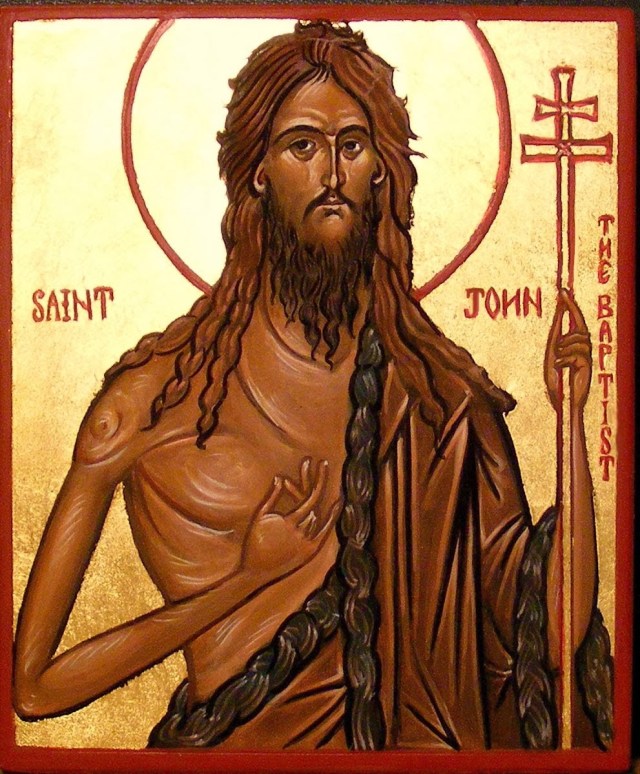
Orthodox icon of John the Baptist

Into this violation of Old Testament marriage laws (the Herod’s were Jewish) came John who made no bones about the fact this was not right (Leviticus 18:16, 20:21). Herodias nursed a grudge against John for speaking out against her and Herod’s choices.

Hell, hath no fury like a woman’s scorn, and when Herodias found an opportunity to get rid of John, she coached her daughter into asking for John the Baptist’s head on a platter. Herod, too insecure to take back his ridiculous promise and look like a fool, consented to the execution of John.

In contrast to all this tragic theater is John the Baptist. John was a messenger of God and a preacher of repentance. As one who was preparing the way for Jesus, his message was simple and to the point: Repent, for the kingdom of God is near.

John got into trouble and lost his life because he spoke truth to power by meddling in the life of King Herod and his family. The Herod’s were the political establishment of the day, and John did not temper his words when dealing with them.

There is a refreshing integrity about John. He was always the same, no matter where he was, and no matter who the people were around him. In contrast to Herod, John was bold, courageous, confident, unafraid, and secure enough in his relationship with God to engage in ministry without thought to the consequences. 

John was unconcerned for what others might think of him, if he proclaimed truth in the public square, and it ended up costing him his life.

John the Baptist Rebuking Herod, by Giovanni Fattori (1825-1908)

The story of John the Baptist’s death speaks about the hostility of this world. And it prefigured and foreshadowed the death of Jesus:

  • Like John, Jesus was executed by the civil authorities.
  • Herod, like Pilate after him, hesitated to execute and was swayed by the crowd.
  • Herodias, like the chief priests toward Jesus, finally got her way through scheming and manipulation.
  • John’s disciples came and took his body and buried it, just like Joseph of Arimathea and Nicodemus did for Jesus.

These stories, on the surface, appear to be only gloom and doom. Yet, there is a message of hope and joy. The absurd is working out itself in deliverance from sin, death, and hell. Through death, Jesus conquered death. We now have no fear of death; its sting has been taken away. Without fear of death, we have no reason to fear life with its troubles and tribulations.

The fork in the road is between the way of John or Herod. It’s a values-based decision. If worth is derived from what we do, what we have, and/or other’s opinion of us, we will likely identify more with Herod and his choices. If there is a preoccupation with hoarding power and control, this is the path of Herod. 

Conversely, if the ultimate value is in knowing Christ crucified and the power of his resurrection, then we identify with John as our spiritual ancestor. If security and worth is derived from being in Christ, then there is boldness to speak truth to power and give grace to the powerless.

Herod saw no further than his immediate needs and safety; he failed to discern his own heart. Because of his spiritual blindness, Herod did not look away from himself and look to God. Faith in Jesus comes when persons look away from themselves and look to Christ who holds the power to free all from spiritual bondage.

Consider the example of John the Baptist. He consistently sought to do the will of God as best as he understood it. Together with all God’s people past and present, we declare that God is with us, the kingdom of God is near, and the love of Christ brings faith and hope.

Almighty God, through your providence John the Baptist was wonderfully born and was sent to prepare the way of your Son, our Savior, by the preaching of repentance. Lead us to repent according to his preaching and, after his example, constantly to speak the truth, boldly to rebuke vice, and patiently to suffer for truth’s sake; through Jesus Christ your Son, our Lord, who is alive and reigns with you, in the unity of the Holy Spirit, one God, now and forever. Amen.