A Divine Appointment (Genesis 29:1-14)

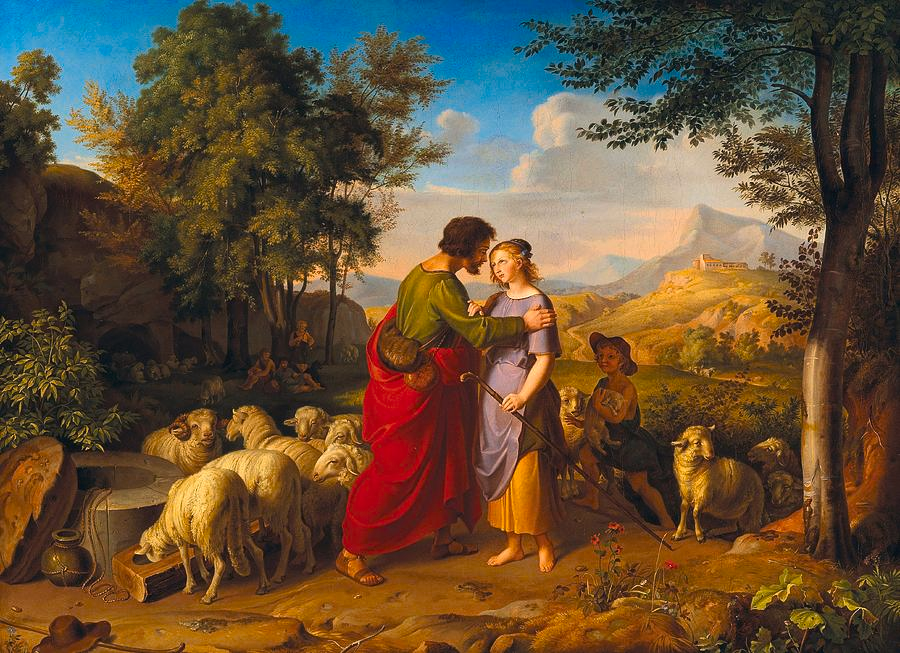
Jacob and Rachel at the well, by Friedrich Wilhelm Müller (Kirchditmold 1801–1889)

Then Jacob continued on his journey and came to the land of the eastern peoples. There he saw a well in the open country, with three flocks of sheep lying near it because the flocks were watered from that well. The stone over the mouth of the well was large. When all the flocks were gathered there, the shepherds would roll the stone away from the well’s mouth and water the sheep. Then they would return the stone to its place over the mouth of the well.

Jacob asked the shepherds, “My brothers, where are you from?”

“We’re from Harran,” they replied.

He said to them, “Do you know Laban, Nahor’s grandson?”

“Yes, we know him,” they answered.

Then Jacob asked them, “Is he well?”

“Yes, he is,” they said, “and here comes his daughter Rachel with the sheep.”

“Look,” he said, “the sun is still high; it is not time for the flocks to be gathered. Water the sheep and take them back to pasture.”

“We can’t,” they replied, “until all the flocks are gathered and the stone has been rolled away from the mouth of the well. Then we will water the sheep.”

While he was still talking with them, Rachel came with her father’s sheep, for she was a shepherd. When Jacob saw Rachel daughter of his uncle Laban, and Laban’s sheep, he went over and rolled the stone away from the mouth of the well and watered his uncle’s sheep. Then Jacob kissed Rachel and began to weep aloud. He had told Rachel that he was a relative of her father and a son of Rebekah. So she ran and told her father.

As soon as Laban heard the news about Jacob, his sister’s son, he hurried to meet him. He embraced him and kissed him and brought him to his home, and there Jacob told him all these things. Then Laban said to him, “You are my own flesh and blood.” (New International Version)

Jacob meets Rachel at the well, by Paolo Fiammingo, c.1585

Jacob was a homebody. Unlike his twin brother Esau, who loved the outdoors and was often away hunting, Jacob preferred to hang around home with his mother – which is probably why Rebekah preferred him over his brother. It’s also why the two of them succeeded in a plan to deceive Isaac and steal the family blessing from Esau.

In Esau’s bitterness over not being blessed by his father, he began laying plans of his own: to kill his brother Jacob in revenge. This came to the attention of Rebekah, who then warned Jacob to flee to her family of origin in Paddan-Aram.

The boy who was attached to his mother and stayed at home, was now a man on the run, in need of a new life. Jacob was alone. One can only imagine the fear and apprehension, the grief and loneliness, of being on his own in a strange place. But God was with him. And the Lord graciously assured Jacob of the divine presence and promises.

Since God was with Jacob and was going to accomplish divine purposes through him, the Lord set up a divine appointment.

Upon arriving at a well, Jacob discovers some shepherds who know his uncle. And then, along comes Rachel with a flock of sheep. God’s providential guidance is evident in leading both Jacob and Rachel to this place and for this time.

Jacob’s mother, Rebekah, was the brother of Laban and the father of Rachel. In the lives of both Rebekah and her son Jacob, Laban ran out to greet and be involved in the divine appointments. (Genesis 24) The narratives differ, however, in that Abraham’s servant had wealth to share in bringing Isaac and Rebekah together; yet Jacob showed up without two pennies to rub together.

And whereas, on both occasions a future bride comes to a well, Rebekah and Rachel differ greatly in their betrothal times. Rebekah’s marriage was quickly arranged; Rachel’s marriage is uncertain and everything is nebulous on how things will shake out with Jacob.

The divine appointment has happened. God’s protection, presence, and guidance are with Jacob. Yet, at this point in the narrative, everything seems up in the air. Will Jacob marry Rachel? Are there going to be numerous descendants? How in the world is Jacob going to return to the land which was promised?

Though this initial foray into the unknown has had a divine stamp on it, Jacob will soon discover that there are many obstacles to negotiate before the promises of God are fulfilled.

And that is the way of us all. Sometimes things come easy and effortless. At other times, it’s a hard slog. In the scope of a life, there are extended seasons of tedious and mundane work – punctuated with times of amazement, even miracle, letting us know there is a God still watching.

You never quite know what’s around the corner of your life – whether good or bad. Yet, the real issue is trust.

The thing about divine appointments is that God is the sovereign ruler of the universe – which means that everything is in the Lord’s hands. All of life, and all events, are providentially bent for divine purposes. Both good and trouble are appointed.

If we believe the Lord is good, right, and just – all the time and that there is never a time when God is bad or capricious – then we are able to accept all circumstances as being from the hand of God. We will trust, even though we don’t know what’s coming next.

The Apostle Paul had it right by saying that “every detail in our lives of love for God is worked into something good.” (Romans 8:28, MSG)

What would your life look like by adopting this perspective God and all events you encounter?

Gracious God, you alone know what my real needs are. You love me more than I myself know how to love. Help me to see my real needs which are hidden from me. I am afraid to ask for either a cross or consolation, so I wait on you; my heart is open to you. Visit me and help me for the sake of your great mercy. Strike me and heal me, cast me down and raise me up, according to your good will. I put all my trust in you. Amen.

The Power of a Blessing (Genesis 27:30-46)

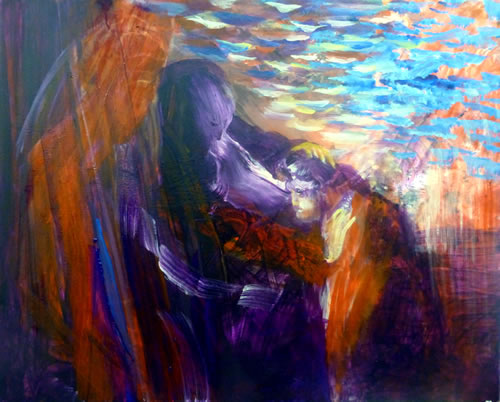
Isaac Blesses Jacob, by Yoram Raanan

After Isaac had finished blessing Jacob, and just as Jacob left his father Isaac, his brother Esau came back from his hunt. He too made some delicious food, brought it to his father, and said, “Let my father sit up and eat from his son’s game so that you may bless me.”

His father Isaac said to him, “Who are you?”

And he said, “I’m your son, your oldest son, Esau.”

Isaac was so shocked that he trembled violently. He said, “Who was the hunter just here with game? He brought me food, and I ate all of it before you came. I blessed him, and he will stay blessed!”

When Esau heard what his father said, he let out a loud agonizing cry and wept bitterly. He said to his father, “Bless me! Me too, my father!”

Isaac said, “Your brother has already come deceitfully and has taken your blessing.”

Esau said, “Isn’t this why he’s called Jacob? He’s taken me twice now: he took my birthright, and now he’s taken my blessing.” He continued, “Haven’t you saved a blessing for me?”

Isaac replied to Esau, “I’ve already made him more powerful than you, and I’ve made all of his brothers his servants. I’ve made him strong with grain and wine. What can I do for you, my son?”

Esau said to his father, “Do you really have only one blessing, Father? Bless me too, my father!” And Esau wept loudly.

His father Isaac responded and said to him,

“Now, you will make a home
    far away from the olive groves of the earth,
        far away from the showers of the sky above.
You will live by your sword;
        you will serve your brother.
But when you grow restless,
        you will tear away his harness
        from your neck.”

Esau was furious at Jacob because his father had blessed him, and Esau said to himself, When the period of mourning for the death of my father is over, I will kill my brother.

Rebekah was told what her older son Esau was planning, so she summoned her younger son Jacob and said to him, “Esau your brother is planning revenge. He plans to kill you. So now, my son, listen to me: Get up and escape to my brother Laban in Haran. Live with him for a short while until your brother’s rage subsides, until your brother’s anger at you goes away and he forgets what you did to him. Then I will send for you and bring you back from there. Why should I suffer the loss of both of you on one day?”

Rebekah then said to Isaac, “I really loathe these Hittite women. If Jacob marries one of the Hittite women, like the women of this land, why should I go on living?” (Common English Bible)

Jacob and Esau

The twins Esau and Jacob are the very definition of sibling rivalry. Even at their birth, they jostled and positioned for their entry into the world. Although brothers, they were different from one another in every way. As their aged father, Isaac, was near the end of his days, he was looking to pass on a family blessing to Esau, the firstborn. And that’s where things got dicey.

Jacob, always the trickster, was still playing out the rivalry. When his brother Esau was out hunting and preparing to receive his father’s blessing, Jacob posed as his brother and deceitfully gained the blessing of Isaac.

Both Isaac and Esau were shocked to discover what happened. Esau’s response was one of grief, disappointment, bitterness, with tears and weeping. Despite Esau not being known for his sensitivity to God or family before this event, we can certainly feel his cry: “Do you have only one blessing, my father? Bless me too, my father!”

The Blessing

As a Pastor and a Chaplain who works with a variety of people, I have heard many times over the lament of individuals without a blessing from their father. As people created in the image and likeness of God, we were meant to be blessed – to have a loving and enduring stamp of approval from both our heavenly Father and our earthly fathers.

And when an earthly father, or father figure, either cannot or will not extend a vital blessing to children, it is a terrible wound – like an invisible open putrid abscess which continually leaves the person emotionally and spiritually sick.

Blessing is needed. Without blessing we flounder in the world, struggling to see hope, wondering if we are loved, and lacking confidence in our faith. To be blessed is to receive a beautiful gift.

The term “blessing” in Scripture is a powerful communication of God’s presence and approval.

So, when humans bless one another, we offer commitments of love and connection. We provide powerful words of encouragement and picture a special future for those we are close to.

None of this is optional. To bless others is the way of building up one another and fortifying each other for the rigors of this world. When blessing is withheld, and even worse, when it is replaced with cursing, then individuals are left untethered, bereft of support to face stressful situations. Like a ship adrift without any power or wind, so the person trying to live in this world without blessing is dead in the water.

Jesus Blesses

Where there is no blessing, like Esau, revenge fills our hearts. But Jesus clearly understood the need and the power of blessing, and he was not deterred in deliberately offering it:

People were bringing little children to Jesus for him to place his hands on them, but the disciples rebuked them. When Jesus saw this, he was indignant. He said to them, “Let the little children come to me, and do not hinder them, for the kingdom of God belongs to such as these. Truly I tell you, anyone who will not receive the kingdom of God like a little child will never enter it.” And he took the children in his arms, placed his hands on them and blessed them. (Mark 10:13-16, NIV)

I wonder how this simple encounter affected the lives of those children on that day in which Jesus blessed them. I am curious in what ways they grew-up and how Christ’s blessing shaped their lives. Because that is what blessing does: it forms us into the kind of people we were meant to be.

So, receive today this blessing from Holy Scripture:

The Lord bless you and keep you;
the Lord make his face to shine upon you, and be gracious to you;
the Lord lift up his countenance upon you, and give you peace. Amen. (Numbers 6:24-26)

The Struggle Within (Romans 7:15-25)

I do not understand what I do. For what I want to do I do not do, but what I hate I do. And if I do what I do not want to do, I agree that the law is good. As it is, it is no longer I myself who do it, but it is sin living in me. For I know that good itself does not dwell in me, that is, in my sinful nature. For I have the desire to do what is good, but I cannot carry it out. For I do not do the good I want to do, but the evil I do not want to do—this I keep on doing. Now if I do what I do not want to do, it is no longer I who do it, but it is sin living in me that does it.

So I find this law at work: Although I want to do good, evil is right there with me. For in my inner being I delight in God’s law; but I see another law at work in me, waging war against the law of my mind and making me a prisoner of the law of sin at work within me. What a wretched man I am! Who will rescue me from this body that is subject to death? Thanks be to God, who delivers me through Jesus Christ our Lord! So then, I myself in my mind am a slave to God’s law, but in my sinful nature a slave to the law of sin. (New International Version)

We can relate to the Apostle Paul. We, along with him, have said to ourselves many times, “I don’t understand why I act the way I do. I don’t do what I know is right. I do the things I hate.” 

Paul’s experience of uneasiness, his existential angst because of the struggle within, is a timeless description of our common human condition. There are times we seem completely unable to follow our conscience and do what’s right. It can be maddening, even to the point of experiencing a continual low-level discouragement or depression which underlies almost everything we do.

The prescription for dealing with this mental, emotional, and spiritual malady does not include the law. That’s right. Putting our willpower and effort into obeying commands gets us nowhere. Even if we obey laws and rules and commands for a time, our efforts eventually break down. We fail to do what we want, and end up doing just the opposite.

In all fairness, the law is good, not bad; it just doesn’t have the capacity to transform us. The law’s purpose is to show us how bad off we really are in this world, to give us an awareness of our true condition, so that we will seek help. 

We humans are a bundle of contradictions, doing good, then bad, and flip-flopping back and forth – all with great frustration. In such a miserable condition, what then shall we do? Who will help us? Is there anyone to save us from our plight?

Sheer willpower and obedience will not help us; it won’t work. It will only give us a false hope. Any success in using willpower only deludes one into believing they have the answer… until they yet fall again into the pit of their own inner darkness. But the good news is that there is a Savior, a Redeemer, a Rescuer who has the will and the power to deliver us from our predicament.

The grace of God in Christ is the operative power that changes lives, not the law. Freedom from the tyranny of our “should’s” and our misplaced desires comes from Christ’s forgiveness through the cross. 

Like a lover enamored with his beloved, our desires become oriented toward Jesus for his indescribable gift to us. That is the strength of grace. Transformation is relational; it is found in a person, not a program. And the only person and relationship which has the ability to change us is, I believe with all my heart and mind, the Lord Jesus Christ.

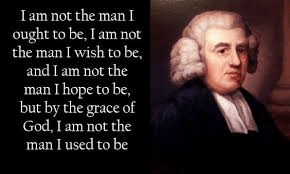
Why? Because I myself have been transformed and changed by such a relationship with Christ. I, along with the hymn writer John Newton, can say, “I once was lost but now am found, was blind but now I see.”

“Self-help” for all the good it really can do, is in many ways an oxymoron. We need a Savior to help us, and we need a community of people who encourage us. And even if we can do it ourselves today, that may not (and eventually will not) be true of us tomorrow. None of you got this far in life on your own – and you will continue to need God and others going forward.

Love must be completely sincere. Hate what is evil, hold on to what is good.Love one another warmly as Christians, and be eager to show respect for one another. Work hard and do not be lazy. Serve the Lord with a heart full of devotion. Let your hope keep you joyful, be patient in your troubles, and pray at all times. Share your belongings with your needy fellow Christians, and open your homes to strangers. (Romans 12:9-13, GNT)

We have an incredible capacity for good and vast internal resources within us. And yet, we too often lack awareness of this reality, for which we can tap into. When it comes to an outright metamorphosis, we need a new heart – and we can no more simply decide to change our lives any more than we can perform heart transplant surgery on ourselves.

People need the Lord.

Whenever the foundation of a house is about to crumble, it won’t do to rearrange the living room furniture and do a bit of spruce up painting. We deceive ourselves if we believe that all our efforts at landscaping the property and having a great curb appeal will do the trick. If the foundation crumbles, and the house implodes, all efforts at curb appeal won’t matter.

Jesus is our cornerstone. Without him, we are at risk, about to fall and without hope. With him, true restoration and renewal happens. And then, when the house is repaired and in order, we set about the task of being good stewards and maintaining and caring for the wonderful changes which were made.

Freedom from a dilapidated soul and misplaced energies to consistent times of peace and contentment, calmness and confidence, satisfaction and settled peace, comes by growing ever closer to the Savior who exudes all those qualities, and more. For the Lord not only saves and delivers; he also sanctifies and encourages.

In Christ, the uneasiness and unsettling experience – the existential angst – becomes a thing of the past because of the grace of merciful deliverance and continual help.

Saving God, I thank you for delivering me from sin, death, and hell through your Son, the Lord Jesus. May your Holy Spirit apply the work of grace to my life every day so that I can realize practical freedom from all that is damaging and destructive in my soul. Amen.

The Vision of Jesus (Luke 10:21-24)

Cristo de la Concordia (Christ of Peace) in Cochabamba, Bolivia

At that time Jesus was filled with joy by the Holy Spirit and said, “Father, Lord of heaven and earth! I thank you because you have shown to the unlearned what you have hidden from the wise and learned. Yes, Father, this was how you were pleased to have it happen.

“My Father has given me all things. No one knows who the Son is except the Father, and no one knows who the Father is except the Son and those to whom the Son chooses to reveal him.”

Then Jesus turned to the disciples and said to them privately, “How fortunate you are to see the things you see! I tell you that many prophets and kings wanted to see what you see, but they could not, and to hear what you hear, but they did not.” (Good News Translation)

A healthy view of Holy Scripture is to see it as an unfolding drama of redemption. Ever since the fall of humanity, God has been on a rescue mission to reclaim, redeem, and restore people. This human project has obviously taken several millennia; and, it still has not reached its fulfillment.

The Christian tradition understands that the climax of victory and final restoration to our true state as humans will occur when Christ returns. By warning us that divine mysteries are hidden to some, and revealed to others, is Christ’s way of cautioning us toward triumphalism and self-congratulation.

Redemption is a reality; and, it’s also not a reality. It is both. Redemption is here; and it’s also coming. We are delivered from sin, death, and hell – and we still labor against the evil machinations of systemic world problems, our own sinful nature, and a demonic realm which is looking for every opportunity to exploit sin’s residue upon the earth.

This all means, on a practical level, that the good old days for some were the bad old days for others. History is always written by the winners and those in power. The hidden voices are typically squelched.

The vision of Jesus is that all kinds of people, not just a certain segment of winners, should enjoy God’s favor.

There were ancient people who longed for spiritual and physical freedom. They looked forward into history and had the hope of Messiah and God’s promises being fulfilled. History is still unfolding. There are people who yet remain locked in personal bondage; large swaths of humanity still experience oppression and a longing to enjoy the blessings which others possess and take for granted.

It is vital that we hold together both the blessings of realized freedom, along with the limits of others’ freedom. This realization helps us continue to actively work for all people, and keep praying that God’s kingdom come, and God’s will be done, here on earth, as it is always done in heaven.

I lift a voice from history which exemplifies the struggle of the black experience in the United States. The following is a small portion from a speech by the ex-slave Frederick Douglass, orated on July 4, 1852, nine years before civil war, with President Millard Fillmore and many congressional politicians in attendance:

“The feeling of the nation must be quickened; the conscience of the nation must be roused; the propriety of the nation must be startled; the hypocrisy of the nation must be exposed; and its crimes against God and man must be proclaimed and denounced. What, to the American slave, is your 4th of July? I answer: a day that reveals to him, more than all other days in the year, the gross injustice and cruelty to which he is the constant victim. To him, your celebration is a sham; your boasted liberty, an unholy license; your national greatness, swelling vanity; your sounds of rejoicing are empty and heartless; your denunciations of tyrants, brass fronted impudence; your shouts of liberty and equality, hollow mockery; your prayers and hymns, your sermons and thanksgivings, with all your religious parade, and solemnity, are, to him, mere bombast, fraud, deception, impiety, and hypocrisy — a thin veil to cover up crimes which would disgrace a nation of savages. There is not a nation on the earth guilty of practices more shocking and bloodier than are the people of these United States, at this very hour.”

Frederick Douglass

Because history is forever unfolding, freedom and blessing develop over time and come more powerfully to some than others. True spiritual discernment, with the awareness to labor on behalf of the common good, does not ultimately come through astute observation and superior intellect; it comes by divine revelation.

God both conceals and reveals according to divine purposes and not human agendas.

Christian spirituality cannot be reduced to praying a sinner’s prayer, and then maintaining a holding pattern on earth until heaven. Rather, Jesus remains present in this world through the person of the Holy Spirit, and is continually interceding on behalf of those who need freedom and blessing.

As Christ’s Body, Christians are to be the hands and feet of Jesus, animated by the Spirit to bring God’s ethical and benevolent regime to those who need it most. If we are blessed, we are to pass blessing onto others without prejudice. For the kingdom of God belongs to the poor in spirit.

Dear God, Creator of the universe and all that inhabit it, we come as your Church, and as individuals, in humble submission to your word and your way.

God, you are the Alpha and Omega, The Almighty Judge and The Forgiver of All Sins, so we come with humility and contrition on behalf of generations past, present and those yet unborn. We ask that you forgive us and create in us a new spirit.

Bind our hearts and send forth the healing power that you and you alone can give to us and this sin-sick world. Bring us into reconciliation with one another and restore us to your righteous and holy path. Amen.