Dealing with Spiritual Blindness (John 9:1-41)

Coptic Church depiction of Jesus healing the man born blind

As he went along, he saw a man blind from birth. His disciples asked him, “Rabbi, who sinned, this man or his parents, that he was born blind?”

“Neither this man nor his parents sinned,” said Jesus, “but this happened so that the works of God might be displayed in him. As long as it is day, we must do the works of him who sent me. Night is coming when no one can work. While I am in the world, I am the light of the world.”

After saying this, he spit on the ground, made some mud with the saliva, and put it on the man’s eyes. “Go,” he told him, “wash in the Pool of Siloam” (this word means “Sent”). So the man went and washed, and came home seeing.

His neighbors and those who had formerly seen him begging asked, “Isn’t this the same man who used to sit and beg?” Some claimed that he was.

Others said, “No, he only looks like him.”

But he himself insisted, “I am the man.”

“How then were your eyes opened?” they asked.

He replied, “The man they call Jesus made some mud and put it on my eyes. He told me to go to Siloam and wash. So I went and washed, and then I could see.”

“Where is this man?” they asked him.

“I don’t know,” he said.

They brought to the Pharisees the man who had been blind. Now the day on which Jesus had made the mud and opened the man’s eyes was a Sabbath. Therefore the Pharisees also asked him how he had received his sight. “He put mud on my eyes,” the man replied, “and I washed, and now I see.”

Some of the Pharisees said, “This man is not from God, for he does not keep the Sabbath.”

But others asked, “How can a sinner perform such signs?” So they were divided.

Then they turned again to the blind man, “What have you to say about him? It was your eyes he opened.”

The man replied, “He is a prophet.”

They still did not believe that he had been blind and had received his sight until they sent for the man’s parents. “Is this your son?” they asked. “Is this the one you say was born blind? How is it that now he can see?”

“We know he is our son,” the parents answered, “and we know he was born blind. But how he can see now, or who opened his eyes, we don’t know. Ask him. He is of age; he will speak for himself.” His parents said this because they were afraid of the Jewish leaders, who already had decided that anyone who acknowledged that Jesus was the Messiah would be put out of the synagogue. That was why his parents said, “He is of age; ask him.”

A second time they summoned the man who had been blind. “Give glory to God by telling the truth,” they said. “We know this man is a sinner.”

He replied, “Whether he is a sinner or not, I don’t know. One thing I do know. I was blind but now I see!”

Then they asked him, “What did he do to you? How did he open your eyes?”

He answered, “I have told you already and you did not listen. Why do you want to hear it again? Do you want to become his disciples too?”

Then they hurled insults at him and said, “You are this fellow’s disciple! We are disciples of Moses! We know that God spoke to Moses, but as for this fellow, we don’t even know where he comes from.”

The man answered, “Now that is remarkable! You don’t know where he comes from, yet he opened my eyes. We know that God does not listen to sinners. He listens to the godly person who does his will. Nobody has ever heard of opening the eyes of a man born blind. If this man were not from God, he could do nothing.”

To this they replied, “You were steeped in sin at birth; how dare you lecture us!” And they threw him out.

Jesus heard that they had thrown him out, and when he found him, he said, “Do you believe in the Son of Man?”

“Who is he, sir?” the man asked. “Tell me so that I may believe in him.”

Jesus said, “You have now seen him; in fact, he is the one speaking with you.”

Then the man said, “Lord, I believe,” and he worshiped him.

Jesus said] “For judgment I have come into this world, so that the blind will see and those who see will become blind.”

Some Pharisees, who were with him, heard him say this and asked, “What? Are we blind too?”

Jesus said, “If you were blind, you would not be guilty of sin; but now that you claim you can see, your guilt remains. (New International Version)
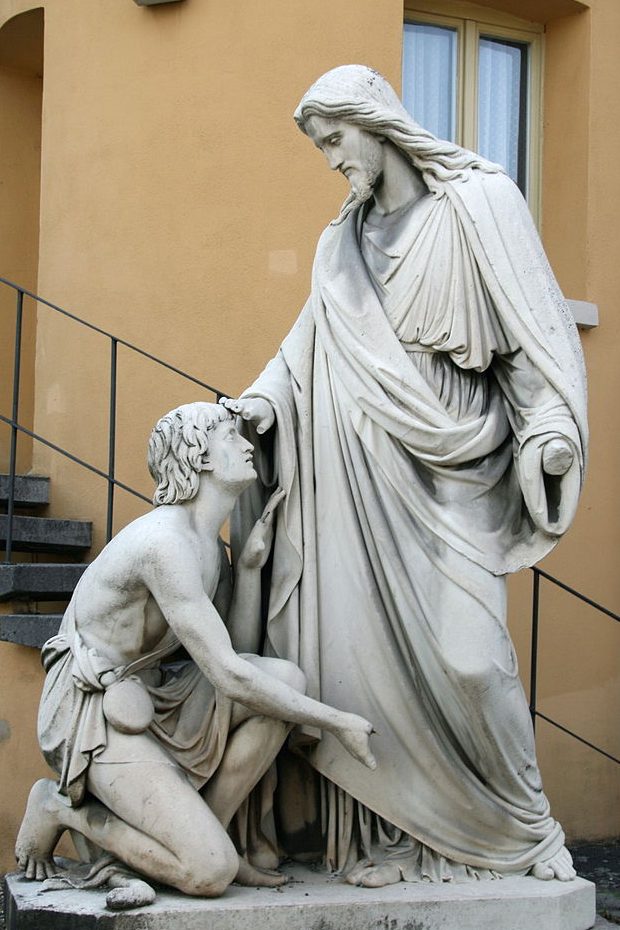
Jesus healing blind Bartimaeus by Johann Heinrich Stöver, 1861. St John’s Church, Hesse, Germany

Assuming Blindness

Behind everything we believe and talk about, there are pre-suppositions or assumptions. The disciples had an assumption about blindness: its sin – not just a result of living in a fallen world, but personal sin. That is, an individual sinner whom we can point the finger to. The disciples demonstrated they were just as blind as the physically blind man.

Jesus had a clear and concise response to that assumption: nobody is at fault here, nobody. Which, to me, begs the question:

Have you considered that your thoughts are subjective, not objective?

Too many people treat their thoughts, ideas, and beliefs as if they were pure gospel truth (which is probably why they feel justified in assuming they are always right and are arbiters of truth!). Reality check: You, nor I, have the corner on truth. Jesus is the truth, not anybody else.

Healing Blindness

Since Jesus is the way, the truth, and the life, he has the power and authority to heal, making the blind to see. Sin wasn’t the issue; the true issue was an opportunity to showcase the gracious work of God. So, Jesus healed the man’s eyes so that he could see again. Healing is not a one-size-fits-all, which is why Jesus did something unique with the blind man, and then gave specific instructions on what to do.

Therefore, we must not assume that we know how a healing is supposed to happen. There’s no codifying a particular process or prayer in order to leverage God into performing one.

Investigating Blindness

The religious leaders always seem to have a problem about something. They, like the disciples, assumed sin was at the core of the man’s blindness. The leaders were befuddled that a sinner like Jesus (who doesn’t keep the Sabbath properly) could ever heal another sinner (a blind man). That’s a conundrum they couldn’t live with, and so, the questions kept getting heaped on the poor guy who was healed.

The religious leaders were trying to make sense out of what they thought was a nonsensical situation. It’s only nonsensical to them because they didn’t have any good sense to begin with. Their interaction with the healed man, and then with Jesus, only demonstrated their profound lack of awareness resulting in spiritual blindness.

Remaining in Blindness 

Many of the religious leaders, heretics in the early church, and spiritual phonies of today are not deliberately trying to deceive or lead others astray; they think they are doing the right thing when they are actually not. 

An eye-opening reality I discovered when I first studied church history is that the early heresies, condemned at church councils, were doctrines promoted by men who were not evil – they were just sincerely misguided. The heretics believed they were helping the church better understand the nature of God and Christ. However, they were unaware and blind to the actual nature of their teachings. 

Back when I wrote my master’s thesis in nineteenth century American Religious History, I read hundreds of sermons from southern preachers before the American Civil War. They had a “biblical” defense of Black chattel slavery. Many of them were influential pastors of large churches who led many people to Christ, that is, white people. Yet, at the same time, they were blind to how they slammed the door of God’s kingdom in the faces of Black folk, were complicit in slaveholder abuse, and fueled antagonisms between North and South.

Churches and Christians may be unaware and blind to how they keep people out of God’s kingdom by saying God’s grace is for all, and then avoid certain people; by having explicit written statements or rules that exclude people from service; or by binding people to human traditions and practices instead of Holy Scripture.

Our Eyes

“The eye is the lamp of the body. If your eyes are healthy, your whole body will be full of light. But if your eyes are unhealthy, your whole body will be full of darkness. If then the light within you is darkness, how great is that darkness! (Matthew 6:22-23, NIV)

In the ancient world, the eye represented what you fixed your gaze on, or what your focus was. In our culture, we could replace the word “eye” with the word “goal.” The word “body” represents the entirety of one’s life.  So, we might interpret Christ’s words in this way: 

A goal is the focus of a life. If your goals are good, your whole life will be full of proper focus. But if your goals are bad, your whole life will be full of blindness. If then, the focus within you is only really blindness, how great is that darkness!

If goals and dreams are toward earthly treasure, one will blindly move in that direction and have misplaced values. Today’s Gospel story portrays the need to be self-aware as individual Christians and as a church. We can choose to:

  1. Be open to new information
  2. Entertain the notion that you might be wrong
  3. Embrace a full range of knowing (head, heart, and gut)
  4. Allow the light of Christ to shine on every person and each situation
  5. Stick to your experience of others and events
  6. Consider how your words and actions affect others
  7. Keep accountable to others and ask for feedback

Monitoring ourselves and our own emotional landscape will help us to become aware of what’s happening inside us. And then, in turn, having our eyes opened enables us to truly see others and be aware of their needs.


The Word Is Life and Light (John 1:1-9)

In the beginning was the Word
    and the Word was with God
    and the Word was God.
The Word was with God in the beginning.
Everything came into being through the Word,
    and without the Word
    nothing came into being.
What came into being
    through the Word was life,
    and the life was the light for all people.

The light shines in the darkness,
    and the darkness doesn’t extinguish the light.

A man named John was sent from God. He came as a witness to testify concerning the light, so that through him everyone would believe in the light. He himself wasn’t the light, but his mission was to testify concerning the light.

The true light that shines on all people
    was coming into the world. (Common English Bible)

Jesus lives here. And that’s because he chose to – so that we might have an abundant life out in the bright sunshine of grace.

The Word has always been and always will be. The Word decided to show up on this earth in an unexpected way, to bring light, illumination, and awareness to a dark world and the shadowy places of our hearts.

Frankly, my friends, Jesus abides with your every dream about life and happiness, hope and fulfillment, purpose and direction, emotional healing and wholeness. Christ is for you, to experience a thriving and flourishing daily life. And what’s more:

To live the Christian life, to center your entire life totally and completely around the person and work of Jesus Christ, is an act of rebellion against all that is dark, unjust, and broken in this world.

Jonathan Edwards, one of the greatest intellects in American history, was a pastor, theologian, and scholar. He insisted that the hope of humanity lies with turning to and dwelling with Jesus:

“Conversion to Jesus Christ is a great and glorious work of God’s power, at once changing the heart, and infusing life into the dead soul…. Jesus Christ is the highest good of the reasonable creature. The enjoyment of him is our proper focus; and is the only happiness with which our souls can be satisfied.”

Jonathan Edwards

St. Augustine lived centuries ago. A big chunk of his life was apart from Christianity. He knew what it felt like to be without Jesus. Yet, after his conversion, life with Jesus was so compelling for Augustine, that his vigorous intellect and spiritual devotion were put to work, leaving an enormous footprint that can be found even today, in both the church and the academy.

Reflecting upon his life, and all he had experienced and accomplished, Augustine uttered this simple prayer to God:

“You have made us for yourself, Lord Jesus, and our hearts are restless until they rest in you.”

St. Augustine

Arguably, Christianity’s greatest convert was the Apostle Paul. Once a vehement opponent to Christ and Christ’s followers, Paul had a dramatic encounter that left him completely undone. He gave his life to Jesus and became Christianity’s most influential missionary. Here is a smattering of his thoughts on Jesus:

Though he [Christ] was in the form of God,
        he did not consider being equal with God something to exploit.
But he emptied himself
        by taking the form of a slave
        and by becoming like human beings.
When he found himself in the form of a human,
        he humbled himself by becoming obedient to the point of death,
        even death on a cross. (Philippians 2:6-8, CEB)

His glorious power will make you patient and strong enough to endure anything, and you will be truly happy… For God has rescued us from the dark power of Satan and brought us into the kingdom of his dear Son, who forgives our sins and sets us free. (Colossians 1:11, 13, CEV)

Nothing is as wonderful as knowing Christ Jesus my Lord… God accepted me simply because of my faith in Christ. (Philippians 3:8-9, CEV)

We find ourselves standing where we always hoped we might stand—out in the wide open spaces of God’s grace and glory, standing tall and shouting our praise… Christ arrives right on time to make this happen. He didn’t, and doesn’t, wait for us to get ready. He presented himself for this sacrificial death when we were far too weak and rebellious to do anything to get ourselves ready. (Romans 5:2, 6, MSG)

Jesus is the One who fills our hearts with love, delivers our wayward souls from emptiness, and sets our feet on the solid rock of faith and hope in God. The love of God is found in Jesus. And Jesus so closely identifies with us, that we enjoy God’s peace and healing in our lives. Not just personal transformation, but systemic change in institutions and corporations, families and neighborhoods, is possible in Christ. 

To live for Jesus is an act of subversion against all that is evil, dark, and unjust. Imagine a world where love rules, not hate; where creativity and faith abound, and are not squelched; and, hope, not hurt, fuels progress into a bright future. It is a world where the light of Jesus brings life.

“I am the light for the world! Follow me, and you won’t be walking in the dark. You will have the light that gives life.”

Jesus (John 8:12, CEV)

The God who said, “Out of darkness the light shall shine!” is the same God who made his light shine in our hearts, to bring us the knowledge of God’s glory shining in the face of Christ. (2 Corinthians 4:6, GNT)

I am grateful that God so loved the world, loved me and loved you, that he gave his one and only Son – the Sun of Righteousness for our benefit so that we might have life.

Praise God from whom all blessings flow
Praise Him, all creatures here below
Praise Him above, ye heavenly host
Praise Father, Son, and Holy Ghost. Amen.

Obedience is Better than Sacrifice (1 Samuel 15:22-31)

“Tell me,” Samuel said. “Does the Lord really want sacrifices and offerings? No! He doesn’t want your sacrifices. He wants you to obey him. Rebelling against God or disobeying him because you are proud is just as bad as worshiping idols or asking them for advice. You refused to do what God told you, so God has decided that you can no longer be king.”

“I have sinned,” Saul admitted. “I disobeyed both you and the Lord. I was afraid of the army, and I listened to them instead. Please forgive me and come back with me so I can worship the Lord.”

“No!” Samuel replied, “You disobeyed the Lord, and I won’t go back with you. Now the Lord has said that you can’t be king of Israel any longer.”

As Samuel turned to go, Saul grabbed the edge of Samuel’s robe. It tore! Samuel said, “The Lord has torn the kingdom of Israel away from you today, and he will give it to someone who is better than you. Besides, the eternal God of Israel isn’t a human being. He doesn’t tell lies or change his mind.”

Saul said, “I did sin, but please honor me in front of the leaders of the army and the people of Israel. Come back with me, so I can worship the Lord your God.”

Samuel followed Saul back, and Saul worshiped the Lord. (Contemporary English Version)

God had given Saul explicit instructions on how to handle a group of people called the Amalekites (the first nation to attack the Jewish people after the Exodus from Egypt, and viewed as the archetypal enemy of the Jews). Saul obeyed only some of the instructions, but not all of them.

King Saul rationalized his behavior as worship. But God would have none of it. The Lord rejected Saul as king. God wants no monkey business when it comes to obedience. (1 Samuel 15:1-21)

Whenever I come across biblical characters like Saul, I find myself trying to distance from them. Yet, oftentimes, when I take the time to sit a bit with the Scriptures, I realize I can have some of the same propensities as their behavior. In today’s Old Testament lesson, I am like Saul whenever:

  • I say I will do something and then get busy and not do it. I sometimes rationalize my lack of follow through by explaining what good things I was doing with my time instead.
  • I justify a purchase of something I do not really need, but want, with the excuse that I am generous with my money.
  • I slander another person, even though its forbidden by God, with the knucklehead notion that I am protecting and helping others from that person’s evil ways.
  • I keep quiet in the face of a bad situation when I should be speaking up. I dismiss the lack of engagement and involvement with needing to save my energy for people who want it….

I could keep going with this little exercise, but I’m too convicted to keep thinking about it anymore. So, before we get too uppity about saying we are not like Saul and would never be like him, perhaps we ought to sit with the story for a while, being mindful and aware of any unacknowledged disobedience.

Rationalization is the way of sinners.  Repentance is the path of saints.  Which road will you choose today?

Unfortunately, as the story of Saul’s life unfolds, we discover that the encounter with Samuel becomes a typical pattern of behavior in which Saul:

  1. Disobeys or ignores God’s commands
  2. Rationalizes his bad behavior by putting a spiritual spin on it
  3. Is confronted with his sin
  4. “Repents” with crocodile tears
  5. Then goes back to his old ways of doing whatever the heck he wants

It seems that whenever Saul feels threatened, or anxious, or jealous, or stressed, he crumbles into a heap of fear and ends up making boneheaded decisions, hurting people, or becoming complicit in somebody else’s sin.

Don’t be like Saul.

Instead, get to the root of the trouble by addressing your own anxiety.

Focus on What Is Within Your Control

We cannot control other people. Many circumstances are also outside our control. However, we are always in control of ourselves. Learn good self-care, focus on helpful attitudes, and use the adversity before you to strengthen your faith.

The Serenity Prayer is a good reminder in those times when we feel out of control:

God, grant me the serenity to accept the things I cannot change,

The courage to change the things I can,

And the wisdom to know the difference.

Promote a Positive Mindset

Positive attitudes help us widen our perspective on things – and with a broader view of things comes more awareness of choices. Making spiritually and emotionally healthy choices for ourselves builds resilience and fortifies us for difficult situations down the road, without succumbing to old unhealthy coping mechanisms.

Be Humble

False humility looks a lot like what Saul did. But true humility isn’t about trying to save face or suck up to others. It’s about the willingness to ask for what you need and want without manipulation, to serve others without making sure everyone notices. Humility relates to, and empathizes with, others and doesn’t go out of the way to distance from folks on the lower end of society. And humility is always willing to accept the consequences of decisions and actions.

Rationalizing disobedience never ends well, especially with a God who holds everyone accountable for their words and behaviors. So, let’s all do ourselves a favor, and seek the good, the right, and the just with a spirit of meekness.

Holy God, you expect obedience to clear instructions. I am sorry for all those times I found creative ways to circumvent your teaching. Help me not to avoid your good commands, but to own them with vigor and vitality through Jesus Christ my Lord in the power of your Holy Spirit. Amen.

New Rules for a New Society (Ephesians 4:25-32)

We are part of the same body. Stop lying and start telling each other the truth. Don’t get so angry that you sin. Don’t go to bed angry and don’t give the devil a chance.

If you are a thief, quit stealing. Be honest and work hard, so you will have something to give to people in need.

Stop all your dirty talk. Say the right thing at the right time and help others by what you say.

Don’t make God’s Spirit sad. The Spirit makes you sure that someday you will be free from your sins.

Stop being bitter and angry and mad at others. Don’t yell at one another or curse each other or ever be rude. Instead, be kind and merciful, and forgive others, just as God forgave you because of Christ. (Contemporary English Version)

New life means being a part of a new society; and a new society means new rules to live by which benefit and uplift the entire community. Old destructive practices must be replaced with new encouraging and supportive ways of being together. Stop taking the broad easy road to destruction and start walking the hard path to life and contentment.

Stop Lying and Start Telling the Truth

Lying exists because people believe that being truthful and transparent is too traumatic. Many people don’t think that being open, honest, real, vulnerable, and genuine is worth the risk. They have believed the lie that they won’t be accepted, that they’ll lose face with others, or that people will just gossip about me if they really knew about me. So, we hide from others and avoid the truth.

In truth, we are responsible for one another – to make and keep promises to each other because that is what God does with us. Churches that love truth will make a safe place for the awkwardness of confession, forgiveness, and healing.

Truthful communities are places of hospitality where we are safe to be real. No one ought to ever suffer in silence, cry alone, or wonder whether others will forsake them. We belong to one another. Therefore, to have union with Christ is to have union with one another; you can’t have one without the other.

Stop Stealing and Start Giving

Theft comes in many forms, especially in our contemporary age. Embezzlement, shoplifting, fraud, plagiarism, and robbery are just a few examples of the ways in which we humans steal from one another.

Embezzlement is the theft of assets (money or property) by a person who has been trusted to keep those assets safe. Instead of embezzling funds, we are to steward those assets well, distributing them with care and a conscience – using them for the benefit of others, not simply ourselves.

Shoplifting involves stealing goods from retail establishments. Some people steal because they are in dire need. Many more steal because they can and want to. We must stop taking things we want, and learn to be satisfied with what we have. And we will only do this by using our own money to buy things for others who are in need.

Fraud is stealing that involves convincing the victim to surrender their money or property under false pretenses. This is nothing more than manipulating someone to get what you want. Work hard to defend the defenseless and ensure their justice, rather than commit a gross injustice against them.

Plagiarism is the practice of taking someone else’s work or ideas and passing them off as one’s own. It’s cheap. It’s easy. And don’t do it, period. Someone else worked very hard to create what you may nonchalantly use for your quick benefit. Take the pains to credit someone else’s work and document the sources you use.

Robbery is a theft that involves using violence, intimidation, or threats to obtain property. Put the threats, guns, and false confidence away. In it’s place, do whatever it takes to do things right, hold a job, and give something back to society.

Stop All the Unhelpful Talk and Start Encouraging

Corrupt or dirty talk is totally unnecessary. It’s unwholesome and benefits nobody. Rather, make it your aim to use your words for good by encouraging others.

Encouragement involves strongly urging someone to do something with an equal commitment to lovingly come alongside and help. This requires both verbal exhortations and tangible assistance. Encouragement is the glue which holds a people together. Without it, a society degenerates into watching-out-for-number-one, and destructive personal survival tactics which will say anything to get what one wants.

Stop the Bitterness and Start Forgiving

Forgiveness is choosing not to hold another’s persons offensive words or actions over their head. It is:

  • Specific to an event, action, or words.
  • A process: it takes time to truly forgive.
  • Something anybody can do, regardless of race, creed, religion, etc.
  • Hard.
  • Freeing.
  • Ongoing.
  • Gracious.

“To forgive is to set a prisoner free and discover that the prisoner was you.”

Lewis Smedes, Forgive and Forget: Healing the Hurts We Don’t Deserve

Bitterness, however, wants to hold onto a grudge and seeks to punish the one who has offended them. That’s the way of Satan, not God. Even if the person has set themselves up as your enemy, we have clear exhortations from Jesus to love our enemies and do good to them, not harm. (Matthew 5:43-48)

The world revolves on the axis of mercy, not judgment. The sooner we get in the groove of how things actually operate for us to live a good life, the better that our relationships and society will be.

Good and gracious God, we ask that you make our life journey safe as we choose integrity, not disintegration. Shed light on those who follow crooked paths. May their dishonesty be exposed so that corrections can be made before further damage occurs. Help our nations, neighborhoods, and faith communities choose a path of mercy and goodness, rather than the crooked way of lies, theft, vitriol, and grudge-bearing. May we see a new wave of integrity sweeping over our world, through Jesus Christ our Lord, by the power of your Holy Spirit. Amen.