Pride Comes Before the Fall (Luke 22:31-33, 54-62)

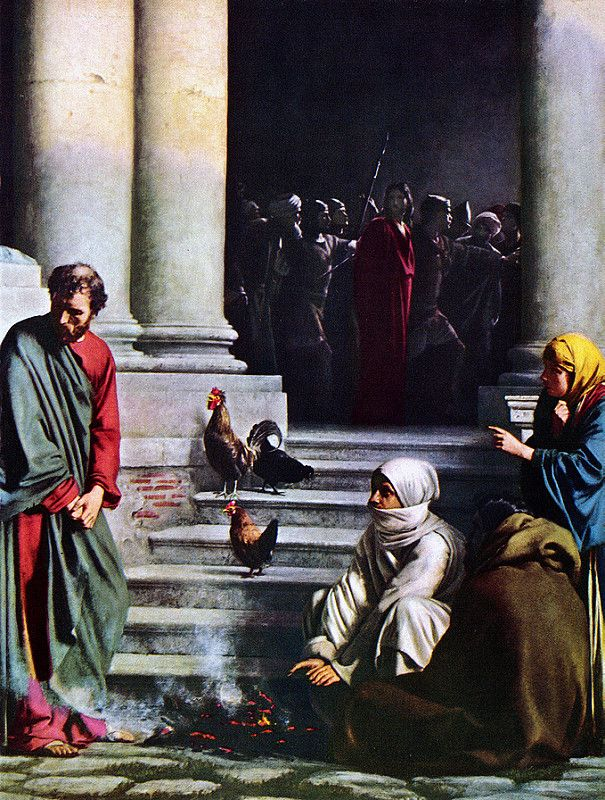
The Denial of Peter by Carl Bloch (1834-1890)

“Simon, Simon, Satan has asked to sift all of you as wheat. But I have prayed for you, Simon, that your faith may not fail. And when you have turned back, strengthen your brothers.”

But he replied, “Lord, I am ready to go with you to prison and to death….”

Then seizing Jesus, they led him away and took him into the house of the high priest. Peter followed at a distance. And when some there had kindled a fire in the middle of the courtyard and had sat down together, Peter sat down with them. A servant girl saw him seated there in the firelight. She looked closely at him and said, “This man was with him.”

But he denied it. “Woman, I don’t know him,” he said.

A little later someone else saw him and said, “You also are one of them.”

“Man, I am not!” Peter replied.

About an hour later another asserted, “Certainly this fellow was with him, for he is a Galilean.”

Peter replied, “Man, I don’t know what you’re talking about!” Just as he was speaking, the rooster crowed. The Lord turned and looked straight at Peter. Then Peter remembered the word the Lord had spoken to him: “Before the rooster crows today, you will disown me three times.”And he went outside and wept bitterly. (New International Version)

A Lesson In Trust

One day I watched a lifeguard handle a group of kids for their first time in the pool. She went to each one and told them to put their ears in the water and their belly buttons in the air while she was holding them up. “When I count to three, you won’t feel my hands underneath you, but they’re there,” she said. 

Most of the kids frantically jerked their knees toward their chins and flailed their arms.

Even though nearly all people float when they assume a posture of rest, many believe they’ll sink, and don’t keep their posture for long. 

The disciples had a hard time trusting Jesus. They couldn’t seem to rest and relax because Jesus said and did things that they were not expecting him to say and do. 

Jesus preached the necessity of humility and loving one’s enemies; and he focused on ministry to the least persons around them. The disciples had not yet really bought into Christ’s kingdom agenda because they kept pulling their knees up by thinking Jesus was going to lead a rebellion against the Romans and put Israel back on the map – believing it would be just like the old days of Jewish domination of the land.

But Jesus is all about a different agenda: transformation of the inner person that leads to greater submission to God’s will so that the least persons among us will be reached.

Bad News Before Good News

Many already believe they know what God wants and how to follow Jesus, and so, aren’t much open to the Spirit. They acknowledge they’re sinners, yet don’t believe their sin is as bad as others. “O, sure, we sin, but not like murderers and child molesters. Our sins are ‘respectable’– a little resentment, a little prejudice, and a little gossip is even necessary to make sure people submit to the unwritten rules.”

We must first hear the bad news before we can hear the good news. Once we hear the bad news and accept it, we must receive God’s remedy for it. In order to do this, let’s compare and contrast two disciples: Peter and Judas.

Peter’s Denial, 17th Century Ethiopian

Peter and Judas

Peter and Judas shared a similar vision about seeing Israel restored to its previous glorious prominence. Judas was a Zealot, ready to take military action, if necessary; and Peter had no problem taking up the sword when it seemed the time was ripe for a political rebellion and takeover.

Even though Peter insisted he would never turn on Jesus, Jesus knew better. And, sure enough, Peter did a full-fledged moral belly flop in the pool of denial by disowning Jesus three times.

Judas actually caught on, quicker than Peter, that Jesus wasn’t going to lead a military coup. Judas had enough of wasting time on poor marginalized people; they weren’t going to make good soldiers. After Judas clearly saw that Jesus had no intention of forcing an earthly political kingdom, he actively sought an opportunity to betray him.

Neither Judas or Peter, nor any of the disciples wanted to take a step into the world of suffering as the means of reaching others and embracing the kingdom of God. They wanted glory not suffering. But Jesus chose the cup of suffering.

Both Judas and Peter realized after denying Jesus that they had made a terrible mistake. But that is where the similarities end. 

Judas realized what he had done, and so, went out and died by suicide. Rather than throw himself upon the mercy of God, Judas tried to atone for his own sin. He tried to fix something that could not be undone. It was a refusal of grace.

Peter responded by weeping bitterly, consistent with someone experiencing repentance. He realized he was poor in spirit and mourned over his sin. Peter later becomes a genuinely meek person with God’s righteousness taking root within him as he, in the book of Acts, demonstrated mercy and became a preacher of truth and grace.

The Need for Transformation

There cannot be systemic and structural renewal without personal transformation. And there cannot be personal transformation without a brutally honest assessment of myself. “I will never fall,” comes from a heart of pride that believes “I’m not so bad.”

Our sins and failures stem ultimately from a lack of trust. We keep pulling our knees up because we are too anxious to let the agenda of Jesus control our lives. 

Proud people don’t pray much because they are self-sufficient. But humble people pray a lot because they don’t want to fall into temptation. They pray because they discern they’re prone to being like a cockeye little dog who thinks he is a big dog. 

Even Jesus felt the need to watch and pray so that he could face his hour of pain and suffering on behalf of all mankind.

Following Either Close or From a Distance

Jesus was arrested and Peter followed him at a distance. If we are brutally honest with ourselves, this too, describes much of our own following of Jesus. We want to see how everything will shake-out before we commit. 

Christ is asking us to trust him, to make and keep promises before we even know what it all means. We need to acknowledge and admit that we have commitment-it is; we have made a mess of our lives by our stubbornness and holding on to our own ideas for how we think things ought to go.

If you find yourself in a mess, whether it is of your own making or of somebody else, the only thing that can handle it is a close following of grace. We are to approach God with brutal honesty, humility, and a willingness to rest and relax when he is telling you to. 

The Lord will give you his righteousness; you need not try to obtain it on your own. So, let the knees go down and stick the belly button out – rest in Jesus.

A Divine Perspective of Time (2 Peter 3:8-13)

But do not forget this one thing, dear friends: With the Lord a day is like a thousand years, and a thousand years are like a day. The Lord is not slow in keeping his promise, as some understand slowness. Instead, he is patient with you, not wanting anyone to perish, but everyone to come to repentance.

But the day of the Lord will come like a thief. The heavens will disappear with a roar; the elements will be destroyed by fire, and the earth and everything done in it will be laid bare.

Since everything will be destroyed in this way, what kind of people ought you to be? You ought to live holy and godly lives as you look forward to the day of God and speed its coming. That day will bring about the destruction of the heavens by fire, and the elements will melt in the heat. But in keeping with his promise, we are looking forward to a new heaven and a new earth, where righteousness dwells. (New International Version)

We are invited, through today’s New Testament lesson, to see the moving of history as God sees it.

The Apostle Peter addressed two questions and concerns the people had about the Lord’s coming:

  1. Will this coming be worth the wait?
  2. What should I be doing in the meantime, now, while I wait?

The Christians, for whom Peter wrote his letter, were impatient. They saw time from a mere human perspective. The believers needed a bigger and fuller understanding of God’s purposes. We must come to grips with the reality that God’s timing is different than ours.

There are two words for “time” in the New Testament: chronos and kairos

Chronos is where we get our English word “chronological.” This is time measured by the clock. It’s the way much of our lives are governed.

Kairos is seasonal time. It’s not determined by the clock but is event oriented. 

God is not time-oriented in the same sense that we are. The Lord is not ruled and controlled by the clock but is above all time. God is event-oriented, which is why the Lord’s understanding of time is that a thousand years are like a day, and a day like a thousand years.

In other words, God measures time differently than most Westerners do. When the Bible says Christ is coming soon, it means there are no events left in the course of history except the Day of the Lord, the return of Jesus, to judge the living and the dead.

I admit to being a clock-oriented guy. I also confess that my wife and girls are not. They are much more event oriented than me. So, I suppose when it comes to time, they are the godly ones. After all, the seasons will continue to come and go but a clock will eventually die when its “time is up.”

I cannot begin to count how many hours of my life have been spent waiting on my wife and girls. I used to get frustrated and impatient because I thought they should be clock-oriented, like me.

Yet, over the years, I have learned to accept this reality. Now I take the time of waiting and read. I have read a lot of books over the years through my waiting. I used to want to time travel because of wasted time, but that is all in the past now.

A clock-oriented guy like me needs to grasp that God has all the time in the world. God serves no clock. Clocks are merely playthings for the Lord.

When God wants a hot time, he just puts a clock in the oven. I, however, tend to get antsy, impatient, and frustrated, believing that God must operate on my time schedule. Yet, what seems to me is divine tardiness, is really something else.

God seems slow in keeping divine promises. But the truth is, the Lord takes all the time in the world because of divine mercy. While I am beating my chest trying to get everyone on my time deadlines, God beats up the clock, just to kill time.

In the face of so much that is not right with the world, we might wonder why God is not just stepping in and taking care of all the evil and unjust situations on this earth.

But what we view as a lack of mercy is, in fact, sheer grace on God’s part – patiently waiting for all kinds of people to confess their guilt and shame and come to Jesus. God is waiting for that lost soul to make their way to forgiveness. You cannot bear your secrets with a clock around because time will tell.

Whereas I tend to think I am waiting on God, God is waiting for me, too.

What should I be doing in the meantime while I wait? We ought to be living holy and godly lives as we look forward to Christ’s coming and speed its coming. Yes, God is the One who is waiting on us. Do you know the time of the Second Coming? No, me neither; we have not met yet.

The holiness and peace of God’s people will influence the timing of the Christ’s return. When God upends our current situations, it’s time to get a new set of circumstances. Since God is an event-oriented God, the Lord has all the time in the world to wait on us to be the kind of people we need to be.

The fact that we are two-thousand years removed from the first Advent of Christ probably does not speak very well to the church in general. It will do no good to sit on our watches so that we can be on time. God is still waiting for a lot of folks to come to repentance, as well as the church to take up her mandate of making disciples.

God is gracious and does not bully us or strike us with lightning when we disobey. Rather, God is patient, wanting us to approach and receive mercy. The Lord is waiting for us to avail ourselves of divine help to live holy and godly lives.

Holiness simply means to be separated from evil and connected to God. Godliness means to live a worshipful and spiritually disciplined life.  Our Lord’s patience means deliverance from all that detaches us from Jesus so that we might rightly attach ourselves to him.

Robby Robins was an Air Force pilot during the first Iraq war. After his 300th mission, he was given permission to immediately pull his crew together and fly his plane home. They flew across the ocean to Massachusetts and then had a long drive to western Pennsylvania. They drove all night, and when his buddies dropped him off at his driveway just after sun-up, there was a big banner across the garage—”Welcome Home!”  How did his wife know? No one had called her, and the crew themselves had not expected to leave so quickly.

Robins relates, “When I walked into the house, my wife came running down the hall—she looked terrific—hair fixed, make-up on, and a crisp yellow dress. ‘How did you know?’ I asked.  ‘I didn’t,’ she answered through tears of joy. ‘Once I knew the war was over, I knew you’d be home one of these days. I knew you would try to surprise me, so I was ready every day.'”

In the history of redemption, the war has been won. There is only one event left on God’s calendar: The return of Jesus.

When a clock stops ticking, it just hangs around. That’s not what the Lord wants.

Throwing the watch across the room will not make time fly; Jesus will come when he comes. Meanwhile, our focus is on living holy and godly lives as we wait….

Even so, come Lord Jesus.

How To Handle Trouble (Psalm 94)

Lord, you are a God who punishes;
    reveal your anger!
You are the judge of us all;
    rise and give the proud what they deserve!
How much longer will the wicked be glad?
    How much longer, Lord?
How much longer will criminals be proud
    and boast about their crimes?

They crush your people, Lord;
    they oppress those who belong to you.
They kill widows and orphans,
    and murder the strangers who live in our land.
They say, “The Lord does not see us;
    the God of Israel does not notice.”

My people, how can you be such stupid fools?
    When will you ever learn?
God made our ears—can’t he hear?
    He made our eyes—can’t he see?
He scolds the nations—won’t he punish them?
    He is the teacher of us all—hasn’t he any knowledge?
The Lord knows what we think;
    he knows how senseless our reasoning is.

Lord, how happy are those you instruct,
    the ones to whom you teach your law!
You give them rest from days of trouble
    until a pit is dug to trap the wicked.
The Lord will not abandon his people;
    he will not desert those who belong to him.
Justice will again be found in the courts,
    and all righteous people will support it.

Who stood up for me against the wicked?
    Who took my side against the evildoers?
If the Lord had not helped me,
    I would have gone quickly to the land of silence.
I said, “I am falling”;
    but your constant love, O Lord, held me up.
Whenever I am anxious and worried,
    you comfort me and make me glad.

You have nothing to do with corrupt judges,
    who make injustice legal,
    who plot against good people
    and sentence the innocent to death.
But the Lord defends me;
    my God protects me.
He will punish them for their wickedness
    and destroy them for their sins;
    the Lord our God will destroy them. (Good News Translation)

Courageous, brave, bold, and strong – it seems most people do not characterize themselves this way, especially when they are in the throes of overwhelming circumstances.

Whenever one feels crushed under the weight of adverse situations caused by evil, it can be hard for them to see their resilience and strength.

I suppose it makes sense as to why we lose sight of this, because we can all readily recall times and events in which we wilted with fear; did not speak up; or were not assertive.

The many conversations we have in our heads for which will never take place, are testament to our supposed withdrawal in the face of adversity. We have far too many discussions with ourselves of how something should have gone; and too many brave retorts for someone whom we really have no intention of saying those words toward.

If this all sounds like the convoluted musings of a wimpy kid, that’s not far off the mark. When we get bullied, even as adults, it can be easy to wilt, or to take it, or to simply find a way to avoid the bully. With some folks, we even create elaborate internal reasons why it’s our fault someone is upset with us. In such times, bravery and courage seem a long way from our true selves.

Faced with a daunting task or an ornery person at work, home, or school, we may wonder if we really have the internal stuff to deal with it. We feel that maybe someone else would be better suited to handle the trouble. 

Yet, what if I told you that you are, indeed, brave, strong, and confident?

What if I insisted that courage resides within you, even if you yourself cannot see it right now?

And, what if I told you that bravery isn’t something you must go on a quest to find, but that it’s been in you all along? 

If you are already enough, then you only need to be aware of it, acknowledge it, and let it out.

You intuitively know I’m on to something here. After all, the most common exhortation and assurance in the entirety of Holy Scripture is to not be afraid because God is with us:

So do not fear, for I am with you;
    do not be dismayed, for I am your God.
I will strengthen you and help you;
    I will uphold you with my righteous right hand. (Isaiah 41:10, NIV)

God has said, “Never will I leave you; never will I forsake you.” So, we say with confidence, “The Lord is my helper; I will not be afraid. What can mere mortals do to me?” (Hebrews 13:5-6, NIV)

In the great litany of fear, we face every day, spiritual confidence and personal bravery is not so much commanded by God, as it is a calling forth of something which is already within you.

Now, before you go thinking I’m some looney-tune, hear me out. From the beginning of the world, in God’s creative activity, the Lord did it all by calling forth creation from within himself. What I mean is this: God did not simply command everything into being; instead, he said, “Let there be…”  God let out what was already there in God’s very Being. It was almost as if God belched-out from the great depth of his Being and let out all this wondrous creation.

Concerning our fear and bravery, God does not so much command us to be courageous but wants us to draw from the great reservoir within. The Lord has already created us strong, as creatures in the divine image. We just need to get in touch with what is already there. 

“Do not let your hearts be troubled,” said Jesus to his disciples, because he knew his followers had it in them to walk in his way without fear. (John 14:6, NRSV)

“Let not your heart faint, and be not fearful,” said God to the prophet Jeremiah, in the face of a terrible destruction that was about to unfold against Jerusalem, because the Lord knew that Jeremiah could face what was going to happen. (Jeremiah 51:46, ESV)

Christians can act with boldness because Jesus is the pioneer of our salvation. He is the One which enables us to draw from the deep well of courage:

So then, since we have a great High Priest who has entered heaven, Jesus the Son of God, let us hold firmly to what we believe. This High Priest of ours understands our weaknesses, for he faced all of the same testing we do, yet he did not sin. So let us come boldly to the throne of our gracious God. There we will receive his mercy, and we will find grace to help us when we need it most. (Hebrews 4:14-16, NLT)

I insist that you are brave, you are strong, and you are good. Those are not words meant to make you believe something which may or may not be true, as if I were trying to convince you to take some panacea to feel better.  No, I say it because it is true. 

You really can face the immense mountain in front of you and climb it. You can surmount the adversity you are in the middle of – not because of some words I say, but because you were created for courage.

So, how do you let out the bravery and let the boldness shine? 

You already know the answers to your own questions. You have all the knowledge you need to face your problems. So, the real question is:

Will you let your bravery come out to play, or will you keep it hidden beneath layers of insecurity?

It’s a whole lot easier to let me tell you what to do than to draw from what you already know, deep down, how to handle that troublesome something. 

I’m not going to give you a simple three-step process out of fear and into courage. That’s because you already have been endowed with the process. 

This certainly isn’t a sexy way to end a blog post, but it just might be the most effective and lasting.

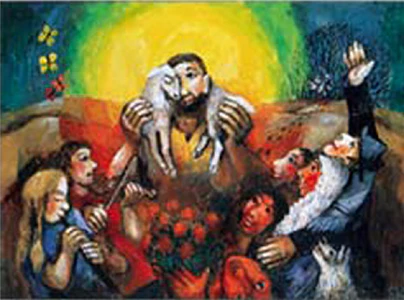
The Parables of the Lost Sheep and the Lost Coin (Luke 15:1-10)

By Sieger Koder (1925-2015)

Now the tax collectors and sinners were all gathering around to hear Jesus. But the Pharisees and the teachers of the law muttered, “This man welcomes sinners and eats with them.”

Then Jesus told them this parable: “Suppose one of you has a hundred sheep and loses one of them. Doesn’t he leave the ninety-nine in the open country and go after the lost sheep until he finds it? And when he finds it, he joyfully puts it on his shoulders and goes home. Then he calls his friends and neighbors together and says, ‘Rejoice with me; I have found my lost sheep.’ I tell you that in the same way there will be more rejoicing in heaven over one sinner who repents than over ninety-nine righteous persons who do not need to repent.“

Or suppose a woman has ten silver coins and loses one. Doesn’t she light a lamp, sweep the house and search carefully until she finds it? And when she finds it, she calls her friends and neighbors together and says, ‘Rejoice with me; I have found my lost coin.’ In the same way, I tell you, there is rejoicing in the presence of the angels of God over one sinner who repents.” (New International Version)

Lost people matter to God… a lot. They matter so much to the Lord that one lost soul who is found is the grounds for a big celestial party. 

Note a simple observation of today’s Gospel lesson: If there is rejoicing in the presence of angels over one sinner who repents, then it is God who is doing the rejoicing. The Lord is absolutely giddy with joy over a lost person being found.

Jesus told two short stories, each teaching the same thing, so that we will be absolutely sure to get it: A loving God has unbounded joy over lost people being found. These parables of Jesus give us a glimpse of God’s own heart. The Lord would do anything to find a lost person, to restore and reconcile that person to right relationships. 

The Lost Sheep by Jorge Cocco Santángelo

God would go dumpster diving and wade through stinky nasty garbage to find just one lost valuable person.

Restoring lost people is such a high priority to God that the Father sent the Son to this earth. Jesus paid the ultimate price of a cruel death on a cross to reconcile a broken lost relationship between people and God.

I have not always been a devoted follower of Christ. I still remember what it felt like to be separated from God and estranged from the Church – it was lonely and awful, like being in a deep black hole with no way of getting out and no one around to help. 

But God mercifully sent people into my life to share good news with me and help me out of my prodigal way of life. I once was lost. But now I am found. When I turned from my path of destruction and embraced Jesus Christ, there was a big party in heaven.

God gathering wayward and lost persons is a gracious activity, seemingly free from criticism. But there was. The rightful Judge of the universe got judged by a group of spiritual simpletons. And because there were complaints leveled at Jesus for purposely going after the lost, it therefore needs to be asked: 

Where do we locate ourselves in these parables? 

The two stories were downright offensive to many of Christ’s original hearers. Those upset with Jesus were so inwardly focused that they believed ministry ought to revolve around them and their needs.

And, what’s more, the religious leaders were offended because they thought all the fuss about sinners would only highlight their sin. In other words, there ought to be no party and no rejoicing for people who have lived an ethically and morally dubious life.

Preaching grace is always offensive to people who work for their salvation. It is scandalous to such persons to hear that Jesus did not come to call the righteous, but sinners to repentance. 

If we hear Christ’s parables and the concern for lost sinners who don’t know Jesus and say, “Well, all this talk about outreach is well and good, but what about us?  What about me? After all, I never went down a path of immorality or hurt anyone. I’m a good person. Where’s my party?” Then, we must locate ourselves as the lost persons in need of being found by God’s grace.

Consider for a moment the worst sinner you can think of – a person for whom you would label as being akin to the devil…. Now picture that person being found by God and becoming a follower of Christ….

Would you attend the party to celebrate that person’s repentance, reconciliation, and recovery? 

If any of us feels justified in our hate, then we are the lost one in need of turning from our sin.

In leaving the ninety-nine sheep in the flock and going after the one sheep, God gave preferential attention to the lost….

Can you live with that? 

These parables of Jesus have significant meaning for church programs, budgets, and committees. By most estimations, only one-in-five lost people in America even knows one Christian. Statistics like that are what keep me up at night; it deeply saddens me. It drives me to prayer.

God’s unconditional mercy and amazing grace is what makes all the difference. 

If we lose the sense of awe and appreciation for what God has done for us in Christ, then there will be no outreach. Finding lost people is not dependent on completing a class on evangelism or getting training in how to answer every question.

Outreach is fueled by passion and desire. Healthy Christians reproduce themselves. I assume you didn’t take a class on how to procreate – you just had the desire and the willingness; and then, you celebrated nine-months later, the birth of new life.

New life always needs to be celebrated because that’s what God does. Yet, the party cannot commence until the lost are found….

O God – blessed Father, Son, and Spirit – sanctify all believers everywhere with your abiding presence. Enlighten the minds of your people more and more with the light of the Gospel. Bring lost people to the knowledge of our Savior Jesus Christ; and those who are walking in the way of life, keep steadfast to the end. Guard those who are strong and prosperous from forgetting you and straying from the flock. Increase in us your grace and love so that we may participate with you in finding the lost. Amen.