Psalm 37:12-22 – Get Some Perspective

Merciless people make plots
against good people
    and snarl like animals,
but the Lord laughs and knows
    their time is coming soon.
The wicked kill with swords
and shoot arrows
to murder
    the poor and the needy
    and all who do right.
But they will be killed
    by their own swords,
    and their arrows
    will be broken.

It is better to live right
and be poor
    than to be sinful and rich.
The wicked will lose all
    of their power,
but the Lord gives strength
    to everyone who is good.

Those who obey the Lord
    are daily in his care,
    and what he has given them
    will be theirs forever.
They won’t be in trouble
    when times are bad,
    and they will have plenty
    when food is scarce.

Wicked people are enemies
    of the Lord
    and will vanish like smoke
    from a field on fire.

An evil person borrows
    and never pays back;
    a good person is generous
    and never stops giving.
Everyone the Lord blesses
    will receive the land;
    everyone the Lord curses
    will be destroyed.
(Contemporary English Version)

The angle from which we view things is really important.

Perspective is everything. 

Whenever some ornery cuss swears at us, or a group of people think the worst of us, or an organization takes advantage of us, we might feel like crumbling underneath the weight of stress.

Throw into the mix the state of world affairs: pandemic, natural disasters, war, poverty, human trafficking, and a legion of unjust victimization and oppression around the globe.

And add our own personal issues, whatever they are, of dealing with mental and physical health, and/or difficult relationships with family, co-workers, or neighbors.

Put it all together and it would be rather easy to believe evil is winning. Can we even begin to make a dent in the wickedness of injustice, abuse, and maltreatment?

When we infuse God to the menacing challenges of our world, it changes everything.

Don’t you know? Haven’t you heard?
    The Lord is the everlasting God,
    the creator of the ends of the earth.
    He doesn’t grow tired or weary.
His understanding is beyond human reach.

Isaiah 40:28, CEB

The vantage of the psalmist is that all this immense malevolent plotting which exists cannot even begin to stand up to the even larger sovereign and benevolent God. 

It’s almost as if the Lord looks down from heaven at wicked people and says, “Well, now, isn’t that something, those tiny little yippee dogs thinking they can take on the big dog!” Truth is, the Lord laughs at the wicked, for God sees that their day is coming – and it won’t be pretty for them. 

Or we might picture some puny bugs on the ground making nefarious plans, completely oblivious to the hugeness of God that towers over them. They are about to be squished but are too busy going about their pathetic business to look up and see what is coming. The bugs are totally powerless in the face of such an awesome presence.

So cut away the thick calluses from your heart and stop being so willfully hardheaded. God, your God, is the God of all gods, he’s the Master of all masters, a God immense and powerful and awesome. He doesn’t play favorites, takes no bribes, makes sure orphans and widows are treated fairly, takes loving care of foreigners by seeing that they get food and clothing. (Deuteronomy 10:17-18, MSG)

We humans who try our best to be good, do right, and live a spiritual life can become much too discouraged, far too easily. 

The remedy to the malady of such disillusionment is to be filled with a robust theology which wisely discerns God as far above all our problems and situations. 

“I am the Lord, the God of all people. Nothing is too difficult for me.”

Jeremiah 32:27, GNT

No matter how ominous the machinations of malicious corruption array against us, the spiritual believer is assured that God is in control, and, in the end, the wicked will get their comeuppance. 

And if we will have the spiritual eyes to see, that fearsome lion who scares the baloney out of us with his loud roar, is really an old toothless cat with no bite. Malicious and malevolent people typically make all kinds of noise and talk a big line, but all they really have is their belligerent bullying and ballyhoo.

No earthly power, no clever person, no loudmouth tormentor, and no human organization can ever go toe to toe with the gargantuan God we serve. 

Put all your circumstances beside this God and see if it changes your perspective.

Mighty God, you bless those who are dedicated to you, and you put down those who rage against you.  Fortify my spirit and let me see just the train of your robe, and I will glimpse the large grandeur of your glory.  Let me know Jesus Christ risen and ascended far above all principalities and powers of this earth.  Amen.

Philippians 4:10-20 – Be Generous

I’m glad in God, far happier than you would ever guess—happy that you’re again showing such strong concern for me. Not that you ever quit praying and thinking about me. You just had no chance to show it. Actually, I don’t have a sense of needing anything personally. I’ve learned by now to be quite content whatever my circumstances. I’m just as happy with little as with much, with much as with little. I’ve found the recipe for being happy whether full or hungry, hands full or hands empty. Whatever I have, wherever I am, I can make it through anything in the One who makes me who I am. I don’t mean that your help didn’t mean a lot to me—it did. It was a beautiful thing that you came alongside me in my troubles.

You Philippians well know, and you can be sure I’ll never forget it, that when I first left Macedonia province, venturing out with the Message, not one church helped out in the give-and-take of this work except you. You were the only one. Even while I was in Thessalonica, you helped out—and not only once, but twice. Not that I’m looking for handouts, but I do want you to experience the blessing that issues from generosity.

And now I have it all—and keep getting more! The gifts you sent with Epaphroditus were more than enough, like a sweet-smelling sacrifice roasting on the altar, filling the air with fragrance, pleasing God to no end. You can be sure that God will take care of everything you need, his generosity exceeding even yours in the glory that pours from Jesus. Our God and Father abounds in glory that just pours out into eternity. Yes. (The Message)

“It takes generosity to discover the whole through others. If you realize you are only a violin, you can open yourself up to the world by playing your role in the concert.” 

Jacques-Yves Cousteau

Who is “you?”

That’s a question more significant than “you” might think….

In the English language, the words “you” and “your” can be either singular or plural. One must determine which it is by the sentence and surrounding context. 

In the language of New Testament Greek, however, this is not the case. We clearly know which words are singular and which are plural because they aren’t spelled the same, as in English. 

It is important to know that in the Apostle Paul’s letter to the Philippians, all the “you” pronouns are plural. Yep. Every single one of them. This is significant because the theme of unity and solidarity runs powerfully and affectionately through the entire book.

Everyone in the Philippian church, not just an individual or two, shared in Paul’s troubles with him. They partnered with him through financial resources, prayer, and ministry. Paul was quite confident that every need the Philippians encountered would be supplied by the riches of God because they had learned a valuable lesson from Paul and discovered a vital lesson about their church. 

The Philippians were taught by Paul that the practice of contentment in all circumstances would bring unity, not division. In fact, contentment eases a group’s normal anxieties. And contentment comes from the practice of gratitude. What’s more, the Philippians also experienced firsthand the seeming paradox that through the practice of giving they become rich. 

Trying to do any of this as a single solitary individual will not work – because gratitude, giving, and contentment are bonded to community. It’s a lot like spiritual gifts. We aren’t gifted with a speaking gift just to stand in front of the mirror and talk at ourselves. We aren’t gifted with serving gifts just to serve ourselves. And so, it is with giving and receiving, gratitude and thanksgiving, peace and contentment. They’re meant to be done in the context of a group.

We are not to be islands only operating at the level of individuation. Believers are designed by God and hard-wired into our spiritual DNA to know the blessing of partnering and working together in the unity of the gospel.  Learning contentment and generosity go hand-in-hand. 

Hoarding actually creates anxiety, whereas a collective generous spirit leads inexorably toward satisfaction and joy. If we want to be free of division and of having that constant uptight feeling, then we must be wildly generous. 

Generosity comes in all shapes and sizes. The big idea is that it is meant to bless others. Here are some ways anyone can be generous:

  1. If you can tip generously, do it. If not, be effusive in offering gratitude to others who serve you. If in doubt, always be on the side of grace and say thanks for everything.
  2. Share your knowledge, expertise, or ability. Hoarding doesn’t just have to do with money or stuff. People can also hoard their wisdom and abilities. Generously and freely sharing is a way to loosen up the gratitude and contentment so that burdens don’t become too heavy to bear.
  3. Give yourself to a cause or organization you believe in, either through donating time or money. Most places can’t have enough volunteers. Just be willing to let them dictate what needs to be done. Generously listen to their needs and wants.
  4. Compliment at least one person every day. Be generous with words of encouragement. It is a myth that complimenting another will give them a big head. Just the opposite is true. A lack of genuine encouragement causes a person to feel small.
  5. Give blood. It truly saves lives. Need I say more?

Go ahead, try it; you’ll like it. Be generous with your money, generous with your words of encouragement toward others, and generous with your gratitude to God.  Find out whether or not this changes your level of contentment in life.

Whether you do something big or small, the impact an act of generosity can have on someone else may be life changing. And it can completely change a group dynamic from stingy and critical to open and affirming.

Who ought to be generous? Yes, “you!”

Generous God, your storehouse of grace and mercy is infinite and unending.  Help me to partner with you in a manner that my generosity flows in the same way that yours does so that Jesus Christ is glorified, and his church is edified.  Amen.

Psalm 14 – On the Significance of God

Statue of George Washington, outside the National Gallery, Washington D.C.

Godless fools say in their hearts,
“There is no God.”
They are corrupt.
They do disgusting things.
There is no one who does good things.
The Lord looks down from heaven on Adam’s descendants
to see if there is anyone who acts wisely,
if there is anyone who seeks help from God.
Everyone has turned away.
Together they have become rotten to the core.
No one, not even one person, does good things.
Are all those troublemakers,
those who devour my people as if they were devouring food,
so ignorant that they do not call on the Lord?
There they are—panic-stricken
because God is with the person who is righteous.
They put the advice of oppressed people to shame
because the Lord is their refuge.

If only salvation for Israel would come from Zion!
When the Lord restores the fortunes of his people,
Jacob will rejoice.
Israel will be glad
. (God’s Word Translation)

George Washington, first President of the United States, in his farewell address to the nation in 1796, constructed his encouragements to the American people on the basis of virtue. 

Only a virtuous people, Washington believed, could cause the American experiment to succeed among the family of nations. Virtue, for Washington, could only occur through the twin pillars of religion and morality. He stated:

“Observe good faith and justice towards all nations; cultivate peace and harmony with all. Religion and morality enjoin this conduct; and can it be, that good policy does not equally enjoin it – It will be worthy of a free, enlightened, and at no distant period, a great nation, to give to mankind the magnanimous and too novel example of a people always guided by an exalted justice and benevolence. Who can doubt that, in the course of time and things, the fruits of such a plan would richly repay any temporary advantages which might be lost by a steady adherence to it? Can it be that Providence has not connected the permanent felicity of a nation with its virtue? The experiment, at least, is recommended by every sentiment which ennobles human nature. Alas! is it rendered impossible by its vices?”

George Washington, Farewell Address, 1796

Washington was no fool. He understood that the guiding hand of Providence [God] was necessary to the flourishing of a free and happy people. 

Indeed, the ancient psalmist would agree. When humanity is untethered from their own deep spirituality, they become worthless, heartless, cruel and can rarely do right by others. 

Whatever Washington’s true personal sensibilities were about theology, he most certainly was convinced that belief in God along with the Scripture’s moral guidance were needed for a fledgling nation. The people’s ability to recognize and engraft religion into their lives would be a must for America.

Unmooring ourselves from the moral compass within us and forsaking the Creator leads to vice – whereas enjoining God and paying attention to the divine leads to virtue. 

It is not wise to ignore the God of all creation. From the psalmist’s perspective, through daily attentiveness and devotion to the Lord, moral and ethical ways can take root and produce justice, reconciliation, and peace.

Sovereign God, you rule the nations through your wise and benevolent reign. Help me to participate with you in your grand kingdom enterprise so that I can make decisions consistent with true morality, for the sake of Jesus, in the power of your Holy Spirit. Amen.

John 4:31-38 – Real Food

Meanwhile his disciples urged him, “Rabbi, eat something.”

But he said to them, “I have food to eat that you know nothing about.”

Then his disciples said to each other, “Could someone have brought him food?”

“My food,” said Jesus, “is to do the will of him who sent me and to finish his work. Don’t you have a saying, ‘It’s still four months until harvest’? I tell you, open your eyes and look at the fields! They are ripe for harvest. Even now the one who reaps draws a wage and harvests a crop for eternal life, so that the sower and the reaper may be glad together. Thus, the saying ‘One sows, and another reaps’ is true. I sent you to reap what you have not worked for. Others have done the hard work, and you have reaped the benefits of their labor.” (New International Version)

Today’s Gospel narrative reads something like the stereotypical mother concerned for her son saying, “Sit down and eat some of Mama’s pasta. You need some food!” As if preparing and serving a meal will make everything better.

Food has both the power to bring us together, as well as separate us. A meal can create the conditions for fellowship, acceptance, and enjoyment. Eating can bond people together through hospitable love. On the other hand, sitting down to eat can also be a way to avoid painful emotions. In this manner, eating becomes an obstacle to giving and receiving love.

It seems Christ’s disciples were doing the latter. They were uncomfortable and perhaps a bit stressed. Looking to fill up with food instead of with God, the disciples’ sense of unfulfillment was coming out sideways by opening the refrigerator, poking through the meager leftovers, and putting the emphasis on feeling better.

I know we can be hard on the disciples in the Gospels. Their ups and downs from faith to fear and back to faith again can be weird. Yet, through it all, I believe their hearts (excepting Judas Iscariot) were in the right place.

Jesus could see through the entire scenario and put the focus off eating. He addressed the disciples’ soul hunger through putting the spotlight on doing the will of God. Deep within they were hungering and thirsting for righteousness.

Paying attention to our vocation and discovering our humble work in the service of God, rather than a vacation to the pantry to cover our unwanted feelings, is the essence of Christ’s interaction with his disciples.

People are much more ready for the gospel of Jesus than we think. There are times we can become so insular, and lost within our own heads, that we are then unable to see the world as ripe for a harvest of people who are actually eager to be gathered into the community of the redeemed.

Jesus just had a significant interaction with the Samaritan woman. Back in that day, you just didn’t have dialogues with half-breed Samaritans – an unholy mix of Jewish and hated ancient Assyrian Gentile blood – let alone a man talking with a woman of disrepute who experienced several failed marriages.

Christ had a way of doing the will of God, despite conventional thinking of the time. And a lot of people got their undies in a bundle from it. The disciples, having a front seat to most of Christ’s shenanigans, did a few too many palms to the forehead, believing their Rabbi’s un-orthopraxis was going to make him unpopular. They feared no one would follow him.

Looks like the disciples didn’t quite get that one right.

The Samaritan woman received Jesus as Living Water, having her ultimate needs met by the penultimate Lord of all. The disciples hadn’t quite caught up to this, so fell back on their old ways of physical food and drink to assuage the weirdness happening inside them.

The woman was gushing over with Living Water, becoming a wellspring of good news to her community. Whereas the disciples (eventually becoming an incredible fountain of the gospel after Christ’s death and resurrection) are here nothing but an annoying drip from the kitchen faucet.

A non-descript ethnically suspect woman of dubious character coming to faith was meant by Jesus to open the disciples’ eyes to a new reality: The good news of Christ is meant for the world, not just Jewish men.

The disciples were given the opportunity to participate in the world’s takeover – a mission of bringing the love of God where love wasn’t present, of helping all kinds of people awaken to the deep spirituality within them, of lifting their downcast faces of guilt and shame to see the Living God wanting to bless the world with the body and blood of Jesus.

For this is real food and real drink.

Many believers in Jesus today think they are working hard for the Lord by seeking people for their churches. Yet, the real work is being done by the triune God – the heavenly Father who scans the world and seeks spiritual misfits to bless; the gracious and truthful Son who put hands and feet to that blessing; and the wild Holy Spirit who moves in unpredictable ways – are working infinitely harder for our churches, our families, our neighborhoods, and our world.

All of our work, no matter how big or small, is made possible by the pre-work of the Holy Trinity. The great Three-in-One has done all the preparations of chopping the onions, mincing the garlic, slicing the carrots, and peeling the potatoes so that we, his followers, can make a savory stew of diverse people sharing a common pot of God’s love and hospitality.

This is the food we know nothing about, and that God knows intimately.

O God, you made us in your own image, and you have redeemed us through your Son Jesus Christ: Look with compassion on the whole human family; take away the arrogance and hatred which infect our hearts; break down the walls that separate us; unite us in bonds of love; and work through our struggle and confusion to accomplish your purposes on earth; that, in your good time, all nations and races may serve you in harmony around your heavenly throne; through Jesus Christ our Lord. Amen.

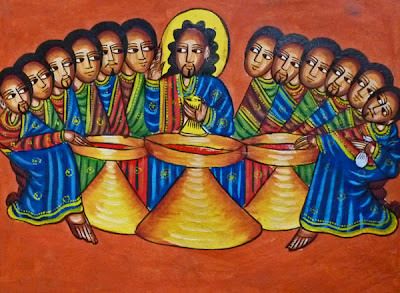
*Above painting: Ethiopian Orthodox Church depiction of the Last Supper