Matthew 16:5-12 – Beware of Bad Teaching

Later, after they crossed to the other side of the lake, the disciples discovered they had forgotten to bring any bread. “Watch out!” Jesus warned them. “Beware of the yeast of the Pharisees and Sadducees.”

At this they began to argue with each other because they hadn’t brought any bread. Jesus knew what they were saying, so he said, “You have so little faith! Why are you arguing with each other about having no bread? Don’t you understand even yet? Don’t you remember the 5,000 I fed with five loaves, and the baskets of leftovers you picked up? Or the 4,000 I fed with seven loaves, and the large baskets of leftovers you picked up? Why can’t you understand that I’m not talking about bread? So again, I say, ‘Beware of the yeast of the Pharisees and Sadducees.’”

Then at last they understood that he wasn’t speaking about the yeast in bread, but about the deceptive teaching of the Pharisees and Sadducees. (New Living Translation)

I tend to think in metaphors, which is probably one reason I like the teaching of Jesus so much. While on this earth, he used a range of metaphors from common everyday life to communicate his point. Seems as though the disciples were more concrete thinkers.

Yeast was a common symbol for evil, which is why the Jews ate unleavened bread. Jesus was trying to get the point across to his disciples that, like yeast, even just a little bit of unhealthy teaching can have far-reaching effects. Partaking of bad teaching works through the whole batch of dough and ruins the spiritual life.

We might think that after seeing Jesus heal the sick, raise a paralyzed man, cure the blind, restore the demon-possessed, walk on water, and feed the masses with only a few loaves of bread that his disciples would be clamoring with praise and responding with a big “Wow! Look at what Jesus did!  Tell us what to do next!”  Instead, they stood around mumbling about how to interpret the great feeding of the four thousand.

The math lesson Jesus explained to the disciples about the basketfuls of food that they had gathered was that the less the disciples had and the bigger their problem, the more Jesus did. 

Jesus Math adds up to grace.  And grace means that who we are, or are not, and what we have, or do not have, is immaterial; what matters is that we have Jesus. We give him what little we have, along with ourselves, and let him do the work.

We must avoid the trap and the temptation of thinking, “If only I had ___; If only I were ___.”  This is unsound doctrine because it denigrates the image of God within us and the good gifts God has already given to us, as if we ourselves are not enough. Yet, even if we have next to nothing, with few abilities, when offering it to Jesus, he turns it into a miraculous bounty of blessing for the world.

Seeing ourselves, our relationships, our stuff, and our world through the person and work of Jesus Christ is our task.  It does not take great powers of interpretation to see that the times are evil and bad information gets disseminated and spread.  What is more difficult for us is discerning that there is a great opportunity for mission and service amid this decaying world. 

We will miss that wonderful opportunity if we partake of bad teaching.

It is imperative that we feed upon sound teaching and be very discerning about who we listen to and what they are really saying to us. Words which are heavy with judgment and light on grace are to be suspect because such teaching is antithetical to the gospel.

Instruction which sets apart and demonizes groups of people or characterizes certain individuals as monstrous or animalistic is completely out of step with the way of Jesus Christ.

We are to be on our guard against any teaching which places an unrealistic and dispassionate heavy load of guilt and shame upon people. We must be vigilant to not accept teaching that plays upon people’s fear and twists reality, making groundless and unsubstantiated claims without evidence. In short, the Holy Scriptures are not to be used as a club to beat people into submission toward our way of thinking and acting.

The spiritual abuse and objectification of others by using the Bible is a terrible condition which unfortunately exists in today’s world. The sad reality is that there are people who engage in harassing others by using God’s Holy Word.

People have been created in the image and likeness of God, and therefore deserve to be treated with respect and civility, regardless of their creed, color, or condition.

So, let me be clear and deliberate about the use and abuse of God’s revelation to us:

I do not condone any use of the Bible which seeks to intimidate, bully, impede, or affect any person’s ability: to work effectively at their jobs, to worship joyfully at their church, or to live without fear of being blacklisted or redlined to the periphery of society.

I do not condone any use of the Bible which intends to control either by threat or by use of physical force any person, their family, and/or their property through inducing fear.

I do not condone any use of the Bible which justifies touching any person without their consent, or coerces, or physically forces another person to engage in a sexual act against their will.

I reject any use of the Bible which encourages any sort of hate crime, act of violence, or hate speech against any person regardless of their gender, sexual orientation, race, ethnicity, class, or religion.

I reject any use of the Bible by any clergy and/or church leadership which demeans and marginalizes women in their basic humanity, role, function, or leadership.

I reject any use of the Bible by any church member and/or attender which demeans and discounts the worldwide Christian community.

I uphold any use of the Bible which seeks to communicate its theology and message gently, carefully, graciously, and lovingly for the spiritual edification and healing of all people.

I uphold any use of the Bible which intends to cultivate one’s own soul and develop a teachable spirit.

I uphold any use of the Bible which looks for truth, wisdom, beauty, and humility.

I champion use of the Bible for both personal and corporate encouragement.

I champion use of the Bible for critical inquiry, scrutiny, and learning.

I champion use of the Bible for all people, regardless of age, including genuine seekers and spiritual misfits, as well as the hurt, abused, lonely, lost, confused, and concerned.


1 Corinthians 11:27-34 – The Body

But if you eat the bread and drink the wine in a way that isn’t worthy of the Lord, you sin against his body and blood. That’s why you must examine the way you eat and drink. If you fail to understand that you are the body of the Lord, you will condemn yourselves by the way you eat and drink. That’s why many of you are sick and weak and why a lot of others have died. If we carefully judge ourselves, we won’t be punished. But when the Lord judges and punishes us, he does it to keep us from being condemned with the rest of the world.

My dear friends, you should wait until everyone gets there before you start eating. If you really are hungry, you can eat at home. Then you won’t condemn yourselves when you meet together.

After I arrive, I will instruct you about the other matters. (Contemporary English Version)

The body. The body and blood of Christ. The Body of Christ. Throughout the Apostle Paul’s first letter to the Church at Corinth he employs the full literal and metaphorical understanding of the word “body.”

“Body” is an important word for Paul. He consistently and insistently uses it to convey a message of solidarity, unity, community, and responsibility.

Christ identifies with his people closely. This relationship is so intimate that it is like a head connected to a body. Jesus is committed to the Church.

God put everything under Christ’s feet and made him head of everything in the church, which is his body. His body, the church, is the fullness of Christ, who fills everything in every way. (Ephesians 1:22-23, CEB)

Believers in Jesus are connected to one another closely. They are vitally linked, like the parts of a body all unified together, acting in concert.

God handed out gifts of apostle, prophet, evangelist, and pastor-teacher to train Christ’s followers in skilled servant work, working within Christ’s body, the church, until we’re all moving rhythmically and easily with each other, efficient and graceful in response to God’s Son, fully mature adults, fully developed within and without, fully alive like Christ. (Ephesians 4:11-13, MSG)

The Church, believers in God and followers of Christ, are the community of the redeemed. They serve and share together as if they were one body, not many bodies.

Christ is like a single body, which has many parts; it is still one body, even though it is made up of different parts. In the same way, all of us, whether Jews or Gentiles, whether slaves or free, have been baptized into the one body by the same Spirit, and we have all been given the one Spirit to drink.For the body itself is not made up of only one part, but of many parts…. As it is, there are many parts but one body. (1 Corinthians 12:12-14, 20, GNT)

And so, Christians have a responsibility to one another, They must work together as one Body of Christ, paying attention to each other and caring for all the members. There are not to be divisions of special interest groups or a separation of class, ethnicity, race, or gender.

Unfortunately, when the Corinthian Church gathered around the Lord’s Table, their eating and drinking didn’t eliminate barriers but instead maintained and created obstacles between each other.

Paul would have none of that kind of thinking or behavior. He cited it as a reason why many of the individual physical bodies of persons were sick, weak, and even dead. We are holistic people, so whenever there is a spiritual illness in the Body of Christ, it effects the physical bodies of members with sickness.

So, what to do about this malady of both body and soul? Wait for each other. Be patient with one another. Show deep concern for the Body because we are all truly one in Jesus Christ.

Be devoted to one another in love. Honor one another above yourselves…. Live in harmony with one another. Do not be proud but be willing to associate with people of low position. Do not be conceited. (Romans 12:10, 16, NIV)

And all of this is rooted in grounded in the body and blood of Jesus. Whenever believers come to the Table, their eating and drinking is meant to be an outward display of the inward reality of our collective redemption.

Christ gave his literal body so that we might be redeemed from old empty ways of living selfishly and independently from other people. He gathered believers together as the Body. The Church is to reflect Christ’s concern for humanity. The Spirit is given, so that together as one people of God, we will be the continuing presence of Jesus to a fragmented world in need of kindness, justice, and deliverance.

As the Lord’s Body, we are to understand our special purpose on this earth – to bless the world by demonstrating a different and better way to live. Proclaiming this good news in both word and deed is what we are about.

If we look, speak, and act no different than everyone else, we will all be lumped together at the end of the age when Christ returns. And it won’t go so well for us.

Yet, I am confident of better things with you and me.

Our coming together at the Lord’s Table needs to be a genuine celebration of redemption. Examining ourselves does not mean unnecessary navel gazing. Because whenever we go trying to find sin inside us, we will never be disappointed. Instead, the examination is to be communal – ensuring there is room at the Table for everyone, and that each person is connected and participating.

In short, we are to love one another, just as Christ loved us and gave himself for us.

Help carry each other’s burdens. In this way you will follow Christ’s teachings. (Galatians 6:2, GW)

May it be so, to the glory of God.

Lord Jesus, who prayed that we might all be one, we pray to you for the unity of Christians, according to your will, according to your means. May your Spirit enable us to experience the suffering caused by division, to see our sin, and to hope beyond all hope. Amen.

Psalm 51:1-12 – Sin, Sinners, and God

Have mercy on me, O God,
    according to your steadfast love;
according to your abundant mercy
    blot out my transgressions.
Wash me thoroughly from my iniquity,
    and cleanse me from my sin.

For I know my transgressions,
    and my sin is ever before me.
Against you, you alone, have I sinned,
    and done what is evil in your sight,
so that you are justified in your sentence
    and blameless when you pass judgment.
Indeed, I was born guilty,
    a sinner when my mother conceived me.

You desire truth in the inward being
    therefore teach me wisdom in my secret heart.
Purge me with hyssop, and I shall be clean;
    wash me, and I shall be whiter than snow.
Let me hear joy and gladness;
    let the bones that you have crushed rejoice.
Hide your face from my sins,
    and blot out all my iniquities.

Create in me a clean heart, O God,
    and put a new and right spirit within me.
Do not cast me away from your presence,
    and do not take your holy spirit from me.
Restore to me the joy of your salvation,
    and sustain in me a willing spirit.
(New Revised Standard Version)

Sin. The word is rarely used anymore in places outside of churches. And when it is used within the church, sometimes it is grossly misrepresented, as if humanity’s identity is sin.

Although everyone has sinned and fallen short of God’s glory, our inherent personhood is not sinful. Every human is made in the image and likeness of God. Sin is like a permanent putrid abscess which never seems to go away.

Sin is everywhere – in our hearts, in our world, in our institutions, and in our families. It is on television, the internet, social media, and moves in and out of smartphones. Sin, apparently, is even in our desserts (oh, the decadence of chocolate!). If it takes one to know one, we are all experts on being sinners.

From a biblical vantage, sin is serious business. It is both the things we do (1 John 3:4), as well as the things we leave undone (James 4:17). Sin is both the breaking of God’s commands, and the lack of conforming to the teachings of Jesus.

Christians throughout the ages have generally understood that the Ten Commandments (Exodus 20:1-17) and Christ’s law of love (Luke 10:27) constitute a brief summary of God’s holy and moral instruction for humanity.  This is all based in the character of God as both holy and loving. 

Sin, then, might be defined as anything present within a person which does not express, or is contrary to, the basic character of God.

All sin, whether in actions or inactions, has at its root an attitude and activity of self-centeredness. It is a selfish bent of thinking, feeling, and acting. And, oh my, the consequences!

Sinful attitudes bring about an obsession with lust (1 John 8:34; Galatians 5:16); a broken relationship with God (Romans 3:23; Galatians 5:17); bondage to Satan (1 Timothy 3:6-7; 2 Timothy 2:26); death (Romans 6:23; 8:6); hardening of the heart (Hebrews 3:13); and deception (1 Corinthians 3:18; James 1:22, 26) just to a name a few.

Sin lurks in the shadows of the heart, drips from the tongue of the wicked, and lingers in the actions of the selfish and proud. Sin is not something to trifle with, dabble in, or even manage. No, sin, at its core, is a rebellion against God, a stiff-arm to the Lord that claims we know better than God about how to run our lives. 

Sin will eventually break us.  It may initially look good and meet a quick emotional need, but in the end it is like a poisonous snake bite that will kill unless treated.

People are guilty of transgressing basic morality, as well as failing to be ethically virtuous people on any on-going consistent basis. 

Well, that sounds like a total Debbie-Downer. Actually, it’s total depravity. Being depraved people does not mean we are never capable of doing good; it just means that sin has profoundly touched everything in our lives, without exception.

God is faithful and reliable. If we confess our sins, he forgives them and cleanses us from everything we’ve done wrong.

1 John 1:9, GW

When we come to the realization that we are in dire straits, then it is high time we blurt out a prayer of confession along with David. The book of Psalms is the Christian’s prayer book, and there is no better prayer to pray when we come to the end of ourselves than the psalmist’s plea for mercy, based in the steadfast love of God.

The ironic paradox of all this is that experiencing true joy and comfort comes through knowing how great our sin is. 

We can live above sin by being set free from it by the grace of God in Jesus Christ. If a person is to be redeemed from sin, then a provision must be made. Sin has been dealt with once for all through the person and work of Jesus. Christ is our representative, taking our place with the punishment we deserved (Galatians 4:4-5; Ephesians 2:5-6; Colossians 2:9-15; Hebrews 2:17-18; 1 John 2:1).

Jesus Christ is our ultimate substitute (Romans 5:8) which resulted in: our redemption (Galatians 5:13); satisfying all justice (Romans 3:25); and reconciliation to God (Romans 5:10). 

Therefore, the person who believes in Jesus is forgiven of sin because Christ’s sacrifice is sufficient to deal with all the effects of sin.  The Christian is complete in Christ (Colossians 2:10).

A genuine prayer of confession asks for mercy based upon God’s character and ability to heal, rather than trusting in the attempted quality of our petition. In other words, neither the eloquence nor the sheer word structure itself is the proper basis for confession; utterances of a broken and contrite heart, submitted to God, trusting solely in his grace to transform, are the only kind of words appropriate for approaching God with our sin. 

Such prayers are not to be few and far between; they are to be a regular regimen, engaged on a daily basis. Just as we take pills each day for all that ails us, so we need to take in the mercy of God through prayers of confession that link us to the true healing power which brings spiritual health and life.

Create a clean heart for me, God; put a new, faithful spirit deep inside me! Please don’t throw me out of your presence; please don’t take your holy spirit away from me. Return the joy of your salvation to me and sustain me with a willing spirit. Amen.

Mark 6:35-44 – You Want Us To Do What?

Late in the afternoon his disciples came to him and said, “This is a remote place, and it’s already getting late. Send the crowds away so they can go to the nearby farms and villages and buy something to eat.”

But Jesus said, “You feed them.”

“With what?” they asked. “We’d have to work for months to earn enough money to buy food for all these people!”

“How much bread do you have?” he asked. “Go and find out.”

They came back and reported, “We have five loaves of bread and two fish.”

Then Jesus told the disciples to have the people sit down in groups on the green grass. So, they sat down in groups of fifty or a hundred.

Jesus took the five loaves and two fish, looked up toward heaven, and blessed them. Then, breaking the loaves into pieces, he kept giving the bread to the disciples so they could distribute it to the people. He also divided the fish for everyone to share. They all ate as much as they wanted, and afterward, the disciples picked up twelve baskets of leftover bread and fish. A total of 5,000 men and their families were fed. (New Living Translation)

I once knew a dear church lady who made a pan of lasagna for a local soup kitchen. When she showed up, it turned out, other church ladies didn’t. Hers was to be one pan amongst many. Instead, it was the only one. When a long line formed of hungry impoverished people, she felt both compassion and heartsick. Her immediate thought was to go and buy several pans of lasagna. But she knew it would take too long, and she wasn’t even sure she could find enough to feed everyone.

So, rather than turning the people away, the dear woman looked up to heaven, uttered a prayer of thanksgiving to God for what little she had, and began serving. She said, “I just kept sticking my spatula into the pan, and lasagna kept coming out. By the time the last person in line came, I served the last of it. I can’t explain it. It just happened.”

No one left hungry.

Today’s Gospel lesson of Jesus feeding the five thousand men and their families is not just a nice account of something that happened a long time ago. Jesus is still doing miracles. The Lord is still expanding his benevolent reach all across God’s big world.

Jesus takes our meager resources and turns them into something with a large impact on a lot of people. For this to happen, all we need to do is follow our Lord’s simple instructions: “You feed them.” 

“But Jesus! I don’t have much money. I’m not a good organizer. I can’t do what you’re asking!”

“I don’t…” “I’m not…” “I can’t…” Jesus hears it every day.

Jesus really doesn’t want to hear about our “buts.” Maybe we ought to take the word “but” out of our language altogether. That’s because it’s not about us, at all.

Jesus can multiply whatever little we have to accomplish his benevolent work through us. 

Jesus could clearly do miracles without us having any involvement. Yet, he deliberately chooses to use us and our drop-in-the-bucket resources to participate in his work. Jesus wants to use our minds, our mouths, and the very marrow of our being to effect a miracle.

Our work is to bring Jesus our five small loaves and two fish. He’ll do the rest.

It is the compassion of Jesus which motivates him to miracles.

The crowd did not leave him alone. Rather than being annoyed by the situation because it was not on his agenda to deal with any people, Jesus looked at the large group of people and had compassion on them.  His heart went out to them.

God does not begrudgingly deal with us, as if we are an interruption to his day.

All these hungry people. What to do about it? “You feed them,” Jesus says. I perhaps detect a hint of sarcasm in the tone of the disciples reply: “We have only five loaves of bread and two fish.”  Their math was way off because they did not count Jesus. 

Through simple prayer and active obedience, we must give Jesus what we have, no matter how little or insignificant.

In this contemporary era, much of what we do is concerned to be reasonable and rational with a strong scientific or proven base for engaging ministry. Although I don’t have much of a stomach for believers who incessantly want a miracle for everything and see devils under every rock, I equally have no stomach for doing ministry as if it were an Enlightenment project, completely drained of all faith and the possibility of seeing God work in ways that are incomprehensible to our modern sensibilities.

Indeed, looking out at all the vast Western resources have accomplished with money and buildings and programs, it makes me want to explain, “This is amazing! It is incredible what we know-how American Christians can do without God!” 

I am curious what Christ’s Church would look like if we were to have an underlying presupposition and assumption that God is still in the business of doing miracles? I wonder: Would it impact the way we pray, and the way we act? 

What if we altogether forsook shame and had the boldness to say, “This might sound crazy, but what if we…”

  • “Found everyone in our city who needs food and go love on them and feed them” (instead of just going the rational route of only supplying the food pantry).
  • “Used our property to create a community garden and seek to help people grow their own food.” (instead of just giving out some food cards).
  • “Built a smart robot to plant the fields of disabled farmers and gave them the rights to the tech we developed.” (am I getting too crazy yet!?). 

In the kingdom of God, there are no boundaries – only unlimited opportunities to give our small ideas, little bits of strength, and puny resources to Jesus so that he can take it and feed the world.

Jesus is perfectly able to do his work without us and without what we have. However, he wants to use us and our meager resources to accomplish the miraculous meeting of needs far beyond what we could ever imagine. 

We too often do nothing. That’s because we mistakenly believe God either cannot or does not want to use me or what I have.

It just won’t do to stand afar off and expect God to work without us giving what we have, whether that something is time, money, conversation, food, hospitality, or whatever. Our excuses won’t do for Jesus – my home is too small, it is not clean enough, I don’t have enough money, I am not smart enough, my schedule won’t allow it, I don’t have enough resources…. All you need is something, no matter how seemingly insignificant it is.

You want me to do what? Feed thousands? The real pre-miracle work for many people is to be open, real, and transparent enough to believe Christ can do a miracle through confessing sin, participating in a ministry, having a spiritual conversation with somebody different than me, or just saying what I actually think and feel.  

The question is never, “Can God use me?” The real question is, “What miracle does Jesus want to do through me and through his Church?”

It was no accident when Jesus distributed the bread that it sounds a lot like communion.

The Lord’s Supper may seem to be irrelevant to some – as if it is only a way to remember Jesus, a mere regular ritual. Yet, God’s design is much bigger. Jesus wants to do a miracle through the distribution and ingestion of the common elements of bread and wine – a miracle of healing, a miracle of bringing true satisfaction the world can never give. 

It isn’t realistic to expect that Jesus can use the Table to feed and reach thousands. However, we don’t serve a God who is limited to work through rational means by only using our five senses. 

We serve a God who does unexpected miracles within the life of the community.

Lord, I believe. Help me in my unbelief! I open my mind and heart believing in your infinite power and possibility. I believe in your constant expression of perfect good in and through me. I know that with you all things are possible. All that I am, all I was, and all I hope to be I give to you. I am yours. Amen.

*Above painting: Feeding of the 5,000 by Laura James

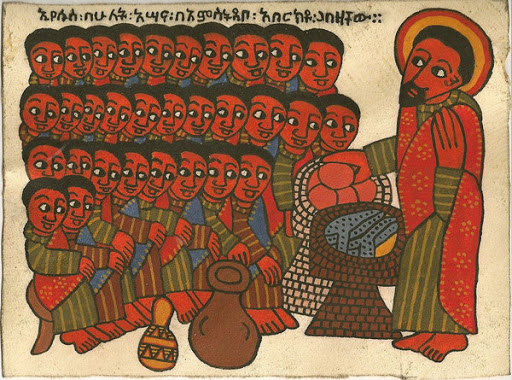
**Above: Ethiopian Orthodox Church depiction of Christ feeding the 5,000