Joshua 20:1-9 – Asylum

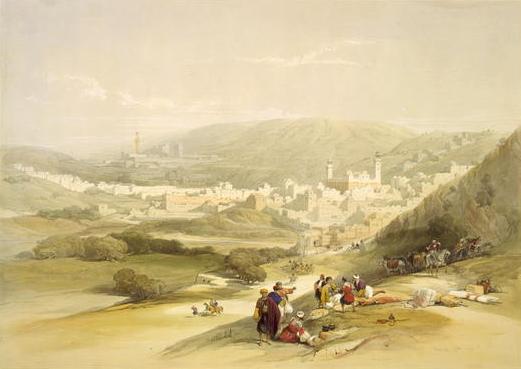
A painting of Hebron, one of the cities of refuge, 1839.

The Lord said to Joshua, “Now tell the Israelites to designate the cities of refuge, as I instructed Moses. Anyone who kills another person accidentally and unintentionally can run to one of these cities; they will be places of refuge from relatives seeking revenge for the person who was killed.

“Upon reaching one of these cities, the one who caused the death will appear before the elders at the city gate and present his case. They must allow him to enter the city and give him a place to live among them. If the relatives of the victim come to avenge the killing, the leaders must not release the slayer to them, for he killed the other person unintentionally and without previous hostility. But the slayer must stay in that city and be tried by the local assembly, which will render a judgment. And he must continue to live in that city until the death of the high priest who was in office at the time of the accident. After that, he is free to return to his own home in the town from which he fled.”

The following cities were designated as cities of refuge: Kedesh of Galilee, in the hill country of Naphtali; Shechem, in the hill country of Ephraim; and Kiriath-arba (that is, Hebron), in the hill country of Judah. On the east side of the Jordan River, across from Jericho, the following cities were designated: Bezer, in the wilderness plain of the tribe of Reuben; Ramoth in Gilead, in the territory of the tribe of Gad; and Golan in Bashan, in the land of the tribe of Manasseh. These cities were set apart for all the Israelites as well as the foreigners living among them. Anyone who accidentally killed another person could take refuge in one of these cities. In this way, they could escape being killed in revenge prior to standing trial before the local assembly. (NLT)

God is concerned for justice. The Lord made sure that as soon as the Israelites got into the Promised Land that the divine rule of law would be established concerning cities of refuge. God did not take the stance of saying, “Well, these guys need to get settled in after all this military campaigning. I don’t want to overwhelm them with having to deal with this issue.” No, the Lord considered it imperative to have the cities set up. It was important enough to not put off or wait for Joshua to get around to it, even though it was on his to-do list.

The six cities of refuge in Israel.

God made it clear to Moses what was to happen in the case of involuntary manslaughter:

When the Lord your God has destroyed the nations whose land he is giving you, and when you have driven them out and settled in their towns and houses, then set aside for yourselves three cities in the land the Lord your God is giving you to possess. Determine the distances involved and divide into three parts the land the Lord your God is giving you as an inheritance, so that a person who kills someone may flee for refuge to one of these cities.

This is the rule concerning anyone who kills a person and flees there for safety—anyone who kills a neighbor unintentionally, without malice aforethought. For instance, a man may go into the forest with his neighbor to cut wood, and as he swings his ax to fell a tree, the head may fly off and hit his neighbor and kill him. That man may flee to one of these cities and save his life. Otherwise, the avenger of blood might pursue him in a rage, overtake him if the distance is too great, and kill him even though he is not deserving of death, since he did it to his neighbor without malice aforethought. Therefore, I command you to set aside for yourselves three cities. (Deuteronomy 19:1-7, NIV)

A city of refuge is a place of safety where someone who murdered another unintentionally could seek asylum. Safeguarding life is a premium value for God. If one person is accidentally killed, the last thing the Lord wanted was even more innocent blood to be shed out of vengeance.

Law and grace are meant to exist together for the benefit of the entire nation.

Six cities are named, three on the west side of the Jordan River and three on the east side. No place in the land of Israel was more than one day’s journey from at least one of these cities, so God graciously provided ample opportunity for preserving the life of the one who killed without malicious forethought or intent.

Although sanctuary was given, there was a full investigation of the killing to ensure the innocence of the killer. If the killer was found to be guilty, then appropriate legal action was taken. If not, the person was only protected while within the bounds of the refuge city.

Therefore, it is important to approach God’s law and God’s grace not as an either/or but as a both/and. We are to show grace while obeying the law, and we are to maintain just laws when extending grace.

The crime should fit the punishment, and actions, even unintended ones, have consequences.

We need to continually work to uphold both law and grace together without forfeiting one for the other. Simplistic answers along with cut-and-dried approaches will not do when holding them together. Instead, issues of human life and death are to be given due diligence with examining the situation in all its complexity.

There is to be public respect for the sanctity of human life.

Showing such respect will come through both law and grace. By establishing cities of refuge, God was squelching generational feuds that go on and on and on. Justice will be done, yet it will be done with grace and not by family vendettas and blood feuds, like the Hatfield’s and McCoy’s.

God’s people are to live differently, with gracious respect for all life at the forefront of civil law.

Lord God, thank you for creating human life in your image and likeness, for the inherent worth you place on human existence. Help us to uphold the sanctity of life in our communities. Give us the strength to stand up to those forces that seek to destroy the lives of those most vulnerable. Today I commit myself never to be silent, never to be passive, never to be forgetful of respecting life. I commit myself to protecting and defending the sacredness of life according to your will, through Christ our Lord. Amen.

Joshua 8:30-35 – Recall the Ancient Ways

One day, Joshua led the people of Israel to Mount Ebal, where he told some of his men, “Build an altar for offering sacrifices to the Lord. And use stones that have never been cut with iron tools, because that is what Moses taught in The Book of the Law.”

Joshua offered sacrifices to please the Lord and to ask his blessing. Then with the Israelites still watching, he copied parts of The Book of the Law of Moses onto stones.

Moses had said that everyone in Israel was to go to the valley between Mount Ebal and Mount Gerizim, where they were to be blessed. So, everyone went there, including the foreigners, the leaders, officials, and judges. Half of the people stood on one side of the valley, and half on the other side, with the priests from the Levi tribe standing in the middle with the sacred chest. Then in a loud voice, Joshua read the blessings and curses from The Book of the Law of Moses. (CEV)

The ancient Israelites were in the Promised Land. Finally! It was quite the circuitous journey to get to this point. It might have been easy to kick back and celebrate. However, Joshua, their leader, knew there was a prerequisite to jubilation. First, the tone had to be set for how they were going to live and be as the inhabitants of this land.

So, Joshua gathered the entire nation and copied God’s Law in front of them, as given to Moses from God. Then, in the hearing of all the people, Joshua read the attitudes, activities, and attributes which would bring them ongoing blessing, as well as the behaviors which would bring a curse.

Joshua’s work is paradigmatic for us. Just as Moses received the Law from God and read it to the people; and, then, did it again just before the people started their campaign to enter the land, so Joshua followed his mentor’s lead and did the same. Reminders of God’s work and faithfulness, recollecting God’s gracious commands, and renewing our vows to God are all significant and ongoing works for every generation to emulate.

Why, pray tell, must we engage in such a ritual repeatedly? For two reasons: we tend to forget the things we are supposed to remember; and performing a practice again and again helps press it into our minds and hearts. This is precisely why I am a believer in liturgical worship and following the Christian Year. The redemptive events of Jesus become more than doctrines to believe; they are grafted into the soul by the sheer repetition of practice.

Part of the reason why so many Christian evangelicals have fled the Church is that they received no catechetical instruction again and again through time honored methods of worship and instruction. So, when they left, it was as if there was nothing to leave – it was easy. With little awareness of the great inheritance they possess in the faith, many persons have scant knowledge that what they are leaving is a rich historical tradition with the very things they are searching for but never received.

Oh, my goodness, people of God, it behooves us to pass on the faith in ways which both make sense and are true to the ancient way of the commandments, our apostolic tradition, and of Christ. It will do no good to disparage history, as if it began with Billy Graham. If folks are going to walk away, let them do it with the full cognizance of what they are walking away from. I cannot say I could blame anyone for leaving an eviscerated faith that is no faith, at all.

This very blog is partly dedicated to following the Revised Common Lectionary because it is the continual cycle of following Christ daily and yearly which patiently and profoundly constructs the soul over time.

Psychology as a discipline was established in the late nineteenth and early twentieth centuries largely because of a grand collective loss of memory amongst so many people. Psychological studies vigorously investigated the reason why this phenomenon was so ubiquitous.

It is also noteworthy that the great rise in secularism over the past few centuries before the 1800’s, found an apex at this same time with the introduction of psychology as a bona fide academic discipline. If humanity was meant for living in consistent rhythms of life and faith, then it makes sense that, when taken away, what remains is a massive societal memory loss with large implications for the individual.

We must reverse the curse of sacred memory loss and confusion of mind (Deuteronomy 28:28). We ought to recapture the mind, heart, and spirit for their intended purpose and design. We need metaphysicians who will do the important work of soul craft and bring blessings yet again to the world. There is some urgency to mentoring others in the faith, as the Apostle Paul did with his young protégé Timothy:

“You have heard my message, and it’s been confirmed by many witnesses. Entrust this message to faithful individuals who will be competent to teach others.” (2 Timothy 2:2, GW)

Spiritual care and connection are not optional – they are a necessity we cannot live without. A spiritual cultivation and tending of the soul have positive effects on our stress and overall well-being. Spirituality brings health and vitality to our psychosocial selves and reinforces integrity and excellence in relating to others.

So, let us not jettison the important work of tending the soul through ancient practices of breathing, reading, reflecting, contemplating, praying, worshiping, and applying the work of Christ to our world’s greatest issues and needs.

Almighty and everlasting God, in Christ you have revealed your glory among the nations: Preserve the works of your mercy, that your Church throughout the world may persevere with steadfast faith in the confession of your Name; through Jesus Christ our Lord, who lives and reigns with you and the Holy Spirit, one God, for ever and ever. Amen.

Psalm 78:1-7 – For the Next Generation

O my people, listen to my instructions.
    Open your ears to what I am saying,
    for I will speak to you in a parable.
I will teach you hidden lessons from our past—
    stories we have heard and known,
    stories our ancestors handed down to us.
We will not hide these truths from our children;
    we will tell the next generation
about the glorious deeds of the Lord,
    about his power and his mighty wonders.
For he issued his laws to Jacob;
    he gave his instructions to Israel.
He commanded our ancestors
    to teach them to their children,
so the next generation might know them—
    even the children not yet born—
    and they in turn will teach their own children.
So each generation should set its hope anew on God,
    not forgetting his glorious miracles
    and obeying his commands. (NLT)

Every generation needs to recall and renew their ancestral faith – not in a wooden or bland acceptance but through vigorous retrospection of God’s past actions applied to present life. This happens primarily through the telling and retelling of stories. Both verbal and written history play a significant role in shaping current and future generations for ongoing faith.

Discussing God and Scripture need not be forced nor awkward. Most people like talking about things important to them. I have no problem talking about the latest books I am reading, my kids and grandkids, and bacon, simply because they are such a big part of my life. Conversations about these and other subjects arise organically out of the time and attention I have given them over so many years.

One of the best ways to live into faith and pass the baton is to regularly spend time with God through consistent Bible reading, heartfelt worship, earnest prayer, ongoing fellowship, participation in service, and other opportunities to learn about God. Talking about Jesus is to be an organic thing from a heart-wellspring that loves God and ponders divine commands.

The passing along of faith needs some intentional purpose and planning. When it comes to family, we can be willing and ready to ask good questions, instead of merely barfing out information. Typically, when my girls were growing up, most of our conversations around the table would center around one question I asked. We discussed it, talked about it, and mulled it over together. Sometimes, the question was deeply theological, and other times it was an intensely practical question. My wife and I often had others share a meal with us, and I would usually ask them to tell their “God story” or to participate with us in the question. If they were not followers of Jesus, I would ask them what they thought about him, and why, as well as tell us about their own religion.

Passing on the faith to the next generations is a sacred trust God has given to us. Embrace it within the home by talking about God and God’s Holy Word as a regular part of your everyday life, and freely converse in public, as well. The following are a few ways of impressing faith to younger generations:

  1. Train them to lead. Adults do not have to do everything. Everyone from toddlers to teenagers can be empowered to serve, if we will take up the challenge to mentor them. When my girls still lived at home, I took at least one of them everywhere I went; it made no difference what it was, whether to the grocery store, on a hospital visit, or even a church meeting. Serving is now second nature to them, part of the air they breathe.
  2. Show empathy to young persons and young families. Any old fool can criticize younger generations about their lack of involvement and how they are always on social media. The wise person will recognize they need our help, not our judgment. To have empathy for them means we recognize they are just trying to do the best they can in this crazy world we live in – a world very different than the one many of us grew up in. It is a hard world, one that is extremely competitive, requiring an offbeat energy and drive than previous generations. Being a student today is not like being a student when I was a kid. And being a young parent is not the same today as it once was. Today’s family structure is completely changed; what we think of as a traditional family only makes up 7% of the American population. The needed response is not to criticize but to empathize and find ways to help.
  3. More dialogue, less monologue. Discussion, conversation, questions, and mutual sharing are the ways Jesus developed his followers, and it is a way that we can likely reach younger generations. Dialogue will go much further than just telling others what they should believe and do. I admit I had to learn this one the hard way. Being a preacher does not always translate well at home.
  4. Adopt a young person, or a young family. If you consider yourself within an older generation, seriously think about taking a younger person or even family under your wing who is not related to you.
  5. Look for ways to support children, teens, and young families. Prioritizing younger generations will mean they do not have to do everything our way. Instead, we will commit to listening for what they tell us they need to love God and build into their own kids’ lives.
  6. Be a great neighbor. Again, any common curmudgeon can crank on about how messed up the world is. However, the wise person will focus on teaching, empowering, and developing young people into good neighbors who engage their local community and the world by addressing issues with great love and lots of compassion.

Lord God Almighty, I believe. I wish for the next generations to believe in you, too. So, let my faith be full and unreserved; let it penetrate all my thoughts and ways. Let my faith be joyful, worthy of being emulated by others. Give peace and gladness to my spirit so that it may shine forth in all my conversations, whether sacred or secular. Let my faith be humble and fully surrendered to the work of your Holy Spirit, for the sake of Jesus Christ my Lord. Amen.

Psalm 128 – Blessed

The Lord will bless you 
    if you respect him 
    and obey his laws. 
Your fields will produce, 
    and you will be happy 
    and all will go well. 
Your wife will be as fruitful 
    as a grapevine, 
and just as an olive tree 
    is rich with olives, 
    your home will be rich 
    with healthy children. 
That is how the Lord will bless 
    everyone who respects him. 

I pray that the Lord 
    will bless you from Zion 
    and let Jerusalem prosper 
    as long as you live. 
May you live long enough 
    to see your grandchildren. 
    Let’s pray for peace in Israel! (CEV) 

There is a consistent connection between obedience and blessing. That is, in observing God’s ways, one will typically enjoy divine favor and approval.  

Keep in mind, however, this is not a math equation. Like 2+2=4 there are folks who expect a neat linear connection between their obedience and their blessing. In math theology, when a woman is unable to have children, or a child goes astray from their heritage, the parent concludes that they themselves must have been unfaithful to God’s law or are being punished. Conversely, with children who grow to be good citizens and respectful persons, the parents might conclude it was because of their superior observance to the spiritual life. 

In both cases, parents take too much credit, either for a child’s wandering or success. As for kids going astray, even God had prodigal children, so cut ourselves some slack. As for children who maintain faithfulness, a lot of factors went into who they are. I suppose it is only natural to quickly assume we have far more control of than we really do. 

This all cuts to the heart of biblical interpretation. If all Scripture is read literally, then we will likely see the Bible as a math equation where doing and saying the right things gets a predictable result of blessing. Yet, this mistakenly views promise and proverb as the same thing, and divine work with one person or group will be precisely the same for another. The wisdom literature of Scripture, which includes the psalms, were never designed as prescriptive decree but rather as the sage approach for work, worship, and family. 

Today’s psalm communicates the path of happiness coming through love and respect for God. It neither promises lots of kids, ensures money, nor guarantees smooth sailing. Rather, when one lives each day being cognizant and observant to center everything around the divine, then blessing and happiness will tend to follow. 

Blessings and benedictions are given to sustain us in hope and confidence. The best things in life usually come through faith and family. So, when we choose to walk with God and travel down the ethical road, then life becomes full of peace and prosperity – perhaps not always in the manner we expect, yet blessing, nonetheless. 

Humanity is hard-wired for blessing, for a steady diet of encouragement, acceptance, and approval from God and others. When this is withheld from us, unhappiness, even despair begins to settle. Giving and receiving blessing is at the heart of being fully human and alive. Our work and family life will likely be miserable if blessing is absent. Yet, with blessing, we have a sustainable form of happiness and enjoyment. 

Eternal God, by whose power we are created and by whose love we are redeemed, guide, strengthen, and bless us through your Spirit so that we may give ourselves to your service and live today in love to one another and to you, through Jesus Christ our Lord. Amen.