Incline your ear, O Lord, and answer me,
for I am poor and needy.
Preserve my life, for I am devoted to you;
save your servant who trusts in you.
You are my God; be gracious to me, O Lord,
for to you do I cry all day long.
Gladden the soul of your servant,
for to you, O Lord, I lift up my soul.
For you, O Lord, are good and forgiving,
abounding in steadfast love to all who call on you.
Give ear, O Lord, to my prayer;
listen to my cry of supplication.
In the day of my trouble I call on you,
for you will answer me.
There is none like you among the gods, O Lord,
nor are there any works like yours.
All the nations you have made shall come
and bow down before you, O Lord,
and shall glorify your name.
For you are great and do wondrous things;
you alone are God. (NRSV)
What is your view of God? For some, God is up there, somewhere, like some white-bearded old guy who is aloof to what is going on down here – there is neither anything personal nor personable about him, at all. For others, God is a force which binds all things together; he is there, but you’re never quite sure how to get in touch with him – it’s like a crap shoot trying to connect with him. For yet others, God is perpetually perturbed about something; he’s got a bee in his bonnet and it’s our job to figure out what he’s sullen and upset about all the time so that we might appease him in some way.
The psalmist, David, sees God in wholly other ways than all the aforementioned. For David, God is personal, knowable, and very reachable. Reading this psalm tells us a great deal of how David thought about God. Notice what we learn about God from the way David describes him: good and forgiving; abounding in steadfast love; listens and answers; and, does great and wondrous things.
Now this is a God you can sink your teeth into. He is attentive, engaged, and is anything but upset all the time. This is the reason why David has no problem asking God to listen and answer his prayer. David put his trust in God to save him and make his heart glad. With this kind of God, David can willingly affirm his devotion.
If your view of God cannot support and bear the weight of your life’s hardest circumstances, then you need a different view of God! I invite you to see the God of David. This God has the ability within himself to satisfy your life’s greatest needs. We call out in our misery. God responds in his love and mercy. With God, we can move from trouble to confidence.
Great God of David, you are above all things and beside all things and with all things. You are uniquely positioned and powerful to walk with me through all the situations of my life. Thank you for sending the Son of David to make real your promises to me. Amen.
Jesus carrying his cross, from the Stations of the Cross at Holy Hill in Hubertus, Wisconsin.
It is not to angels that he [God] has subjected the world to come, about which we are speaking. But there is a place where someone has testified:
“What is mankind that you are mindful of them,
a son of man that you care for him? You made them a little lower than the angels;
you crowned them with glory and honor and put everything under their feet.”
In putting everything under them, God left nothing that is not subject to them. Yet at present we do not see everything subject to them. But we do see Jesus, who was made lower than the angels for a little while, now crowned with glory and honor because he suffered death, so that by the grace of God he might taste death for everyone. (NIV)
By Christmas eve of 1914, World War I had come to the point of trench warfare. On one point along the miles of trenches, there were the allied troops of French and Scots, and on the other side, the Germans. That night one Frenchman began singing Nuit Silencieuse(Silent Night). Eventually his comrades joined in. Much to their surprise, the Germans on the other side of the trench, recognizing the familiar tune, began singing in their native tongue, Stille Nacht, along with them. The Scots then joined in with their bagpipes. After the song, heads began to stick out from the trenches as both sides realized they had a common celebration in song. This led to the white flags going up on both sides, and then the unthinkable happened. Both trenches, allied and axis powers, enemies of one another, left their holes in the ground and met in the middle, exchanging pictures, and communicating with each other. The evening was capped off with the Scottish chaplain leading all the men together in a celebration of communion. The 2006 movie, Joyeux Noel, recounts the actual events.
Whenever we come together, expressed most highly for the Christian through the sacrament of communion, it puts our differences in their proper perspective – we all come together as one, not seeing each other as rich or poor, black or white, American or Asian, or anything else. The events of that Christmas eve in 1914, however, did not have a happy ending. The two sides found that, once the holiday had passed, they did not have the will to fight their new brothers. The top brass on each side were very upset and sent the Germans to the Russian front (and certain death); and, the Scottish chaplain was defrocked for his actions and sent home never to pastor again, letting us see in dramatic fashion that unity has a price.
Scene from Joyeux Noel, 2006. A Scot, German, and Frenchman together on Christmas Eve on the western front of World War I.
The book of Hebrews was originally written (or preached) to encourage and exhort struggling Jewish Christians. The way the author of Hebrews did that was to point them squarely at Jesus. They were in danger of forgetting what the pioneer and champion of their salvation had done for them, and, what is more, they were in danger of reneging on their commitment to Christ. So, the entire book is dedicated to demonstrating and reminding discouraged believers that Jesus Christ is superior to everything, both in heaven and on earth. Because of that truth, Jesus is worthy of our eternal devotion and remembrance.
Jesus is qualified to be our Savior and Lord. Every day and each minute of our lives are an opportunity for a fresh commitment to Jesus. The regular practice of Christian communion and consistent spiritual practices are meant to lead us into celebrating our Savior’s work. The worldwide communion of saints is celebrating with us in remembering and committing ourselves afresh to the lordship of Jesus Christ. A great victory has been won, not just in the trenches of human wars, but on the cross of Christ. This singular death on our behalf qualified Jesus to be our Savior from sin, once and for all.
Christ’s suffering qualified him to be our Savior.
Jesus suffered an inglorious and ignominious death. Yet, paradoxically, glory came through suffering. Jesus did not only suffer at his crucifixion; he experienced the full range of human suffering throughout his life. He knew what it was like to face adversity and hardship. It is Christ’s suffering that helps us make sense of our own suffering. We can only truly be free from all that binds us by embracing that which makes us suffer. And because we live in a fallen world, we all personally suffer in some way. In addition, entire groups of people suffer – whether it is religious persecution, racial profiling, class warfare, or government oppression. This suffering is very much real, damaging, and dehumanizing which results in terrible living conditions and even death.
Maybe because of this reality, some tend to minimize their own suffering. After all, what is a harshly worded e-mail, trying to lose a few extra pounds, or an unexpected car repair compared to families devastated by COVID-19 and entire black neighborhoods in deathly peril? It is all suffering none-the-less. It is good to keep our life situations in proper perspective; and, we must be careful to not tell God what he should and shouldn’t care about in this world. If the only things that matter and qualify as hardship and difficulty is human trafficking, the terrors of war, or grinding poverty, then you will soon find yourself plastering a smile on your face and nodding over-enthusiastically whenever someone asks you how you are doing. Happy with-it Christians are insufferable, (pun intended).
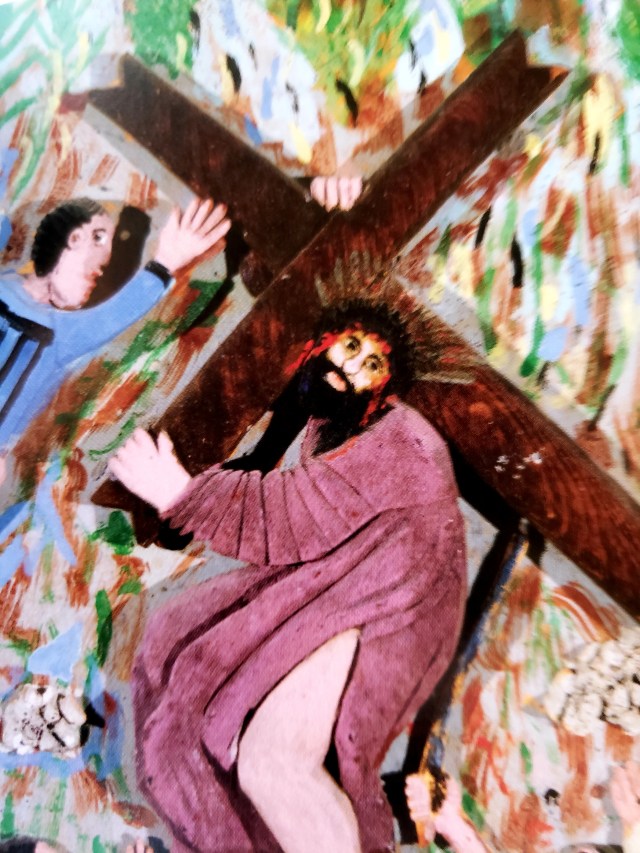
Christ Carrying the Cross by Elijah Pierce, 1892-1984.
It is our task to find commonality and solidarity with Jesus in our own personal and corporate suffering. An admission of weakness, trouble, hardship, or suffering is neither a lack of faith nor the unpardonable sin. We know there must be a Good Friday before there is an Easter. Identifying with the adversity of our brothers and sisters in Christ throughout this nation and the world can be transformed into suffering that has meaning and significance. Our temporary sufferings now will someday result in the glory of being with Christ forever.
Christ’s suffering qualified him to be our compassionate helper.
Through the death of Jesus on the cross we have victory over Satan and all his wicked spirits. I have heard more than one motivational speaker say: “If you could do one thing in your life and not be able to fail, what would it be?” The truth is, because of Christ’s atoning sacrifice, we have victory and can live our lives in confidence and commitment to Jesus. What is more, we know that temporary failures and failings are not the end of the story. We possess a union with Christ because of the cross. Jesus is our champion. He stands with us in our suffering and temptations.
Christian speaker, author, and professor emeritus, Tony Campolo, told a story about observing communion when he was a child: “Sitting with my parents at a Communion service when I was very young, perhaps six or seven years old, I became aware of a young woman in the pew in front of us who was sobbing and shaking. The minister had just finished reading the passage of Scripture written by Paul that says, ‘Whosoever shall eat the bread and drink the cup of the Lord unworthily, shall be guilty of the body and blood of the Lord’ (1 Corinthians 11:27). As the Communion plate with its small pieces of bread was passed to the crying woman before me, she waved it away and then lowered her head in despair. It was then that my Sicilian father leaned over her shoulder and, in his broken English, said sternly, ‘Take it, girl! It was meant for you. Do you hear me?’ She raised her head and nodded—and then she took the bread and ate it. I knew that at that moment a heavy burden was lifted from her heart and mind. Since then, I have always known that a church that could offer communion to hurting people was a special gift from God.”
In solidarity with all who suffer, along with your brothers and sisters who agonize throughout the world, we have the blessed opportunity of bringing our troubles to a gracious God – thus finding forgiveness and hope. May your burdens be lifted, and may you know Christ, and him crucified, died, buried, risen, ascended, and coming again. For, precious one, he knows you because he tasted death for you – for everyone.
Merciful Lord help me to remember in these troubled times the cross you carried for my sake so that I may better carry mine and help others do the same. Since you tasted death that I might taste life, I forever belong to you and offer up all that I am and all I hope to be to the glory of Jesus Christ through the power of the Holy Spirit. Amen.
The Israelites gathered for a day of fasting. They wore sackcloth and put ashes on their heads to show they were sad and upset. Those people who were true Israelites separated themselves from foreigners. The Israelites stood and confessed their sins and the sins of their ancestors. They stood there for about three hours, and the people read the Book of the Law of the Lord their God. Then for three more hours they confessed their sins and bowed down to worship the Lord their God….
They said, “Stand up and praise the Lord your God! God has always lived and will live forever.
People should praise your glorious name.
May your name be lifted above all blessing and praise.
You are God.
Lord, only you are God.
You made the sky and the highest heavens
and everything in them.
You made the earth
and everything on it.
You made the seas
and everything in them.
You give life to everything.
All the heavenly angels bow down and worship you.
You are the Lord,
the God who chose Abram.
You led him from Ur in Babylonia.
You changed his name to Abraham.
You saw he was true and loyal to you,
and you made an agreement with him.
You promised to give him the land
of the Canaanites, Hittites, Amorites, Perizzites, Jebusites, and Girgashites.
But you promised to give that land to Abraham’s descendants.
And you kept your promise because you are good.” (ERV)
We have many examples in Holy Scripture of people coming together for corporate prayers to confess sin. Today’s Old Testament lesson is a representation of such a confession. I understand that many churches, especially in the western world, jettisoned prayers of confession in their corporate worship services long ago. Eschewing rituals, such gatherings of believers have the inclination to be neither liturgical nor focus on such a negative subject as extended focus on sin through confessing prayer.
Yet, here we are, in the Bible, with a prayer of confession before us. There’s no getting around it: without prayers of confession, we are left in the realm of human pride and hubris – believing we can tackle whatever is in front of us with a solid dose of Protestant work ethic and robust free will. I hate to burst your bubble (no, I confess I really like bursting bubbles!) where there is no confession of sin, both personal and corporate, there is no righteousness and no eternal life.
“If only it were all so simple! If only there were evil people somewhere insidiously committing evil deeds, and it were necessary only to separate them from the rest of us and destroy them. But the line dividing good and evil cuts through the heart of every human being. And who is willing to destroy a piece of their own heart?”—Aleksandr Solzhenitsyn
Prayers of confession invite us to voice what is in the darkest places of our hearts. – to be raw and real about our own sin, as well as the sins of the world. Speaking aloud such words do not come naturally, which is why we need to graft these types of prayers into our life and worship. Naming with honesty and sincerity our personal and collective sins becomes liberating when we sense the immensity of God’s grace. Whereas in most situations, we do not feel safe to name our sins, in the presence of God we are empowered by his love to call forth and bring to light the deepest and darkest shadows of our personal lives and of our society.
A full-frontal prayer of confession acknowledges that our sin is more than a random example of bad judgment. We are sinful people, living in a sinful world, and we absolutely need a Savior! Our confessions of sin also acknowledge and bring to light that sin is a power that resides not only within individual persons but also has infected every society, institution, structure, and even church. An authentic confession of sin admits complicit participation in the structures of evil which exist everywhere.
What is more, a simple observation of the Israelites’ prayer notices that they were not only repenting of their own sin; they freely recognized and professed their ancestor’s sins, as well. Sin never simply dies with the person – it infects and influences the next generation. And unless we come to grips with this terrible reality, we will keep perpetuating the sins of our ancestors.
Which is why it is so vitally important that right now the people of God admit and confess the sins of their slaveholder ancestors, as well as affirm our implicit bias against people different than us and our complicity in perpetuating racism through our silence, unquestioning allegiance to particular political parties, and assuming we should always be in power because we are the best persons to do it. So, then, here is a prayer of confession concerning our present situation of racism:
Merciful God, we confess that we have sinned against you in thought, word, and deed, by what we and our ancestors have done in the past, and by what we have left undone in the present through: allowing racism to continue and evolve in our social systems of economics and education; not reforming criminal justice; discriminating in housing and practicing gentrification; and, suppressing voting rights. In our racial geography and, painfully, in the continuing segregation of our churches, we have been complicit in racism through the betrayal of silence.
Holy God, we have not loved people of color as ourselves. We confess we have let ourselves off the hook by viewing racism as mere individual behavior, language, and overt hostility; and, have failed to see racism as systemic and structural, harming people of color in very specific, measurable, and tangible ways.
God Almighty, in your mercy forgive us for being racist, help us amend what we are, and direct what we shall be so that we, along with all people, may delight in your will and walk in your ways to the glory of Jesus Christ in the power of your Holy Spirit. Amen.
“Grow in the grace and knowledge of our Lord and Savior Jesus Christ.” (2 Peter 3:18)
We ought always to thank God for you, brothers and sisters loved by the Lord, because God chose you as first-fruits to be saved through the sanctifying work of the Spirit and through belief in the truth. He called you to this through our gospel, that you might share in the glory of our Lord Jesus Christ.
So then, brothers and sisters, stand firm and hold fast to the teachings we passed on to you, whether by word of mouth or by letter.
May our Lord Jesus Christ himself and God our Father, who loved us and by his grace gave us eternal encouragement and good hope, encourage your hearts, and strengthen you in every good deed and word.
As for other matters brothers and sisters, pray for us that the message of the Lord may spread rapidly and be honored, just as it was with you. And pray that we may be delivered from wicked and evil people, for not everyone has faith. But the Lord is faithful, and he will strengthen you and protect you from the evil one. We have confidence in the Lord that you are doing and will continue to do the things we command. May the Lord direct your hearts into God’s love and Christ’s perseverance. (NIV)
As with most sections of Holy Scripture, if we merely focus on this singular passage from the Bible and seek daily to live into its message, it is likely we would live a consistently rich and full spiritual life. As the Apostle Paul said to the Thessalonians, and indeed to us, standing firm and holding a solid grip on apostolic teaching will mean a daily life of loving words and actions.
Notice the many elements of this Scripture for us to spotlight for our spiritual lives: gratitude; salvation; sanctification; truth; spiritual calling; sharing in God’s glory; love; grace; hope; encouragement; prayer; faithfulness; perseverance; and, deliverance. We could even highlight just one of these words and, if seeking to do a deep dive with it, could spend unending days learning and living into its multi-faceted dimensions.
I want to pause here and do a bit of a check-in with you. How we approach this passage of Scripture, as well as any other verses which encourage us to hold onto sound teaching and living, will likely determine our level of joy, satisfaction, confidence, and success. It all begins with our view of self. If we come at the Christian life and Holy Scripture with a view of self as a mere tool or object for God’s use – then we are truly objectifying ourselves.
The key point of awareness to realizing whether we have such an objectifying view is if we continually “should” ourselves. The word “should,” brings self-hatred. We primarily see only shortcomings and original sin – and are blind to the majesty of being in God’s image. In such a view there is typically boat loads of shame for not living up to the ideal form of a devoted Christian. Belittling ourselves inwardly only transfers outwardly to looking down on others for their failures. Any exhortation from me or anybody else would be seen in this view as a demanding duty.
“The gospel is bearing fruit and growing throughout the whole world—just as it has been doing among you since the day you heard it and truly understood God’s grace.” (Colossians 1:6)
Instead, we can come to Scripture’s admonitions, encouragements, and exhortations with the glasses of grace. After all, our text for today says that God loved us and by his grace gave us this teaching. The dense amount of Christian living in such a few verses, when viewed through the lenses of grace, are merciful words communicating support. God wants to strengthen us with grace just because he loves us. God does not objectify us by seeing us as pawns in some twisted divine game for his own cosmic pleasure. Rather, God is looking to direct our hearts toward a delight in his love. Because it is only with love and grace that we can really persevere throughout our Christian lives.
Not everyone has faith, and that saddens the heart of God. It also puts us, at times, in awkward situations. Again, the love of God does not leave us alone. Divine love will strengthen and protect us. The Apostle Paul never wags his finger and levels the “should” on us like some uptight legalist. Paul expresses confidence, knowing that we most certainly have the capacity to live the will of God. The Scriptures are given to engender strengthening of faith and spiritual growth rather than self-hatred, which has a nasty tendency to come out sideways in a lack of compassion and grace toward others.
This letter was written by Paul to the church because they were finding it difficult to endure their hard circumstances. The Thessalonian Christians began longing for heaven to such a degree that they were losing their grip on living presently in the moment of now. This is part of the reason why Paul encouraged them to pray for him and his colleagues. The people needed to put some focus on the now of spreading the message of God’s grace.
To be rather frank, truth be told, the chief reason I write these daily reflections on Scripture is because I need God’s Word. Yes, I do write for the reader. I want to contribute to people’s growth in grace and I have a deep desire to make the message known. Yet, honestly, I write more for myself. This is a way for me to remind myself of God’s love and grace and utilize it every day.
When I hear Paul talking in biblical texts like these, I detect some of the same reason – Paul himself wants to continue growing in grace, and when writing to and for others he is very much writing to himself. The reading of the Bible and the dedication to living its message is meant to be life-giving, or rather, eternally life-giving.
So, today, I leave with this blessing:
May you take refuge in the wondrous grace of God, and all the little miracles of mercy which he bestows each day.
May you always be inclined to rush into God’s Holy Word and discover its life working within you.
May you imitate the flower as it opens to the day’s sunshine in receiving all that God has for you this day.
May you be in solidarity with brother stone, who sits in silence, calm and secure, and be excessively gentle with yourself.
May you wisely steer clear of those vexed in spirit with only God knows what; and, when in that space of others walking all over your boundaries, may your confidence surge and God’s protection deliver you.
May you return to the glory that is yourself, learning a new respect for your heart, and the joy that has always been there, given graciously to you by a God who has invited you to share in Jesus Christ.








 Rev. Tim Ehrhardt