Numbers 10:11-36

            These verses from the book of Numbers might, at first glance, seem irrelevant to contemporary worshipers of God.  Numbers matter-of-factly informs us of how the ancient Israelites set out in the desert by stages according to their respective tribes and how they proceeded when stopping their sojourns.  Yet, if we take the time to engage in pilgrimage with the Israelites, we observe the heart of worship and life for God’s people.
 
            The tabernacle, that is, the ark of the covenant with its accompanying tent and holy articles, was the primary symbol for Israel of God’s presence.  As such, the tabernacle was at the actual center of Israelite life, both physically and spiritually.  The tabernacle would leave first and be set up by the tribe of Levites before the other tribes came and encamped around it.
 
            Observing this constant ancient ritual in the desert begs several questions for us today:  Is God at the center of our life and worship?  Or, do we expect him to come and bless our already camped out thoughts, ideas, and practices?  If God is truly at the center of all we do, what is the evidence that this is so?  Are we patient to wait for God’s leading to present itself?  Or, do we act and then seek God to give his stamp of approval over it?  The wise believer will allow God to set the agenda and pace of our life journey, and not the other way around.
            Sovereign God, you always lead in a way that is good, just, and right.  Help me to slow down long enough to enter into the rest and connection with your will that I so desperately need through Jesus my Lord.  Amen.

2 Samuel 2:1-11

            Power is never a neutral thing.  Power is either used to further a personal or special interest group agenda by using its considerable weight, or power is employed for the benefit of others in order to ensure the common good of all.  Ancient kings held nearly absolute power, and many were corrupted by its addictive allure to hold onto it at any cost.  So, when David became the king of Judah he immediately demonstrated why he was going to be a king that applied power differently than most earthly kings.
 
            The previous king, Saul, had been seduced by power and sought to hold that power by any means possible.  This meant David was a rival and had to go.  A large chunk of chapters in the book of 1 Samuel are given to a cat and mouse act of Saul chasing David, never quite getting ahold of him.  Now Saul is dead, killed in battle.  Any run-of-the-mill new king would act quickly and decisively to consolidate power and snuff out any potential faction to the throne.  But, instead, David’s initial response after Saul’s death was to inquire of the Lord and determine specifically what he should do according to God’s will.
 
            We should not pass over this detail too quickly because this was an unprecedented disposition for a king to adopt.  King David did not simply make presumptions about what to do.  Not only did David allow the men loyal to the deceased King Saul to live, he blessed them and actively sought to do them good.  This is precisely why David was a man after God’s own heart:  he acted in a manner that reflected the character of God.  God shows steadfast love and faithfulness to people; David showed the same grace and commitment toward others.  God woos people to himself through kindness instead of throwing his weight around and shoving people into the kingdom; David acted deftly and wisely toward others who did not readily acknowledge him as king through blessing instead of misusing his power.
 
            If we want to be people of influence; if we desire to see the kingdom of God expand; if we seek to have the church grow; then, we must exercise our given power in ways consistent with how King David used his power.  Prayer, discernment, and listening to the Spirit of God are the means of the right use of the resurrection power provided for us.
            Mighty God, you have demonstrated your power in many ways in creating life and giving new life.  I look to you in all things so that my words and actions will reflect your grace and kindness toward everyone I encounter, whether they are for me or against me.  Through the strong name of Jesus I pray.  Amen.

1 Chronicles 10:1-14

            The books of Samuel and Chronicles contain, for the most part, the same content and material concerning the kings of Israel and Judah. Yet, whereas 1 & 2 Samuel gives a more straightforward narrative, 1 & 2 Chronicles often provides the narrative with explanatory comments.  So, we have such a story in today’s Old Testament lesson.  The last chapter of 1 Samuel gives an account of King Saul’s death, along with his sons.  However, in 1 Chronicles 10, we get the narration of their deaths along with a clear concise note on why King Saul perished in battle:
 
“So, Saul died for his breach of faith.  He broke faith with the LORD in that he did not keep the command of the LORD, and also consulted a medium, seeking guidance.  He did not seek guidance from the LORD.  Therefore the LORD put him to death and turned the kingdom over to David the son of Jesse” (ESV).
 
            The original compiler of Chronicles did so for the Jewish exiles who were returning to Palestine.  He did not want to simply recount the important stories of the kings of Israel; he wanted the exiles to know exactly why they went into exile to begin with, and how in the future they could keep it from happening again.  So, Saul served as Exhibit A of the kind of person that erodes the true worship of God and lives against the grain of faithfulness to the Lord.
 
            The true measure of a person of God is not in titles, positions, or membership.  The real test of a God-follower is being faithful to the revealed will of God contained in Holy Scripture.  Thus, to read it, know it, and live it is one of our highest callings as God’s people.
            Eternal God, you remain the same throughout the ages of time.  Help me to be faithful to your standard of righteousness and live faithfully into the ways of Jesus, my Lord.  Amen.

The Need for Lament, Part 2


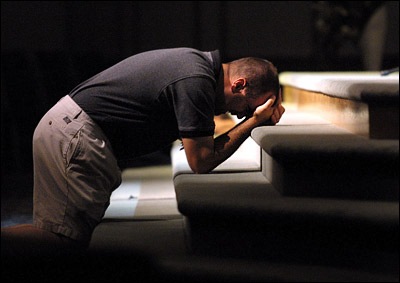
We all accumulate a host of losses over the course of a lifetime.  Many of them are small losses; some of them are devastating losses.  The death of children, disability, rape, abuse, cancer, infertility, suicide, and betrayal are all examples of crushing loss – losses that need to experience lament.  All these losses are irreversible; we cannot return to how things once were.  We must push forward by grieving each loss.  And as we lurch ahead we cling to these words from Holy Scripture:  Because of the LORD’s great love we are not consumed, for his compassions never fail.  They are new every morning; great is your faithfulness (Lamentations 3:22-23).
 
            So, how do we lament our losses in a healthy way?  Here is what the prophet Jeremiah did in the book of Lamentations:
  1. Jeremiah remembered his afflictions and his losses.  We need to avoid superficial repentance and forgiveness.  We must own and feel the pain of the loss before we can begin to offer a mature forgiveness.
  2. Jeremiah paid attention to faith, hope, and love.  This can only be done if we are alert to the process of grieving.  Elizabeth Kubler-Ross was the person who identified the famous five stages of grief:  denial, anger, bargaining, depression, and resolution/acceptance.  We rarely move neatly through each stage.  The important thing is that we get to the place of seeing God’s committed love to us not just in spite of the suffering but because of it.
  3. Jeremiah did not minimize his pain and suffering.  We must sit with our pain.  Do not sluff off a loss by saying others have it worse, or that it is nothing.  Year after year many Christians do not confront the losses of life, minimizing their failures and disappointments.  The result is a profound inability to face pain, and has led to shallow spirituality and an acute lack of compassion.
  4. Jeremiah prophesied about how Jesus grieved.  His message predicted what Jesus faced in his passion.  The prophet Isaiah described the Messiah as a man of sorrows and acquainted with grief (Isaiah 53:3).  Peter Scazzero, in his book The Emotionally Healthy Church, points out what Jesus did not say, and what he did say at particular events in his ministry.  At the tomb of Lazarus, Jesus did not say “Come on everyone, stop all this crying” but wept with the people.  When entering Jerusalem, Jesus did not say “too bad guys, I’m moving on without you” but lamented over the city desiring to gather them as a hen does her chicks.  On the cross, Jesus did not say “Lighten up everyone; God is good; he will be victorious!”  But instead said, “My God, my God, why have you forsaken me?”  Hebrews 5:8 tells us that Jesus “learned obedience from what he suffered.”
Grieving is an indispensable part of a full-orbed spirituality and emotional health.  Life does not always make sense.  There is deep mystery to the ways of God.  The Lord is doing patient and careful work inside of each one of us.  While he is busy within our souls, we will likely feel lost and disconnected, not seeing the full tapestry of what he is creating.  Weariness, loneliness, a sense that prayers are not being heard, and a feeling of helplessness are all common experiences of God’s reconstruction of a broken spirit.
 
People who have truly lamented their losses are not hard to spot.  They have a greater capacity to wait on God and be patient toward others.  They are kinder and more compassionate.  They lack pretense and are liberated from trying to impress others.  They are comfortable with mystery, not having to be certain about every theological minutiae.  They are humble, gentle, and meek.  They are able to see God not only in the glorious and victorious, but in the mundane, banal, and lowly.  They are more at home with themselves and with God.  People transformed through the power of lament are equipped to live and love others as Jesus did.


            So, then, the church really ought to be the best place on planet earth for people to be open in their grief, find openness in love, and effectively move through a process of lament so that they become mature disciples able to help others with the comfort they have received.  Let us pray toward that end.