It’s In the Details (Exodus 28:29-38)

Aaron the High Priest

“Whenever Aaron enters the Holy Place, he will bear the names of the sons of Israel over his heart on the breast-piece of decision as a continuing memorial before the Lord. Also put the Urim and the Thummim in the breast-piece, so they may be over Aaron’s heart whenever he enters the presence of the Lord. Thus Aaron will always bear the means of making decisions for the Israelites over his heart before the Lord.

“Make the robe of the ephod entirely of blue cloth, with an opening for the head in its center. There shall be a woven edge like a collar around this opening, so that it will not tear. Make pomegranates of blue, purple and scarlet yarn around the hem of the robe, with gold bells between them. The gold bells and the pomegranates are to alternate around the hem of the robe. Aaron must wear it when he ministers. The sound of the bells will be heard when he enters the Holy Place before the Lord and when he comes out, so that he will not die.

“Make a plate of pure gold and engrave on it as on a seal: holy to the Lord. Fasten a blue cord to it to attach it to the turban; it is to be on the front of the turban. It will be on Aaron’s forehead, and he will bear the guilt involved in the sacred gifts the Israelites consecrate, whatever their gifts may be. It will be on Aaron’s forehead continually so that they will be acceptable to the Lord. (New International Version)

This area of Holy Scripture is likely not one of the more popular places to read. Frankly, it’s boring and pedantic. Yet, contained within the Bible it is, for us to examine.

After giving Moses the Ten Commandments in Exodus 20, the next several chapters, from Exodus 20-31 contain detailed instructions from God concerning the covenant code stipulations with the Israelites. Plans for liturgical and sacrificial worship are covered with a fine tooth comb. Instructions for building implements for worship are precise.

And the special garments of the priests’ clothing are described in detail, both as to their design and the material to be used. It’s as if we’re all sitting in a virtual meeting just trying to stay awake, let alone pay attention. Yet, the fact of the details lets us know that the plan is important.
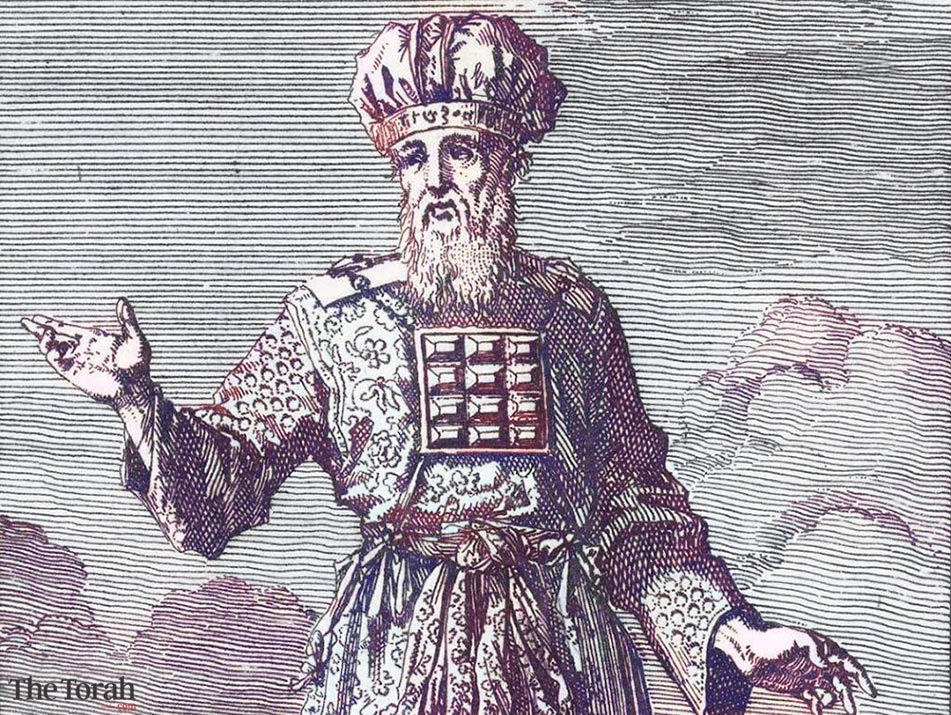
Aaron the High Priest, by Jan Luyken (1669-1712)

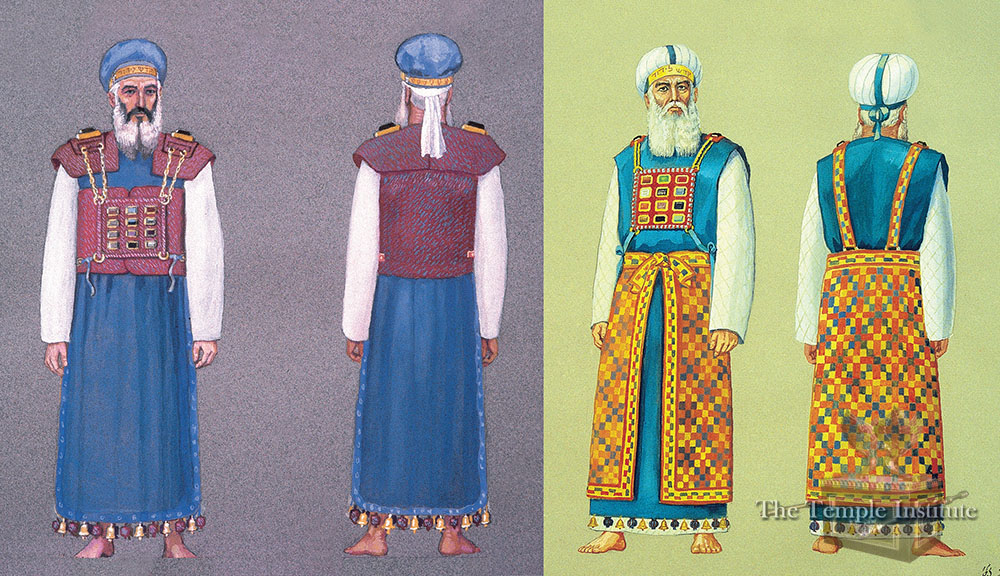
Today’s Old Testament lesson deals specifically with the vestments of Aaron, the first high priest of the covenant. An ephod was made – which is a richly embroidered, apron-like vestment having two shoulder straps and ornamental attachments for securing the breastplate, worn with a waistband. (Exodus 28:1-30)

The garment which Aaron was to wear, when he entered the sacred space, symbolically kept the nation of Israel in front of Yahweh, and also over the high priest’s heart.

There was a robe which covered the ephod, equipped with bells. As Aaron moved, the bells rang, signaling that he was coming into and out of the presence of God. Only the high priest was consecrated to enter the most holy place; and the high priest alone wore the special clothing for the unique service which was done.

The entire ritual of the high priest’s service was a visual display of God’s glory and of the reality that no one may enter God’s presence flippantly or carelessly. God is gracious and merciful; and God also has no tolerance for impurity, unrighteousness, and pride.

God expects divine laws, stipulations, and commands to be obeyed without prejudice. The Israelites could not pick and choose what directives from God they would do, or not do. And that is the core of what holiness before the Lord really is.

An interesting observation about this text of Scripture is that Aaron the high priest is given no instructions or commands about what to say when he entered and then left God’s presence. No mantras. No incantations or formulaic words. The inference is that Aaron was silent.

Instead, the garments spoke. “Holy to the Lord” on the plate affixed to the turban said a lot – along with the ephod and the robe, affirming that holiness is needed in order to make any sort of decisions before God.

We never get an explanation in Scripture about what the Urim and Thummim are – which is why, when translating the words from Hebrew, we merely have English transliterations of them. We only know that they were used when making decisions. Evidently, the high priest was an earthly source of God’s wisdom and direction.

Whatever we think about these verses in the book of Exodus, it seems that we are meant to understand that details matter; and how we go about our obedience, down to the last jot and tittle, matters.
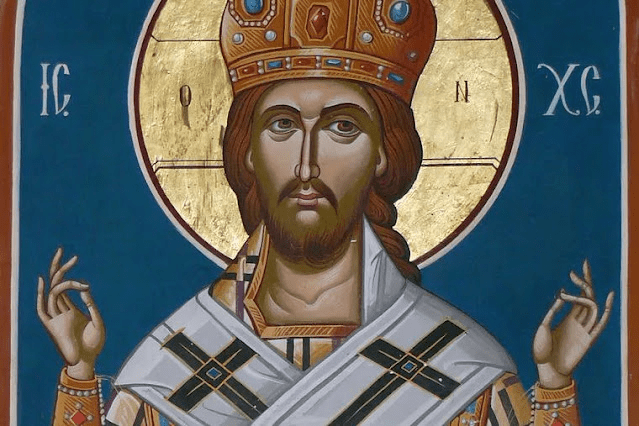
Orthodox icon of Jesus Christ, the High Priest of a New Covenant

In the ministry of Christ, there were people wondering if all of his talk was upending or replacing those detailed imperatives of God. Jesus responded:

“Do not think that I have come to abolish the Law or the Prophets; I have not come to abolish them but to fulfill them. For truly I tell you, until heaven and earth disappear, not the smallest letter, not the least stroke of a pen, will by any means disappear from the Law until everything is accomplished.” (Matthew 5:17-18, NIV)

Jesus furthermore upheld God’s expectation that divine commands be obeyed:

“Therefore anyone who sets aside one of the least of these commands and teaches others accordingly will be called least in the kingdom of heaven, but whoever practices and teaches these commands will be called great in the kingdom of heaven.” (Matthew 5:19, NIV)

At issue was the nature of righteousness – right relations with both God and others. Justice is imperative. Being humble, pure, merciful, and a peacemaker matters. The laws and directives of God are never to be used for walking around like a peacock to display what a wonderfully important and religious person you are.

In other words, the ornate garments of the high priest are not the person; they are special clothing used for a special purpose. Clothes may be important, yet it’s the heart that truly matters. And a heart devoted to God will seek to humbly obey God’s words down to the most minute detail.

O God, by whom the humble are guided, and light rises up in darkness for the godly: Grant us, in all our doubts and uncertainties about obedience, the grace to ask what you would have us to do, that the Spirit of wisdom may save us from all false choices, and that in your light we may see light, and in your straight path may not stumble; through Jesus Christ our Lord. Amen.

The Divine/Human Dialogue (Psalm 95)

Psalm 95: “If today you hear His voice, harden not your heart.” By Gina Lazarchik

Come, let us sing to the Lord!
    Let us shout joyfully to the Rock of our salvation.
Let us come to him with thanksgiving.
    Let us sing psalms of praise to him.
For the Lord is a great God,
    a great King above all gods.
He holds in his hands the depths of the earth
    and the mightiest mountains.
The sea belongs to him, for he made it.
    His hands formed the dry land, too.

Come, let us worship and bow down.
    Let us kneel before the Lord our maker,
    for he is our God.
We are the people he watches over,
    the flock under his care.

If only you would listen to his voice today!
The Lord says, “Don’t harden your hearts as Israel did at Meribah,
    as they did at Massah in the wilderness.
For there your ancestors tested and tried my patience,
    even though they saw everything I did.
For forty years I was angry with them, and I said,
‘They are a people whose hearts turn away from me.
    They refuse to do what I tell them.’
So in my anger I took an oath:
    ‘They will never enter my place of rest.’” (New Living Translation)

Praise and thanksgiving.

Complaining and grumbling.

Those two phrases are antithetical to each other.

And yet, out of the same mouth can come both worship and whining.

Maybe the psalmist was trying to teach us a thing or two by inviting us to sing and bow to the Lord, as well as hear God’s voice.

Worship and listening are meant to go hand in hand. Revelation and response are to be the spiritual rhythm of the believer. True worship is a divine conversation between us and God. The Lord speaks. We listen and answer. Back and forth we go together. God and God’s people are to be involved in a divine/human dialogue.

When the worship rhythm is off, then our response will be off.

And that is what happened to the ancient Israelites. They were miraculously delivered from their cruel bondage in Egypt. You can imagine the kind of praise and worship service the people had in the desert! After four-hundred years of slavery, freedom!

Yet, before you know it, the thanksgiving turned sour; there began some rumblings of grumbling.

At the first encounter of adversity, when there was no water to drink, it was as if the people had some sort of collective dementia take them over. Suddenly, hearts started hardening. Soon, everything coming out of the mouth was a constant stream of complaints, as if the entire world revolved around the complainers.

One minute, hands are raised in praise; the next minute, those same hands clench into fists shaking at God.

The people forgot that life is an ongoing dialogue with God – and not a one and done conversation of revelation and response.

God acted by delivering the people. The people responded with praise and thanksgiving. And they didn’t want it to stop. Yet, all of life is a rhythm. What goes up, comes down. Good times eventually fade into tough times. The real muster of any person or group is the response when the hardship comes.

The Lord purposely brought the Israelites out into the desert to face a difficult circumstance. God was teaching them to trust. The Lord wanted a response of faith and prayer to the adverse situation.

But the people weren’t looking for a dialogue. They were looking for water. And when they didn’t have it, their hearts hardened through murmuring, bellyaching, and dissatisfaction. Then, all the people could see was their own stuff – blinding them to others, especially God.

However, God was still in the conversation. The generation who saw the incredible deliverance from bondage would die in the desert, never setting eyes on the Promised Land. And it all began because of grumbling.

We need to take complaining seriously. Why? Because it rots the soul, like Mr. Grinch who incessantly complained every year about Christmas. Grumbling makes one into a Grinch-like creature, like the song says:

You’re as cuddly as a cactus
You’re as charming as an eel…

You got termites in your smile
You have all the tender sweetness
Of a seasick crocodile…

Your heart’s an empty hole
You got garlic in your soul.

It was only when the Grinch forsook his isolation of complaining and began connecting in conversation with the folks in Whoville, that he had his rhythm restored.

When the divine/human rhythm is off kilter, what will it take to get it back?

The author of the New Testament letter to the Hebrews helps us here. After quoting our psalm lesson for today, the writer responded to the biblical revelation by saying:

Be careful, brothers and sisters, that none of you ever develop a wicked, unbelieving heart that turns away from the living God. Encourage each other every day while you have the opportunity. If you do this, none of you will be deceived by sin and become stubborn. 

After all, we will remain Christ’s partners only if we continue to hold on to our original confidence until the end. Scripture says, “If you hear God speak today, don’t be stubborn. Don’t be stubborn like those who rebelled.” (Hebrews 3:12-15, God’s Word Translation)

Revelation and response is the rhythmic dynamism of the Christian community.

Lone Ranger Christians are an oxymoron, as well as moronic. We are hard-wired by God for community. All of us need to encourage one another – every day. Without the communal connections of encouraging conversations, it will be difficult to sustain a divine dialogue of God speaking, with people listening and responding in obedient faith.

Celebration is wonderful. We need times and experiences of celebrating deliverance from bondage. Eventually, when Christ returns, there will be unending worship in the form of jubilation.

That time is not yet here. This side of heaven, we must learn to engage God in ways which address our hardships and difficulties. Otherwise, our hearts will become stubborn and hard.

Let your heart become open enough to receive encouragement. And let it also be brave enough to encourage others.

Lord Jesus Christ, by your patience in suffering you caused earthly pain to be holy. And you gave us the example of obedience to your Father’s will. Be near me in my time of weakness and pain. Sustain me by your grace so that my strength and courage may not fail. Heal me according to you will. Help me always believe that what happens to me here is of little account if you hold me in eternal life, my Lord and my God. Amen.

Keep Your Spiritual Confidence (Psalm 135)

Praise the Lord!
    Praise the name of the Lord;
    give praise, O servants of the Lord,
you who stand in the house of the Lord,
    in the courts of the house of our God.
Praise the Lord, for the Lord is good;
    sing to his name, for he is gracious.
For the Lord has chosen Jacob for himself,
    Israel as his own possession.

For I know that the Lord is great;
    our Lord is above all gods.
Whatever the Lord pleases he does,
    in heaven and on earth,
    in the seas and all deeps.
He it is who makes the clouds rise at the end of the earth;
    he makes lightnings for the rain
    and brings out the wind from his storehouses.

He it was who struck down the firstborn of Egypt,
    both humans and animals;
he sent signs and wonders
    into your midst, O Egypt,
    against Pharaoh and all his servants.
He struck down many nations
    and killed mighty kings—
Sihon, king of the Amorites,
    and Og, king of Bashan,
    and all the kingdoms of Canaan—
and gave their land as a heritage,
    a heritage to his people Israel.

Your name, O Lord, endures forever,
    your renown, O Lord, throughout all ages.
For the Lord will vindicate his people
    and have compassion on his servants.

The idols of the nations are silver and gold,
    the work of human hands.
They have mouths, but they do not speak;
    they have eyes, but they do not see;
they have ears, but they do not hear,
    a nose, but there is no breath in their mouths.
Those who make them
    and all who trust them
    shall become like them.

O house of Israel, bless the Lord!
    O house of Aaron, bless the Lord!
O house of Levi, bless the Lord!
    You who fear the Lord, bless the Lord!
Blessed be the Lord from Zion,
    he who resides in Jerusalem.
Praise the Lord! (New Revised Standard Version)

Idolatry in the Bible is greatly discouraged. To trust in or worship an idol is a big deal in Holy Scripture, precisely because it is totally worthless. Trusting an idol to do anything for you would be like talking to a bowling ball and asking it to balance your checkbook. In other words, there is no chance whatsoever of a bowling ball or an idol helping you in your life with anything at all.

An idol has zero power or authority to accomplish what you need. Idols are impotent and helpless and can do nothing. Anybody who focuses on something that has no agency to act in the world will soon lose their own personal agency to act in the world. One who practices idolatry will become just like their idol: worthless.

So, if idolatry is so irrelevant, then why do many people put their trust in “gods” other than God? Because so many of us have a form of spiritual attention deficit disorder in which we become attracted to all the shiny deities in front of us. It is no coincidence that idols are consistently lacquered over with gold or silver in order to display an extravagant wealth, communicate prestige, and attract new worshipers.

Slick idol marketing presents that worthless thing as valuable, as something you cannot live without. This ability to seduce others into placing trust and value into the irrelevant object is largely why much of the Old Testament condemns idolatry and encourages destruction of idols.

But this is how you must deal with them; break down their altars, smash their pillars, hew down their sacred poles, and burn their idols with fire… The images of their gods you shall burn with fire. Do not covet the silver or gold that is on them and take it for yourself, because you could be ensnared by it; for it is abhorrent to the Lord your God. (Deuteronomy 7:5, 25, NRSV)

Idolatry drains the energy we could be using for worship and life toward the One true God. The idols are an affront to a committed life of faith relational connections. They are a distraction, siphoning away resources that are better used elsewhere. Perhaps most of all, idolatry skews our worldview; the idolator ceases using common sense, and begins moving toward useless endeavors that do not enrich the entire community.

Instead, we can praise the Lord, because God is good and has our best interests at mind. Not only that, but God also has the ability to follow through with divine promises made. A bowling ball can’t do that! (it can’t even make it so you can throw a perfect 300 bowling game).

God is gracious, and holds us close. We belong to God. Remember all the ways the Lord has delivered people in the past, and let that memory give you confidence moving forward.

One of the best ways to know if the worship of God is intact, is by noticing if worshipers act in generous, gracious ways to uphold the unity and peace of the faith community.

But if a community is characterized by division and special interest groups, and by distortions of faith that only champion their particular brand of belief, then you are likely looking at idolatry. If you observe this, get out fast, while you can.

Whenever people are able to bless one another and bless the world, they themselves have received blessing from God. But if they continually curse each other and bemoan the world, then its time to leave. This earthly life is too short for messing around with a bunch of useless idolatry that gets us nowhere.

Maintaining faith in God – and not in something or someone else – will enable us to deal with our doubts and see the power of the Lord all around us.

O God, come to my assistance; O Lord, make haste to help me. Glory to the Father, and to the Son, and to the Holy Spirit—as it was in the beginning, is now, and will be forever. Amen. Alleluia.

The Blessing of Unity (Psalm 133)

How very good and pleasant it is
    when kindred live together in unity!
It is like the precious oil on the head,
    running down upon the beard,
on the beard of Aaron,
    running down over the collar of his robes.
It is like the dew of Hermon,
    which falls on the mountains of Zion.
For there the Lord ordained his blessing,
    life forevermore. (New Revised Standard Version)

In the ancient world, the temple in Jerusalem sat at the highest point of the city. In fact, Jerusalem itself sits relatively high in its geographic region – about 2,500 feet above sea level. A person walking literally goes up to Jerusalem, and up even higher to the temple mount. It was here, at the highest point, that the worship of God happened.

And as the worshipers made their pilgrimage to Jerusalem, and then to the temple, they sang the psalms, including today’s psalm, where they anticipated meeting with God. The Psalms of Ascent (Psalms 120-134) all express a joy of coming together in faith to worship Yahweh.

To meet with God is to experience an abundant life and joyous unity. It is to be blessed, having a settled peace in being with God and God’s people.

From the vantage of Christianity, the great high place for Christians is the Easter celebration of Christ’s resurrection. Since Jesus rose from death, he raises us up from unbelief to faith, and from death to eternal life.

Everything for the believer in Jesus flows from this infinite and powerful fount of resurrection grace. And everything unites and galvanizes around the center of the person and work of Christ. Because of the resurrection, believers are united into one spiritual family; we are all brothers and sisters.

It is a very good thing that Christ has united us, and it is a very pleasant thing when we consider one another as kindred and maintain the unity that we have been given. And not only are we joined by the gracious action of God, but today’s psalm calls all people to worship God and be united together.

The abundant blessing of unity with each other is maintained by allowing it to flow. The psalm lets us know that the two liquid elements of oil and dew help us to keep things moving and flowing in the right direction for our sense of family and working together. And when those elements flow from the top of Mount Calvary, the result is a world of blessing.

Oil provides the lubrication for our unity here on this earth. This sort of oil was used to consecrate a priest for service.

Moses poured some of the anointing oil on Aaron’s head and anointed him, to consecrate him. (Leviticus 8:12, NRSV)

The consecrated oil was special, to be used for the purpose of anointing the priests. It was both expensive and precious, yet God encouraged liberality with it in the consecration ritual. The oil is poured out so lavishly on the priest’s head that it ran down over the beard and onto the collar of the robe.

This was, indeed, symbolic that God is not stingy, but generous; and that unity with both God and others is pleasant, and not an onerous chore. For the Christian, this recalls the Gospel story of Mary liberally pouring out an entire bottle of perfume on Jesus:

Then turning toward the woman, Jesus said to Simon, “Do you see this woman? I entered your house; you gave me no water for my feet, but she has bathed my feet with her tears and dried them with her hair. You gave me no kiss, but from the time I came in she has not stopped kissing my feet. You did not anoint my head with oil, but she has anointed my feet with ointment.” (Luke 7:44-46, NRSV) 

The Lord has always been a generous God. And because of Christ’s resurrection, a new life of abundance and generosity is possible. It’s like the dew of Mount Hermon.

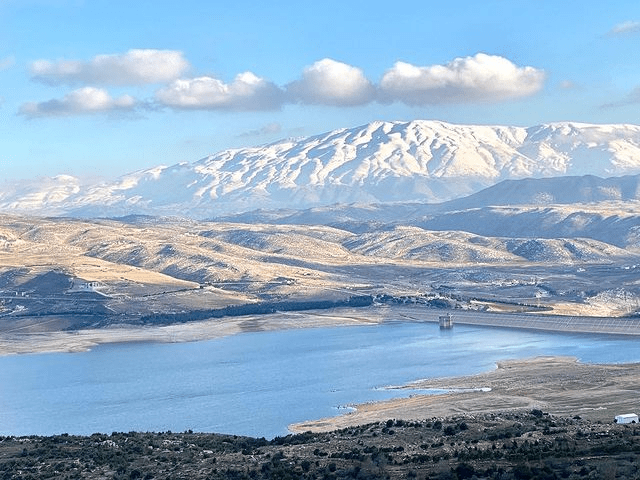
Mount Hermon is on the border between Lebanon and Syria

Mount Hermon is well north of the temple mount in Jerusalem. It too, is high up. Mount Hermon  rises to 9,232 feet and is the highest point on the east coast of the Mediterranean Sea. When the snow-capped ridge of the mountain melts, it liberally flows down and feeds the Jordan River, providing life for the valley.

Without Mount Hermon, there would be nothing and no one in the valley, which is why this water source is so important. Just like the oil flowing down Aaron’s beard, so the dew of Mount Hermon flows well beyond the mountain’s peak to provide abundant life. It enables us to come together united as one family in one place together.

Life and unity are not scarce. The resurrection of Christ opened the floodgates of heaven with life-giving grace, instead of death-dealing judgment, as in Noah’s day. Jesus is the wellspring of life who makes us one big family of faith by providing people with living water.

“Those who drink of the water that I will give them will never be thirsty. The water that I will give will become in them a spring of water gushing up to eternal life.” (John 4:14, NRSV)

No longer does life need to be quantified and measured in terms of years of time. Yes, we are mortal. But this will give way to immortality because a resurrected life is an everlasting life – made possible by Jesus.

My prayer and my hope is that our psalm for today will be like a glass of cold water on hot day when you are feeling parched. And this water will keep coming, as much of it as you need. The oil will keep flowing, with as much love and grace as you need for today. And there will be plenty more when tomorrow comes. It never runs out.

Perhaps you are encouraged with your own faith walk, but are awfully discouraged with the lack of unity in your family, neighborhood, church, workplace, nation, and world. Unity is not a piece of pie in which some get only a sliver, if any at all. In reality, there is plenty to go around. The power of the resurrection has made it possible.

In this present evil age, there are times of angry conflict and emotional distress, along with periods of great separation and sorrow. People everywhere who are divided and estranged from one another can hear God’s call to live together in unity. It is a call of love which beckons us to participate in the generous overflowing love of the Savior who has paved the way for an abundant life by bringing people together in faith.

Jesus prayed, “Holy Father, protect them in your name that you have given me, so that they may be one, as we are one.” (John 17:11)