The Contrast of Good and Bad (1 Samuel 2:11-17)

Top picture: Eli’s sons commit sacrilege; Bottom picture: Hannah and Elkanah bring the boy Samuel to the tabernacle; by William de Brailes, c.1230 C.E.

Elkanah and Hannah went back home to Ramah, but the boy Samuel stayed to help Eli serve the Lord.

Eli’s sons were priests, but they were dishonest and refused to obey the Lord. So, while people were boiling the meat from their sacrifices, these priests would send over a servant with a large, three-pronged fork. The servant would stick the fork into the cooking pot, and whatever meat came out on the fork was taken back to Eli’s two sons. That was how they treated every Israelite who came to offer sacrifices in Shiloh. Sometimes, when people were offering sacrifices, the servant would come over, even before the fat had been cut off and sacrificed to the Lord.

Then the servant would tell them, “The priest doesn’t want his meat boiled! Give him some raw meat that he can roast!”

Usually the people answered, “Take what you want. But first, let us sacrifice the fat to the Lord.”

“No,” the servant would reply. “If you don’t give it to me now, I’ll take it by force.”

Eli’s sons did not show any respect for the sacrifices that the people offered. This was a terrible sin, and it made the Lord very angry. (Contemporary English Version)

Stories in the Old Testament of the Bible typically have two or more contrasting characters within them. One of the characters is good and the other not so much. The narrative is set up without having to tell us who is good and who is bad because the unfolding story makes it patently obvious.

This method of contrast is meant for us to look at the narrative and say to ourselves that we don’t want to go down the bad path but to walk in the good way of helpful obedient service.

In today’s story, we clearly see that, in the case of Eli’s sons, the apple doesn’t fall far from the tree. Old Eli the priest is a contrast to the boy priest-in-residence Samuel.

Eli had many faults, especially when it came to dealing with his sons, who were also priests. Eli seems to have continually had an issue with not listening very well – which ended in making a mess of things.

His sons took the casualness to an entirely new level of bad. They were not only worthless but also interfered in the people’s sincere worship of God. The sons were more than simply incompetent; they were also downright evil.

The Law made it clear how the priests and their portion of the sacrificial animals was to occur. There were detailed instructions on the importance of what part of the animal the priests received; and that the sacrifice needed to have the fat boiled off before it was given to the priest. (Leviticus 7:30-36)

But Eli’s sons took whatever they wanted, and did whatever they wanted, with calloused impunity. They disregarded divine instructions. If they wanted to roast their meat, they did. If they decided to have a different part of the animal, they took it from the worshiper. The sons did not care about anyone, and especially about God. They were bullies of the worst kind.

When sincere worshipers tried to stop the insanity of the priests’ blatant neglect, the servant of the priests threatened them. Although Eli himself did not do this detestable practice, we are meant to see in the narrative that he is an absent father and grossly negligent as a priest.

That entire incompetent and insensitive situation raised the ire of a holy God. It would not end well for Eli and his sons. That particular branch of the Levite priesthood was completely eradicated by the direct judgment of the Lord.

The contrast between Eli and Samuel – both serving as priests – has an unexpected twist. Whereas one would reasonably expect Eli to be the good mentor because of his age and experience, it turns out that the much younger Samuel is the actual mentor to the good and right life of priesthood. Eli needed to take his cues from a child. But, alas, he did not.

Hannah presenting Samuel to Eli, by John Flaxman, 1783

Many adults seem to think that children have nothing to teach them. We who are the big people believe we’re the teachers, leaders, and mentors. Yet, in the kingdom of God, age hasn’t got much to do with it. In fact, generally speaking, children are closer and wiser to knowing how God’s kingdom works, often better than the adults do.

In many respects, I am more like an eight year old boy than the actual father and grandfather that I am. I consider that a good thing. It serves me well in living the spiritual life. And as a boy in an adult body, I say we need to take children more seriously. How can we do that?

Listen carefully. Listen with the intent to understand and learn. The best way of talking to a child is listening to them. Hear both what they’re saying and not saying. Jesus insisted that we must become like little children before we can enter the kingdom of heaven. (Matthew 18:2-5)

Since we are to become like children, there’s no reason not to do your very best in getting on a child’s level and hearing what they have to say. After all, they’re the experts on being kids. The young Samuel is our model: “Speak, Lord, for your servant is listening.” (1 Samuel 3:10)

Validate a child’s emotions, especially their fears. In truth, kids are some of the bravest souls on the planet. They typically have no real hang-ups on connecting with other people, whereas many adults have a lot of anxieties and fears concerning other people.

So, when a child is afraid of something, it’s wise to take notice. They have a special radar to reality that most adults lost a long time ago. I’ll bet the children of the community knew the score of Eli and his sons well before the adults caught on to it.

Observe children’s artworks. For those interested in learning from a child, their drawings with crayons say a lot; their sand sculptures and garbage art speak loads to us if we observe and take notice. Kids are communicating their worldview and how they make sense of things.

Art is about understanding life and the human spirit, connecting to the past and other cultures, and expressing emotions. Becoming open to what children create is a pathway to the divine and to what is important in this world. Eli’s sons removed the art and craft of priesthood; they made it a mere exchange of goods and services. And God was not happy with this arrangement. It took away something significant about connecting with the Lord.

By contrasting the way of Samuel with the way of Eli and his sons, we begin to see the wide chasm between a one-dimensional bullying approach to being a priest, with a multi-dimensional, beautiful, and authentic expression of priesthood that embodies the conduit between heaven and earth.

How will you go about living your life? What does the way you do things say about God?

Holy God, infuse in us your ability to remain present to your people. Help us to be there for the people who need us – for the young, the old, the needy, and the brokenhearted. Enflame our hearts with a spirit of service and obedience. And enable us to be open and ready to love. Amen.

Giving Freely for a Worthy Project (Exodus 25:1-22)

Gathering To Build the Tabernacle, by Yoram Raanan

The Lord said to Moses, “Tell the Israelites to bring me an offering. You are to receive the offering for me from everyone whose heart prompts them to give. These are the offerings you are to receive from them: gold, silver and bronze; blue, purple and scarlet yarn and fine linen; goat hair;ram skins dyed red and another type of durable leather; acacia wood; olive oil for the light; spices for the anointing oil and for the fragrant incense; and onyx stones and other gems to be mounted on the ephod and breast-piece.

“Then have them make a sanctuary for me, and I will dwell among them. Make this tabernacle and all its furnishings exactly like the pattern I will show you.

“Have them make an Ark of acacia wood—two and a half cubits long, a cubit and a half wide, and a cubit and a half high. Overlay it with pure gold, both inside and out, and make a gold molding around it. Cast four gold rings for it and fasten them to its four feet, with two rings on one side and two rings on the other. Then make poles of acacia wood and overlay them with gold. Insert the poles into the rings on the sides of the ark to carry it. The poles are to remain in the rings of this ark; they are not to be removed. Then put in the ark the tablets of the covenant law, which I will give you.

“Make an atonement cover of pure gold—two and a half cubits long and a cubit and a half wide. And make two cherubim out of hammered gold at the ends of the cover. Make one cherub on one end and the second cherub on the other; make the cherubim of one piece with the cover, at the two ends. The cherubim are to have their wings spread upward, overshadowing the cover with them. The cherubim are to face each other, looking toward the cover. Place the cover on top of the ark and put in the ark the tablets of the covenant law that I will give you. There, above the cover between the two cherubim that are over the ark of the covenant law, I will meet with you and give you all my commands for the Israelites. (New International Version)

Israel gathers to bring gifts for the construction of the Tabernacle

Details matter. Typically, when something is important to someone, they go into great detail about it. It won’t do for them to ignore the nuances of what they care about. So when God goes into intricate detail about the construction of the portable sanctuary, the Tabernacle, the people can take notice that this has great significance.

The Israelities were delivered from Egyptian slavery. Now, in the desert of the Sinai peninsula, they are to worship in a particular way with certain sacred objects for its use. The sacred tent, the Tabernacle, was the center of Israel’s religious life while wandering in the years between Egypt and the Promised Land. It became God’s dwelling place amongst the people – the place where sacrifices were offered and Moses their leader communicated with the Lord.

The instruction manual given to Moses from God for the holy implements of worship was very specific and involved a lot of people. It was such an important and technical project that it required the participation of all the people. In a national-level sort of fundraiser, God asked Moses to ask the Israelites to bring their contributions and donations as freewill offerings for the work to be done.

Moses went up Mount Sinai to meet with God. The expressed purpose was to provide divine instructions concerning the law, worship, and how to live in the Promised Land once they get there. Since the Tabernacle was a central part of the nation’s covenant with God, the Lord sought to communicate how everything was to be built.

But before it could all happen, there needed to be a collection of the materials for construction. And it was not something to be taxed or required; it was an ask. The true heart of righteousness is that giving is an opportunity to help and do the right thing; it’s a privilege.

Righteousness is a healthy dynamic of freely giving, and thus, freely receiving. It benefits everyone – both giver and receiver. The wise and righteous person understands that it is the giver who benefits most.

When everyone has an opportunity to give, all persons are of equal status; there is no charity because the whole community acts as one person together in ensuring needs are satisfied.

If everyone gives, then we benefit from living in a society where everyone’s needs are met, and none are in want. The truly righteous society that is full of justice and goodness is the one in which everyone is privileged, and everyone receives the benefits of giving.

In the New Testament, the Apostle Paul picked up on this form of right living and described it to the Corinthian Church:

“And now, brothers and sisters, we want you to know about the grace that God has given the Macedonian churches. In the midst of a very severe trial, their overflowing joy and their extreme poverty welled up in rich generosity. For I testify that they gave as much as they were able, and even beyond their ability.

Entirely on their own, they urgently pleaded with us for the privilege of sharing in this service to the Lord’s people. And they exceeded our expectations: They gave themselves first of all to the Lord, and then by the will of God also to us… For if the willingness is there, the gift is acceptable according to what one has, not according to what one does not have.” (2 Corinthians 8:1-5, 12, NIV)

Paul went on to encourage the believers that each individual should give what they have decided in their heart to give, not reluctantly or under compulsion. Why? Because God loves a cheerful giver, and not a reluctant miser. (2 Corinthians 9:7)

If something is important enough to warrant a full detailed and technical plan, then it’s worthy enough to allow others to freely give for that project as they so desire.

Everyone is blessed when we know what has to be done, and are willing to freely give what we possess to make that important thing happen.

Lord of our lives, teach us how to use our money and our possessions. Deliver us from stinginess and wasteful extravagance; inspire our giving with the spirit of true generosity. Help us always to remember your generous love for us, that we may be wise and faithful stewards of the good gifts you have given us. Amen.

Learn To Do Right (Isaiah 1:1-4, 16-20)

Statue of Isaiah the Prophet, by Salvatore Revelli (1816-1859), Rome, Italy

The vision concerning Judah and Jerusalem that Isaiah son of Amoz saw during the reigns of Uzziah, Jotham, Ahaz and Hezekiah, kings of Judah.

Hear me, you heavens! Listen, earth!
    For the Lord has spoken:
“I reared children and brought them up,
    but they have rebelled against me.
The ox knows its master,
    the donkey its owner’s manger,
but Israel does not know,
    my people do not understand.”

Woe to the sinful nation,
    a people whose guilt is great,
a brood of evildoers,
    children given to corruption!
They have forsaken the Lord;
    they have spurned the Holy One of Israel
    and turned their backs on him…

Wash and make yourselves clean.
    Take your evil deeds out of my sight;
    stop doing wrong.
Learn to do right; seek justice.
    Defend the oppressed.
Take up the cause of the fatherless;
    plead the case of the widow.

“Come now, let us settle the matter,”
    says the Lord.
“Though your sins are like scarlet,
    they shall be as white as snow;
though they are red as crimson,
    they shall be like wool.
If you are willing and obedient,
    you will eat the good things of the land;
but if you resist and rebel,
    you will be devoured by the sword.”
For the mouth of the Lord has spoken. (New International Version)

Whenever the prophet has a vision, everyone better perk up and take notice.

After the northern Jewish kingdom of Israel fell to the Assyrians in 722 B.C.E., they lost their national identity. The southern Jewish kingdom of Judah, and its capitol Jerusalem, continued to exist for nearly a century and a half – even though they were vassals of either the Assyrians or the Babylonians.

Yet, Judah still functioned as its own nation in a semi-independent state. It was during this time that the prophet Isaiah had his vision, under the kingship of those descended from King David.

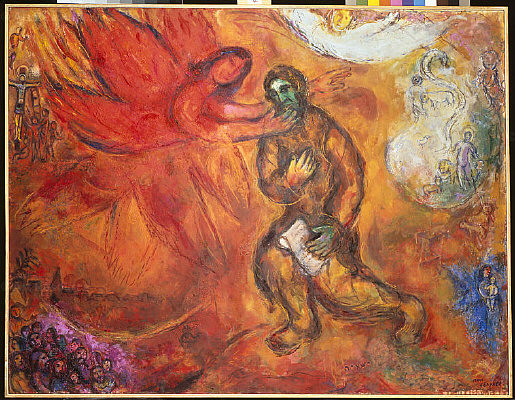
The Prophet Isaiah, by Marc Chagall,1968

The initial section of Isaiah’s prophecy is a series of oracles that establish the relationship between God and the nation of Judah, especially Jerusalem. The gist of God’s message is that the people are guilty of lots of sins.

However, the Lord left a gracious opening for them; their fate was not yet sealed. The nation could repent of their sins and experience a future restoration. God wanted to bring a resolution, and not have the people keep going in their unhealthy ways.

Throughout Isaiah’s vision, God is presented as a Father, with the children being Israel (both northern and southern kingdoms). And Father God has a complaint against them. The people’s principal sins were rebellion and ignorance. They spurned God’s authority, and did not accept their family intimacy with God.

Thus, the Lord is quite disappointed with the people. Heavenly witnesses are called to hear the charges of wrongdoing. The troubles of the nation were to be interpreted as warnings and disciplines, meant to lead them to stop and do right. Yet it seems that the warnings go unheeded by the people. It appears that God’s efforts to woo the people back are in vain.

Although the people’s continued sacrificial worship is merely done as a mere perfunctory act, and without true hearts of devotion for what is just and right, God offered them a chance to make things right, so that they could do justice and embrace righteousness.

God made it clear what it would take to repent: learn to do good; seek justice; recuse the oppressed; defend the orphan; plead for the widow. God even issued an invitation for a divine/human dialogue to happen.

Grace and cleansing from sin are possible, that is, if the people are willing and obedient, instead of remaining rebellious and refusing to do what is right, just, and good.

The nation was at a crossroads and had to make a decision. Would they choose wisely or foolishly?

Decision-making is critical. Some choices are harder than others. Yet the ability to decide is a God-given gift and ability.

Making decisions is fraught with consequences; we may try to anticipate or ignore what might happen with a particular choice. And how we go about decision-making is important. Who do we listen to? What information do we need? How will this choice shake out in the end?

Intentions are not choices, but are simply a mental resolve to do or not do something, at some point. And to not make a decision is to have already made a decision to either procrastinate or not do anything at all.

There are also decisions of duty. This may or may not be admirable. There is also the choice of attitude and energy given to the decision – because a choice of doing one’s duty can be done with joy or grumpiness, excitement or bitterness, with a bright disposition or a flat sullen affect.

It’s not really hard to guess or assess the choices of the people in Judah and Jerusalem in Isaiah’s day. They were doing an outward duty of temple worship, but without any heart to it.

Many of the people looked upon their duty as a sort of magical talisman that would ward off any trouble or army invasion. With that kind of approach, the people looked upon the rest of their time as their own, as discretionary, as the choice to do whatever they wanted to do.

If their business practices were dubious and not quite right, then big deal. After all, they give their money at the temple.

If the leaders played favorites and overlooked the needy person among them, then so what? The poor and oppressed can work harder, right?

And if orphans and widows – who were the most vulnerable persons in society – were not completely cared for, then that’s sad, but too bad for them.

I can picture an ancient city council saying something like, “We have a lot on our plate, dealing with foreign powers, the economy, and political issues. Those needy persons need to get a clue. It’s their own fault for hanging around and not leaving the city for greener pastures. Not our problem.”

Oh, but it very much was their problem. It was everyone’s problem, and each person’s responsibility, to ensure that God’s justice, goodness, and righteousness was infused throughout the entire city and nation.

Hence, the reason for the book of Isaiah. Tackle the moral and ethical problems head on before it’s too late and the gravity of judgment presses everyone out of the land.

What’s needed is a willing heart inclined to walk into divine obedience, without any talkback, and without any negotiations or deals.

God is merciful, and is willing to talk it out. But justice must be done. Needs must be met. People must be cared for. The Lord’s will must be done, here on earth, as it is always done in heaven. Is this what you are about, or not? Will you learn to do right?

Most merciful God, shine the light of your gracious love upon my cold hard heart. Enlighten my mind and dispel the darkness; speak the truth and help me obey; and have pity upon me. Forgive me yet again of my offenses, transgressions, and guilty acts. Grant me the grace to serve you with faithfulness and care for your people with love and purity, today and always. Amen.

Set Apart for the Lord (Numbers 8:5-22)

Consecration of the Levites, by Dutch artist Jan Luyken (1649-1712)

The Lord said to Moses: “Take the Levites from among all the Israelites and make them ceremonially clean. To purify them, do this: Sprinkle the water of cleansing on them; then have them shave their whole bodies and wash their clothes. And so they will purify themselves. Have them take a young bull with its grain offering of the finest flour mixed with olive oil; then you are to take a second young bull for a sin offering.

“Bring the Levites to the front of the tent of meeting and assemble the whole Israelite community. You are to bring the Levites before the Lord, and the Israelites are to lay their hands on them. Aaron is to present the Levites before the Lord as a wave offering from the Israelites, so that they may be ready to do the work of the Lord.

“Then the Levites are to lay their hands on the heads of the bulls, using one for a sin offering to the Lord and the other for a burnt offering, to make atonement for the Levites. Have the Levites stand in front of Aaron and his sons and then present them as a wave offering to the Lord. In this way you are to set the Levites apart from the other Israelites, and the Levites will be mine.

“After you have purified the Levites and presented them as a wave offering, they are to come to do their work at the tent of meeting. They are the Israelites who are to be given wholly to me. I have taken them as my own in place of the firstborn, the first male offspring from every Israelite woman. Every firstborn male in Israel, whether human or animal, is mine. When I struck down all the firstborn in Egypt, I set them apart for myself. And I have taken the Levites in place of all the firstborn sons in Israel. 

“From among all the Israelites, I have given the Levites as gifts to Aaron and his sons to do the work at the tent of meeting on behalf of the Israelites and to make atonement for them so that no plague will strike the Israelites when they go near the sanctuary.”

Moses, Aaron and the whole Israelite community did with the Levites just as the Lord commanded Moses. The Levites purified themselves and washed their clothes. Then Aaron presented them as a wave offering before the Lord and made atonement for them to purify them. After that, the Levites came to do their work at the tent of meeting under the supervision of Aaron and his sons. They did with the Levites just as the Lord commanded Moses. (New International Version)

Levite priests, by Sefira Lightstone

Holiness is very important to God; therefore, people are to be properly set apart for special divine work.

Perhaps we might think about this in the context of a professional vocation – which requires a good deal of training and development. The process, as well as the participants, need to be certified by a certification body. Without a specialized training, their work may hurt others, and even harm themselves.

Setting apart the Levites for the special work of caring for all the aspects of worship required a particular sort of calling, initiation, and ritual in order to have them ready – without harming themselves, or others. Because God is holy, things must be done in a way that helps, not harms.

The ritual for preparation essentially involved de-sinning the Levites, and purifying them from any ceremonial uncleanness. The community was to lay their hands on them, setting them apart for service as representatives of the people.

The Levites served before the Lord in a vicarious position, that is, all Israel came to God through them. They performed the needed sacrifices, handled the worship symbols and implements, and protected the sacred objects in the tent of God’s presence, the tabernacle.

With the Levites in their sacred role, they were near to the people, but distinct from them. They acted as a conduit between God and the people. Levites were something like the sunglasses protecting the people from the bright sun of the Lord’s presence; and like the workers laboring to make people thrive and flourish before God.

In the holiness of worship, the Levites were living sacrifices, offered to God for sacred purposes. So, as such, they understood their need to be continually pure of heart and free from anything that would defile them.

Sacrificial service was literally the job description of the Levites. They absolved themselves of any self-assertive ambitions, and pursued God’s will for the lives without question. This is, of course, the expected ideal, which would soon become deflated in the lives of the two older sons of Aaron the high priest.

Nevertheless, the descendants of Levi were a permanent visual aid and a daily reminder for God’s people of their unique status before Yahweh, as well as the redemption secured for them from Egyptian slavery. Whenever the people saw a Levite – consecrated to God – they knew that the Lord was with them.

God had said that the Levites belonged to him, were completely given over to the Lord, and set apart for dedicated holy and divine work. Moving into the New Testament, every Christian belongs to God, and those who labor for Christ and maintain holiness of life, demonstrate God’s ownership and special relationship to them.

Self-surrender and commitment to the common good of everyone in the community is supposed to be a hallmark of every Christian person. Whereas others may give themselves to self-discovery and self-fulfillment, followers of Jesus are to wholly dedicate themselves to self-sacrifice.

All believers, much like the ancient Levites, are called to a different life, with Christ as their constant mentor and model.

Loving God and Father of our Lord Jesus Christ, may the holy sacrifice of your Son cleanse my soul, strengthen my heart, pardon my past, and restore me in your peace. May I always adore you through my sacrificial service, fueled by your divine love. May I learn to sacrifice my own comfort, plans, and dreams, if it is not for your glory and the good of others. Amen.