Exodus 19:16-25 – An Awesome God

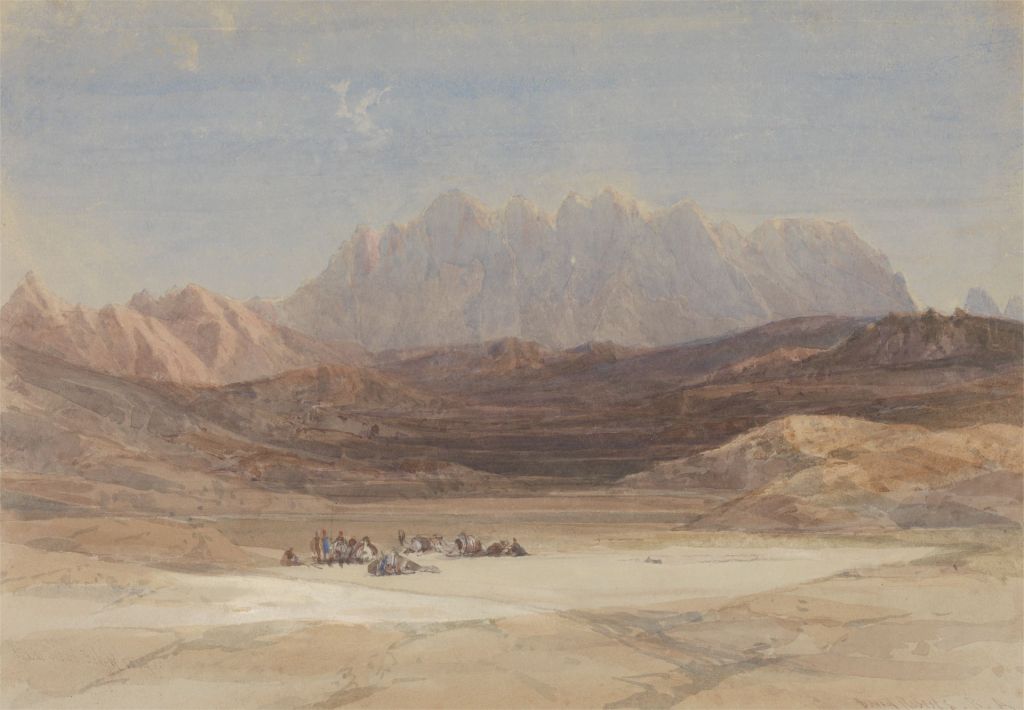
Mount Sinai by Scottish painter David Roberts (1796-1864)

On the morning of the third day, thunder roared, and lightning flashed, and a dense cloud came down on the mountain. There was a long, loud blast from a ram’s horn, and all the people trembled. Moses led them out from the camp to meet with God, and they stood at the foot of the mountain. All of Mount Sinai was covered with smoke because the Lord had descended on it in the form of fire. The smoke billowed into the sky like smoke from a brick kiln, and the whole mountain shook violently. As the blast of the ram’s horn grew louder and louder, Moses spoke, and God thundered his reply. The Lord came down on the top of Mount Sinai and called Moses to the top of the mountain. So, Moses climbed the mountain.

Then the Lord told Moses, “Go back down and warn the people not to break through the boundaries to see the Lord, or they will die. Even the priests who regularly come near to the Lord must purify themselves so that the Lord does not break out and destroy them.”

“But Lord,” Moses protested, “the people cannot come up to Mount Sinai. You already warned us. You told me, ‘Mark off a boundary all around the mountain to set it apart as holy.’”

But the Lord said, “Go down and bring Aaron back up with you. In the meantime, do not let the priests or the people break through to approach the Lord, or he will break out and destroy them.”

So, Moses went down to the people and told them what the Lord had said. (NLT)

As Christians await Easter and the resurrected Christ, the Revised Common Lectionary reminds us of another great anticipation from the Old Testament. The ancient Israelites were amazingly delivered from Egyptian slavery, miraculously walked through the Red Sea, and traveled with wondrous anticipation to Mount Sinai. Now, in today’s reading, they are about to meet with God!

The scene of this meeting is not exactly the romantic highland encounter of the Man from Snowy River (my wife’s all-time favorite movie). The landscape is much more akin to the dark and volcanic Mount Doom from The Lord of the Rings. The picture appears more foreboding than loving. The thing about mountain top experiences is that they are not all monolithic one-size-fits-all encounters with bright rainbows and happy skipping unicorns.
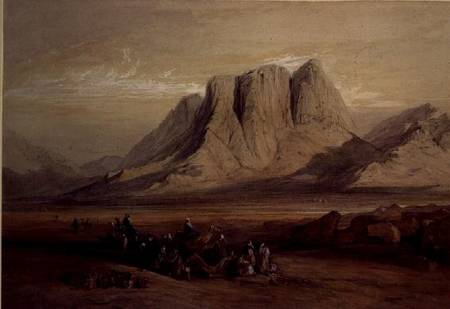
Mount Sinai by English painter Edward Lear (1812-88)

Mountain Top Experiences

Holy Scripture is replete with mountain experiences. Mountains serve as symbols for significant encounters with a mighty God. Whether it is Christ’s transfiguration on a mountain, or the giving of the law on a mountain, the awesome mountain serves as a tangible symbol of divine majesty, strength, and sovereignty. And, I might add, conversely, valleys in Scripture are symbolic of difficulty and suffering. Our God is Lord of both mountain and valley. The God of the Bible is both transcendent and immanent, ruling with power and might high above us on the holy mountain. Yet, the Lord also comes near to us in the valley of the shadow of death.

Leading up to the giving of the Ten Words (Commandments) in Exodus 20, Exodus 19 portrays an awesome scene of God in transcendent holiness and power. In fact, the experience was so otherworldly that the people were afraid to even come near the mountain. The Israelites needed limits placed on themselves because of God’s holy presence. Just like coming too near the immense power of the sun will destroy us, so getting near to God can ruin us if we do not respect divine holiness.

The Lord of the Mountain

Respecting God’s power and transcendence brings the reality of the Lord’s immanence into greater appreciation. God has gone to extreme lengths of self-revelation to people. For the Christian, it all culminates through the incarnation of Christ, the sending of the Son. In Jesus, the transcendence and immanence of God meet perfectly to bridge the chasm between humanity and the divine. Because of Jesus, the awesome sounds of thunder and trumpet do not lead to fear; they announce grace to those who approach God by faith.

You have not come to a mountain that can be touched and that is burning with fire; to darkness, gloom and storm; to a trumpet blast or to such a voice speaking words that those who heard it begged that no further word be spoken to them, because they could not bear what was commanded: “If even an animal touches the mountain, it must be stoned to death.” The sight was so terrifying that Moses said, “I am trembling with fear.” But you have come to Mount Zion, to the city of the living God, the heavenly Jerusalem. You have come to thousands upon thousands of angels in joyful assembly, to the church of the firstborn, whose names are written in heaven. You have come to God, the Judge of all, to the spirits of the righteous made perfect, to Jesus the mediator of a new covenant….

See to it that you do not refuse him who speaks. If they did not escape when they refused him who warned them on earth, how much less will we, if we turn away from him who warns us from heaven? At that time, his voice shook the earth, but now he has promised, “Once more I will shake not only the earth but also the heavens.” The words “once more” indicate the removing of what can be shaken—that is, created things—so that what cannot be shaken may remain. Therefore, since we are receiving a kingdom that cannot be shaken, let us be thankful, and so worship God acceptably with reverence and awe, for our “God is a consuming fire.” (Hebrews 12:18-29, NIV)

Our God is an awesome God. The divine dramas of God’s victory over Egypt and Christ’s victory over sin, death, and hell, have provided God’s people with spiritual power. Both the deliverance of the Israelites from Egyptian slavery by God and the deliverance secured on Mount Zion from spiritual slavery by Jesus are meant to free us to do the will of God. With God’s Word and God’s Spirit given to us, we are emancipated from an empty way of life to experience the fullness of Christ.

May the peace of God which surpasses all understanding, keep your hearts and minds in the knowledge and love of God, and of the Son, Jesus Christ, our Lord, and the blessing of God almighty. May Father, Son, and Spirit be among you and remain with you always. Amen.

Praise the Lord!

Praise the Lord!

Praise the Lord from heaven!
    Praise God on the heights!
Praise God, all of you who are his messengers!
    Praise God, all of you who comprise his heavenly forces!
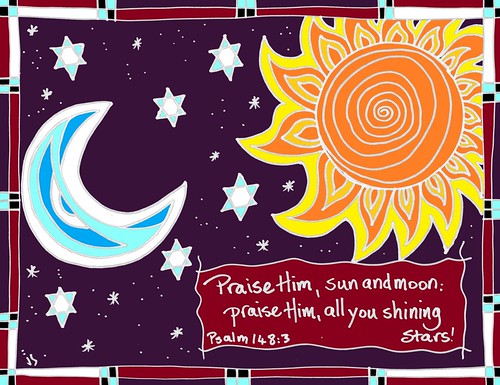
Sun and moon, praise God!
    All of you bright stars, praise God!
You highest heaven, praise God!
    Do the same, you waters that are above the sky!
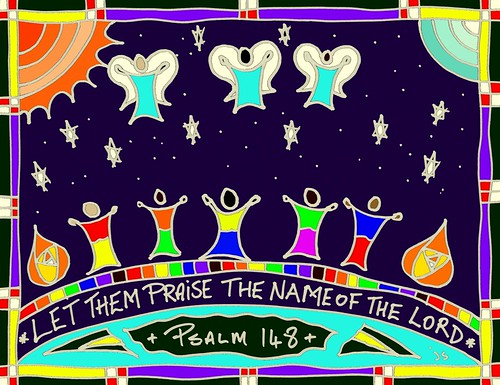
Let all of these praise the Lord’s name
    because God gave the command and they were created!
God set them in place always and forever.
    God made a law that will not be broken.

Praise the Lord from the earth,
    you sea monsters and all you ocean depths!
Do the same, fire and hail, snow and smoke,
    stormy wind that does what God says!
Do the same, you mountains, every single hill,
    fruit trees, and every single cedar!
Do the same, you animals—wild or tame—
    you creatures that creep along and you birds that fly!
Do the same, you kings of the earth and every single person,
    you princes and every single ruler on earth!
Do the same, you young men—young women too!—
    you who are old together with you who are young!

Let all of these praise the Lord’s name
    because only God’s name is high over all.
    Only God’s majesty is over earth and heaven.
God raised the strength of his people,
    the praise of all his faithful ones—
        that’s the Israelites,
        the people who are close to him.

Praise the Lord! (Psalm 148, CEB)

This is the Christmas season.  We are in the third day of the twelve days of Christmas.  This time in the Church Calendar gives focus to declare along with the angels and all of God’s creation:  Glory to God in the highest; praise the Lord!  Everything in all creation points to a creator who cares for us. 

These days between December 25 and January 5 are to be a great celebration because King Jesus has come and is the rightful Sovereign over all creation.  We are to grasp the meaning of Christ’s incarnation; and affirm the identity of Jesus as both full human and fully divine.  Beginning with Christ’s birth, we enter a reflection on the meaning of Christ’s life and prepare for the journey toward the cross and the empty tomb.

Today, however, we simply praise the Lord along with all creation.  This is what the psalmist calls us all to do.  The entire universe is called to praise the Lord.  Everything outside our earth is to give God glory.  Everything in the universe points to a God who is worthy to be praised.

Let us assume the distance between the earth and the sun (ninety-two million miles) was reduced to the thickness of a sheet of paper. If that is the case, then the distance between the earth and the nearest star would be a stack of papers seventy feet high. And the diameter of the galaxy would be a stack of papers three-hundred-ten miles high. Our galaxy is just a speck of dust in the universe, yet Jesus holds the universe together by the word of his power.

We serve a big God who is worthy to be praised, not only out there in the universe but here on earth.  The psalmist calls on all the earth to echo the adoration of God.  That means everything and everyone on earth – fish, animals, birds, even trees as well as people. 

Research in the field of bioacoustics has revealed that every day we are surrounded by millions of ultrasonic songs. For example, the electron shell of the carbon atom produces the same harmonic scale as a Gregorian chant.  Whale songs can travel thousands of miles underwater.  Meadowlarks have a range of three hundred notes. Supersensitive sound instruments have discovered that even earthworms make faint staccato sounds!

Arnold Summerfield, a German physicist, and pianist observed that a single hydrogen atom, which emits one hundred frequencies, is more musical than a grand piano, which only emits eighty-eight frequencies.  Science writer Lewis Thomas summed it up it this way: “If we had better hearing, and could discern the singing of sea birds, the rhythmic drumming of schools of mollusks, or even the distant harmonics of flies hanging over meadows in the sun, the combined sound might lift us off our feet.”

Praise the Lord.  We have a vision in this psalm of all creation praising God as one great big choir. Praise is to occur with both words and actions.  With words, praise is an expression of gratitude to God for who she is and what he has done.  With actions, praise is a posture of submission and an acknowledgement of dependence.

Therefore, through testimony we declare what God has done in our lives and how he is worthy to be praised and obeyed.  With the emphasis on praise in a season dedicated to joy, we must also recognize that for many people Christmas is difficult.  Loneliness, thin finances, unemployment, illness, strained relationships, and bittersweet memories can all be a discouraging contrast to the celebration going on around them.

Praise, however, is not just for the joyful; it can happen no matter the circumstances because the Christian’s happiness is not dependent upon positive situations but rather upon the person and work of Jesus.  It may not be easy to find our voice of praise along with everyone else, but we are not alone.  We can choose to join with all creation to praise the name of the Lord. 

A dear parishioner of mine shared this a few years ago after experiencing multiple surgeries in the year:

“I am thankful for a chance to get out of the house. Of course, my walker was with me.  I am amazed how quickly folks move over, slow down, and give me space when I am out with that thing….  At church it feels like I am parting the Red Sea! The reason I hate the walker is because it says to the whole world, ‘Hey, I’m broken!’  I realize we all have areas that we are broken, most of them we can hide or cover up. Why are we so ashamed to confess the truth? Who really has it all together? I know we love our privacy and shun pity. However, I have been shown so much grace, kindness, and compassion as I push this piece of aluminum around that I hope this experience continues to change me for the better. I hope in the future I will be sensitive to those who are broken on the inside as well as the outside. May the love of Christ give me eyes to see people as he does, precious and accepted, just as they are.”

That, my friends, is the reasonable and logical end of praising the Lord – to connect what God has done and is doing with what he can do through us as we glorify his name. By simply being who we are created to be, we praise the Lord along with all creation.  When we as people in God’s image, reflect that image in how we talk and how we live, we participate with the universe in declaring God is good. 

Praise is to be the glue that binds us all together. Let us praise the name of the Lord. To be more specific, let the church praise the Lord!  Let leaders everywhere praise the Lord!  Let healthcare workers praise the Lord!  Let salespersons and factory workers praise the Lord!  Let police and lawyers praise the Lord! Let the trees, mountains, and all living things praise the Lord!  Let engineers and educators praise the Lord!  Let the little children praise the Lord!  Let clerks and cashiers, waiters and waitresses, janitors and housekeepers praise the Lord!  Let the lost and the lonely praise the Lord along with the happy and satisfied. Let everything that has breath praise the Lord!  Praise the Lord!

Whether you are bursting to proclaim it, or struggle to say it and live it, praise the Lord along with everything in the universe because we serve a God who keeps us close to heart.  Praise the Lord!

What do you have to praise the Lord for today?

How do you express your praise, both personally and publicly?

Where is your favorite place to praise the Lord?

When does praise to God come easily for you, and when it is difficult?

Who do you like praising the Lord with?

May your life become a paeon of praise to the God who is worthy to receive all glory, honor, and praise. Amen

Jeremiah 26:1-9, 12-15 – How to Use Our Voice

The Prophet Jeremiah by Marc Chagall (1887-1985)

Early in the reign of Jehoiakim son of Josiah king of Judah, this word came from the Lord: “This is what the Lord says: Stand in the courtyard of the Lord’s house and speak to all the people of the towns of Judah who come to worship in the house of the Lord. Tell them everything I command you; do not omit a word. Perhaps they will listen, and each will turn from their evil ways. Then I will relent and not inflict on them the disaster I was planning because of the evil they have done. Say to them, ‘This is what the Lord says: If you do not listen to me and follow my law, which I have set before you, and if you do not listen to the words of my servants the prophets, whom I have sent to you again and again (though you have not listened), then I will make this house like Shiloh and this city a curse among all the nations of the earth.’”

The priests, the prophets and all the people heard Jeremiah speak these words in the house of the Lord. But as soon as Jeremiah finished telling all the people everything the Lord had commanded him to say, the priests, the prophets and all the people seized him and said, “You must die! Why do you prophesy in the Lord’s name that this house will be like Shiloh and this city will be desolate and deserted?” And all the people crowded around Jeremiah in the house of the Lord….

Then Jeremiah said to all the officials and all the people: “The Lord sent me to prophesy against this house and this city all the things you have heard. Now reform your ways and your actions and obey the Lord your God. Then the Lord will relent and not bring the disaster he has pronounced against you. As for me, I am in your hands; do with me whatever you think is good and right. Be assured, however, that if you put me to death, you will bring the guilt of innocent blood on yourselves and on this city and on those who live in it, for in truth the Lord has sent me to you to speak all these words in your hearing.” (NIV)

Although much attention is given to Christmas Day, the Christian season of Christmas spans twelve days from December 25 through January 5. Celebrating Christmas as a season helps us immerse ourselves in Christ’s incarnation more fully than merely celebrating for one day.

Perhaps today’s Old Testament lesson is a curious choice for a Christmas season Scripture text. Yet, although we hold in one hand the joy and celebration of Christ’s birth, in the other hand we hold the deep sadness of recognizing that not everyone was or is excited about Jesus. For Christ is both the cornerstone of faith and the stone which causes people to stumble and fall. (1 Peter 2:8)

The fact of the matter is that God is not okay with cruel injustice, hollow worship, and an inattention to both the divine and human. Jesus came to make things right. But not everyone wants that. Systemic evil persists because there are always people who benefit from how power and resources are structured – and they care little about how it impacts those on the underbelly of their control.

Therefore, just as important it is to recognize the inbreaking of God into this world and celebrate the incarnation of Christ, it is equally necessary to acknowledge that the world is broken and that we must speak truth to power. This is no easy task because rarely are things simply black and white, all good or all bad.

Jeremiah by Marc Chagall, 1956

In Jeremiah’s day, it was not that his opponents were pure evil with no acknowledgment of God. Rather, the problem was that the power brokers in Judah tried to keep a strict separation of religion from everything else. In other words, they were perfectly fine with God, that is, if the Lord would stay in the temple where he belonged. But Jeremiah would have none of it. Keeping Yahweh out of matters of social justice, geopolitics, and institutional governance led to great humanitarian problems. Jeremiah became God’s voice to a generation of people who ignored the divine in everything but religious ritual.

Bifurcating worship and work disconnect daily life from divine resources. Without God infused in all of life, a lack of grace fills the empty places. What is more, the sovereign Lord of all can neither be silenced nor dismissed; God will find a way to accomplish peace and justice for the common good of everyone, and not just the few.

The heart of Jeremiah’s message was for king and people to be obedient in all of life, to recenter themselves around God’s law – not just the religious bits but the social ones, as well. Jeremiah did not proclaim something new. He was just calling the powers that be to Torah observance.

The true needs and interests of our communities can never be addressed and lifted-up in the narrow self-serving interests of persons in power who turn a blind eye to anyone unlike them. The needs and interests of our world lie in becoming who we were designed from the beginning to be: A people belonging to God, tapping into the deep reservoir of spirituality inside us.

For the Christian, we are to acknowledge the baby born as a king and follow in the way of grace and truth. There is to be no division between sacred and secular because Jesus is Lord of all. We are to continually use our voice for both praise and prophecy, for shouting celebration to God and speaking truth to power.

Holy God, Sovereign of all, we give you praise for sending your Son, our Savior, Jesus as a baby, a human just like us. Keep us grounded in humility, sensitive to sin, attentive to that which is just and right, merciful in all things, pure in worship, and peace-loving through Christ our Lord in the strength of your Spirit. Amen.

John 1:1-14 – Christmas Day

The Word was first,
the Word present to God,
    God present to the Word.
The Word was God,
    in readiness for God from day one.

Everything was created through him;
    nothing—not one thing!—
    came into being without him.
What came into existence was Life,
    and the Life was Light to live by.
The Life-Light blazed out of the darkness;
    the darkness couldn’t put it out.

There once was a man, his name John, sent by God to point out the way to the Life-Light. He came to show everyone where to look, who to believe in. John was not himself the Light; he was there to show the way to the Light.

The Life-Light was the real thing:
    Every person entering Life
    he brings into Light.
He was in the world,
    the world was there through him,
    and yet the world didn’t even notice.
He came to his own people,
    but they didn’t want him.
But whoever did want him,
    who believed he was who he claimed
    and would do what he said,
He made to be their true selves,
    their child-of-God selves.
These are the God-begotten,
    not blood-begotten,
    not flesh-begotten,
    not sex-begotten.

The Word became flesh and blood,
    and moved into the neighborhood.
We saw the glory with our own eyes,
    the one-of-a-kind glory,
    like Father, like Son,
Generous inside and out,
    true from start to finish. (MSG)

Merry Christmas! Glory to God in the highest, and on earth peace, goodwill toward humanity! Today we celebrate the mystery of the incarnation – the unfathomable miracle of God becoming human – all for us and for our salvation.

The beginning of the Apostle John’s Gospel is an astounding passage of Scripture. These are verses to slowly and worshipfully read through because it is a theologically rich, lovingly beautiful, and missionally sensitive piece of Holy Scripture. 

The high and holy God has chosen to come and reveal true divinity to us in the person of Jesus. We know God through Christ. We learn what God is like through Jesus. God graciously condescended to us, bent down to communicate in ways we can understand and discern, through the Lord Jesus. 

The God which Christians worship and serve is an over-the-top gracious and generous God. This is a God who has gone to incredible lengths in restoring lost humanity. Since God has bridged the great chasm between heaven and earth, we have hope, joy, peace, and faith. With God in the neighborhood, divine love becomes our motivation to reach out in compassionate service. People matter to God. We matter so much that God cared enough to be born.

This Tiny Baby by Madeleine L’Engle

Whoever is the baby?

Nothing but a little lamb

who says God is and that I am.

Who is this tiny baby?

Just an infant, meek and mild,

just a feeble, mortal child.

Who is this tiny baby?

The Lord strong and mighty

even the Lord mighty in battle.

The king of glory is coming,

who is the Lord of Hosts.

This is the tiny baby!