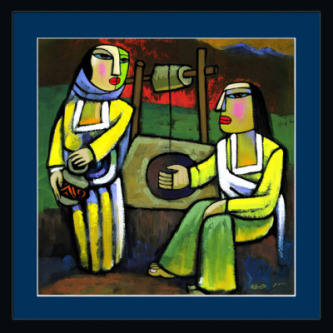
John 4:7-26 – Living Water

Samaritan Woman at the Well by He Qi

When a Samaritan woman came to draw water, Jesus said to her, “Will you give me a drink?” (His disciples had gone into the town to buy food.)

The Samaritan woman said to him, “You are a Jew, and I am a Samaritan woman. How can you ask me for a drink?” (For Jews do not associate with Samaritans.)

Jesus answered her, “If you knew the gift of God and who it is that asks you for a drink, you would have asked him, and he would have given you living water.”

“Sir,” the woman said, “you have nothing to draw with and the well is deep. Where can you get this living water? Are you greater than our father Jacob, who gave us the well and drank from it himself, as did also his sons and his livestock?”

Jesus answered, “Everyone who drinks this water will be thirsty again, but whoever drinks the water I give them will never thirst. Indeed, the water I give them will become in them a spring of water welling up to eternal life.”

The woman said to him, “Sir, give me this water so that I won’t get thirsty and have to keep coming here to draw water.”

He told her, “Go, call your husband and come back.”

“I have no husband,” she replied.

Jesus said to her, “You are right when you say you have no husband. The fact is, you have had five husbands, and the man you now have is not your husband. What you have just said is quite true.”

“Sir,” the woman said, “I can see that you are a prophet. Our ancestors worshiped on this mountain, but you Jews claim that the place where we must worship is in Jerusalem.”

“Woman,” Jesus replied, “believe me, a time is coming when you will worship the Father neither on this mountain nor in Jerusalem. You Samaritans worship what you do not know; we worship what we do know, for salvation is from the Jews. Yet a time is coming and has now come when the true worshipers will worship the Father in the Spirit and in truth, for they are the kind of worshipers the Father seeks. God is spirit, and his worshipers must worship in the Spirit and in truth.”

The woman said, “I know that Messiah” (called Christ) “is coming. When he comes, he will explain everything to us.”

Then Jesus declared, “I, the one speaking to you—I am he.” (New International Version)

Jesus and the Samaritan Woman by He Qi

Many years ago, I was the pastor of a small congregation north of Detroit, Michigan. Many of the people in the community viewed the big city as a place of disrepute. So, they avoided going into the heart of the great city as much as possible.

The locale of Samaria was viewed much the same way by many Jews back in Christ’s day. Samaritans were seen as untrustworthy, a mongrel people with a mix of Jewish and ancient Assyrian blood. And their religion was most suspect of all – an amalgam of Jewish and Gentile practices.

Jesus, however, didn’t avoid the territory. He confidently walked through Samaria and had no problem stopping to rest on his journey in a foreign area. That’s because Jesus didn’t class people into groups, nor did he attach adjectives to people, such as “those” Samaritans.

Jesus had no obstacles between himself and others.

Which is why an organic conversation happened between Jesus and a Samaritan woman. Christ simply saw a human being who happened to be a woman and a Samaritan. He acknowledged both her gender and her ethnicity without those being a problem. Not even Christ’s knowledge of her string of husbands was a problem in conversing with her.

Every time I read this narrative of Jesus interacting with the Samaritan woman, I wonder and use my imagination about all the non-verbal communication. I am sure the conversation was as much about Christ’s affect, gestures, and tone of voice, as it was his well placed words. I fully believe his verbal and non-verbal communication was perfectly congruent with each other, giving the woman a compelling sense that her ultimate needs could be met with the living well of a person in front of her.

Water gives life. And Jesus, as living water, gives new life. A bunch of failed relationships testified to the woman’s dissatisfaction. Even though we hear no more about her after this story in the Bible, we as readers get the overwhelming sense that the woman finally found satisfaction. The love which kept slipping through her fingers now had staying power.

I am sure the Samaritan woman discovered true worship, in spirit and in truth.

I still remember my first encounter, at least my first aware experience, with the living Christ. I am quite sure Jesus was near me for a long time, without me knowing his presence. Words will never truly capture the overwhelming sense of love, acceptance, mercy, kindness, and deep satisfaction – a contentment and gratification which has stuck with me now for decades.

Messiah, “Savior,” is an apt term for Jesus. He certainly saved me from myself. And Christ has never left me nor forsaken me – always there, always available, always loving with both tender love and tough love.

I’m glad that Jesus didn’t consider this earth like the city of Detroit – a place to avoid – but willingly came to encounter people like the Samaritan woman, and me. And this is the basis of true worship.

“Have faith in me, and you will have life-giving water flowing from deep inside you, just as the Scriptures say.” (John 7:38, CEV)

Lord Jesus, Son of God, Savior of humanity, there is a river flowing straight from your heart into mine — replenishing, renewing, sustaining. May you, as Living Water, be persistent in me, breaking through every barrier in its path. Send this hydro-power through the dark crevices of my heart like a mighty flood overcoming and pushing everything out of the way that blocks its path. I want my heart to be washed clean of any debris cluttering and blocking your life-giving flow. May your love overflow onto your people — your grace, your mercy — into the lives of those we encounter, to your glory and honor, in spirit, and in truth. Amen.

Colossians 1:15-23 – Worship That Is Fit for a King

The Son is the image of the invisible God, the firstborn over all creation. For in him all things were created: things in heaven and on earth, visible and invisible, whether thrones or powers or rulers or authorities; all things have been created through him and for him. He is before all things, and in him all things hold together. And he is the head of the body, the church; he is the beginning and the firstborn from among the dead, so that in everything he might have the supremacy. For God was pleased to have all his fullness dwell in him, and through him to reconcile to himself all things, whether things on earth or things in heaven, by making peace through his blood, shed on the cross.

Once you were alienated from God and were enemies in your minds because of your evil behavior. But now he has reconciled you by Christ’s physical body through death to present you holy in his sight, without blemish and free from accusation— if you continue in your faith, established and firm, and do not move from the hope held out in the gospel. This is the gospel that you heard and that has been proclaimed to every creature under heaven, and of which I, Paul, have become a servant. (New International Version)

Jesus is King. Neither you, nor I, are. 

A simple statement; yet, not easily engrafted into daily life. 

The original sin of Adam and Even was rebellion – to break the bonds of loving authority God provided for them. We (especially us Americans) have this nasty anti-authoritarian strain which runs rather deep in us. 

As a child, when my middle daughter was grappling with the implications of faith in Christ, she once blurted out an honest cry that we can likely resonate with: “I just don’t want another person in my life telling me what to do!” 

Indeed, Jesus is King; we are not.

The New Testament lesson for today is rich with the pre-eminence and lordship of Jesus Christ: 

  • All things were created through Jesus and for him. 
  • Everything in all creation is held together by Jesus. 
  • Christ is the head of the church. 
  • In Jesus Christ, complete divinity exists and reigns. 
  • Jesus made peace through the cross because he had the authority and the qualifications to do so. 
  • Broken relationships and proper lines of authority are now restored and redeemed in Christ.

We can also likely relate to, at times, indulging an illusion of being in control and independently dictating the course of our lives. Yet, mercifully, Jesus is the great Sovereign, and this is a good thing – because in Christ we find reconciliation and purity of life. 

“The supreme thing is worship. The attitude of worship is the attitude of a subject bent before the King… The fundamental thought is that of prostration, of bowing down.”

G. Campbell Morgan

Because Christ is King, we really ought to submit to him. In fact, we need to pay some attention to how our bodies are to submit to his lordship.

When the body moves to animating physical actions of submission, this helps the heart to follow. Whole person worship involves engaging the mind, spirit, emotions, and, yes, the body. To neglect the body in worship is to truncate the ability to connect with God in Christ.

A typical metaphor for the Church is the “Body of Christ.” We can live into that phrase through an embodied spirituality of submission. Our individual bodies are temples of the Holy Spirit, important for expressing worship. (1 Corinthians 3:16)

God created us with literal physical bodies. And Jesus has a literal physical body. Bodies are important for whole person worship. This means the physical postures we take in worshiping King Jesus are significant. We need to pay attention to them.  

A healthy practice for Christians is to kneel in the presence of the Lord. I realize some Christian traditions do it as a part of their worship, and some do not. Some like it, some don’t. Yet, bowing, even prostrating oneself (if you are physically able!) can be a powerful symbol of the heart’s desire and disposition to submit to the lordship and authority of Jesus Christ. 

Crawling out of bed in the morning onto one’s knees and beginning the day aiming to live into the will of God, and ending the day in the same manner, are a practical means of remembering who Jesus is and who we are.

I believe all believers need to feel free in adopting a physical posture of worship which helps them connect with God in Christ. For some, that will be sitting in a comfortable position in contemplation. Others will want to stand, raise their hands, even dance in praise.

It also behooves us to let our bodies respond to whatever is happening with us spiritually. Exuberant praise needs the expression of hand clapping and toe tapping. Confession of sin needs a bit of bowing, kneeling, even prostrating. For prayer, hands open and palms facing up to receive blessing from God is a good bodily position of worship.

You get the idea. Just remember we need to strive for congruence in our worship, that is, what is happening with our outward bodily movements needs to match what is occurring inward with our spirits. And when the two are in sync, meaningful worship can happen – worship of submission fit for a king.

Sovereign God, in your mercy you have sent your Son, the Lord Jesus, who has brought reconciliation to a once broken relationship.  I bow before you in obedience, submission, and worship.  Let me live a cross-shaped life through enjoying the peace you have given me in Christ in both body and soul. Amen.

2 Samuel 6:16-23 – Shameless Worship

As the Ark of the Lord came into the city, Saul’s daughter Michal looked out the window. When she saw David jumping and dancing in the presence of the Lord, she hated him.

David put up a tent for the Ark of the Lord, and then the Israelites put it in its place inside the tent. David offered whole burnt offerings and fellowship offerings before the Lord. When David finished offering the whole burnt offerings and the fellowship offerings, he blessed the people in the name of the Lord All-Powerful. David gave a loaf of bread, a cake of dates, and a cake of raisins to every Israelite, both men and women. Then all the people went home.

David went back to bless the people in his home, but Saul’s daughter Michal came out to meet him. She said, “With what honor the king of Israel acted today! You took off your clothes in front of the servant girls of your officers like one who takes off his clothes without shame!”

Then David said to Michal, “I did it in the presence of the Lord. The Lord chose me, not your father or anyone from Saul’s family. The Lord appointed me to be over Israel. So, I will celebrate in the presence of the Lord. Maybe I will lose even more honor, and maybe I will be brought down in my own opinion, but the girls you talk about will honor me!”

And Saul’s daughter Michal had no children to the day she died. (New Century Version)

“God wants worshipers before workers; indeed the only acceptable workers are those who have learned the lost art of worship.”

A.W. Tozer

A true celebration of God was underway, enjoying the blessing of God. The sacrifices before God were sweet smelling because they were done in a spirit of obedience and humility, and according to the specifications of worship with the Ark of God’s Covenant.

However, David’s wife, Michal, the daughter of the former king, Saul, did not worship. She critically observed David and the others and evaluated the worship service by how it appeared to her. Michal was not with everyone else giving herself to the true worship of God. She did not like how her husband went about worship. 

The acceptable worship of God was not acceptable to her, and she gave David an earful about it. Yet, David was undaunted. He had his focus where it ought to be.

We get a cryptic last note on Michal, describing that she was barren to the day of her death – it is a note on her meant to convey both a physical reality of her body, and a spiritual reality of her soul.

So, how are we to worship God? In the New Testament Gospels, Jesus said about worship: 

“Indeed, the time is coming, and it is now here, when the true worshipers will worship the Father in spirit and truth. The Father is looking for people like that to worship him. God is a spirit. Those who worship him must worship in spirit and truth.” (John 4:4:23-24, GW) 

Neither good intentions alone (in spirit) nor appropriate actions alone (in truth) constitute acceptable worship.  We must possess both. The worship Jesus talked about was literally “to prostrate oneself before God.”  In other words, it is to embrace both the disposition and the attitude of submission and humility toward God, seeking to obey the Lord as rightful Ruler, rather than superimpose our desires on him. 

Furthermore, God is both near to us and far away from us, all at the same time. God is close to us through the person and work of Jesus Christ, and now in the person of the Holy Spirit. God exists supreme and far above us, calling the shots of how we ought to be living our lives.

We must appreciate both divine transcendence and divine immanence.

The presence of God is both comforting and dangerous. God’s holiness is like a fire, giving us light and warmth – get too close to the flame and you will get burned, even destroyed. We do not get to tell God what we are to be doing and how to go about it. We have collective promises and blessings given to us as God’s people. Yet, at the same time, we have a responsibility to know God’s will and to do it in God’s way.

God cares about worship. If we worship any old way we want without consideration of how God wants it done, or if we just critically watch worship without engaging in it, then we ought not to expect blessing. However, if pay attention to God and are careful to do what God wants in God’s way, then we will enjoy God’s approval.

The Church is first and foremost a worshiping community of redeemed persons through the blood of Christ, which are given to the world in order to glorify God:

Everyone on this earth,
    sing praises to the Lord.
Day after day announce,
    “The Lord has saved us!”
Tell every nation on earth,
“The Lord is wonderful
    and does marvelous things!
The Lord is great and deserves
    our greatest praise!
He is the only God
    worthy of our worship.
Other nations worship idols,
but the Lord created
    the heavens.
Give honor and praise
    to the Lord,
whose power and beauty
    fill his holy temple.”

Tell everyone of every nation,
“Praise the glorious power
    of the Lord.
He is wonderful! Praise him
and bring an offering
    into his temple.
Worship the Lord,
    majestic and holy. (1 Chronicles 16:23-29, CEV)

The text in 1 Chronicles, a restatement of our Old Testament lesson for today, goes on to say:

David left Asaph and his coworkers with the Chest of the Covenant of God and in charge of the work of worship; they were responsible for the needs of worship around the clock.

He also assigned Obed-Edom and his sixty-eight relatives to help them. Obed-Edom son of Jeduthun and Hosah were in charge of the security guards. The priest Zadok and his family of priests were assigned to the Tent of God at the sacred mound at Gibeon to make sure that the services of morning and evening worship were conducted daily, complete with Whole-Burnt-Offerings offered on the Altar of Burnt Offering, as ordered in the Law of God, which was the norm for Israel.

With them were Heman, Jeduthun, and others specifically named, with the job description: “Give thanks to God, for his love never quits!” Heman and Jeduthun were also well equipped with trumpets, cymbals, and other instruments for accompanying sacred songs. The sons of Jeduthun formed the security guard. (1 Chronicles 16:37-42, MSG)

David exerted his kingly authority by instituting that in Israel the worship of God was to take place every day – not just one day a week. He hired hundreds of musicians, singers, and worship leaders to minister before the Lord every single day, twice a day. 

“I must take time to worship the One whose name I bear.”

Oswald Chambers

Many believers bemoan the morality and lack of spirituality in our world. Yet, if God’s people are not first and foremost a worshiping community, then we have nowhere else to look to institute the change which is needed.

In addition, every conceivable instrument and voice was used to praise God in worship. New songs were written continually by David, and arranged by Asaph, the worship leader. 

While we make plans and conceive of ideas for our lives, God is waiting for us to worship. It would be good to spend some time each morning when we arise, and each evening at bedtime, in worship following the example of David: remembering God, and who we are; singing to the Lord; confessing sin; claiming forgiveness; reading Scripture; and, praying. 

If we all devoted ourselves to worship without shame, then we might begin to imagine God opening to us blessing upon blessing.

*Above sketches of King David dancing before the Lord, by Rebecca Brogan

Psalm 68:24-35 – A Mighty God Who Rides the Skies

O God, your march of triumph is seen by all,
    the procession of God, my king, into his sanctuary.
The singers are in front, the musicians are behind,
    in between are the young women beating the tambourines.
“Praise God in the meeting of his people;
    praise the Lord, all you descendants of Jacob!”
First comes Benjamin, the smallest tribe,
    then the leaders of Judah with their group,
    followed by the leaders of Zebulun and Naphtali.

Show your power, O God,
    the power you have used on our behalf
    from your Temple in Jerusalem,
    where kings bring gifts to you.
Rebuke Egypt, that wild animal in the reeds;
    rebuke the nations, that herd of bulls with their calves,
    until they all bow down and offer you their silver.
Scatter those people who love to make war!
Ambassadors will come from Egypt;
    the Ethiopians will raise their hands in prayer to God.

Sing to God, kingdoms of the world,
    sing praise to the Lord,
    to him who rides in the sky,
    the ancient sky.
Listen to him shout with a mighty roar.
Proclaim God’s power;
    his majesty is over Israel,
    his might is in the skies.
How awesome is God as he comes from his sanctuary—
    the God of Israel!
He gives strength and power to his people.

Praise God! (Good News Translation)

The biblical psalms are uniform in praising God for God’s inherent character and for how that character acts in the world.

Since God is an infinitely immense Being, our human language cannot begin to adequately contain or describe such divinity. Yet, words are what we have for trying to communicate the attributes of such an incredible and awesome God.

This is why the use of metaphors is significant. Whenever we can picture something we are familiar with, then imaginatively place God alongside it, it helps give us at least a rudimentary idea and feeling of who this God is, what this God is all about.

To gain a glimpse of God’s majesty and sovereignty over the universe, we are invited to see with our spiritual eyes, God riding the sky; to hear with our spiritual ears the thunderous shout which roars and reverberates throughout the cosmos.

We are also invited to respond to what we see and hear by using our power of words and speech to proclaim God’s power. And that power is well beyond our ability to describe. With all of the powerful forces in this world, they are but a mere puff of breath to the God who reigns supreme over all powers, both in heaven and on earth. God’s power is a thunderous beauty. God’s splendor and strength rise larger than thunderheads.

Having grown up in Midwest America, I’ve seen my share of large thunderheads (massive cumulus clouds which form just before a storm), thunderstorms replete with bright lightning and noise so awesome it shakes the farmhouse, and tornados with such force that they rip the roof off a barn as if it were a Lego building.

And God is bigger than that – stronger, louder, and brighter.

The appropriate response to such a God is to make music for the one who strides the ancient skies in a heavenly chariot yet stoops to listen and care about puny humans.

The reasonable response to such a God is to listen to the divine voice thundering in the world and submit to the sound which seems like it might split the heavens open.

To gain a mere glimpse of God’s strength and power will inevitably result in a response of giving up our all to the Lord of the universe, everything we have, and all that we are.

To know, even a tiny smidgeon, of such a God will bring our own loud shouts of proclaiming God’s goodness, grace, and generosity to anyone who will listen to us.

To glimpse what the psalmist sees will consume us with awe, as we intuitively connect with the glory which is constantly streaming from heaven.

God shares divine strength with people. God doesn’t have to do that. The Lord has no obligation to do so. Yet, it happens, despite our fickle praise and inconsistent devotion.

So, let’s give our highest praise to the God of the psalms. Let’s imbibe of God’s thunderous presence among us.

Then, we will likely be happier than a gopher in soft dirt; or a butcher’s dog; or a unicorn eating cake on a rainbow.

Eternal Trinity – blessed Father, Son, and Spirit – the awesome God whom I serve: The more I enter you, the more I discover, and the more I discover, the more I seek you. A massive thunderhead is but a small cloud next to you, the Godhead, the incredible Three-in-One.

Through you, almighty Lord, I shall come to know myself and my world. And that knowledge is a mighty love for humanity which spans longer and higher than the universe itself. May the love, unity, harmony, community, goodness, and power which is always present within yourself, mighty God, be present with me, your servant.

For just a molecule of You is enough to power me for eternity. Amen.

*Above photo by Moritz Bu00f6ing on Pexels.com