John 18:33-37 – Worship Christ the King

14th century painting of Jesus standing before Pilate by Italian artist Duccio di Buoninsegna

Pilate then went back inside the palace, summoned Jesus and asked him, “Are you the king of the Jews?”

“Is that your own idea,” Jesus asked, “or did others talk to you about me?”

Am I a Jew?” Pilate replied. “Your own people and chief priests handed you over to me. What is it you have done?”

Jesus said, “My kingdom is not of this world. If it were, my servants would fight to prevent my arrest by the Jewish leaders. But now my kingdom is from another place.”

“You are a king, then!” said Pilate.

Jesus answered, “You say that I am a king. In fact, the reason I was born and came into the world is to testify to the truth. Everyone on the side of truth listens to me.” (New International Version)

In Christianity, to worship God means we praise the person and work of Christ and are also spiritually formed through that adoration. Christ the King Sunday focuses our worship on Jesus Christ’s reign over the entire world. It is a proclamation that everything and everyone in all creation is subservient to King Jesus. Furthermore, it is an invitation to actively enjoy Christ’s gracious and benevolent rule over us.

Jesus came to this earth to bring connection and intimacy to God and humanity. We all have relationships in which we want to be closer.

  • A parent might be dissatisfied, and sad, that one of their children is estranged from them, because they want intimacy.
  • A spouse may want to have a more relationally intimate marriage, having been distant for too many years.
  • A teenagers or twenty-something might want to get closer to that special someone. 
  • A friend might be keeping their distance. And although you have conversations with them, they only let you in so far.

We want to go deeper, and it isn’t happening because the other party is not willing.

In this we reflect the image of God within us because God feels that same longing and desire to move deeper and closer to us. The Lord desires intimacy, yet we might keep treating him like he is some untouchable monarch like Queen Elizabeth – as if there is no chance of really getting close, and we wonder if there is any real power there to make a difference. 

However, God is not a ruling figurehead, and does not want a casual superficial relationship with us. Christ’s kingship moves closer to people, not further away. Everything Jesus did on this earth was to bring people closer to God because God wants a personal and familiar relationship with us. 

Jesus does not want us estranged from God, and he has gone to the greatest lengths possible to make that close relationship possible and real through the cross, resurrection, ascension, and a kingly reign which is near to us. The kingdom of God, with Jesus as King, is a kingdom of closeness and fellowship with the divine.

Christ the King Sunday appropriately challenges us to consider what it means to say that Jesus Christ is the Lord of our life. Jesus Christ, as our Lord and King, means much more than God calling the shots and issuing commands; it means Christ uses his lordship to satisfy his longing to be with us.

Our Gospel lesson for today plunges us into an event we associate with Holy Week. Christ has been arrested by the conniving of his enemies. Since the religious authorities could not put anyone to death, they bring Jesus to the Roman governor, Pontius Pilate, in the hope he will do their dirty work for them. 
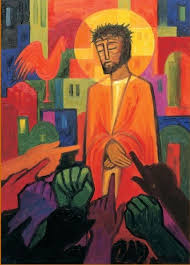
Jesus condemned to death, painting by the Benedictine Sisters of Turvey Abbey

The scene takes place early in the morning at Pilate’s palace. Pilate doesn’t like the Jewish authorities because they put a dent in his career plans through their constant complaints about him to his supervisors in Rome. For purely political reasons, Pilate decides he will satisfy their demand and interview this Jesus who they claim is an enemy of Rome.

The prisoner, Jesus of Nazareth, is brought to Pilate. He is a mess. Christ’s clothes are stained with dirt and blood. His face is bruised and haggard. He has not slept all night. Pilate has heard of Jesus, and so he’s curious to make a personal evaluation of him. Jesus looks nothing like a king to Pilate.

Pilate, in contrast, looks the image of a worldly leader with his power suit on and all the strength of Rome behind him. He hardly has time for this sideshow, this pathetic presentation of leadership in front of him. Jesus looks like nothing more than a kingly wannabe. There is nothing from Christ’s outward appearance that gives any impression he is qualified to be a leader of anybody. We can almost picture Pilate rolling his eyes, saying “so you are the King of the Jews?”

What follows is a strange, convoluted conversation about kingship and truth with a contrast between this world and a world to come. Repeatedly, Jesus makes it clear his kingdom is not of this world. Two thousand years have passed since that dialogue between Jesus and Pilate, yet the same issue remains.

The issue is this: Jesus is calling all of us to follow him – to put his Kingdom first in our lives. In Pilate, we have a symbol of worldly power, which is arbitrary, unprincipled, self-serving, and brutal. Pilate knows the right thing to do but chooses the path of least resistance. He caves to the political pressure, denying the truth which is right under his prominent Roman nose.

Earthly power seeks its own ends. It wants to hold onto control and call the shots. Conversely, Christ’s kingly power is used to serve, to wash feet and meet needs, to move closer to people. Earthly kingdoms use violence to conquer and maintain order and control its subjects. In stark contrast, Christ’s kingdom uses love to transform and unify people around Jesus so that the subjects are with the king and enjoy his rule and reign.

Christ’s kingdom is not of this world. It is counter-cultural and counter-intuitive to how every other leadership structure works on earth. It is an upside-down kingdom that seems like it won’t work or make sense: The way up is down; to be great is not to work for a high position, suck up to the boss, and climb the ladder of wealth and success. Rather, it is to embrace humility and be a servant.

In God’s kingdom, the way to pursue truth is not in forming original ideas and expressing opinions but is found in a person. Truth-seeking disciples will listen to this one voice of Jesus, and filter-out all others. It is a voice calling for submission to his lordship, and to do so because it brings us into an intimate relationship with God.
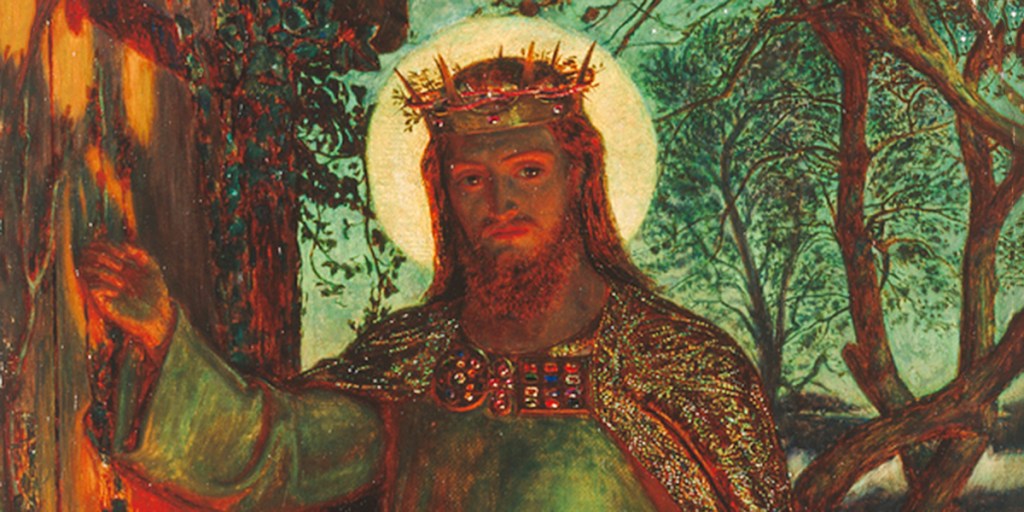
The Light of the World, by English artist William Holman Hunt, 1852

The message of our crucified Savior reigning as King in our lives is not that, having suffered for us, Jesus will somehow keep us from facing difficult times. Instead, Jesus faced a horrible death so that our own tough times can triumph with God’s power to save us and move deeper into our lives. God’s presence and promise is what sustains us, not the avoidance of suffering. Christ as our King means God is with us.

Black Friday and Cyber Monday are almost upon us. This season demonstrates a contrast between two kingdoms. The kingdom of this world calls on us to demonstrate our worth and gain meaningful relationship through grabbing control and obtaining stuff. The pressure in seeking the perfect gift at the perfect price in the hope that if we can bag it, wrap it, and get it under the tree, then we will be perfect, and the perfect family Christmas will happen, and relationships will be great, and everyone will act like I want. Right!?

In contrast, the kingdom Jesus describes assures us we don’t have to prove our worth through endless accomplishments and generous gifts. We don’t need to have the perfect Christmas experience to gain our deepest relational needs. Because, in our baptism, we have been accepted; we are sons and daughters of the living God; and we do not need to achieve greatness through financially and emotionally bleeding ourselves.

In his conversation with Pilate, Jesus said: “My kingdom is not of this world.” When Christians say Jesus Christ is our King, we acknowledge we are his subjects and that we march to the beat of a different drum. The heart of this relationship is our dependence on Jesus who came that we might have life and have it in abundance.

On this Sunday, followers of Jesus Christ boldly state our confidence that, at the end of time, Jesus will come again as King and Ruler of all. 

Blessed are those who see the truth by faith and not by sight. Blessed are those who say “Jesus is the King and the Lord of Life” without rolling their eyes or with a selfish agenda but with a sincere conviction that they belong to Jesus and want to be ever closer to him who is the Way, the Truth, and the Life.

Almighty God, everlasting heavenly Father, you break the power of evil and make all things new in your Son Jesus Christ, the King of the universe. Our confidence is firmly in you, Lord Jesus, knowing you will redeem all things and make all things new. 

We affirm that our security is not in personal abilities, clever plans, or lucrative jobs; our security is in you alone. Your creation still groans with the pain of living in a fallen world. But you have conquered sin through your love, and it is to your love we rely upon. May all things in heaven and on earth recognize the glory of your kingly rule and never cease to praise you. We ask this through our Lord Jesus Christ, your Son, who lives and reigns with you and the Holy Spirit, one God, now and forever. Amen.

1 Kings 8:22-30 – Solomon’s Prayer of Dedication

Then Solomon stood before the altar of the Lord in the presence of all the assembly of Israel and spread out his hands to heaven. He said, “O Lord, God of Israel, there is no God like you in heaven above or on earth beneath, keeping covenant and steadfast love for your servants who walk before you with all their heart, the covenant that you kept for your servant my father David as you declared to him; you promised with your mouth and have this day fulfilled with your hand. Therefore, O Lord, God of Israel, keep for your servant my father David that which you promised him, saying, ‘There shall never fail you a successor before me to sit on the throne of Israel, if only your children look to their way, to walk before me as you have walked before me.’ Therefore, O God of Israel, let your word be confirmed, which you promised to your servant my father David.

“But will God indeed dwell on the earth? Even heaven and the highest heaven cannot contain you, much less this house that I have built! Regard your servant’s prayer and his plea, O Lord my God, heeding the cry and the prayer that your servant prays to you today; that your eyes may be open night and day toward this house, the place of which you said, ‘My name shall be there,’ that you may heed the prayer that your servant prays toward this place. Hear the plea of your servant and of your people Israel when they pray toward this place; O hear in heaven your dwelling place; heed and forgive. (New Revised Standard Version)

I grew up in rural Iowa, a place with lots of gravel roads. In the seasons of Spring and Fall, the thawing and re-freezing lead to some impressive ruts in those roads. It’s difficult to avoid them since they nearly dominate the driving space. 

With our prayers, there are seasons of life where we can slip into ruts – times where focused wrestling in prayer is set aside by just going along with the rut of prayer with the same lifeless words and phrases. There are Christians who pray wonderful prayers… over and over again with almost no thought to it, continually saying the same things anytime they pray.

In today’s Old Testament lesson, we have a prayer of Solomon at the dedication of the Lord’s temple. The two aspects of this prayer that jump out to me are: 

  1. Solomon reminded God of divine promises to the covenant people.
  2. Solomon reminded God of who God is. 

Solomon, as the wisest person to ever live, did not believe that somehow God forgot about promises made or had some sort of divine dementia about theology proper. Instead, Solomon prayed with the kind of prayer that God delights to hear. 

“Prayer does not change God, but it changes him who prays.”

Søren Kierkegaard 

God enjoys hearing us pray. The Lord likes it when we pray according to the promises given us. God adores when we pray with a focused understanding of whom we are praying to.

So, then, in our prayers, it is good to emulate the example of King Solomon. Know the promises of God contained in Holy Scripture and pray they will be confirmed in our lives, families, churches, and world. 

Also, pray with the intention of declaring God’s inherent nature, attributes, and character. Acknowledge the basic trait of God’s steadfast love. Believers serve a big God whose hugeness is continually above all things, and whose work is always continuing according to divine decrees and words. 

One way of moving our prayers out of the ruts of familiar language and thoughts is to journal them. Writing our prayers can become for us an act of worship as we slow down enough to craft a response to God that is thoughtful and connects us with him beyond the rote and routine.

In its simplest definition prayer is a conversation between the one who is praying and the one to whom those prayers is directed. So, whenever we craft a written or spoken prayer, it’s good to get out of a rut by:

  • Using language and words that are meaningful to you.
  • Making your intentions clear by stating exactly what you need or want.
  • Taking your time and not rushing.
  • Lighting candles, burning incense, or creating a special sacred space for prayer. 

Thank you Lord God for the opportunity of prayer and worship. Thank you that I can put aside uncertainties of this world and rest and rely upon the certainties of your good promises. Thank you that we can bring to your feet all the hurts and fears that trouble us and leave them there knowing that your strength and assurance are all that we require. May all your people find peace, healing, wholeness, and joy in your presence, through Jesus Christ, your Son, our Savior, who with you and the Holy Spirit exist as one God, now and forever. Amen.

Psalm 84 – Sacred Space

How lovely is your dwelling place,
    Lord of heavenly forces!
My very being longs, even yearns,
    for the Lord’s courtyards.
My heart and my body
    will rejoice out loud to the living God!

Yes, the sparrow too has found a home there;
    the swallow has found herself a nest
    where she can lay her young beside your altars,
    Lord of heavenly forces, my king, my God!
Those who live in your house are happy;
    they praise you constantly.

Those who put their strength in you are genuinely happy;
    pilgrimage is in their hearts.
As they pass through the Baca Valley,
    they make it a spring of water.
    Yes, the early rain covers it with blessings.
They go from strength to strength,
    until they see the supreme God in Zion.
Lord God of heavenly forces,
    hear my prayer;
    listen closely, Jacob’s God! Look at our shield, God;
    pay close attention to the face of your anointed one!

Better is a single day in your courtyards
    than a thousand days anywhere else!
I would prefer to stand outside the entrance of my God’s house
    than live comfortably in the tents of the wicked!
The Lord is a sun and shield;
    God is favor and glory.
The Lord gives—doesn’t withhold! —good things
    to those who walk with integrity.
Lord of heavenly forces,
    those who trust in you are genuinely happy! (Common English Bible)

I want to be where God is.

That works out quite well, since I believe God is everywhere, anyway.

Yet, there are those special sacred spaces for us, and holy places where we especially sense and perceive a connection with the divine.

That’s why the psalmist’s heart was set on the pilgrim’s way. He was longing for the chance to go to that sacred place of basking in spiritual grace.

I know the feeling. There are times when I begin itching to go to a particular place, a hermitage, which I try to get away to, at least once a year. In 2020, with the coronavirus raging, that didn’t happen. And now, this year, with so many current responsibilities, I’m not sure when it’s going to happen. Yet, happen it must.

Even though we don’t always have the opportunity in traveling to a sacred site, having small spaces set aside just for divine connection can make a real difference. After all, we don’t need to walk a thousand miles to a grand cathedral in order to meet that deep spiritual need. It could be as simple as walking a few steps to a special chair, perhaps with small rituals of lighting a candle or incense, playing contemplative music, and/or having objects, such as a cross, which enables us to enter that connection with God.

“Your sacred space is where you can find yourself again and again.”

Joseph Campbell

Unhappiness can settle in rather quickly when we go for long stretches without a break, not properly attending to our spirit in special ways. Loneliness, and feeling as if no one understands, are normal responses when there is disconnection.

Unfortunately, we aren’t always aware of what’s happening within us. Then, all of a sudden, we wake up – as if having been in the lower deck of a boat – and discover we are in the middle of the sea, unable to see the land. The disconnection becomes palpable.

I strongly urge walking. It has more than physical benefits. The spirit also needs some movement to remain healthy and happy. Do a pilgrimage around your neighborhood of prayer walking, or purposely trying to notice things you’ve never seen before. If limited, do what you can. Even a stroll around the living room can have a therapeutic effect.

The point is to have a sense of God’s presence. For the psalmist, it was taking the journey to Jerusalem, ascending the temple mount, along with other worshipers, praying and singing along the way. It was about enjoying the process of getting to the temple, reveling in the experience of being in the temple, and descending the mount with a heartful of peaceful satisfaction – knowing that, deep down, everything is going to be okay because God is with me.

Just a single day in the sacred space is better than a thousand days elsewhere. I picture it something like enjoying those rare days when our girls and their families, with grandkids and dogs in tow, are with my wife and I for a meal. It doesn’t happen often. Yet, when it does, all the loud hubbub becomes sacred time. I take off my shoes because I realize I’m on holy ground.

Indeed, all of life is sacred and holy. And yet, those special times and places help us remember how sacred and holy life really is.

Just as good nutrition, hygiene, diet, and exercise are part of the continuum of care for the body, a personal sacred space for prayer, meditation and spiritual thought is part of the spiritual self-care that can enrich and support our practices of regular worship within a community of faith, as well as service to the world.

And we must never lose sight that the most sacred space we each have to maintain is our own heart, where the light and life of Christ resides. The fruit of the Spirit come from a humble life surrendered to God’s guidance and healing. That can happen as we visit sacred places and create sacred spaces in our lives.

Lord, let me dwell for a moment on your life-giving presence. I open my heart to you. I can tell you everything that troubles me. I know you care about all the concerns in my life. Teach me to live in the knowledge that you care for me today, will care for me tomorrow, and all the days of my life. Amen.

Psalm 101… Again

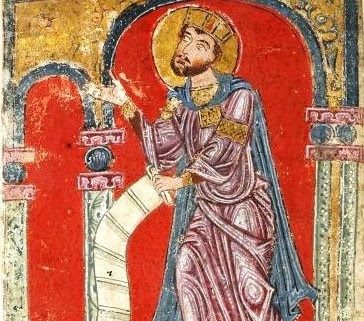
King David, by Unknown artist, c.14th century B.C.E.

I will sing of loyalty and of justice;
    to you, O Lord, I will sing.
I will study the way that is blameless.
    When shall I attain it?

I will walk with integrity of heart
    within my house;
I will not set before my eyes
    anything that is base.

I hate the work of those who fall away;
    it shall not cling to me.
Perverseness of heart shall be far from me;
    I will know nothing of evil.

One who secretly slanders a neighbor
    I will destroy.
A haughty look and an arrogant heart
    I will not tolerate.

I will look with favor on the faithful in the land,
    so that they may live with me;
whoever walks in the way that is blameless
    shall minister to me.

No one who practices deceit
    shall remain in my house;
no one who utters lies
    shall continue in my presence.

Morning by morning I will destroy
    all the wicked in the land,
cutting off all evildoers
    from the city of the Lord. (New Revised Standard Version)

Routine and repetition might seem tedious and boring. However, they are indispensable. People are designed for doing, saying, and thinking the same things over and over again. Habits help to press what is most important into our minds, our speech, and our behavior.

Transformation and change aren’t accomplished through sheer willpower. It happens through the small daily decisions of life. A mere ten minutes, dedicated specifically to a particular task each day, has the power to completely alter our lives.

The biblical psalms, read every day, out loud, through singing and praying, can bring an inside-out metamorphosis which can serve us for a lifetime. To help remind us of this, I sometimes include the psalm readings in my blog reflections two, even three, days in a row.

The Revised Common Lectionary is a method of reading through the Bible in a three-year cycle (Year A, B, C). Rather than reading the Bible from cover to cover, the Lectionary follows the seasons of the Christian Year (Advent, Christmas, Epiphany, Lent, Easter, Pentecost and Ordinary Time).

The advantage to reading the Bible with daily assigned texts from the Old Testament, Psalms, and the New Testament is that the reader has an opportunity to follow the life of Jesus through the course of a year. For a Christian who wants to grow in discipleship, the Lectionary is a helpful way of getting to know Christ better.

Another benefit of following the Lectionary readings is that they can be read slowly in about ten to fifteen minutes. This affords the opportunity to spend time reflecting and thinking about how the Bible applies to our life today. Since the daily readings relate to one another from various places in the Bible, it is a helpful way of keeping in mind the whole of Scripture.

The daily readings of the Lectionary revolve around the Sunday readings. Monday, Tuesday, and Wednesday readings reflect on the Sunday texts. Thursday, Friday, and Saturday prepare for Sunday. This has the obvious advantage for making Christian worship a special experience.

The purpose of the Lectionary is to encourage Bible reading, a well-rounded understanding of the Bible’s contents, as well as provide a good foundation for prayer. The Lectionary is meant to be a devotional reading of the Bible which draws people closer to God.

A consistent feature of the Revised Common Lectionary is that the same Psalm is read three days in a row. There is a reason for that. Psalms are meant for more than reading. They are also designed for prayer, singing, and worship.

Since I spiritually dwell a lot within the psalter, I have written out my own translation of many of them. I encourage you to read the following version out loud as a prayer to God….


God almighty, I will sing about your committed love and the exercise of your justice;
    and I will make music to and for you.
I have committed myself to wise discernment so I can walk in the way of integrity;
    so when will you come and help me?
    I will, with your assistance, establish integrity in my own home.
I refuse to set goals on worthless things which add no value to my life.
    I despise the actions of deviant and deceitful people,
    and I will not let their crud stick to me.
My mind and heart won’t go down that crooked path,
    for I will have nothing to do with the deeds of darkness.
The person who slanders another behind their back –
    well, just know, I will not put up with it!
The person who is full of themselves and looks down on others –
    believe you me, I will not tolerate it!

My eyes are fixated on pursuing trustworthy persons,

    and I will surround myself with them.

The person who walks in the way of integrity –

    for sure, will be my friend and confidant.
There is absolutely no room for deceitful hypocrites within my household,
    nor for any two-faced liar; they won’t be around me for long!
Every morning, without fail, I will practice justice,
    I will make it so evil persons cannot survive around me,
    effectively cutting-off troublemakers from your holy place.
Amen.