

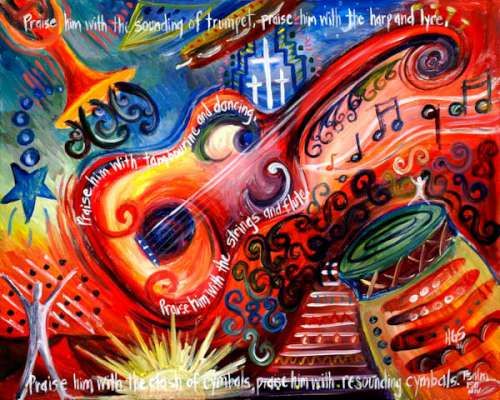
Psalm 150 – Praising God

Psalm 150 by Hope G. Smith

Shout praises to the Lord!
    Praise God in his temple.
    Praise him in heaven,
    his mighty fortress.
Praise our God!
    His deeds are wonderful,
    too marvelous to describe.

Praise God with trumpets
    and all kinds of harps.
Praise him with tambourines
    and dancing,
    with stringed instruments
    and woodwinds.
Praise God with cymbals,
    with clashing cymbals.
Let every living creature
praise the Lord.
    Shout praises to the Lord! (CEV)

There is a time for quiet reflection and contemplation, and there is a time for jubilant shouts of praise. The biblical psalms mirror the full range of human emotion. Having moved through the ups and downs of doubt, curiosity, anger, lament, and trust, it is appropriate that the psalter ends with lots of joyful noise.

I grew up in a generation where children were expected to be quiet in church. Not surprisingly, as a child, I found the church worship service on Sunday to be the most boring hour of my week. After a Saturday of morning cartoons, sugary cereal, All-Star Wrestling, and playing outside in the dirt with my brother, Sunday morning was typically a big letdown.

All I have to say about that, and about cranky old women shushing kids in church, is that the adults somehow forgot to read Psalm 150. Maybe if us big people were better about encouraging our little people to dance in the aisles, blow a kazoo as loud as they can, and freely give a shout to the Lord, then perhaps there would be a lot fewer defections from church worship services.

“Praise is the rehearsal of our eternal song. By grace we learn to sing, and in glory we continue to sing. What will some of you do when you get to heaven, if you go on grumbling all the way? Do not hope to get to heaven in that style. But now begin to bless the name of the Lord.”

Charles Haddon Spurgeon

But don’t think I’m advocating going all out noise, all the time. Just as it is neither necessary nor appropriate to always shout everything you say, and skip everywhere you go, so the worship of God needs to encompass the broad scope of the human condition. Silence, meditation, and stillness have their important place. In a desire to make church fun, some Christians have created imbalanced experiences of only victory in Jesus.

One of the reasons I follow the Christian Year with its liturgical movements is that it holds and maintains the balance of worship and the theological tension of both crucifixion and resurrection. We need healthy rhythms of sorrow and joy, stillness and movement, quietness and shouting.

The Church is currently in the Christian season of Eastertide. It is a focused time of celebration – which is why we have biblical sections in this time of year like Psalm 150. This is the appropriate time to lift loud praise to God for the risen Christ and celebrate salvation and new life in Jesus.

I’m not really a numbers kind of guy, yet its easy to notice the word “praise” occurs 10 times in a psalm of just 6 verses. And 7 musical instruments are mentioned. Methinks we’re supposed to not miss something here.

“Through Jesus, therefore, let us continually offer to God a sacrifice of praise—the fruit of lips that openly profess his name.”

hebrews 13:15, NIv

Praise is to happen in heaven and earth, in all creation, out in the world as well as inside the walls of the church building. It is to be done with voice, dance, drums, horns, woodwinds, and stringed instruments. Because God has done wonderful and marvelous acts throughout the earth, people are to respond with profuse gratitude expressed with lots of emotion.

Just so you know, that means sourpuss Christians who wrongheadedly believe human feelings ought to be stuffed and suppressed, need some remedial theological education about who God is and exactly what he expects from people. Somebody, please dispense the laxative of Psalm 150 to loosen their spiritual constipation!

God gave us our breath, and we are to use it for praise. If we see the entire book of Psalms as a life, then it is fitting the final psalm ends with sanguine praise. Indeed, when a person is at end of life, do they have reason to praise? A life of walking with God through thick and thin will inevitably end with recounting the ways in which the Lord has shown up and delivered. They want musical praise filling their last days and minutes.

That is exactly what Duke Ellington did in the twilight of his life. On January 19, 1968, Ellington performed a concert of sacred music at St. John the Divine cathedral in New York City. Among the original songs he performed and later recorded was his musical interpretation of Psalm 150. He called it “Praise God and Dance.”

Duke Ellington said that this praise music, and the two other albums of sacred music he recorded, were “the most important thing I have ever done.” When Ellington performed “Praise God and Dance” at the ancient Church of Santa Maria del Mar in Barcelona, Spain, the congregation spontaneously burst into the aisles with dancing and singing.

The whole person is to be involved in praise – mind, body, emotions, and spirit – because God is Lord of all of us, not just the spiritual dimension.

Make a joyful noise to the Lord, all the earth; break forth into joyous song and sing praises. Sing praises to the Lord with the lyre, with the lyre and the sound of melody. With trumpets and the sound of the horn make a joyful noise before the King, the Lord. (Psalm 98:4-6, NRSV)

I will bless you every day. I will praise your name forever and always. The Lord is great and so worthy of praise! God’s greatness can’t be grasped. (Psalm 145:2-3, CEB)

Praise the Lord! My whole being, praise the Lord. I will praise the Lord all my life; I will sing praises to my God as long as I live. (Psalm 146:1-2, NCV)

Shout praises to the Lord! Our God is kind, and it is right and good to sing praises to him. (Psalm 147:1, CEV)

Amen.

Speak to One Another with Psalms, Hymns, and Spiritual Songs


You have probably noticed that when a person gets drunk, that person says and does things that he does not typically say and do when he is sober.  When it comes to being filled with the Spirit (Ephesians 5:18-20), instead of doing and saying stupid things, we are to be so filled with God that we do things and say things that we would not typically do and say if we were not filled with God – that is, good things.  Apart from God, apart from being full of God’s Spirit, we will tend toward not singing, but mumbling; we will not make music in our hearts, but will worry and fret about everything; and, what comes out of our mouths will be complaining and grumbling instead of giving thanks.
 
            God has called his people to be filled with the Spirit.  Singing is part of being filled with the Spirit of God.  Singing is what happens when we experience God’s overflowing grace in our lives.  Having been predestined, elected, adopted, and redeemed by Jesus leads to a joyful overflow of praise which comes out in song.  Music is powerful.  Music is not only a means of expressing our praise and commitment to Christ and each other, it is also a powerful means of being impressed.  When children first learn the alphabet, it is taught to them in a song; just trying to teach letters in a rote fashion typically doesn’t work well for pre-school kids.  This is why we remember certain words for a lifetime.  It is why we still remember words from old TV shows, because those words were set to a catchy tune.  I still know all the words to the Gilligan’s Island theme song, as well as The Brady Bunch, The Partridge Family, and Underdog. Music is powerful.  It is why an Alzheimer’s patient may not remember who her daughter is, but can flawlessly sing the words of Amazing Grace.
 
            It is important for us to understand this power of music and song, because singing is not to be exclusively a matter of expression; it is to be a powerful means of being impressed.  Singing is to be both an offering, a sacrifice of praise (Hebrews 13:15) that is given to God; and, singing is to be a vehicle whereby we are taught and encouraged and built up in the community of believers.  We are to sing; and, we don’t only sing to God, but we also sing to one another, and even to ourselves.  Church music, then, is to be both a means of praising God and a practice of encouraging each other.
 
            If we are to speak to one another with singing, it is necessary for us to know what psalms, hymns, and spiritual songs are.  When we think of the word “psalm” we may rightly think of the bible book of Psalms.  Singing the psalms is an ancient practice that goes all the way back to the Israelites singing psalms in the temple and synagogue.  The early church maintained this practice, especially as a means of being faithful to praying without ceasing.  However, over time, medieval congregations did not sing psalms.  In fact, the congregation did not typically sing at all.  Almost all the singing was done by church choirs and professional musicians employed by the state (since there was no separation of church and state) to write, compose, and perform in worship services.  500 years ago, when the Reformation came in all its force, one of the reforms made, especially by Martin Luther, was giving music back to the people.  One of the results of this change was putting the book of psalms to song in what we know as the Psalter.  For many Protestant denominations, the Psalter was the primary means of singing.  The Psalter was chiefly setting prayers to song; it was both a means of expressing prayer to God, and a means of learning Scripture.
 
            There had always been hymns in the church, but it was not until the Reformation that hymns began to be written and sung by congregations by the thousands.  Hymns for the Reformers were used to both impress sound doctrine and theology on Christians, and be a means of confessing the faith together.
 
 
            Spiritual songs are the present day equivalent of praise and worship choruses, or what some refer to as contemporary songs.  These are songs that are purposefully designed to be emotional, to be expressions of praise to God and give powerful testimony to what God has done or is doing for a person on a very feeling level.
 
            So, then, psalms are used to pray and learn scripture; hymns are used to teach us sound doctrine and confess the faith together; and, spiritual songs are an important way of expressing praise to God, and being encouraged in the faith.  Church music is to serve, then, as both a revelation from God, and as a response from God’s people.
 
            There are two important deductions from the admonition in Scripture to sing to one another with psalms, hymns, and spiritual songs:  1) a variety of songs is inferred and expected; and, 2) Paul commanded their use.
 
            The reason worship style is such a hot topic, and always has been so, is because we all have our personal preferences.  Yet, if we are to be faithful to this passage of Scripture we will not just lock in on what I want.  The truth is that we are selfish people when it comes to music.  We want what we want and we don’t care what somebody else wants.  And we will persist in that selfishness until somebody calls us on it.  That somebody is the Apostle Paul.  The Word of God is calling us to encompass psalms, hymns, and spiritual songs – all three of them – in our worship.
 
            Last year I asked a trusted Christian musician and pastor some questions about worship and music.  I asked him how I can lead among a variety of preferences concerning music.  One of his responses I have not forgotten.  He answered my question with a question:  “How highly do people, including and especially your musicians, value the unity of the church?  Do they love each other so much that they can allow for a wider range of style, and do so without vocally complaining about it?  When I arrived at our church, some people were in a rather bad habit of saying very openly, ‘Oh I hate that song,’, or, ‘If I hear this song one more time I’m walking out.’  What I tried to do was teach people that this is not the most loving or mature approach, and does little to build up the rest of the Body of Christ.”


            If the music in your church is being done well, and is faithful to Scripture, yet others or even yourself thinks the music is lifeless, or dull, or strange, the real issue is not one of style.  The place to look is in the heart.  Is that heart filled with the Spirit of God?  If it is, we will speak to one another using the Psalter, using time-honored hymns, and utilizing fresh contemporary praise songs.  The result will be that the Body of Christ, the Church, will be built up in the faith.  And that is my desire and my prayer.