Approach Everything with Humility and Wisdom (Esther 5:1-14)

Esther, by Marc Chagall, 1960

On the third day Esther put on her royal robes and stood in the inner court of the palace, in front of the king’s hall. The king was sitting on his royal throne in the hall, facing the entrance. When he saw Queen Esther standing in the court, he was pleased with her and held out to her the gold scepter that was in his hand. So Esther approached and touched the tip of the scepter.

Then the king asked, “What is it, Queen Esther? What is your request? Even up to half the kingdom, it will be given you.”

“If it pleases the king,” replied Esther, “let the king, together with Haman, come today to a banquet I have prepared for him.”

“Bring Haman at once,” the king said, “so that we may do what Esther asks.”

So the king and Haman went to the banquet Esther had prepared. As they were drinking wine, the king again asked Esther, “Now what is your petition? It will be given you. And what is your request? Even up to half the kingdom, it will be granted.”

Esther replied, “My petition and my request is this: If the king regards me with favor and if it pleases the king to grant my petition and fulfill my request, let the king and Haman come tomorrow to the banquet I will prepare for them. Then I will answer the king’s question.”

Haman went out that day happy and in high spirits. But when he saw Mordecai at the king’s gate and observed that he neither rose nor showed fear in his presence, he was filled with rage against Mordecai. Nevertheless, Haman restrained himself and went home.

Calling together his friends and Zeresh, his wife, Haman boasted to them about his vast wealth, his many sons, and all the ways the king had honored him and how he had elevated him above the other nobles and officials. “And that’s not all,” Haman added. “I’m the only person Queen Esther invited to accompany the king to the banquet she gave. And she has invited me along with the king tomorrow. But all this gives me no satisfaction as long as I see that Jew Mordecai sitting at the king’s gate.”

His wife Zeresh and all his friends said to him, “Have a pole set up, reaching to a height of fifty cubits, and ask the king in the morning to have Mordecai impaled on it. Then go with the king to the banquet and enjoy yourself.” This suggestion delighted Haman, and he had the pole set up. (New International Version)

Esther Comes Before the King, by Johann Boeckhorst (1604-1668)

Three days of fasting by Esther and her attendants, along with all of the Jewish people in the Persian capital city, came to the point of approach and confrontation. But it was not confrontation in the sense of in-your-face; that would get you killed in the emperor’s court.

One did not approach the king without being asked to do so. Yet, Queen Esther was the only person in a position to try and speak to the king on behalf of the Jewish people. A royal edict had been pronounced; a day was coming when they would be slaughtered and plundered. Something had to be done. And that something became a someone: Esther.

Although Esther was a queen, it was not by her own choice. She was brought into the royal court through a long process of finding a queen for the king. Esther was taken from her home; she had to participate.

It seemed as if she had no agency of her own. But there came a time when Esther had to find that personal agency and speak her own voice – even though it was at great risk to her own life, as well as the life of her people.

Perhaps because Esther had no ability to seek status, she seems to have come to the conclusion that she could be used where she was – that somehow she came to the Persian court for just such a time as this, the saving of many lives.

Queen Esther evidenced a spirit of collaboration and wisdom. She knew she could not directly confront the king concerning Haman’s evil scheme to rid the earth of Jews. She needed to approach by coming in the side door of humility and gentleness.

Thus, Esther requested the presence of King Xerxes and his right hand man Haman to a banquet. There was no arrogant demanding of justice or rights. There was only a genuine spirit of trying to do right.

All of us have others who hold positions of power over us. They make decisions which impact us significantly, whether for good or for ill. The way in which we deal with people in authority can make all the difference, not only for ourselves, but also for many other folks as well.

Power dynamics exist everywhere, in every organization, institution, family, workplace, neighborhood, and faith community. We are not in control of those structures. Yet, you and I have control of ourselves. We can choose how to respond to any given situation.

We have the opportunity to decide whether to be respectful or disrespectful, patient or impatient, wise or foolish, encouraging or discouraging, helpful or obnoxious.

Esther chose wisely. Haman chose foolishly. He was self-centered, power hungry, status conscious, angry, and downright arrogant.

Haman was obsessed with everyone giving him honor. So, when Mordecai didn’t bow to him, Haman made it his personal mission to do away with him. But that wasn’t enough. He also created a devious plan to kill all Jews.

The misuse of power is one of the most devastating sins a person can do, namely because it affects so many people and makes their lives miserable, if not dead. Abusers are typically, at their core, insecure persons who overcompensate for feeling better by pushing others down.

Abusive persons in authoritative positions is a very bad combination. The only human life they value is themselves. And they don’t care who they destroy to get what they want to feel secure and important.

Unfortunately, those in high positions sometimes (maybe oftentimes) have no idea how to properly assess the character and competence of those who want authority. Xerxes was a terrible judge of character, choosing Haman for high office and listening to him.

There are far too many persons in this world, in our own societies and institutions, who are not fit to hold any sort of public office or responsible position of power. They may talk a good line on the outside, but inside they have a hollow spot where there soul should be.

Yet, we elect them, or are okay with them in office. There’s no pushback. We can even stump for some of those morally stunted individuals. It should not be that way. We can most certainly do better, in this day and age. King Xerxes isn’t around, and there isn’t any supreme sovereign emperor calling all the shots.

We need to take responsibility, first and foremost, by developing a just and wise character within ourselves.

One’s own spiritual growth and emotional maturity will help to make wise decisions and right judgments. It is imperative that we have enough discernment to judge between the genuine article and a charlatan; and between one who has authentic potential, and one who has none.

Haman was no good for anybody but himself. And that, he even screwed up. But Esther was the right person for the right time. She evidenced a solid character, a listening spirit, and moral sensitivity.

May her tribe increase.

O Spirit of God, we ask you to help orient all our actions by your good and wise inspiration, and carry them on by your gracious assistance, so that every prayer and work of ours may always begin from you; and through you be happily ended. Amen.

Family Drama (2 Samuel 13:37-14:24)

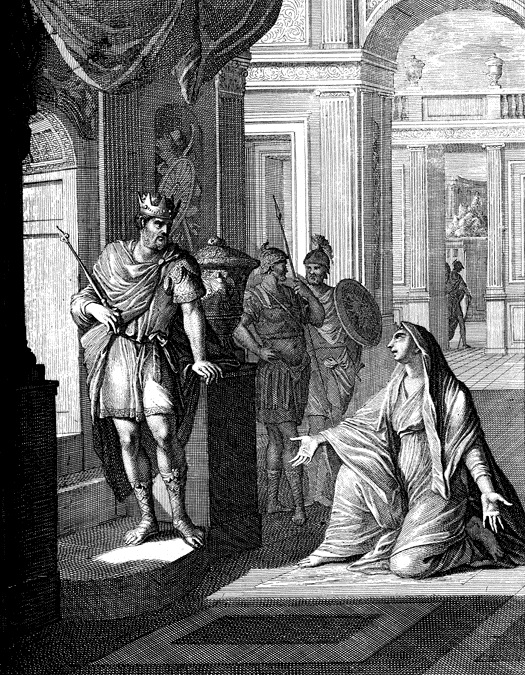
The woman of Tekoa before King David, by Caspar Luiken, 1700

Absalom fled and went to Talmai son of Ammihud, the king of Geshur. But King David mourned many days for his son.

After Absalom fled and went to Geshur, he stayed there three years. And King David longed to go to Absalom, for he was consoled concerning Amnon’s death.

Joab son of Zeruiah knew that the king’s heart longed for Absalom. So Joab sent someone to Tekoa and had a wise woman brought from there. He said to her, “Pretend you are in mourning. Dress in mourning clothes, and don’t use any cosmetic lotions. Act like a woman who has spent many days grieving for the dead. Then go to the king and speak these words to him.” And Joab put the words in her mouth.

When the woman from Tekoa went to the king, she fell with her face to the ground to pay him honor, and she said, “Help me, Your Majesty!”

The king asked her, “What is troubling you?”

She said, “I am a widow; my husband is dead. I your servant had two sons. They got into a fight with each other in the field, and no one was there to separate them. One struck the other and killed him. Now the whole clan has risen up against your servant; they say, ‘Hand over the one who struck his brother down, so that we may put him to death for the life of his brother whom he killed; then we will get rid of the heir as well.’ They would put out the only burning coal I have left, leaving my husband neither name nor descendant on the face of the earth.”

The king said to the woman, “Go home, and I will issue an order in your behalf.”

But the woman from Tekoa said to him, “Let my lord the king pardon me and my family, and let the king and his throne be without guilt.”

The king replied, “If anyone says anything to you, bring them to me, and they will not bother you again.”

She said, “Then let the king invoke the Lord his God to prevent the avenger of blood from adding to the destruction, so that my son will not be destroyed.”

“As surely as the Lord lives,” he said, “not one hair of your son’s head will fall to the ground.”

Then the woman said, “Let your servant speak a word to my lord the king.”

“Speak,” he replied.

The woman said, “Why then have you devised a thing like this against the people of God? When the king says this, does he not convict himself, for the king has not brought back his banished son? Like water spilled on the ground, which cannot be recovered, so we must die. But that is not what God desires; rather, he devises ways so that a banished person does not remain banished from him.

“And now I have come to say this to my lord the king because the people have made me afraid. Your servant thought, ‘I will speak to the king; perhaps he will grant his servant’s request. Perhaps the king will agree to deliver his servant from the hand of the man who is trying to cut off both me and my son from God’s inheritance.’

“And now your servant says, ‘May the word of my lord the king secure my inheritance, for my lord the king is like an angel of God in discerning good and evil. May the Lord your God be with you.’”

Then the king said to the woman, “Don’t keep from me the answer to what I am going to ask you.”

“Let my lord the king speak,” the woman said.

The king asked, “Isn’t the hand of Joab with you in all this?”

The woman answered, “As surely as you live, my lord the king, no one can turn to the right or to the left from anything my lord the king says. Yes, it was your servant Joab who instructed me to do this and who put all these words into the mouth of your servant. Your servant Joab did this to change the present situation. My lord has wisdom like that of an angel of God—he knows everything that happens in the land.”

The king said to Joab, “Very well, I will do it. Go, bring back the young man Absalom.”

Joab fell with his face to the ground to pay him honor, and he blessed the king. Joab said,

“Today your servant knows that he has found favor in your eyes, my lord the king, because the king has granted his servant’s request.”

Then Joab went to Geshur and brought Absalom back to Jerusalem. But the king said, “He must go to his own house; he must not see my face.” So Absalom went to his own house and did not see the face of the king. (New International Version)

By Bible Art

Absalom’s sister, Tamar, was sexually assaulted by their half-brother Amnon. As a result, Absalom brought Tamar to live in his house, because she had become a desolate woman.

When their father, King David, heard all this, he was, of course, furious; yet, he did nothing. And Absalom never talked to Amnon again; he hated Amnon because he had disgraced his sister Tamar.

For two years, Abasalom stewed on the terrible event of his sister’s assault. When the man’s bitterness came to it’s full poison, Abasalom created a ruse in order to kill Amnon. And the murderous plot was successful.

Then, Absalom fled and went to Geshur (north of Israel, in present day Syria) and stayed there three years. King David longed to go to Absalom, but he never did, nor did he do anything, either good or bad.

All of that stuff is what led up to today’s story about bringing Absalom back. When I was younger, I would read these stories of David and his sons and scratch my head as to why a guy that’s so wise to so many things seems stupid when it comes to his own family.

And then I became a father myself, with grown adult children. Now, I understand David’s actions and in-actions. I get it. When it comes to being a parent of adult kids, there is a very different perspective. It’s an outlook that’s hard to communicate and put into words.

Sometimes I wonder if it’s how God looks at us.

The nearest I can get to describing it, is that the sense of awe and wonder at that little baby being born never quite goes away.

The incredible and seemingly miraculous thing we call childbirth creates a view that this human being is so special, there is always hope they will become a little child again, that is, not literally, but in the sense of being yet again humble, right, good, and endearing – that the relational value will return.

In this sense, a parent never loses hope. And I think that is something of what King David was experiencing with his own adult children. What’s more, it seems that God has this unfailing love for us that continually longs for humanity to come back to the divine relationship.

God appears in Holy Scripture as this heavenly Father (and Mother) who is slow to judgment and long on steadfast love and covenant loyalty. The Lord is not slow in keeping promises or doing what is right. Rather, God is patiently waiting for humans to come to repentance and faith.

Admittedly, there is the sense that King David seems unreasonable, that he was unwilling to do something about his adult children’s shenanigans. Yet, there is also this sense of longing, of King David knowing the potential of his children, and holding out the hope that they will live into who they were created to be on this earth.

I definitely don’t think David always got it right. But he also didn’t always get it wrong, either. Which is pretty darned close to how every parent is doing, if we are honest about it. So, here is a blessing for parents of adult children:

May the Lord bless your adult children with the gift of the Holy Spirit. May they be filled with faith, hope, love, peace, truth, and spiritual power, so that they may be blessed and be a blessing to others.

And may God guide parents everywhere with discernment and wisdom, so that everything they do will come from the place of grace, truth, and love. Amen.