A Ruler for the Good of the People (2 Samuel 5:11-16)

King David, by Sefira Lightstone

King Hiram of Tyre sent some officials to David. Carpenters and stone workers came with them, and they brought cedar logs so they could build David a palace.

David knew that the Lord had made him king of Israel and that he had made him a powerful ruler for the good of his people.

After David left Hebron and moved to Jerusalem, he married many women from Jerusalem, and he had a lot of children. His sons who were born there were Shammua, Shobab, Nathan, Solomon, Ibhar, Elishua, Nepheg, Japhia, Elishama, Eliada, and Eliphelet. (Contemporary English Version)

Once David became ruler of a united kingdom – Israel and Judah – he established the capital in a central place between the two (much like how Washington D.C. was built at a geographical juncture between North and South of the United States).

The Jebusites were firmly lodged within Jerusalem. Yet, with a good deal of ingenuity, David and his men found a way into the formidable stronghold of Jerusalem and took it. It then became the City of David. (2 Samuel 5:8-10)

King David has the spiritual sense to understand that the Lord was with him; and that his own greatness was directly tied to the greatness of God. The Lord is concerned for the divine/human covenant, and for the glory of Israel and Judah. David did not believe that his success was in any way tied to his own personal skills or abilities.

In light of David’s spiritual stance, it seems a bit strange that today’s text then turns to David’s response of taking more women as wives in Jerusalem. The text also lets us know that David established diplomatic ties with Tyre and worked toward building a royal palace in the new capital.

Typically, Old Testament stories don’t give us explicit moral commentary, telling us what is good and what is bad. Sometimes they inform us of people’s motives, but usually not. So, what was David up to, and why was he doing it? The story invites us to offer up an answer from our own consideration. So, here’s mine…

All of us do the best we can, with what we know at the time. That’s why it is so important to be continually cultivating and nurturing a life of wisdom.

Most things in life don’t have ready-made answers for us. David certainly didn’t Google how to capture Jerusalem, or how to establish a kingdom. He instead had a lifetime of walking with God, learning God’s law, and experiences which God brought him through. And that is exactly what all of us need to do for just about everything.

If you and I were in David’s shoes, within his culture of the ancient world, we might very well do what he did by marrying up and bringing political stability to a new united kingdom that was surrounded by non-Jewish nations.

King David, by Adamo Tadolini, on the Colonna dell’Immacolata, Rome, Italy

Trusting the Lord doesn’t mean that we become passive; it isn’t a let go and let God attitude. Faith requires actively pursuing justice and righteousness for the good of everyone. It takes creativity and a wise mind, a compassionate heart, and a well-attuned sense of one’s own gut.

This approach to life indeed requires a lifetime of learning, growing, and experiencing new things. The following are some ways of developing the experiential knowledge that we understand as wisdom:

Pursue and be open to new experiences

If you don’t like the experience you’re having, create a new one. David was open to following God and engaging in whatever new experiences required fulfilling the will of God. To keep growing as an individual, it’s important to explore unfamiliar and sometimes uncomfortable things; those experiences can teach us how to be more humble and honest, which is especially important for leaders.

Show empathy and be compassionate

This was at the heart of David’s rule as king. He showed steadfast love and commitment to Israel and Judah. Yes, he was a man of war, and did his share of soldiering. And, at the same time, David valued life and went out of his way to show mercy.

After becoming king, instead of wiping out all of King Saul’s family (as was custom for many kings in the Ancient Middle East) David looked for anyone in the family of Jonathan (Saul’s son) to which he could show kindness to (2 Samuel 9:1). There is no path to wisdom that doesn’t go through the land of compassion.

Don’t be afraid to fail

Growth in wisdom usually comes from messing up. How we respond to failure and/or imperfection influences our decision-making and problem-solving skills. A significant part of self-development is learning how not to repeat mistakes. But to do that, you have to make them first.

David made plenty of mistakes, and even outright sinned in ways that effected all Israel and Judah. Yet, he learned his lessons by turning away from the mistakes (repentance) and moving forward (faith).

Ask for help when you need it

A wise person doesn’t have all the answers. They are wise because they know when to consult others and ask for resources. David always had counselors in his court who he knew could give him sage advice whenever he needed it.

Mentor others

One of the best ways of learning and developing wisdom is by coming alongside others and helping them become successful in life. This is one of the main reasons I enjoy teaching and discipling others – so that I can learn from the process, and from the people I mentor. Since David was attuned to this, Israel and Judah had the wisest king in history, his son, King Solomon.

Wisdom is a virtue that goes beyond knowledge. Wisdom is really the study of life. And only by wisdom’s experiential understanding can we make effective changes, influence others, and please God. David was a king for the good of the people.

O God, by whom the meek are guided in judgment, and light rises up in darkness for the godly: Grant us, in all our doubts and uncertainties, the grace to ask what you would have us to do, so that the Spirit of wisdom may save us from all false choices, and that in your light we may see light, and in your straight path, we may not stumble. Amen.

Learn To Do Right (Isaiah 1:1-4, 16-20)

Statue of Isaiah the Prophet, by Salvatore Revelli (1816-1859), Rome, Italy

The vision concerning Judah and Jerusalem that Isaiah son of Amoz saw during the reigns of Uzziah, Jotham, Ahaz and Hezekiah, kings of Judah.

Hear me, you heavens! Listen, earth!
    For the Lord has spoken:
“I reared children and brought them up,
    but they have rebelled against me.
The ox knows its master,
    the donkey its owner’s manger,
but Israel does not know,
    my people do not understand.”

Woe to the sinful nation,
    a people whose guilt is great,
a brood of evildoers,
    children given to corruption!
They have forsaken the Lord;
    they have spurned the Holy One of Israel
    and turned their backs on him…

Wash and make yourselves clean.
    Take your evil deeds out of my sight;
    stop doing wrong.
Learn to do right; seek justice.
    Defend the oppressed.
Take up the cause of the fatherless;
    plead the case of the widow.

“Come now, let us settle the matter,”
    says the Lord.
“Though your sins are like scarlet,
    they shall be as white as snow;
though they are red as crimson,
    they shall be like wool.
If you are willing and obedient,
    you will eat the good things of the land;
but if you resist and rebel,
    you will be devoured by the sword.”
For the mouth of the Lord has spoken. (New International Version)

Whenever the prophet has a vision, everyone better perk up and take notice.

After the northern Jewish kingdom of Israel fell to the Assyrians in 722 B.C.E., they lost their national identity. The southern Jewish kingdom of Judah, and its capitol Jerusalem, continued to exist for nearly a century and a half – even though they were vassals of either the Assyrians or the Babylonians.

Yet, Judah still functioned as its own nation in a semi-independent state. It was during this time that the prophet Isaiah had his vision, under the kingship of those descended from King David.

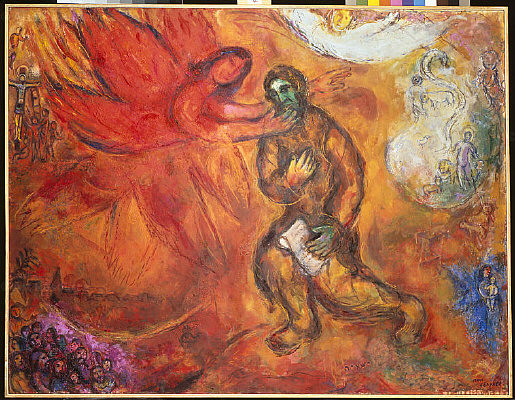
The Prophet Isaiah, by Marc Chagall,1968

The initial section of Isaiah’s prophecy is a series of oracles that establish the relationship between God and the nation of Judah, especially Jerusalem. The gist of God’s message is that the people are guilty of lots of sins.

However, the Lord left a gracious opening for them; their fate was not yet sealed. The nation could repent of their sins and experience a future restoration. God wanted to bring a resolution, and not have the people keep going in their unhealthy ways.

Throughout Isaiah’s vision, God is presented as a Father, with the children being Israel (both northern and southern kingdoms). And Father God has a complaint against them. The people’s principal sins were rebellion and ignorance. They spurned God’s authority, and did not accept their family intimacy with God.

Thus, the Lord is quite disappointed with the people. Heavenly witnesses are called to hear the charges of wrongdoing. The troubles of the nation were to be interpreted as warnings and disciplines, meant to lead them to stop and do right. Yet it seems that the warnings go unheeded by the people. It appears that God’s efforts to woo the people back are in vain.

Although the people’s continued sacrificial worship is merely done as a mere perfunctory act, and without true hearts of devotion for what is just and right, God offered them a chance to make things right, so that they could do justice and embrace righteousness.

God made it clear what it would take to repent: learn to do good; seek justice; recuse the oppressed; defend the orphan; plead for the widow. God even issued an invitation for a divine/human dialogue to happen.

Grace and cleansing from sin are possible, that is, if the people are willing and obedient, instead of remaining rebellious and refusing to do what is right, just, and good.

The nation was at a crossroads and had to make a decision. Would they choose wisely or foolishly?

Decision-making is critical. Some choices are harder than others. Yet the ability to decide is a God-given gift and ability.

Making decisions is fraught with consequences; we may try to anticipate or ignore what might happen with a particular choice. And how we go about decision-making is important. Who do we listen to? What information do we need? How will this choice shake out in the end?

Intentions are not choices, but are simply a mental resolve to do or not do something, at some point. And to not make a decision is to have already made a decision to either procrastinate or not do anything at all.

There are also decisions of duty. This may or may not be admirable. There is also the choice of attitude and energy given to the decision – because a choice of doing one’s duty can be done with joy or grumpiness, excitement or bitterness, with a bright disposition or a flat sullen affect.

It’s not really hard to guess or assess the choices of the people in Judah and Jerusalem in Isaiah’s day. They were doing an outward duty of temple worship, but without any heart to it.

Many of the people looked upon their duty as a sort of magical talisman that would ward off any trouble or army invasion. With that kind of approach, the people looked upon the rest of their time as their own, as discretionary, as the choice to do whatever they wanted to do.

If their business practices were dubious and not quite right, then big deal. After all, they give their money at the temple.

If the leaders played favorites and overlooked the needy person among them, then so what? The poor and oppressed can work harder, right?

And if orphans and widows – who were the most vulnerable persons in society – were not completely cared for, then that’s sad, but too bad for them.

I can picture an ancient city council saying something like, “We have a lot on our plate, dealing with foreign powers, the economy, and political issues. Those needy persons need to get a clue. It’s their own fault for hanging around and not leaving the city for greener pastures. Not our problem.”

Oh, but it very much was their problem. It was everyone’s problem, and each person’s responsibility, to ensure that God’s justice, goodness, and righteousness was infused throughout the entire city and nation.

Hence, the reason for the book of Isaiah. Tackle the moral and ethical problems head on before it’s too late and the gravity of judgment presses everyone out of the land.

What’s needed is a willing heart inclined to walk into divine obedience, without any talkback, and without any negotiations or deals.

God is merciful, and is willing to talk it out. But justice must be done. Needs must be met. People must be cared for. The Lord’s will must be done, here on earth, as it is always done in heaven. Is this what you are about, or not? Will you learn to do right?

Most merciful God, shine the light of your gracious love upon my cold hard heart. Enlighten my mind and dispel the darkness; speak the truth and help me obey; and have pity upon me. Forgive me yet again of my offenses, transgressions, and guilty acts. Grant me the grace to serve you with faithfulness and care for your people with love and purity, today and always. Amen.

Handling a Stressful Situation (Daniel 2:24-49)

Daniel Interprets Nebuchadnezzar’s Dream, by David Martin (1639-1721)

So Daniel went to Arioch, the man the king had appointed to wipe out Babylon’s sages. Daniel said to him, “Don’t wipe out the sages of Babylon! Bring me before the king, and I will explain the dream’s meaning to him.”Wasting no time, Arioch brought Daniel before the king, telling him, “I have found someone from the Judean exiles who will tell the dream’s meaning to the king.”

In reply the king said to Daniel (whose name was Belteshazzar), “Can you really tell me the dream that I saw, as well as its meaning?”

Daniel answered the king, “Sages, enchanters, dream interpreters, and diviners can’t explain to the king the mystery he seeks.But there is a God in heaven, a revealer of mysteries, who has shown King Nebuchadnezzar what will happen in the days to come! Now this was your dream—this was the vision in your head as you lay in your bed:

“As you lay in bed, Your Majesty, your thoughts turned to what will happen in the future. The revealer of mysteries has revealed to you what will happen. Now this mystery was revealed to me, not because I have more wisdom than any other living person but so that the dream’s meaning might be made known to the king, and so that you might know the thoughts of your own mind.

“Your Majesty, you were looking, and there, rising before you, was a single, massive statue. This statue was huge, shining with dazzling light, and was awesome to see.The statue’s head was made of pure gold; its chest and arms were made from silver; its abdomen and hips were made of bronze.Its legs were of iron, and its feet were a mixture of iron and clay.You observed this until a stone was cut, but not by hands; and it smashed the statue’s feet of iron and clay and shattered them.Then all the parts shattered simultaneously—iron, clay, bronze, silver, and gold. They became like chaff, left on summer threshing floors. The wind lifted them away until no trace of them remained. But the stone that smashed the statue became a mighty mountain, and it filled the entire earth.

“This was the dream. Now we will tell the king its meaning:You, Your Majesty, are the king of kings. The God of heaven has given kingship, power, might, and glory to you!God has delivered into your care human beings, wild creatures, and birds in the sky—wherever they live—and has made you ruler of all of them. You are the gold head.But in your place, another kingdom will arise, one inferior to yours, and then a third, bronze kingdom will rule over all the earth.Then will come a fourth kingdom, mighty like iron. Just as iron shatters and crushes everything; so like an iron that smashes, it will shatter and crush all these others.As for the feet and toes that you saw, which were a mixture of potter’s clay and iron, that signifies a divided kingdom; but it will possess some of the unyielding strength of iron. Even so, you saw the iron mixed with earthy clayso that the toes were made from a mixture of iron and clay. Part of the kingdom will be mighty, but part of it will be fragile.Just as you saw the iron mixed with earthy clay, they will join together by intermarrying, but they will not bond to each other, just as iron does not fuse with clay.

“But in the days of those kings, the God of heaven will raise up an everlasting kingdom that will be indestructible. Its rule will never pass to another people. It will shatter other kingdoms. It will put an end to all of them. It will stand firm forever, just like you saw when the stone, which was cut from the mountain, but not by hands, shattered the iron, bronze, clay, silver, and gold. A great God has revealed to the king what will happen in the future. The dream is certain. Its meaning can be trusted.”

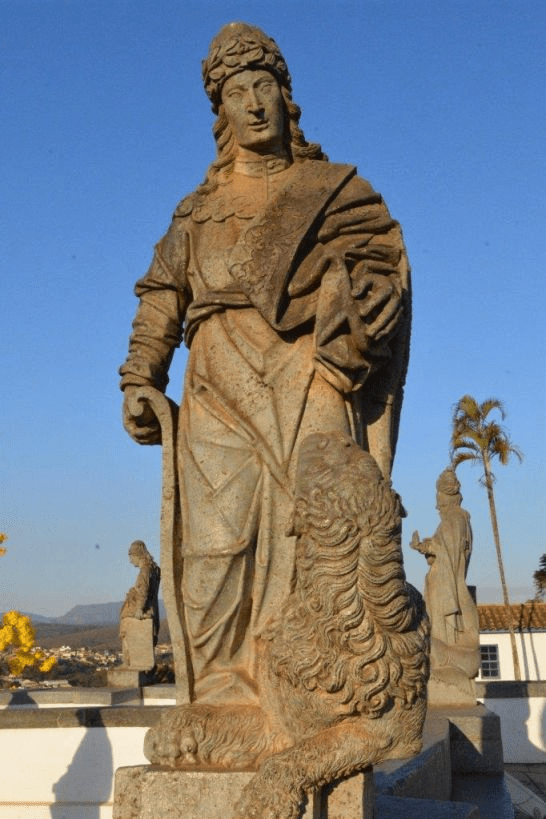
The Prophet Daniel, by Brazilian sculptor Aleijadinho (1738-1814)

Then King Nebuchadnezzar bowed low and honored Daniel. The king ordered that grain and incense offerings be made to Daniel. The king declared to Daniel, “No doubt about it: your God is God of gods, Lord of kings, and a revealer of mysteries because you were able to reveal this mystery!” Then the king exalted Daniel and lavished gifts on him, making him ruler over all the province of Babylon and chief minister over all Babylon’s sages. At Daniel’s urging, the king appointed Shadrach, Meshach, and Abednego to administer the province of Babylon, but Daniel himself remained at the royal court. (Common English Bible)

That was a close one. All the wise men of Babylon, along with Daniel and his three companions, were nearly snuffed out by the rage of a powerful king. Good thing God is the One who is really in charge of things!

King Nebuchadnezzar demanded that his court sages tell him the troubling dream he had, along with an interpretation. Daniel alone was able to provide both the dream’s content and its meaning, precisely because he immediately went to prayer and beseeched God to reveal the mystery. A lot of lives were on the line. And God answered him.

Daniel calmly and confidently handled the life-or-death situation with some deft wisdom. There are likely two reasons for his ability to step into a situation fraught with such heavy stress: 1) he was already a consistent person of prayer; and, 2) he was truly doing this for the benefit of everyone, not just himself. In other words, Daniel was humble, full of faith, and concerned for the common good of all.

It’s interesting to me that Daniel didn’t get all caught up in the specifics of the dream. What was most important to him was communicating to the king that it was the Lord who provided the dream and its interpretation; and doing his very best to ensure something like this wasn’t going to happen again.

After being made the acting ruler over the province of Babylon, Daniel’s first act was encouraging the king to put his three companions in charge of the province. Daniel himself remained at the royal court, close to King Nebuchadnezzar. Not only was Daniel wise in how he handled the potential debacle, but he was also quite wise in discerning that he was needed courtside. I picture Daniel becoming something of Nebuchadnezzar’s handler – maintaining a significant position in order to check the ego and the arrogance of the king.

What stands out to me most about today’s story is not the particulars about ancient history, with the empires coming and going. It’s about Daniel doing what needed to be done, being willing to step into a stress-filled situation and take it on. Then, when things settled down and he was recognized and awarded, Daniel didn’t get caught up in the hoopla near as much as diligently worked behind the scenes for stability in the royal court. Such humility is worth emulating, and is much needed in today’s world.

Gracious God, have mercy on me. As the day unfolds, please grant me humility, kindness, and courage to move toward the situations you have in front of me. Bring glory to yourself, gentleness to my heart, and a good and just outcome. Amen.

What Can I Do in an Impossible Situation? (Daniel 2:1-23)

Daniel Interprets King Nebuchadnezzar’s Dream, by Mattia Preti (1613-1699)

In the second year of Nebuchadnezzar’s rule, he had many dreams. The dreams made him anxious, but he kept sleeping. The king summoned the dream interpreters, enchanters, diviners, and Chaldeans to explain his dreams to him. They came and stood before the king.

Then the king said to them: “I had a dream, and I’m anxious to know its meaning.”

The Chaldeans answered the king in Aramaic: “Long live the king! Tell your servants the dream, and we will explain its meaning.”

The king answered the Chaldeans: “My decision is final: If you can’t tell me the dream and its meaning, you will be torn limb from limb, and your houses will be turned into trash dumps. But if you do explain the dream and its meaning, you’ll receive generous gifts and glorious honor from me. So explain to me the dream as well as its meaning.”

They answered him again: “The king must tell his servants the dream. We will then explain the meaning.”

The king replied: “Now I definitely know you are stalling for time, because you see that my decision is final and that if you can’t tell me the dream, your fate is certain. You’ve conspired to make false and lying speeches before me until the situation changes. Tell me the dream now! Then I’ll know you can explain its meaning to me.”

The Chaldeans answered the king: “No one on earth can do what the king is asking! No king or ruler, no matter how great, has ever asked such a thing of any dream interpreter, enchanter, or Chaldean. What the king is asking is impossible! No one could declare the dream to the king but the gods, who don’t live among mere humans.”

At this, the king exploded in a furious rage and ordered that all Babylon’s sages be wiped out. So the command went out: The sages were to be killed. Daniel and his friends too were hunted down; they were to be killed as well.

Then Daniel, with wisdom and sound judgment, responded to Arioch the king’s chief executioner, who had gone out to kill Babylon’s sages. He said to Arioch the king’s royal officer, “Why is the king’s command so unreasonable?” After Arioch explained the situation to Daniel, Daniel went and asked the king to give him some time so he could explain the dream’s meaning to him. Then Daniel went to his house and explained the situation to his friends Hananiah, Mishael, and Azariah so that they would ask the God of heaven for help about this mystery, in hopes that Daniel and his friends wouldn’t die with the rest of Babylon’s sages. Then, in a vision by night, the mystery was revealed to Daniel! Daniel praised the God of heaven:

God’s name be praised
    from age to eternal age!
        Wisdom and might are his!
God is the one who changes times and eras,
    who dethrones one king, only to establish another,
        who grants wisdom to the wise and knowledge to those with insight.
God is the one who uncovers what lies deeply hidden;
    he knows what hides in darkness;
I acknowledge and praise you, my fathers’ God!
    You’ve given me wisdom and might,
        and now you’ve made known to me what we asked of you:
            you’ve made known to us the king’s demand. (Common English Bible)

Daniel Interprets Nebuchadnezzar’s Dream, 1917

The King’s Trouble

Nebuchadnezzar was quite the guy – a stereotypical ancient king, in many ways. In our story for today, he certainly comes across as a demanding sovereign, expecting his wishes and commands to be done, no matter how difficult or unreasonable they seem to others.

The king was bothered by a troubling dream. So, in expected kingly fashion, Nebuchadnezzar called for his court appointed sages to explain it to him. And in an over-the-top expectation, even for an arrogant king, Nebuchadnezzar had no intention of telling them what it is he had dreamt.

The sages, of course, had no idea what to do with this exaggerated command. The king’s wise men replied that no one – except the gods – can reveal such secrets as what was dreamt. But in King Nebuchadnezzar’s line of thinking, since the gods of the sages cannot reveal the dream – and thus an interpretation of the dream – then those gods must be weak, ineffective, and useless.

The King’s Anger

In reading and listening to the story, we can feel the response of Nebuchadnezzar coming, and know that it isn’t going to be good. Indeed, the king flew into a rage. The wise men’s failure to provide the contents of the dream, and so, a solid interpretation for the dream, led King Nebuchadnezzar to order them all killed. In issuing such a command, this meant that Daniel and his wise friends were to be killed, as well.

Daniel was a Jewish exile, brought to Babylon after Nebuchadnezzar’s conquest of Jerusalem. He was wise, godly, and even-keeled. Daniel calmly intervened and offered to do exactly what the king requested in the first place. All he asked was for some time. Then, Daniel immediately went to his godly and wise friends, and together they looked to the Lord in prayer.

Sure enough, just as God had come to Nebuchadnezzar in a dream, so God came to Daniel and revealed the mystery to him. Daniel’s prayer of thanksgiving makes it clear that the source of the wisdom is the God of heaven, and not Daniel himself. Thus, we are meant to make the connection that Daniel’s God is vastly superior than the gods of the court sages.

The King’s Limits

King Nebuchadnezzar’s sovereignty and control was not universal. It is God who grants wisdom. Yes, we do our part in gaining knowledge and understanding as best we can. We look into Holy Scripture for guidance and seek to obey biblical commands and live into divine promises. Yet, there is also an aspect of wisdom that is given by God.

Ultimate insight comes as a result of both human observation and learning, and divine revelation and response to prayer. Throughout the book of Daniel, a prominent theme is the importance of prayer as the prerequisite to receiving wisdom. Daniel and his three friends joined in prayer together, immediately after hearing of the king’s situation and command.

An even greater theme in the book of Daniel is that God can give wisdom because there is nothing hidden from the Lord; God understands everything. And it is this theological conviction which underlies prayer. Daniel and his companions were supported and emboldened by their knowledge of God.

Believers in every historical age have the privilege of beseeching God for wisdom when circumstances are rough and dire. As the Apostle James says in the New Testament:

My friends, be glad, even if you have a lot of trouble. You know you learn to endure by having your faith tested. But you must learn to endure everything, so you will be completely mature and not lacking in anything. If any of you need wisdom, you should ask God, and it will be given to you. God is generous and won’t correct you for asking. (James 1:2-5, CEV)

Whenever facing opposition and suffering, it is important to know that God is in control, and that divine enablement and insight is only a prayer away.

Blessed God, Light of the world, shine upon us and disperse the clouds of our selfishness and stubbornness, so that we may reflect the power of the resurrection in our life together. Amen.