
I Am Responsible and Accountable (Ezekiel 18:1-32)

The word of the Lord came to me: “What do you people mean by quoting this proverb about the land of Israel:

“‘The parents eat sour grapes,
    and the children’s teeth are set on edge’?

“As surely as I live, declares the Sovereign Lord, you will no longer quote this proverb in Israel. For everyone belongs to me, the parent as well as the child—both alike belong to me. The one who sins is the one who will die.

“Suppose there is a righteous man
    who does what is just and right.
He does not eat at the mountain shrines
    or look to the idols of Israel.
He does not defile his neighbor’s wife
    or have sexual relations with a woman during her period.
He does not oppress anyone,
    but returns what he took in pledge for a loan.
He does not commit robbery
    but gives his food to the hungry
    and provides clothing for the naked.
He does not lend to them at interest
    or take a profit from them.
He withholds his hand from doing wrong
    and judges fairly between two parties.
He follows my decrees
    and faithfully keeps my laws.
That man is righteous;
    he will surely live,
declares the Sovereign Lord.

“Suppose he has a violent son, who sheds blood or does any of these other things (though the father has done none of them):

“He eats at the mountain shrines.
He defiles his neighbor’s wife.
He oppresses the poor and needy.
He commits robbery.
He does not return what he took in pledge.
He looks to the idols.
He does detestable things.
He lends at interest and takes a profit.

Will such a man live? He will not! Because he has done all these detestable things, he is to be put to death; his blood will be on his own head.

“But suppose this son has a son who sees all the sins his father commits, and though he sees them, he does not do such things:

“He does not eat at the mountain shrines
    or look to the idols of Israel.
He does not defile his neighbor’s wife.
He does not oppress anyone
    or require a pledge for a loan.
He does not commit robbery
    but gives his food to the hungry
    and provides clothing for the naked.
He withholds his hand from mistreating the poor
    and takes no interest or profit from them.
He keeps my laws and follows my decrees.

He will not die for his father’s sin; he will surely live. But his father will die for his own sin, because he practiced extortion, robbed his brother and did what was wrong among his people.

“Yet you ask, ‘Why does the son not share the guilt of his father?’ Since the son has done what is just and right and has been careful to keep all my decrees, he will surely live. The one who sins is the one who will die. The child will not share the guilt of the parent, nor will the parent share the guilt of the child. The righteousness of the righteous will be credited to them, and the wickedness of the wicked will be charged against them.

“But if a wicked person turns away from all the sins they have committed and keeps all my decrees and does what is just and right, that person will surely live; they will not die. None of the offenses they have committed will be remembered against them. Because of the righteous things they have done, they will live. Do I take any pleasure in the death of the wicked? declares the Sovereign Lord. Rather, am I not pleased when they turn from their ways and live?

“But if a righteous person turns from their righteousness and commits sin and does the same detestable things the wicked person does, will they live? None of the righteous things that person has done will be remembered. Because of the unfaithfulness they are guilty of and because of the sins they have committed, they will die.

“Yet you say, ‘The way of the Lord is not just.’ Hear, you Israelites: Is my way unjust? Is it not your ways that are unjust? If a righteous person turns from their righteousness and commits sin, they will die for it; because of the sin they have committed they will die. But if a wicked person turns away from the wickedness they have committed and does what is just, and right, they will save their life. Because they consider all the offenses they have committed and turn away from them, that person will surely live; they will not die. Yet the Israelites say, ‘The way of the Lord is not just.’ Are my ways unjust, people of Israel? Is it not your ways that are unjust?

“Therefore, you Israelites, I will judge each of you according to your own ways, declares the Sovereign Lord. Repent! Turn away from all your offenses; then sin will not be your downfall. Rid yourselves of all the offenses you have committed, and get a new heart and a new spirit. Why will you die, people of Israel? For I take no pleasure in the death of anyone, declares the Sovereign Lord. Repent and live! (New International Version)

Every single one of us is accountable to one another for what we say and how we conduct ourselves. Above all, we are accountable to God for our motives, words, and actions in this life.

The flipside to stating that we are accountable, is saying that none of us are responsible for another person’s intentions, words, or actions.

Other people may influence us. We may be either participants in or victims of another’s actions. Some folks might take credit for something another person said or did. Yet, ultimately, we are responsible for our own life.

Whatever I think, say, or do is on me, period.

What’s more, one’s past actions do not replace our current actions. The prophet Ezekiel emphasized individual responsibility and accountability. All of the other Old Testament prophets addressed whole nations, and not individuals. They denounced the social, economic, and political systems and institutions, upholding communal ideals of justice.

Ezekiel communicated that children shall not be punished for their parent’s sins. Only the person who sins will face judgment.

A person ought only to pay for their own sins; punishment should not carry forward to future generations. The prophet also insisted that each individual person has the opportunity to change their behavior, and so, avoid their deserved penalty.

Every individual has the opportunity to change their personal ways of injustice or unrighteousness. For those who refuse, there is a and right and just Judge who knows how to dispense what is needed for each person – whether it is judgment to the arrogant, comfort to a victim, or justice for the underprivileged.

God cares that every person on earth receives what they need to thrive and flourish in this life. And to those who don’t give a wit about others, the Lord gives an opportunity to turn from arrogance and change.

Refusing to change, however, will end badly for the stubborn person.

The prophet Ezekiel calls on individuals to speak and act in ways that are helpful, not harmful. And whenever one harms another, that one must acknowledge the irresponsibility, because I am held accountable for what I say and do.

All words and actions come with consequences. It would do us a lot of good to consider how what we say and do (or fail to say and do) impacts the next generation of people. Everyone leaves a legacy of some sort – whether good or bad – so we need to be aware of how we live.

Each person must take up the mantle to do good, not evil; and to live righteously, not wickedly. Living selfishly with impunity leads to divine judgment. Yet, mercy is always there, if we seek to amend our ways.

Conversely, living righteously, and then resting on my laurels and living however I want, does not inoculate me from divine judgment.

You and I must live one day at a time, trusting God and seeking the welfare of others. And when I mess up, I am to keep a short account with God by admitting my fault and receiving grace.

We humans have quite enough responsibility in our lives without taking on the extra job of exacting judgment on another person. If we live a righteous life to begin with, then there is no need for a new heart and life.

Yet, if I need it, a new existence is there, through a change of direction which humility grants us.

Almighty God, help me to prioritize your values, and put my faith into action. Enable me to use the talents, resources, and time with which I have been blessed. Empower me to serve my community and my world. May I serve you always, and pray with a joyful spirit. Amen.

Mercy and Judgment (Revelation 8:1-5)

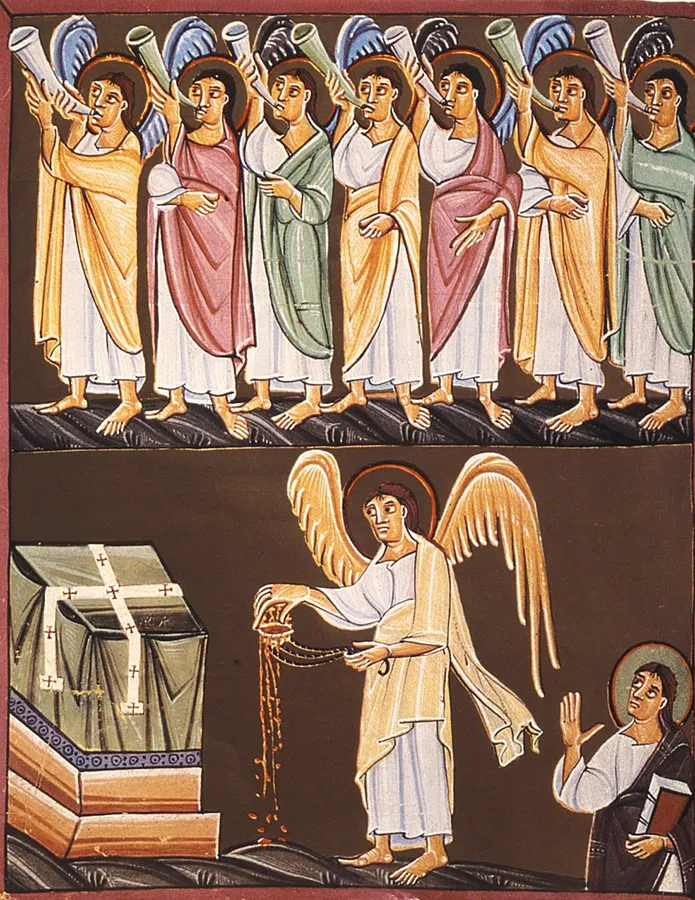
Seven angels with seven trumpets, and the angel with a censer, from the Bamberg Apocalypse, c.1020 C.E.

Then, when the Lamb opened the seventh seal, there was silence in heaven for about half an hour.

Then I saw the seven angels who stand before God, and seven trumpets were given to them. Another angel came and stood at the altar, and he held a gold bowl for burning incense. He was given a large amount of incense, in order to offer it on behalf of the prayers of all the saints on the gold altar in front of the throne. 

The smoke of the incense offered for the prayers of the saints rose up before God from the angel’s hand. Then the angel took the incense container and filled it with fire from the altar. He threw it down to the earth, and there were thunder, voices, lightning, and an earthquake. (Common English Bible)

When I was kid, growing up on a Midwest American farm, I remember times when severe weather was coming. I knew it was going to be bad whenever everything became still and there was complete silence: No wind, no birds singing, no insects chirping, nothing moving whatsoever. It was the eerie silence which precedes something big coming.

That is the way it will be in heaven when the seventh seal is opened. The silence is so quiet that you know a lot of noise and movement are about to happen. It’s not serene silence; it’s scary silent.

With the opening of the seventh seal, a climactic moment is reached. The silence is not only an anticipation of the coming drama, but is also a sign of reverence and awe.

The seventh seal initiates a series of woes: The seven trumpets. But before the trumpets begin, an angel appears. Standing before a heavenly altar, the angel mixes incense along with prayers from the people, then offers them on the altar.

These prayers of the people are for justice, and a longing for the kingdom to come, and God’s will to be done, on earth, as it is always done in heaven.

The imagery relates to us that God hears the prayers, and will act, according to the divine character and will.

The angel takes fire from the altar and hurls it down to earth, causing thunder and lightning, and an earthquake. In other words, the prayers are being answered; they are having an effect. Judgment on the earth begins with the blowing of the seven trumpets.

As we may expect, the incredible silence gives way to an equally incredible noise of weather and the earth moving. And the angel, serving as a quiet and contemplative high priest, now moves to becoming a judge upon the earth.

It turns out that mercy and judgment are not two contrasting concepts and actions; they are two sides of the very same coin. The altar of mercy becomes the source of judgment.

Whenever there is an injustice, we want (and expect) to have that act acknowledged and taken care of by a proper authority. To have a judge simply say that he/she is merciful and will acquit the guilty, does not work in every situation. Mercy only exists because of the presence of guilt and judgment.

God takes care of sin because God loves. An unloving deity would be unconcerned, random, and capricious in handling injustice. But not the God of the Bible. God shows mercy to the righteous, and will judge the wicked.

God’s mercy extends to the point of acquitting the guilty, if God so desires to do so. And everyone needs mercy, because we all have committed injustices in our lives.

Yet, by means of humble contrition and faith, we can mercifully discover gracious amnesty. This is why Jesus came, to take care of the sin issue once for all through the Cross.

We have been made holy by God’s will through the offering of Jesus Christ’s body once for all. (Hebrews 10:10, CEB)

In the time of the Apostle John’s vision, which is the Book of Revelation, Christians were facing persecution and martyrdom. The prayers of the suffering believers rose to heaven:

They cried out with a loud voice, “Holy and true Master, how long will you wait before you pass judgment? How long before you require justice for our blood, which was shed by those who live on earth?” (Revelation 6:10, CEB)

God’s response to the prayers of the saints is to send judgmental fire against the earth by the hand of the angel. In John’s apocalyptic vision, not only are the believers in Christ facing trials and tribulations for their faith, but the unbelieving persecutors who victimize the saints will be punished, as well.

If the persecutors use fiery elements against the believers, God can (and will) turn that fire back on the them. This is similar to the Book of Exodus, in which the plagues that struck and judged the Egyptians were, at the same time, a means of protecting and preserving the Israelites.

The Book of Revelation included in the Christian canon of scripture, not for the purpose of predicting the time or the season in which Jesus Christ will come back to judge the living and the dead. Rather, John’s Apocalypse is meant to encourage the followers of Christ that their suffering will not last forever; and neither will the arrogance of the wicked.

We don’t know when all of this end-of-the-age stuff is going to shake out. Which is why it is so important we learn to persevere through suffering. Because we might have to wait awhile.

Prayer for us then becomes not simply something we do if we have a bit of discretionary time; it becomes vital for us. We discern that we must speak with God. We are compelled to offer our prayers. We feel the great need to cry out and petition God for justice and righteousness.

It seems, if I don’t pray, I won’t make it. Therefore, I must pray. I will pray with all of my heart and soul, till I cannot pray anymore. And then I will pray some more, because I need God.

There is nothing easy about moving through suffering. It’s hard to persevere. It hurts to be the brunt of another’s violent tongue and/or hand. Yet, we do not experience this alone. The divine presence is with us. And that makes all the difference.

Oh God:
Give me strength to live another day;
Let me not turn coward before its difficulties, or fail in its duties;
Let me not lose faith in other people;
Keep me sweet and sound of heart, in spite of ingratitude, treachery, or meanness;
Preserve me from minding little stings, or giving them;
Help me to keep my heart clean, and to live so honestly and fearlessly that no outward failure can dishearten me, or take away the joy of conscious integrity;
Open wide the eyes of my soul that I may see good in all things;
Grant me this day some new vision of your truth;
Inspire me with the spirit of joy and gladness and make me the cup of strength to suffering souls; in the name of the strong Deliverer, our only Lord and Savior, Jesus Christ. Amen.

Have Enough Sense to Learn Some Life Lessons (Proverbs 19:24-29)

Some people are too lazy to put food in their own mouths.

Arrogance should be punished, so that people who don’t know any better can learn a lesson. If you are wise, you will learn when you are corrected.

Only a shameful, disgraceful person would mistreat his father or turn his mother away from his home.

My child, when you stop learning, you will soon neglect what you already know.

There is no justice where a witness is determined to hurt someone. Wicked people love the taste of evil.

A conceited fool is sure to get a beating. (Good News Translation)

I believe one good practice is to ponder the biblical proverbs and write them in our own words. So, here is today’s Proverbs lesson in my own colloquial words, with a brief bit of commentary:

There are folks who have gotten so used to laziness that they don’t even use their hands to feed themselves.

It’s important not to enable such persons to be this way by bringing them food and feeding them. It reinforces bad behavior, and will only frustrate you if you give-in to the rationalizations from the lazy person.

Arrogant fools need sense enough to see that foolish stupidity leads to punishable consequences; but a person with good sense learns the humility of being corrected without having to be harshly punished.

Part of what makes a person foolish and arrogant is that they honestly believe they’re an exception to the rules, that they can do what they want and not suffer the consequences. Conversely, the wise person doesn’t always need to learn the hard way. They listen to correction and accept it, thus avoiding adverse consequences from continuing in a particular way.

Kids without any sense at all are a disgrace to their parents; they steal from mom and dad and refuse to care for them in their need.

A parent’s greatest shame is when one of their children ignore what they’ve been taught and use the parents to get what they want. And then when mom and dad have a need, the kid has every excuse in the book to not help them. Unfortunately, there are times when a parent must take action to protect themselves from a wayward child. It isn’t healthy to let your children use you with impunity.

If you have no inclination to learn, you will eventually become as dumb as a brick.

Anyone who doesn’t take the stance of being a life-long learner will end up losing what little knowledge they have. That’s because memory is tied to actionable learning. If you don’t use it, you’ll lose it.

A witness who lies brings harm to both the court system and the persons involved; he is just like a criminal who commits crimes and revels in a lie as if it was a delicious meal.

Sadly, there are some people in this old fallen world who take delight in lying, cheating, and stealing. It gives them a twisted feeling of superiority and control to manipulate a person or a system. So, beware of the one who has no conscience.

The only thing an arrogant fool can expect to get in this life (and the next) is punishment.

A fool is a fool because they neither learn a lesson from observing what happens to others, nor learn from their own mistakes, misplaced words, and bad behavior. Although they shouldn’t be surprised whenever they are fired from a job, arrested by the police, or have a spouse leave them, they are; somehow they feel entitled to live as they please and have others accommodate to their life.

The biggest chunk of the Book of Proverbs (chapters 10-22) are wise sayings framed mostly in couplets. The majority of the verses are a contrast between the wise and the foolish, the righteous and the wicked, the good and the bad.

The contrasts are meant to demonstrate consequences. If we make decisions and live our lives in a good and right way, then it is likely that we will be successful and have some overall happiness.

However, if we choose to go through life like the fool, then we should expect some rather adverse consequences.

For example, both parents and children need to make some responsible choices in order to live well. Parents are to put a great deal of effort into raising, training, and loving their children so that they can be successful in life. Children are to respond by accepting parental teaching and seeking to live into the wisdom taught to them.

And yet, there are parents who are uncommitted to preparing their children for adulthood. And there are adult children who want nothing to do with anything their parents tell them, believing their mom or dad to be stupid or out of touch. However, sooner or later, they will learn a hard lesson.

A happy family is a beautiful thing; a contentious bunch of relatives always walks away hurt.

Every day is an opportunity to build on a wise foundation of life. The sorts of decisions we make, and why we make them, is of upmost significance for a good, right, and just way of living. And this wisdom, ideally, is to be passed on by both words and actions.

No matter who we are – whether parents or children, community leaders or citizens, managers or employees, neighbors or nations, we are all to grow in maturity by learning to make wise choices in life which bless others, and thus, bless yourself.

We are neither to live arrogantly and selfishly, nor are we to allow bad attitudes and behaviors to exist within our families, communities, and workplaces.

The beginning of wisdom in living a good life is to know God and be a life-long learner of sacred wisdom literature. This is the first and most important choice of all.

All-wise and all-powerful God of the universe, you have given dominion over this earth, in order that we may steward good and right living which allows all life to thrive and flourish. Give us wisdom to use all that you have given, so that no one may suffer from our foolish stupidity, and that the generations yet to come may know that there is a good God in heaven who blesses those who do right and forsake evil. Amen.

Wise Living Is Clean Living (Proverbs 15:1-17)

A gentle answer quiets anger, but a harsh one stirs it up.

When wise people speak, they make knowledge attractive, but stupid people spout nonsense.

The Lord sees what happens everywhere; he is watching us, whether we do good or evil.

Kind words bring life, but cruel words crush your spirit.

It is foolish to ignore what your parents taught you; it is wise to accept their correction.

Righteous people keep their wealth, but the wicked lose theirs when hard times come.

Knowledge is spread by people who are wise, not by fools.

The Lord is pleased when good people pray, but hates the sacrifices that the wicked bring him.

The Lord hates the ways of evil people, but loves those who do what is right.

If you do what is wrong, you will be severely punished; you will die if you do not let yourself be corrected.

Not even the world of the dead can keep the Lord from knowing what is there; how then can we hide our thoughts from God?

Conceited people do not like to be corrected; they never ask for advice from those who are wiser.

When people are happy, they smile, but when they are sad, they look depressed.

Intelligent people want to learn, but stupid people are satisfied with ignorance.

The life of the poor is a constant struggle, but happy people always enjoy life.

Better to be poor and fear the Lord than to be rich and in trouble.

Better to eat vegetables with people you love than to eat the finest meat where there is hate. (Good News Translation)

Here is today’s Proverbs lesson in my own colloquial words:

A calm and kind response sucks the anger out of the room, but hot-headed words set the place on hellfire.

A level-headed person gives helpful answers, but a know-it-all only keeps on babbling nonsense.

Just because you cannot see God, doesn’t mean that God cannot see you, both the good and the bad.

Kind words given to another person are life-giving, but unkind words catapulted at a person ends up crushing their spirit.

You can tell a fool by how their refusal to accept counsel from their parents, but a wise person freely receives parental instruction.

Wise folk understand they need to save for a rainy day, but fools spend everything they have, then wonder why they’re in dire straits.

Wisdom and common sense are akin to one another; foolishness and nonsense are two peas in a pod.

The Lord perks up when the righteous pray, but does a face palm when the wicked offer up anything.

The ways of evil people make the Lord nauseous, but the way of the righteous is delightful to God.

A stupid dog doesn’t live very long, because he won’t heed his training or learn from any natural consequences.

If God can see everything that goes on with death and destruction, why would not the Lord see all things within your own heart?

Prickly people won’t listen to advice, and they refuse to consult anyone when making decisions.

Truthful persons smile when they’re happy and frown when they’re sad, but falsehood smiles when it’s sad and frowns when it’s happy.

Learners are curious about life, but ignorant folk only feed on tabloid information.

Once in survival mode, it’s hard to ever get out of it; but those who thrive have learned how to be content in any circumstance.

It’s a whole lot better to be poor and right with God, than to be rich and on the wrong side of the Lord.

Peanut butter sandwiches eaten on the floor with love are much more delicious than eating a filet mignon with hatred around the table.

Our words reflect what is truly the attitude of our heart. And our attitudes betray what we actually think about God and others.

If you drop a foolish person into a roomful of people, it’s like putting a rotten egg in with the rest of the eggs when making an omelet. Or, to put it according to an old adage, “One bad apple spoils the whole bushel basket of them.”

This is why it’s the responsibility of everyone to develop wisdom and a virtuous life. A faith community, a neighborhood, a workplace, a family, or any group of people are adversely affected whenever there’s one arrogant fool amongst them.

But just as he who called you is holy, so be holy in all you do; for it is written: “Be holy, because I am holy.” (1 Peter 1:15-16, NIV)

It only takes one drop of arsenic to ruin a gallon of water and make it undrinkable. And if you choose to drink it anyway, well, you’ll suffer the consequences.

And this is why purity of heart, righteousness, justice, and goodness are so very important. It’s also why holiness is placed as a premium in Holy Scripture, because impurity ruins the community and defiles any group of people.

For where you have envy and selfish ambition, there you find disorder and every evil practice. But the wisdom that comes from heaven is first of all pure; then peace-loving, considerate, submissive, full of mercy and good fruit, impartial and sincere. Peacemakers who sow in peace reap a harvest of righteousness. (James 3:16-18, NIV)

Wise living is clean living, in every sense of a person’s complete self – in body, mind, emotions, and spirit. The Book of Proverbs can help us with that.

O God, by whom the meek are guided in judgment, and light rises up in darkness for the godly: Grant us, in all our doubts and uncertainties, the grace to ask what you would have us to do, so that the Spirit of wisdom may save us from all false choices, and that in your light we may see light, and in your straight path may not stumble. Amen.