The Divine Gardener

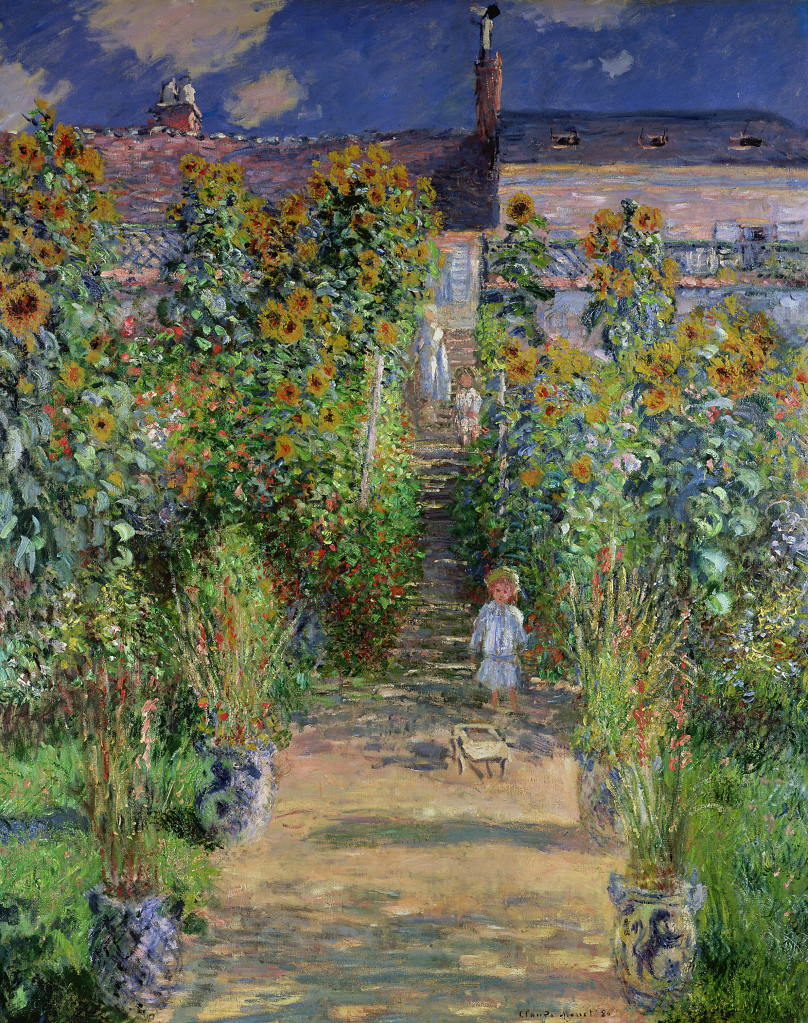
The Artist’s Garden at Vétheuil, by Claude Monet, 1881

The fruit of the Spirit is love, joy, peace, patience, kindness, goodness, faithfulness, gentleness, and self-control. (Galatians 5:22-23, Common English Bible)

Soon it will be Spring. Many people are already planning for the soil in fields and gardens to be turned over for planting and cultivating.

Healthy plants grow and feed many. They don’t simply occur by happenstance. And neither does things like morality, ethics, and living an altruistic life; they don’t just happen.

Virtue and a good life are the result of solid and robust inner work within the soul.

The daily overall trajectory of personal and institutional life demonstrates whether they are driven by egoistic desires, or influenced from an inner garden of delectable fruit which has been wisely plucked for others to enjoy.

 “A good tree doesn’t produce bad fruit, nor does a bad tree produce good fruit. Each tree is known by its own fruit. People don’t gather figs from thorny plants, nor do they pick grapes from prickly bushes. A good person produces good from the good treasury of the inner self, while an evil person produces evil from the evil treasury of the inner self. The inner self overflows with words that are spoken.”

Jesus (Luke 6:43-45, Common English Bible)

The Apostle James learned well from his Teacher when he said:

My brothers and sisters, can a fig tree produce olives? Can a grapevine produce figs? (James 3:12, Common English Bible)

The soul is a garden which must have a faithful gardener to continually attend to it. There is a constant need for paying attention to the plants through consistent weeding, watering, and nurturing the seeds placed in good rich soil.

If we will but only allow it, the Holy Spirit of God can be our Divine Gardener, being the elements we need for growth, maturity, and a good life which produces good succulent fruit for many to enjoy.

Apart from the Spirit’s warming, watering, and protecting, people can easily degenerate into all kinds of illicit thinking and behavior such as immorality, moral corruption, doing whatever feels good, idolatry, substance abuse, casting evil spells, hate, fighting, obsessive behaviors, violent anger, competitive opposition, conflict, selfishness, group rivalry,jealousy, and lying.

The Christian virtues which flower and produce the fruit of love, joy, peace, patience, kindness, goodness, faithfulness, gentleness, and self-control occur through a close intimate connection with the Divine Gardener. 

Our Divine spiritual Gardener knows that all things are connected – that below the surface the roots of every plant become connected with one another. There is really no such thing as a person who is disconnected from the rest of humanity.
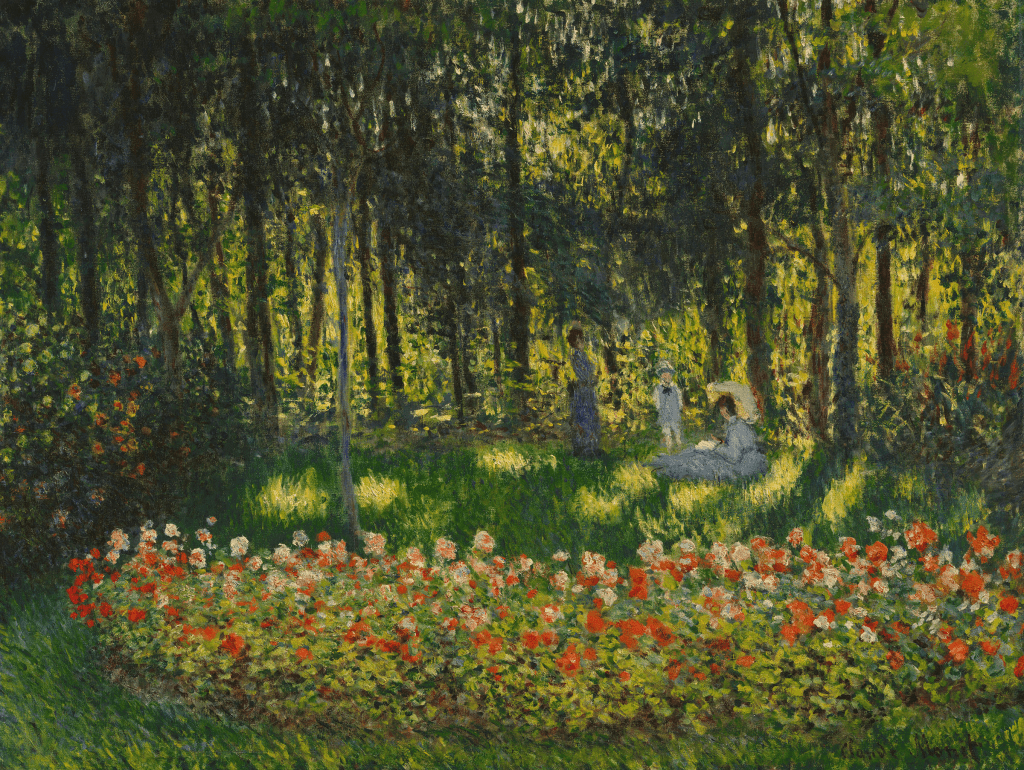
The Artist’s Family In the Garden, by Claude Monet, 1875

Thus, the Apostle Paul, having also learned well, understood that there are not spiritual “fruits,” but only spiritual “fruit.” That is, the nine virtues Paul mentioned are the “fruit of the Spirit,” not “fruits.”

In other words, all virtuous words and behavior are connected with each other. When a person or an organization has the Divine Gardener attending to them, all nine of the Christian values are a collective basket of fruit which cannot be separated from one another.

So then, if we look at the list of spiritual fruit in the New Testament book of Galatians and say something like, “Well, I’m pretty good at kindness and goodness, but I don’t have much peace or patience,” then what this really means is that we are likely doing kindness and goodness from a different place than by means of the Holy Spirit.

Because when the Spirit is manifested in us, we exhibit spiritual fruit. We cannot separate the nine spiritual virtues any more than we can separate the Trinity. They’re all one spiritual fruit, cultivated and produced within the inner person by the agency of God’s Spirit, our Divine Gardener.

Perhaps we need to consider what is happening in the ground, underneath the surface, which is the shadow side of our lives that no one sees.

For example, it could be that we are driven far more by our ego and our anxiety about most things than about genuine altruism and love. The results of our actions and words may look the same or similar, but the motivation might be far from truly altruistic.

Any sort of “fruit” will simply not last if our actions spring from a place of ego control and worry – because it is not of the Spirit.

Both persons and institutions must mortify (put to death) the deeds and the weeds of the sinful nature.

I have been crucified with Christ and I no longer live, but Christ lives in me. And the life that I now live in my body, I live by faith, indeed, by the faithfulness of God’s Son, who loved me and gave himself for me.

The Apostle Paul (Galatians 2:20, Common English Bible)

The Spirit will always have us in the good rich soil of Christ, so that when we are planted and receive the proper amounts of spiritual sun and living water, we will most certainly produce a hundredfold crop.

Then, we learn to make proper and right judgments about what is happening in our world. We are able to see the thief in the garden who cares only to pick fruit he has neither planted nor cared for, having no intention of sharing anything, but instead seeks to amass a gluttonous basket for his own self.

There is a great need for virtuous living, ethical sensibilities, and wise discernment among everyone in this world.

We are now observing what happens when a people are ignorant of how true righteousness, justice, goodness, and peace are grown and developed in any culture, society, and government. Fools are allowed to roam the garden, and they make a complete mess of things.

Let us all do our part in ensuring that genuine spiritual fruit is produced, coming from the true self. Disconnection, destruction, and chaos are the fruit of a bad tree. Then, it is only fit to cut down and thrown into the fire.

Jesus said:

“Every good tree produces good fruit, and every rotten tree produces bad fruit. A good tree can’t produce bad fruit. And a rotten tree can’t produce good fruit. Every tree that doesn’t produce good fruit is chopped down and thrown into the fire. Therefore, you will know them by their fruit.” (Matthew 7:17-20, Common English Bible)

Therefore, beware, watch out, and be wise in the way your own soul is cultivated, and how you discern the souls of others.

For the Christian, the season of Lent is the best and most appropriate time to focus upon spiritual disciplines which help connect us with Christ and with one another.

Daily attention to the garden of our soul prepares us for Holy Week by participating with Jesus in both his crucifixion and resurrection. All that is wrong and sinful in this old fallen world is put to death, and a new life of virtuous and altruistic living is enjoyed.

And the beauty of it all is that it will organically spring from the depths of a well-cultivated soul garden. The Divine Gardener stands ready with both hose and hoe to bring about the fruit of the Spirit.

Soli Deo Gloria

Truth Stumbles In the Public Square

In these past few months, as an American citizen, I have often wondered what God thinks about the current political situation and climate of the United States.

I must say that with a serious reading of the biblical prophets, it’s rather easy to imagine what the Divine stance likely is:

Justice is far from us,
    and deliverance does not reach us;
we wait for light, but there is only darkness;
    and for brightness, but we walk in gloom.
We grope like the blind along a wall,
    groping like those who have no eyes;
we stumble at noon as in the twilight,
    among the vigorous as though we were dead.
We all growl like bears;
    like doves we moan mournfully.
We wait for justice, but there is none;
    for salvation, but it is far from us.
For our transgressions before you are many,
    and our sins testify against us.
Our transgressions indeed are with us,
    and we know our iniquities:
transgressing and denying the Lord
    and turning away from following our God,
talking oppression and revolt,
    conceiving lying words and uttering them from the heart.
Justice is turned back,
    and deliverance stands at a distance,
for truth stumbles in the public square,
    and uprightness cannot enter.
Truth is lacking,
    and whoever turns from evil is despoiled.

The Lord saw it, and it displeased him
    that there was no justice. (Isaiah 59:9-15, NRSV)

These days, many of my prayers echo the complaint of the ancient prophet Isaiah. I too, have an expectation that God will grant justice and righteousness; and that the Lord will take pity upon us for our ignorance of what is just, right, and good.

And like the prophet Isaiah, I grieve a situation of profuse lying, political malpractice, and socio-economic illiteracy. Many, if not most, Americans and the world community alike, lacks things it needs to live a viable and joyous life. So, I mourn, like a bear growling for a long-awaited meal.

It seems to me that we are failing one another. Our collective vice, and lack of virtue, have led us on a path of injustice. We are a flawed people; we need Divine help.

Perhaps you believe I am being something of a curmudgeon, being too negative – that I’m seeing the glass darkly as only half empty. But no, I’m actually seeing the glass as completely empty, for we are a bereft people.

But just maybe this emptiness can be filled with justice and righteousness, and not shallowness and lack of education, nor gaslighting and manipulative selfishness. Just maybe we can filled to the full in truth.

Our public life together depends upon ethics of accountability.

This insipid business of people stating that they are “being transparent” is nothing but a red flag letting us know that they are doing just the opposite.

We need a new community – a fresh vision of what life can be together. And we are getting anything but that. Instead, in the U.S., we get entrenched yelping from both Republicans and Democrats. And in the face of injustice, we receive an eerie silence from those who ought to know better.

This is not simply a struggle for a political party and its policies. What is happening now transcends each party’s vision of how to live together as a people.

Historically, the Democratic party has generally believed that government ought to raise money through a fair system of taxation. The funds then are to be used to provide basic services that serve the common good of all persons, i.e. ensuring a living wage, protection through laws, maintenance of infrastructure, equal access to healthcare and education, etc.

The Republican party has approached a more individualistic vision of government, believing that each person should manage their own money to make the best use of a market economy. Then, they can create economic growth without reliance upon government regulation of business. Private philanthropy and non-profit organizations are relied upon to provide social services. Private companies are called upon to handle infrastructure needs.

In essence, at the core, Democrats have a vision of community and caring for one another, whereas Republicans have a vision of each person living prosperously under their own fig tree without the interference of others.

This is why things like tax increases and tax cuts become such visceral issues, because they get at the practical outworkings of each party’s vision of how to live together.

But the stakes are even higher than an American two-party system. There is presently leadership in the United States that is openly antagonistic, belligerent, bullying, rude, and frankly, unbiblical and unvirtuous. There is nothing that comes out of the current president’s mouth that reflects the words of Jesus; and there is nothing he does which is consistent with the ways of Jesus.

Many, if not most, “Christian” Republicans are woefully out of touch with their own Bibles; and, at the very least, are complicit in retraumatizing the already traumatized people in the nation (and the world) through supporting unjust leadership.

In the time of the prophet Isaiah, not only was there injustice (common citizens not receiving what they need to build a good life and flourish) but there was no one willing and available, no one engaged and at work to turn around an unjust system so that the government would respect basic human rights for the poor and the needy, the least and the lost in society.

So, the prophet was on the scene to announce that Yahweh, the God of Judah, has noticed. Yahweh has seen that the leadership would not accept responsibility for implementing the Law of God (namely, a set of just, right, and good laws which were to frame all of Jewish society).

Nobody cared. No one bothered to help those without a voice and without hope. And Yahweh knew it. Therefore, a sorry state existed which eventually turned into the people losing their land through an active judgment of God.

Truth matters. And when it is suppressed in the public square, God’s eyebrow is raised.

Lips that speak lies, tongues that mutter wickedness, attitudes which are dishonest, hands that work only for self, and feet which run to violence are all anti-truth practices. (Isaiah 59:3-4)

There is no way on this earth and in this life to get along without government. And because of that, government’s legitimate duty to its people is to provide necessary order, safety, peace, and ensure justice – which means making sure that all citizens have what they need to grow, thrive, and prosper.

Both survival and prosperity must have the glue of truth holding society together – which means that a nation’s government needs to have the basic fundamentals of justice in mind and at heart.

A telltale sign that leaders do not have the best interests of their own people is how they speak to and treat others outside their own nation, people in differing circumstances in different places.

“They did not want to consider their duty. They have distorted their intelligence so as to not understand what ought to be done… They have distanced themselves so far from the truth that they openly combat those who turn away from perversity and choose the good.”

Theodoret (393-457 C.E.)

I cannot think of a better way to describe our current failure of leadership in this world.

Lord, have mercy upon us.

Instead of selfishness we need self-discipline. Rather than a personal concern for earthly wealth and profit, we need to seek first the kingdom of God and God’s righteousness.

Instead of simply loving those who love us, we can  love our enemies and seek to do good. We can actively walk alongside beleaguered people who have had quite enough of belligerent bullying and bogus bellicosity in their lives.

To God belongs the ability to save, deliver, redeem, and judge. To you and I belongs the responsibility for treating our fellow humanity with justice, equity, goodness, and humility with a gentle spirit, holding one another accountable for our attitudes and actions. In short, it means living the truth.

That includes every politician and political party.

“Truth is difficult to reach and endure, but it is always the doorway to new freedom and life.”

John O’Donohue

If you yet are looking for some sort of positive outlook, some kind of hope, it is this: Our present suffering of spirit can serve to burn away any illusions (and delusions) that a politician or political process will save us.

Any disillusionment we may have becomes an opportunity to discover both old and new ways living the truth. It often takes suffering to teach us what is truly most important to us.

Our current malaise, national anxiety, and world troubles can become the means of future possibility, if we will let it. Worrisome circumstances can open to us the light of undiscovered truth about ourselves and our world.

We may stumble, yet there is always the chance to catch ourselves and not fall. So, what does God think of this present national and world situation? The prophet Isaiah insisted:

Let the wicked forsake their way
    and the unrighteous their thoughts;
let them return to the Lord, that he may have mercy on them,
    and to our God, for he will abundantly pardon.
For my thoughts are not your thoughts,
    nor are your ways my ways, says the Lord.
For as the heavens are higher than the earth,
    so are my ways higher than your ways
    and my thoughts than your thoughts. (Isaiah 55:7-9, NRSV)

No matter what happens on this earth, Isaiah’s perspective insists upon the truth and reality of God’s ultimate authority. We shall not always understand divine authority, yet at its core, is full of justice and righteousness. And nothing can stop from it breaking out into the public square.

May it be so, to the glory of God.

The Seven Deadly Sins (Proverbs 12:10-21)

A 14th century personification of the Seven Deadly Sins, by Unknown artist

The righteous care for the needs of their animals,
    but the kindest acts of the wicked are cruel.

Those who work their land will have abundant food,
    but those who chase fantasies have no sense.

The wicked desire the stronghold of evildoers,
    but the root of the righteous endures.

Evildoers are trapped by their sinful talk,
    and so the innocent escape trouble.

From the fruit of their lips people are filled with good things,
    and the work of their hands brings them reward.

The way of fools seems right to them,
    but the wise listen to advice.

Fools show their annoyance at once,
    but the prudent overlook an insult.

An honest witness tells the truth,
    but a false witness tells lies.

The words of the reckless pierce like swords,
    but the tongue of the wise brings healing.

Truthful lips endure forever,
    but a lying tongue lasts only a moment.

Deceit is in the hearts of those who plot evil,
    but those who promote peace have joy.

No harm overtakes the righteous,
    but the wicked have their fill of trouble. (New International Version)

Many of the biblical proverbs are set as contrasts between the way of righteousness and the way of wickedness.

Being aware of both vice and virtue in our personal lives, the workplace, neighborhood, family, and faith communities can create an environment of trust, love, fellowship, and enjoyment. Intentionally pursuing the good, while identifying and forsaking the bad, contributes to a thriving community who intentionally cultivates righteousness.

It’s likely that you have heard of “the seven deadly sins.” In medieval Christianity, these were vices to avoid at all costs, because they eroded personal integrity and poisoned the social community. A “vice” is a bad habit which corrupts character and debases society.

The early church eventually formed a short list of the most corrosive vices, the seven deadly sins, which were considered the most heinous desires/actions of all. We find them in our proverbs for today.

The wicked covet the proceeds of wickedness. Desiring evil is a trap for them. They chase after sinister fantasies.

Lust is an intense desire, coupled with a lack of mental self-control, which is manifested in pursuing that desire in the heart. It is to have a passion for someone (or something) that is neither yours, nor meant for you. Lust leers at and indulges in selfish daydreams, without any concern for another person.

Do not desire to possess anything that belongs to another person—not a house, a wife, a husband, a slave, an ox, a donkey, or anything else. (Exodus 20:17, CEV)

The wicked have their fill of trouble. They’ve gobbled up evil as if dining at an all-you-can-eat buffet.

Whereas lust and covetousness is mostly a lack of mental self-control, gluttony is the lack of bodily self-control.

So, whether you eat or drink or whatever you do, you should do it all for God’s glory. (1 Corinthians 10:31, CEB)

Gluttony doesn’t stop eating, buying, talking, drinking, or binging. It only excessively indulges to the point of physical and/or relational sickness. Addictions and workaholism are some modern-day forms of gluttony – it consumes to the point where it cannot control the consumption any more. The thing desired and indulged becomes the master.

Observe the Sabbath and keep it holy. You have six days in which to do your work, but the seventh day is a day of rest dedicated to me. On that day no one is to work—neither you, your children, your slaves, your animals, nor the foreigners who live in your country. (Exodus 20:8-10, GNT)

The tools of greed are deceit and lies; the greedy person goes to just about any lengths to obtain more wealth. They will misrepresent another and spread gossip and slander to get what they want.

Do not tell lies about others.

The Ninth Commandment (Exodus 20:16, CEV)

Money. More money – is the mantra of the greedy person. It is to have an inordinate desire and pursuit of wealth. Just as sex and food are good, but have their proper boundaries, so money is both good and necessary. 

But money is powerful in more ways than one. It can take over a person’s life in such a way that charging exorbitant interest, rent, or price gouging is justified by satisfying the greed. The greedy person lives every waking moment for leveraging wealth to get more wealth.

People who want to be rich fall into all sorts of temptations and traps. They are caught by foolish and harmful desires that drag them down and destroy them. The love of money causes all kinds of trouble. Some people want money so much that they have given up their faith and caused themselves a lot of pain. (1 Timothy 6:9-10, CEV)

The sloth much prefers get-rich-quick schemes to actual hard work. They spend their time in worthless projects, and are easily annoyed at others.

Sloth is more than laziness. It is also failing to do good when it is in your power and ability to do so. To be slothful is to be indifferent to the great need of the world. 

Whereas the previous sins have a more active pursuit of some desire, the sloth is passive, not wanting to get involved in making a difference. The slothful person always has an excuse why they can’t participate; they expect everyone else to do the work. 

Do your work willingly, as though you were serving the Lord himself, and not just your earthly master.

Colossians 3:23, CEV

The irony is that for all of Ebenezer Scrooge’s hard work and thrift, he was really a sloth who had no intention of improving the condition of humanity; he depended on poor houses and work farms to do all the work. It took supernatural means to get him to think differently. It typically takes a lot for the sloth to go out of their way to honor, respect, and bless another.

You must honor and respect your father and your mother. Do this so that you will have a full life in the land that the Lord your God gives you. (Exodus 20:12, ERV)

A wicked person is often an angry person – so full of anger that they abuse their pets and animals who have done nothing against them. And they let their tongues wag and fly off the handle anytime they are perturbed.

Stop being angry!  Turn from your rage!  Do not lose your temper— it only leads to harm. (Psalm 37:8, NLT)

That doesn’t mean that anger itself is a bad thing. As with most things in life, anger has its proper place. For example, we ought to be angry in the face of evil perpetrators. Anger motivates us to not be slothful, but helpful. 

But excessive selfish anger is a vice. Whereas righteous anger seeks to help a victimized person or group, sinful anger is fueled by hatred. Whether it’s a violent verbal decapitation of another, or a deep seated bitterness, such anger destroys relationships – and even life itself.

No murder.

The Sixth Commandment (Exodus 20:13, MSG)

Envy and lust are kissing cousins. They both traffic in excessive desire for what they don’t possess. 

Envy rots the bones.

Proverbs 14:30, NIV

The subtle difference has more to do with the object of the affection. Lust leers at, longs for, a person who belongs to someone else. Envy fixes its gaze on a material possession or a respected position which someone else has. It is to have a passionate pursuit of taking over someone else’s job or keeping up with Jones’s.

For where there is envy and selfish ambition, there will also be disorder and wickedness of every kind. (James 3:16, NRSV)

The wicked and the proud share a table together for lunch every day. They don’t listen to anybody else, because they believe they already have the answers and know what is best.

Pride is an over-inflated view of one’s opinions, thoughts, and self. Proud persons have an overestimation of themselves. They seem to actually believe that if only others followed their thinking and advice, the world would be a better place.  

Every antagonist in the movies, comics, and classic literature are full of themselves. They justify stepping on others to achieve what they think is the greater good of imposing their agenda in the situation. It’s no wonder that in the Bible, Satan is the ultimate antagonist.

The proud must eventually contend with God. And the Lord has no allowance for the foolishness and idolatry of any human believing they know better.

“No other gods, only me.”

First Commandment (Exodus 20:3, MSG)

Consider the following questions:

How will you respond to the seven deadly sins?

In what ways and/or behaviors do you see these vices being manifested in both the church and the world?

What can the book of Proverbs bring to such a discussion?

Proverbs 29:1-27 – Discipline Yourself

Some people refuse to bend when someone corrects them. Eventually they will break, and there will be no one to repair the damage.

When the rulers are good, the people are happy. When the rulers are evil, the people complain.

A son who loves wisdom makes his father happy. One who wastes his money on prostitutes will lose his wealth.

A nation will be strong when it has a fair and just king. A nation will be weak when it has a king who is selfish and demands gifts.

If you give false praise to others in order to get what you want, you are only setting a trap for yourself.

Evil people are defeated by their sin, but good people will sing and be happy.

Good people want to do what is right for the poor, but the wicked don’t care.

Proud people who laugh at what is right cause problems that divide whole cities, but people who are wise are able to calm those who are angry.

If someone who is wise tries to settle a problem with a fool, the fool will argue and say stupid things, and they will never agree.

If you always try to be honest, murderers will hate you, but those who do what is right will want you to be their friend.

Fools are quick to express their anger, but wise people are patient and control themselves.

If a ruler listens to lies, all his officials will be evil.

In one way the poor and those who steal from them are the same—the Lord made them both.

If a king judges the poor fairly, he will rule for a long time.

Punishment and discipline can make children wise, but children who are never corrected will bring shame to their mother.

If the wicked are ruling the nation, sin will be everywhere, but those who live right will win in the end.

Correct your children whenever they are wrong. Then you will always be proud of them. They will never make you ashamed.

If a nation is not guided by God, the people will lose self-control, but the nation that obeys God’s law will be happy.

Servants will not learn a lesson if you only talk to them. They might understand you, but they will not obey.

There is more hope for a fool than for someone who speaks without thinking.

Give your servants everything they want, and they will learn to be wasteful.

An angry person causes arguments, and someone who is quick-tempered is guilty of many sins.

Your pride can bring you down. Humility will bring you honor.

You are your own worst enemy if you take part in a crime. You will not be able to tell the truth even when people threaten you.

Fear can be a trap, but if you trust in the Lord, you will be safe.

Many people want the friendship of a ruler, but the Lord is the only one who judges people fairly.

Good people think the wicked are disgusting, and the wicked feel disgust for those who are honest. (Easy to Read Version)

I’m not much one for binary definitions of either/or. I find both/and to be a better approach to most things. So, when it comes to the nature versus nurture debate, it seems confusing to apply the either/or. Children are shaped by both their nature, DNA, and ancestral lineage – and the nurturing (or lack thereof) provided by their parents, grandparents, and significant people in their lives.

Both nature and nurture influence children so that the way of the parent tends to be the way of the child. It is extremely difficult for kids to rise above traumatic, abusive, or neglectful parenting and be virtuous. Violence, greed, and misdirected anger are vices both inherited and learned.

Even in loving homes directed by good hearts, a child can fall into bad companionship leading to bad behavior. And added to the mix, we are all profoundly touched by the fall of humanity. Our disordered loves, unhealthy habits, and dubious actions easily rub off on others, especially kids.

This is why self-discipline is so very important. It needs constant attention. There are too many obstacles and too much at stake to ignore wisdom and slide into an undisciplined life. The biblical proverbs help us to focus our attention and our efforts in healthy directions so that we might contribute to the good of our families and our society.

Reverence and trust in the Lord is the beginning of wisdom. The self-controlled and self-disciplined life leads to spiritual prosperity, emotional buoyance, and a mentality of abundance. Selfishness, and the lack of proper boundaries, quickly degenerates into foolish behavior and adversely effects the family and society.

Any garden variety fool can bluster on and cause a raucous, being insensitive and shortsighted to the consequences of their words and behavior. Foolish people scoffing and belligerently offering their unsolicited opinions helps absolutely no one. Indeed, it seems the fools around us are a dime-a-dozen.

The security and stability of both home and society depend upon wise order. Such order, applied wisely and graciously, avoids the extremes of harsh discipline and lax correction. It takes wisdom to make sound decisions in finding the sweet spot between too much and not enough.

Holding people accountable for their words and behavior, and doing it without a critical spirit, is at the heart of godly living.

A great deal of self-discipline is to force ourselves, and allow the Lord to bend our will, to exercise faithfulness in a responsible, regular, and robust way over all those whom we nurture and care for – without succumbing to ramshackle improvising, as if spontaneity were our only tool.

The wise sayings of the biblical proverbs are to be our merciful guide, keeping us on the road of life, not falling into the ditch on either side.

May it be so to the glory of G-d, and the shalom of our family homes, faith communities, and societal institutions.