
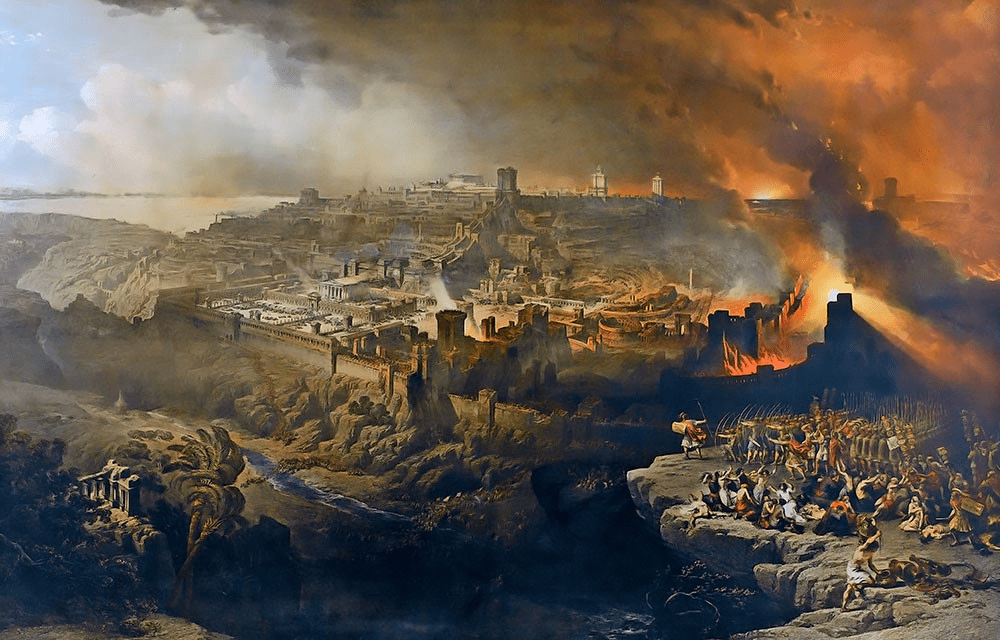
Psalm 74 – A Devastating Loss

Our God, why have you
    completely rejected us?
Why are you so angry
    with the ones you care for?
Remember the people
    you rescued long ago,
the tribe you chose
    for your very own.

Think of Mount Zion,
    your home;
walk over to the temple
left in ruins forever
    by those who hate us.

Your enemies roared like lions
    in your holy temple,
and they have placed
    their banners there.
It looks like a forest
    chopped to pieces.
They used axes and hatchets
    to smash the carvings.
They burned down your temple
    and badly disgraced it.
They said to themselves,
    “We’ll crush them!”
Then they burned each one
of your meeting places
    all over the country.
There are no more miracles
    and no more prophets.
Who knows how long
    it will be like this?

Our God, how much longer
    will our enemies sneer?
Won’t they ever stop
    insulting you?
Why don’t you punish them?
    Why are you holding back?

Our God and King,
you have ruled
    since ancient times;
you have won victories
    everywhere on this earth.
By your power you made a path
    through the sea,
and you smashed the heads
    of sea monsters.
You crushed the heads
    of the monster Leviathan,
then fed him to wild creatures
    in the desert.
You opened the ground
for streams and springs
    and dried up mighty rivers.
You rule the day and the night,
and you put the moon
    and the sun in place.
You made summer and winter
    and gave them to the earth.

Remember your enemies, Lord!
They foolishly sneer
    and won’t respect you.
You treat us like pet doves,
    but they mistreat us.
Don’t keep forgetting us
and letting us be fed
    to those wild animals.
Remember the agreement
    you made with us.
Violent enemies are hiding
in every dark corner
    of the earth.
Don’t disappoint those in need
    or make them turn from you,
but help the poor and homeless
    to shout your praises.
Do something, God!
    Defend yourself.
Remember how those fools
    sneer at you all day long.
Don’t forget the loud shouts
    of your enemies. (Contemporary English Version)

God’s temple was violated. The center and symbol of Jewish worship, culture, and life was gone.

Although we know that nothing lasts forever, that doesn’t mean we are always okay with it.

Asaph, the psalmist, was definitely not okay with the temple’s destruction. It was more than the loss of a building. For Asaph and his people, Jerusalem and the temple were the glue which held the world together.

They lost their center of being. And it was devastating to them.

Everyone and every society has their center, those values and practices which makes them a people. We all need a public center that defines who we are and what we are about. There must be a gravity that holds us to our place and doesn’t allow us to stray into oblivion and nothingness.

The central core of the people was eviscerated. So, today’s psalm is a lament for Jerusalem. It is a painful emotional and spiritual cry which goes well beyond bricks and mortar and the mere physical.

The ruin of the temple, Asaph complains, is the ruin of their God. Yes, it was the Babylonians who came and did the destroying and the de-centering. But it was God’s temple. God is the One responsible. It was God’s action. So, Asaph contends with God and comes at him with full challenge.

Asaph appealed to the Lord much like we do today. “Hey, God, remember how things were back there. It was good, right!? Now look at everything. It’s a mess.” The language is all meant to persuade God that things are so bad, that they are completely intolerable; thus, the Lord should do something about it.

God is bigger than the temple. So, therefore, God can and should restore the temple and make things right again, Asaph reasons. He sounds much like a person in the throes of grief, desperately trying to bargain with God to get things back to the way they were.

Point by point, the psalmist gives a sort of play-by-play to God about the awful situation and what happened. These guys who came and did their dirty work are ultimately your enemies, God, not just ours. So, take notice and act!

Remember the good old days, God, when you performed mighty acts of power against formidable foes, Asaph insisted. Against all odds, the Lord came through for the people… But now… there’s nothing. No divine action. The Babylonians came to Jerusalem, destroyed the city and temple, and got away with it.

Like a person experiencing extreme dizziness, Asaph and the people had a terrible spiritual vertigo which left them unable to get their balance and find their center.

Along with Asaph, in our horrible grief, we not only appeal to God, but we also insist, even tell God exactly what he must do, as if we were the Creator and Yahweh the creature. “Listen, Mr. Almighty God, you made a covenant with us and now you’re reneging on it with all this ridiculous silence and inaction.”

Yet, Asaph really knows better. He knows that, although the temple and the city are important as visible structures, the invisible God transcends all the tangible things we hold so tightly to.

We live in a day and age when all our religious structures are being dismantled, destroyed, done away with. Few persons now look to an institutional and visible building or system for their spirituality and worship.

And, although many believers may lament the changes and the disappearance of churches and religion, there still remains an invisible God to whom we can address – the very same God whom Asaph addressed all those millennia ago.

We are not, therefore, reduced to despair. In the end, it isn’t about buildings, ministries, programs, budgets, or church attendance – it’s about the source of life and hope in the absence of past knowable structures. It is a naked faith in the God who is there.

Lord Jesus Christ, by your patience in suffering you hallowed earthly pain and gave us the example of obedience to your Father’s will: Be near me in my time of weakness and pain; sustain me by your grace so that my strength and courage may not fail; heal me according to you will; and help me always to believe that what happens to me here is of little account if you hold me in eternal life, my Lord and my God. Ame

Matthew 6:19-24 – Where Is Your Loyalty Placed?

Jesus said, “Do not store up for yourselves treasures on earth, where moths and vermin destroy, and where thieves break in and steal. But store up for yourselves treasures in heaven, where moths and vermin do not destroy, and where thieves do not break in and steal. For where your treasure is, there your heart will be also.

“The eye is the lamp of the body. If your eyes are healthy, your whole body will be full of light. But if your eyes are unhealthy, your whole body will be full of darkness. If then the light within you is darkness, how great is that darkness!

“No one can serve two masters. Either you will hate the one and love the other, or you will be devoted to the one and despise the other. You cannot serve both God and money. (New International Version)

Nobody can pursue two diametrically opposed commitments. 

Trying to live in both worlds of pursuing earthly treasure and heavenly treasure is not possible. 

Jesus has no place for any of his followers to ride the fence between those two worlds.

We cannot practice God’s will, and at the same time have a moonlighting job with the world.

As followers of God, we must have a single-minded loyalty to kingdom values. 

We are to do the will of God, from a right and sincere heart, and follow Christ’s teaching alone. 

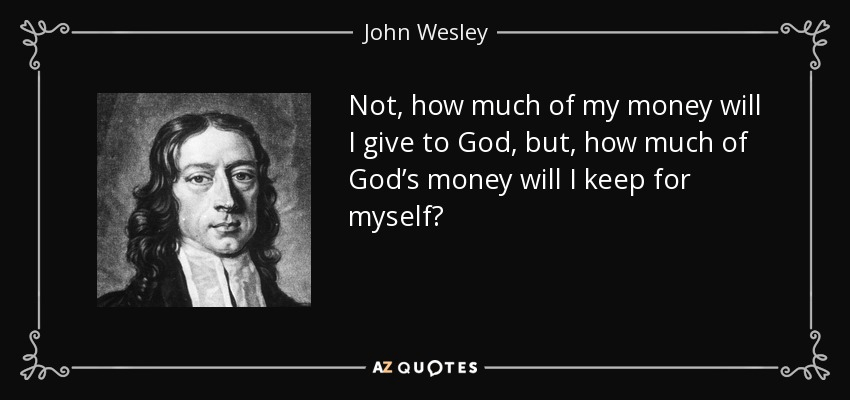
We may give of ourselves, and give of our money, with sincerity, but if we walk away from that and believe the rest of my money, time, talents, and resources are mine to use as I want (since I fulfilled my duty) then we have a divided loyalty between the kingdom of God and the domain of darkness.

Jesus, as he typically does in the Gospels, used metaphors to communicate that we must have an unswerving loyalty to God’s kingdom values.

The Treasure Metaphor

Do not store up for yourselves treasures on earth. So, what are earthly treasures? 

Stuff, money, possessions, control, power, position, and recognition from others. 

You may rightly ask in response, “Is any of that really, in and of itself, wrong?” 

No. However, that’s not the real issue. The real question is this:

Do we use our earthly treasure to build heavenly treasure, or do we hoard earthly treasure for our own purposes apart from Christ’s kingdom values?

A man in a crowd said to Jesus, “Teacher, tell my brother to give me my share of what our father left us when he died.”

Jesus answered, “Who gave me the right to settle arguments between you and your brother?”

Then he said to the crowd, “Don’t be greedy! Owning a lot of things won’t make your life safe.”

So, Jesus told them this story:

A rich man’s farm produced a big crop, and he said to himself, “What can I do? I don’t have a place large enough to store everything.”

Later, he said, “Now I know what I’ll do. I’ll tear down my barns and build bigger ones, where I can store all my grain and other goods. Then I’ll say to myself, ‘You have stored up enough good things to last for years to come. Live it up! Eat, drink, and enjoy yourself.’ ”

But God said to him, “You fool! Tonight, you will die. Then who will get what you have stored up?”

“This is what happens to people who store up everything for themselves but are poor in the sight of God.” (Luke 12:13-21, CEV)

Earthly possessions are tools to be used. Jesus warns that we must not accumulate personal wealth, esteem, and success for the sake of placing ultimate security in money, but for advancing God’s kingdom values. 

Why do that? 

Because earthly treasure is temporary, and heavenly treasure is permanent. 

Heavenly treasure is righteousness; it’s right and just relationships. Humility, peace, grace, mercy, purity, and forgiveness are all relational values. The only thing that we will take with us when we die is relationships; it’s the only thing that’s permanent.

If I am genuinely committed to God’s kingdom, my most cherished values will be established by God. 

Whatever it is that we value, those values consume our thoughts and our efforts. In other words, what’s truly in our hearts directs our work.

And what we value derives from how we perceive our identity. For many Americans, we are defined primarily not as citizens or workers, but consumers. Jesus is neither advocating that we take vows of poverty, nor that we ought not to enjoy the good things in life. Rather, Jesus wants us to define where our loyalties truly lie.

The Light Metaphor

In the ancient world, the eye represented what you fixed your gaze on, or what your focus was. In our culture, we could replace the word “eye” with the word “goal.” The word “body” represents the entirety of one’s life.  So, we may interpret Christ’s words in this way: 

A goal is the focus of a life. If your goals are good, your whole life will be full of proper focus. But if your goals are bad, your whole life will be full of blindness. If then, the focus within you is only really blindness, how great is that darkness!

If the goals and dreams of life are toward earthly treasure, you will blindly move in that direction and your life will end up in disordered love and misplaced values. At death, you will have nothing to take with you because all the eggs have been put in the temporal basket.

The Slavery Metaphor

Jesus flatly stated that we cannot simultaneously serve God and money. Pick and choose. You must go one way or the other; there is no middle ground. 

The question Jesus is posing is: “Who’s your Master?” 

  • When deciding between two jobs, or two homes, or how to spend your time or your money, what set of values comes into play?… values that define me as a follower of Jesus?… or values that define me as an American consumer? 
  • Will I be a bondservant of Jesus, or a slave to credit card debt? 
  • Will I serve God, or serve the lifestyle that I believe I deserve?

Conclusion

None of us are immune from the temptations of all the world’s shiny things, of ambling into misdirected goals.  If you find that you are slave to the wrong god, then there is good news: There is an infinite storehouse of grace that flows from the very heart of God through Jesus Christ. 

If we confess our sins, he is faithful and just to forgive us our sins and cleanse us from everything we’ve done wrong. (1 John 1:9, CEB)

Choose this day whom you will serve.

Our Father in heaven,
may your name always be kept holy.
May your kingdom come
and what you want, be done,
    here on earth as it is in heaven.
Give us the food we need for each day.
Forgive us for our sins,
    just as we have forgiven those who sinned against us.
And do not cause us to be tempted,
but save us from the Evil One.

The kingdom, the power, and the glory are yours forever. Amen. (Matthew 6:9-13, NCV)

Matthew 18:6-9 – Say “No” to Temptation

“If you cause one of these little ones who trusts in me to fall into sin, it would be better for you to have a large millstone tied around your neck and be drowned in the depths of the sea.

What sorrow awaits the world because it tempts people to sin. Temptations are inevitable, but what sorrow awaits the person who does the tempting. So, if your hand or foot causes you to sin, cut it off and throw it away. It’s better to enter eternal life with only one hand or one foot than to be thrown into eternal fire with both of your hands and feet. And if your eye causes you to sin, gouge it out and throw it away. It’s better to enter eternal life with only one eye than to have two eyes and be thrown into the fire of hell.” (New Living Translation)

It’s probably a good idea not to get on the wrong side of Jesus.

Throughout the Gospels, Jesus utilized a variety of teaching methods to communicate his message. In today’s Gospel lesson, Christ used the language of hyperbole to arrest attention and get his point across.

A universal truism of this world is that sin exists. In Holy Scripture, sin is anything people do or say – or fail to do and say – which damages or destroys another’s or one self’s physical, mental, emotional, or spiritual wellbeing.

Greed, envy, gluttony, sloth, anger, lust, and pride abound no matter where one goes on this planet. Sin is downright awful. It causes people to stumble, and, when unchecked, leads to personal and corporate chaos, unrest, and destruction. 

Whenever sin is viewed merely as a character flaw, or simply part of the fabric of organizations and institutions, then hellfire is not far off. Hell exists because of sin. 

We get the flavor that Jesus took sin quite serious. Christ considers sin so terrible and heinous that he deliberately used the height of hyperbole to communicate that radical, drastic, and decisive action must unequivocally be taken to get rid of it. 

The Lord Jesus wanted there to be no mistake in his communication: Sin is not something to dabble in or take a shallow approach; rather, sin must be eradicated, at all costs. The language is severe: If your hand, foot, or eye causes you to sin, cut it off. It’s better to enter life crippled or blind rather than be thrown into a suffering hell.

Temptations will inevitably come. Yet, how we handle those temptations and what we do with them is of eternal significance. 

We must get to the root of the sin – which happens through succumbing to temptation – and re-arrange our lives, alter our schedules, and change our lives in a radical way to remove putting ourselves in a position to sin. 

Solid daily spiritual habits of Scripture reading and prayer; time for sleep and rest; attention to Sabbath; and a regular exercise regimen are all ways to help ensure that temptation will not win the day.

And God forbid that we cause another to sin because we are hangry, tired, and out of shape because we’ve neglected ourselves for far too long. Self-care isn’t a luxury; it’s a necessity. Other people get hurt when we hurt ourselves.

Your self-care is always a valid excuse to say “no.”

If we take the words of Jesus to heart, perhaps we will gain awareness of the ways we need to metaphorically cut off a hand or gouge out an eye. For many people, this means learning to say “no.”

There doesn’t always need to be an explanation for assertively and courteously saying the word “no.” If an explanation is warranted, it should be brief. The word “no” doesn’t mean we are selfish pricks trying to wriggle out of responsibility. “No” simply realizes we are finite creatures with limited time, energy, and resources. Unlike God, we cannot do it all.

Setting personal boundaries is both wise and necessary. Without them, we let others chain us in bondage to their agendas. A lack of personal boundaries also typically means that the boundary-less person continually violates others’ boundaries. Since there are no fences in their own lives, they feel they can hop anybody else’s fence in front of them.

Violating someone’s space through mental or emotional manipulation, spiritual abuse, or bodily harm is sin. Jesus wants radical action to deal with such offense of others.

For the Christian, priority must be given to saying “yes” to Jesus, which then allows a “no” to come when there are competing priorities. A person unclear on their values and priorities will chronically violate others. If you have a specific plan of doing the will of God before being confronted with another person’s request, you’re more likely to stick to your original plan.

Jesus continually said “yes” to the Father. This framed and formed his earthly life so that he crossed social boundaries to speak to a Samaritan woman, a tax collector, and a leper – while maintaining the respect of another’s personal boundary by asking if they want to be helped and healed.

Sin is horrible – which is why Jesus went to the ultimate length to deal with it. He sacrificed himself and suffered an ignominious death so that sin’s power would be crushed, so that you and I could say “no” to temptation.

Holy God, you sent your Son to this earth to deal decisively with the world’s sin.  I choose today to walk in the forgiveness you offer through Jesus, and to avail myself of the Spirit’s power to forsake temptation in all its forms.  Amen.

Daniel 6:1-28 – A Time and a Place for Prayer

Daniel in the Lions Den by John August Swanson

Darius decided to appoint one hundred twenty chief administrators throughout the kingdom, and to set over them three main officers to whom they would report so that the king wouldn’t have to be bothered with too much. One of these main officers was Daniel. Because of his extraordinary spirit, Daniel soon surpassed the other officers and the chief administrators—so much so that the king had plans to set him over the entire kingdom. As a result, the other officers and the chief administrators tried to find some problem with Daniel’s work for the kingdom. But they couldn’t find any problem or corruption at all because Daniel was trustworthy. He wasn’t guilty of any negligence or corruption.

So, these men said, “We won’t find any fault in Daniel, unless we can find something to use against him from his religious practice.”

So, these officers and chief administrators ganged together and went to the king. They said to him, “Long live King Darius! All the officers of the kingdom, the ministers, the chief administrators, the royal associates, and the governors advise the king to issue an edict and enforce a law, that for thirty days anyone who says prayers to any god or human being except you, Your Majesty, will be thrown into a pit of lions. Now, Your Majesty, issue the law and sign the document so that it cannot be changed, as per the law of Media and Persia, which cannot be annulled.” Because of this, King Darius signed the document containing the law.

When Daniel learned that the document had been signed, he went to his house. Now his upper room had open windows that faced Jerusalem. Daniel knelt, prayed, and praised his God three times that day, just like he always did. Just then these men, all ganged together, came upon Daniel praying and seeking mercy from his God. They then went and talked to the king about the law: “Your Majesty! Didn’t you sign a law, that for thirty days any person who prays to any god or human being besides you, Your Majesty, would be thrown into a pit of lions?”

The king replied, “The decision is absolutely firm in accordance with the law of Media and Persia, which cannot be annulled.”

So they said to the king, “One of the Judean exiles, Daniel, has ignored you, Your Majesty, as well as the law you signed. He says his prayers three times a day!”

When the king heard this report, he was very unhappy. He decided to rescue Daniel and did everything he could do to save Daniel before the sun went down. But these men, all ganged together, came and said to the king, “You must realize, Your Majesty, that the law of Media and Persia, including every law and edict the king has issued, cannot be changed.”

So, the king gave the order, and they brought Daniel and hurled him into the pit of lions.

The king said to Daniel: “Your God—the one you serve so consistently—will rescue you.”

A single stone was brought and placed over the entrance to the pit. The king sealed it with his own ring and with those of his princes so that Daniel’s situation couldn’t be changed. The king then went home to his palace and fasted through the night. No pleasures were brought to him, and he couldn’t sleep. At dawn, at the first sign of light, the king rose and rushed to the lions’ pit.

As he approached it, he called out to Daniel, worried: “Daniel, servant of the living God! Was your God—the one you serve so consistently—able to rescue you from the lions?”

Then Daniel answered the king: “Long live the king! My God sent his messenger, who shut the lions’ mouths. They haven’t touched me because I was judged innocent before my God. I haven’t done anything wrong to you either, Your Majesty.”

The king was thrilled. He commanded that Daniel be brought up out of the pit, and Daniel was lifted out. Not a scratch was found on him, because he trusted in his God. The king then ordered that the men who had accused Daniel be brought and thrown into the lions’ pit—including their wives and children. They hadn’t even reached the bottom of the pit before the lions overpowered them, crushing all their bones.

Then King Darius wrote the following decree:

To all the peoples, nations, and languages inhabiting the entire earth: I wish you much peace.I now issue this command: In every region of my kingdom, all people must fear and revere Daniel’s God because:

He is the living God.
    God stands firm forever.
His kingship is indestructible.
    God’s rule will last until the end of time.
He is rescuer and savior;
    God performs signs and miracles in heaven and on earth.
Here’s the proof:
    He rescued Daniel from the lions’ power.

And so, Daniel was made prosperous during the rule of Darius and during the rule of Cyrus the Persian. (CEB)

“If your day is hemmed in with prayer, it is less likely to come unraveled.”

Cynthia Lewis

When Daniel learned about King Darius’ decree, he went home to his upstairs room where the windows opened toward Jerusalem. Three times a day he got down on his knees and prayed, giving thanks to his God, just as he had always done. (Daniel 6:10).

It was Daniel’s regular habit of prayer which gave him the strength to ignore the king’s edict. Daniel was kept safe, not by being saved from the lions’ den, but in the lions’ den. Daniel is our best model in the Bible of one who consistently prayed, no matter the situation. Two characteristics of Daniel’s prayer stands out: a planned approach to prayer; and perseverance in prayer.

We need a plan for prayer.

Daniel had an intentional plan for prayer. He also prayed spontaneously throughout his life – all the time. That, however, was not his bread-and-butter daily life of prayer. Daniel had set times in which he prayed three times a day. 

I am not insisting we all ought to pray at the set times of 6am, 12pm, and 6pm, as Daniel did every day (although that is good biblical plan to emulate!). Yet, I will insist there needs to be some planning behind carving out time for prayer every day. We need to approach prayer with the same deliberate discipline we approach anything else – like housework, writing a paper, sports practice, or getting work accomplished on the job.

Prayer is the way we escape the gravitational pull of our fleshly lives and enter God’s orbit. It takes much planning, energy, commitment, and focus. And it is all worth it.

We need a set time and a set place to pray. Just as we set aside a special room in our house for sleeping (bedroom) and a particular place to sleep (bed) so we need a sacred space just for prayer. We understand the value of a good night’s sleep. So, we plan to go to bed at night and arise in the morning. In the same way, we must arrange a time and place for prayer. The value we place on prayer is demonstrated by our planning for it.

We need perseverance in prayer.

Daniel was a teenager when the Babylonians came to Jerusalem, tore down the wall, and took the best young people of the city into captivity. When the lions’ den event unfolded, Daniel was an old man of about 80 years old. For over sixty years, Daniel prayed three times a day, every day, without fail. His prayers were consistent and sustained. He never gave up. 

The reason Daniel always opened his window and prayed toward Jerusalem is that he was praying consistent with God’s promise. The exiles would someday return to Jerusalem. So, Daniel looked out his window every day, three times a day, praying repeatedly for God’s help and peace.

Daniel was so consistent about prayer that when the jealous rascals in the king’s service went after him, it did absolutely nothing to deter him from his usual routine. Daniel maintained his focus without being sidelined by all the drama. He kept up his regular practice of prayer in the same place at the same time. It is interesting his enemies knew exactly when and where Daniel would be praying every day, and they set their trap according to that knowledge.

Daniel was incredibly calm in facing the lions because of his planned, deliberate, and consistent practice of prayer. Daniel’s ability, confidence, courage, and lack of worry was not simply because he was some extraordinary person. Rather, he had decades of practiced prayer which equipped him for just such an encounter.

Daniel’s posture in prayer was consistently on his knees. It reminded him of his true position, not as a high mucky muck in the kingdom of Darius with all its rights and privileges, but as a humble servant in God’s kingdom with all its joy and responsibility.

Considering Daniel’s example of prayer, it would be wise for us to do some solid planning. Identify and set aside a dedicated space for prayer. Arrange your schedule so that prayer is a priority. You’ll be glad you did!

Our Beloved Father, dwelling in the heavenly realms,
    may the glory of your name
    be the center on which our lives turn.
Manifest your kingdom realm,
    and cause your every purpose to be fulfilled on earth,
    just as it is in heaven.
We acknowledge you as our Provider
    of all we need each day.
Forgive us the wrongs we have done as we ourselves
    release forgiveness to those who have wronged us.
Rescue us every time we face tribulation
    and set us free from evil.
    For you are the King who rules
    with power and glory forever. Amen. (Matthew 6:9-13, TPT)
