Be Helpful, Not Harmful (Psalm 119:113-128)

I hate two-faced people,
but I love your teachings.
You are my hiding place and my shield.
My hope is based on your word.
Get away from me, you evildoers,
so that I can obey the commandments of my God.
Help me God, as you promised, so that I may live.
Do not turn my hope into disappointment.
Hold me, and I will be safe,
and I will always respect your laws.
You reject all who wander away from your laws,
because their lies mislead them.
You get rid of all wicked people on earth as if they were rubbish.
That is why I love your written instructions.
My body shudders in fear of you,
and I am afraid of your regulations.

I have done what is fair and right.
Do not leave me at the mercy of those who oppress me.
Guarantee my well-being.
Do not let arrogant people oppress me.
My eyes are strained from looking for you to save me
and from looking for the fulfillment of your righteous promise.
Treat me with kindness,
and teach me your laws.
I am your servant.
Help me understand
so that I may come to know your written instructions.
It is time for you to act, O Lord.
Even though people have abolished your teachings,
I love your commandments more than gold, more than pure gold.
I follow the straight paths of your guiding principles.
I hate every pathway that leads to lying. (God’s Word Translation)

I don’t know about you, but disingenuous people drive me nuts. This is the type of person who is nice as pie to your face, but then walks away and talks smack about you to another. They seem to always have an agenda in order to get ahead, gain power, and be in the know, so that they can have leverage against you.

There are other people who try to avoid doing wrong and always try to do right. There are yet others who either bulldoze or sleepwalk through life, doing what they will, with impunity, unaware of how they’re damaging people’s lives. And then there are those who try to steer clear of what they consider the biggie sins, while having no problem indulging in so-called little sins. 

Selfishness, self-centeredness, and unawareness of the self’s impact on this world will create all sorts of problems for others. Indeed, sin is messy business. 

No matter the form or the attempt at dealing with one’s selfish proclivities, the bottom line is that we all engage in such behavior because it benefits us, that is, we like doing it. We might not always like the consequences and the fallout of self-centered living, but it sure feels good while it lasts.

Humanity needs a complete reorientation of the heart. Rather than hating every way that doesn’t benefit me, we must learn to hate every way which is contrary to God’s good commands.

The psalmist proclaims and affirms that all God’s precepts are right. It’s important to hate every false path which deviates from the true self and the common good of all persons. 

If we indulge in self-centered ways because we like them, the road to thinking of others and their needs is learning to hate my false self and false belief systems – to loathe them so much that it’s like a nasty stench in our nostrils. 

Hating sin comes from the acquired taste of loving God’s commandments. When we come around to cherish and desire God’s Word, then selfish sinful desires gradually become so odious to us that we want nothing to do with them.

The reason the psalmist could proclaim such an extended love song to the commands of God, is that he tried them, ate them, and imbibed them. And how good they were! It caused him to forsake every selfish way in trying to achieve human enjoyment. 

I encourage people to have a solid plan for reading (or listening to) Scripture every day – because it really has the power to reorient us from being selfish jerks who harm others to becoming unselfish thinkers who help others.

Scripture changes our taste buds. Sustained, consistent, daily eating of the psalms will teach us to want God and God’s ways – while forsaking the dark path of insolence and oppression in order to satiate our own selfish wants.

The psalmist committed himself to avoiding worthless selfish situations, as well as steering clear of harmful people with the propensity to doing wrong. They are fickle, double-minded, two-faced people, divided in their loyalties.

On one side of their mouth, they talk a good line about faith; and then talk out the other side of their mouth, spewing a bunch of worthless gobbledygook which, at the least, adds no value to anything, and, at worst, wrecks good plans and harms others.

If there are people in authority over us who don’t give a wit about our most cherished values, we will likely find ourselves tasked with doing things which rub against our understanding of Holy Scripture. In this state of moral distress, we are pushed, pulled, and tested in our single-minded devotion by the double-minded selfish person to do what we are uncomfortable with.

In the stress and crucible of trouble, we need the courage to speak up, despite the fear of repercussions. And that strength is only possible if we have a resilient spirit with the capacity to sustain our personal integrity in the face of distress. That is, we need God and God’s Holy Word.

Scripture and fellow believers provide support; we need to care for one another as a community of redeemed persons who seek to live into the words of ways of almighty God.

It can be tricky business, wisely trying to discern between what we to accept and what to pushback against. Yet, with God, God’s Word, and God’s people, we possess all the resources required in living the spiritual life and navigating the selfish world we inhabit.

Almighty God, I pray that you will deal with me according to your steadfast love and teach me your statutes. I am your servant; give me understanding so that I might know and live by your commands and forsake the evil of the world. Amen.

The Coming Divine Judgment (Revelation 20:7-15)

Lake of Fire, by David Howard Hitchcock, 1888

When the thousand years are over, Satan will be released from his prison and will go out to deceive the nations in the four corners of the earth—Gog and Magog—and to gather them for battle. In number they are like the sand on the seashore. They marched across the breadth of the earth and surrounded the camp of God’s people, the city he loves. But fire came down from heaven and devoured them. And the devil, who deceived them, was thrown into the lake of burning sulfur, where the beast and the false prophet had been thrown. They will be tormented day and night for ever and ever.

Then I saw a great white throne, and he who was seated on it. The earth and the heavens fled from his presence, and there was no place for them. And I saw the dead, great and small, standing before the throne, and books were opened. Another book was opened, which is the book of life. The dead were judged according to what they had done as recorded in the books. The sea gave up the dead that were in it, and death and Hades gave up the dead that were in them, and each person was judged according to what they had done. Then death and Hades were thrown into the lake of fire. The lake of fire is the second death. Anyone whose name was not found written in the book of life was thrown into the lake of fire. (New International Version)

Almost everything is temporary. All things temporal must come to an end. Therefore, it is foolish to live as if everything we have will last forever.

Conversely, there are a few things which are permanent, namely, God and relationships. So, it only makes sense that we exist for values that will last, while holding very loosely the temporal things. Jesus put the matter like this:

“Do not store up for yourselves treasures on earth, where moths and vermin destroy, and where thieves break in and steal. But store up for yourselves treasures in heaven, where moths and vermin do not destroy, and where thieves do not break in and steal. For where your treasure is, there your heart will be also. (Matthew 6:19-21, NIV)

Yet, despite knowing this, people struggle with their espoused values. Many times, we succumb to the temporal as if it were permanent; and with permanence the things which are temporary. This situation speaks to the power of evil; and evil is not something to trifle with.

Just when we might evil is contained, it isn’t. In today’s lesson, Satan is loosed from his imprisonment, still a threat. That is the nature of evil amongst us; it has the sinister capacity to rebound and wreak havoc in people’s lives.

In the Apostle John’s apocalyptic vision, Satan is joined by Gog and Magog, who represent the nations of the earth. This hearkens back to the prophecy of Ezekiel in the Old Testament (Ezekiel 38-39) in which Gog – the leader of the land of Magog – leads an attack on Jerusalem. In other words, evil comes together and focuses its energies on the people of God in order to destroy them.

However, God intervenes; the destruction the nations intended on God’s people comes upon them. Evil is finally done for, once and for all; it is thoroughly purged from the presence of the righteous.

With evil put in its place, there is nowhere for the old rebellious systems and order of things to exist anymore. A new heaven and a new earth is needed – not just a reconstituted heaven and earth – because that’s how nasty evil really is, that it must be completely purged. New systems are put in place which can accommodate righteousness. Jesus predicted this new reality:

And no one pours new wine into old wineskins. Otherwise, the new wine will burst the skins; the wine will run out and the wineskins will be ruined. No, new wine must be poured into new wineskins.  (Luke 5:37-38, NIV)

When the time comes, all persons will stand as they truly are before the Lord. There can be no making oneself look better than they are, or presenting a particular optic that spins a good look in order to impress. All the actions and deeds of people are laid bare.

God’s grace, along with and human actions, are held together in tension. God grants salvation; and what we humans do with that gift matters a great deal.

Humanity’s works in this life demonstrate what sort of person they actually are. So, if those works are inconsistent and incongruent with how one’s life has been lived, it demonstrates where their hearts truly are; and where their final destination will be.

There is a coming judgment in which death and hell are done away with forever. Anyone whose name is not found in the Book of Life goes the way of death and hell, because when they had the chance to use their temporal life to give permanent life for others, they did not.

The point is not to try and determine who Gog and Magog are; or when in the future this all will happen. The sage person remains far away from such useless folly.

The aim of the Apostle John, for which we must pay attention, is twofold: encourage the faithful; and warn the unfaithful.

The Book of Revelation was given to believers in Jesus, to help them see that suffering, persecution, and hardship is temporary; remain faithful, persevere in faith, and you will see your name written in the Book of Life.

Revelation was also given as great warning sign to those who have put so much stock into power politics, jostling for authority, and oppressing others to get what they want. The positions they hold now are temporary. The oppression they give in this life will be what they receive in the next.

In the end, all things shall be judged rightly. In this, I take great comfort and hope.

Lord Jesus Christ, by your patience in suffering you hallowed earthly pain and gave us the example of obedience to your Father’s will: Be near me in my time of weakness and pain; sustain me by your grace, that my strength and courage may not fail; heal me according to you will; and help me always to believe that what happens to me here is of little account if you hold me in eternal life, my Lord and my God. Amen.

Temporary vs. Permanent (2 Corinthians 5:1-5)

For we know that if the earthly tent we live in is destroyed, we have a building from God, an eternal house in heaven, not built by human hands. Meanwhile we groan, longing to be clothed instead with our heavenly dwelling, because when we are clothed, we will not be found naked. For while we are in this tent, we groan and are burdened, because we do not wish to be unclothed but to be clothed instead with our heavenly dwelling, so that what is mortal may be swallowed up by life. Now the one who has fashioned us for this very purpose is God, who has given us the Spirit as a deposit, guaranteeing what is to come. (New International Version)

Back in the day, when my kids were small, we did our fair share of camping. We had a large two room tent that we called “The Tabernacle.” But even that large tent could not compare to finally getting back home to our house.

We are all on something of a perpetual spiritual camping trip. It may or may not feel like one, but every person is living in a tent. 

One of the challenges of the biblical writers is that they worked to communicate hope and spiritual realities in concrete language. They often made use of metaphors to help us understand. So, when the Apostle Paul likens our current lives to being in a tent, he means that what we are experiencing now with our bodies is temporary. 

Compared to the permanent resurrected body that will be coming in the future, our existence now in this present life, in this body, is not very glorious.

We consider someone homeless if they live in a tent on a permanent basis. In many ways, the Christian is homeless; we are not completely at home in this present body, nor in this present world. So, it seems rather curious to me that many believers in Jesus can be ruthlessly attached to the trappings and stuff of this contemporary campground.

If we were to make a list of all the things we do and all the things we have that are extra-biblical, that is, not specifically mentioned in the Bible, it would not take long to discover that much of what we do on a day to day basis – not to mention religiously and through church ministry – is rather quite temporary. Yet, too many persons cling to their stuff and their ways as if all of it will endure forever.

In those times when we experience bereavement; in the situations that demonstrate that we are mortal; and, in the circumstances that occur in which we glimpse how fleeting this present life can be, we begin to understand that what we need to be living for is the permanence of relationships expressed through the ever-present Spirit of God. 

It is good for us to long for a better day when we will no longer groan in the tent of this body so that we will connect with the unseen God who goes before us, with us, after us.

Camping can be both fun and challenging. But if we had to make an actual tent our real home, I can easily imagine how much groaning would happen every day. We would certainly long for a more established residence. Paul gets at this exasperation, which a temporal finite existence can be, when writing to the Roman Christians:

We know that the whole creation has been groaning as in the pains of childbirth right up to the present time. Not only so, but we ourselves, who have the first-fruits of the Spirit, groan inwardly as we wait eagerly for our adoption to sonship, the redemption of our bodies. (Romans 8:22-23, NIV)

Because we have the Spirit, we have help. The Spirit is our advocate. Sometimes, because of our situation, our prayers to God only come out as groans; words can seem far away from us. Yet, that is enough. The Spirit speaks groaning, and knows how to interpret it.

The Spirit helps us in our weakness. We do not know what we ought to pray for, but the Spirit himself intercedes for us through wordless groans. And he who searches our hearts knows the mind of the Spirit, because the Spirit intercedes for God’s people in accordance with the will of God. (Romans 8:26-27, NIV)

God has our back. We may not know what exactly we are going through, and why we are going through it, much less how to even pray about it. But the one thing we do know is that God works for the good of those who love him, who have been called according to his purpose. (Romans 8:28)

With the Spirit alongside us, there is the continual assurance and reassurance that we belong to God. Our present existence may be temporary, but the presence and love of God are permanent and will never change.

For I am convinced that neither death nor life, neither angels nor demons, neither the present nor the future, nor any powers, neither height nor depth, nor anything else in all creation, will be able to separate us from the love of God that is in Christ Jesus our Lord. (Romans 8:38-39, NIV)

Our present circumstances will eventually pass; they are temporary. But the love of God has staying power; it is permanent and forever. Our bodies are always changing; someday we will die. Yet, because of Christ’s resurrection, believers shall be raised with a body fit for eternity. Our tent will be fashioned into a house.

Eternal God, who always has been and always will be, help me to so connect with your Holy Spirit that I can discern the difference between what is temporary and what is permanent. Guide me with your holy hand so that I can place my present efforts into the things that will make a difference for eternity, through Jesus Christ my Lord. Amen.

A Controversial Christ (Mark 2:23-3:6)

Wheatfield with Crows, by Vincent Van Gogh, 1890

One Sabbath day as Jesus was walking through some grainfields, his disciples began breaking off heads of grain to eat. But the Pharisees said to Jesus, “Look, why are they breaking the law by harvesting grain on the Sabbath?”

Jesus said to them, “Haven’t you ever read in the Scriptures what David did when he and his companions were hungry? He went into the house of God (during the days when Abiathar was high priest) and broke the law by eating the sacred loaves of bread that only the priests are allowed to eat. He also gave some to his companions.”

Then Jesus said to them, “The Sabbath was made to meet the needs of people, and not people to meet the requirements of the Sabbath. So the Son of Man is Lord, even over the Sabbath!”

Jesus went into the synagogue again and noticed a man with a deformed hand. Since it was the Sabbath, Jesus’ enemies watched him closely. If he healed the man’s hand, they planned to accuse him of working on the Sabbath.

Jesus said to the man with the deformed hand, “Come and stand in front of everyone.” Then he turned to his critics and asked, “Does the law permit good deeds on the Sabbath, or is it a day for doing evil? Is this a day to save life or to destroy it?” But they wouldn’t answer him.

He looked around at them angrily and was deeply saddened by their hard hearts. Then he said to the man, “Hold out your hand.” So the man held out his hand, and it was restored! At once the Pharisees went away and met with the supporters of Herod to plot how to kill Jesus. (New Living Translation)

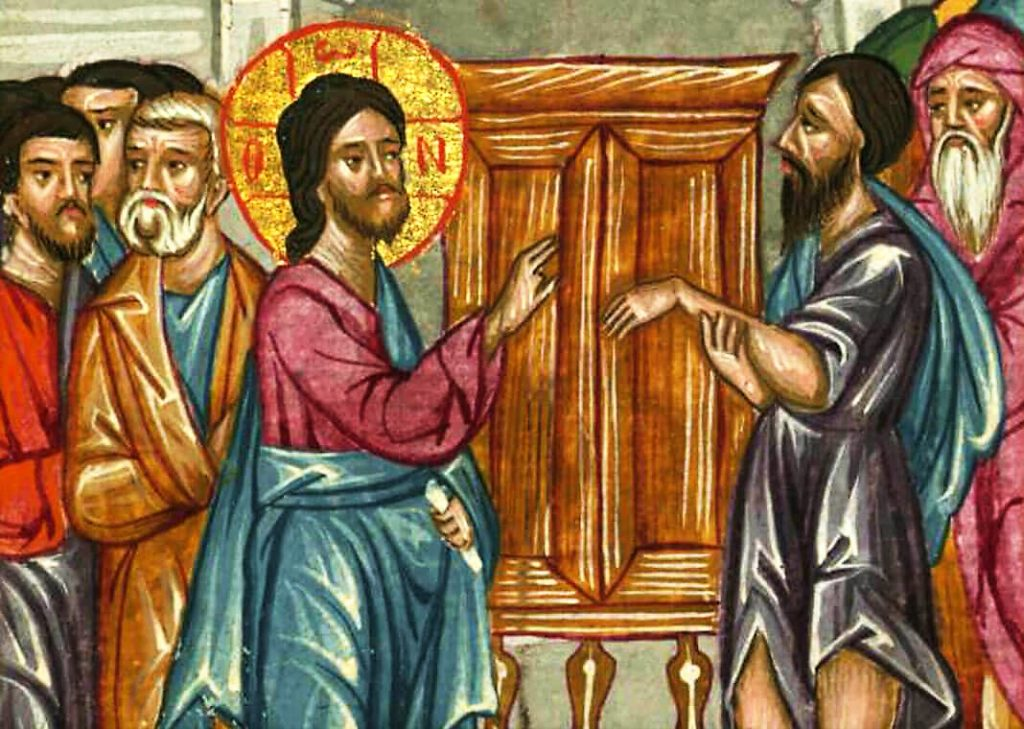
Jesus Heals the Man with the Withered Hand, by Ilyas Basim Khuri Bazzi Rahib, 1684

I am continually amazed whenever good people are surprised by being embroiled in the muck of human controversy. Since we live in a profoundly fallen world, good is often going to buck up against the bad. Besides, Jesus often found himself in a controversy of some kind; and we are not above our Lord.

There are two distinct yet similar controversies in today’s lesson; and they highlight why there were some folk who were all upset about the way Jesus went about things. Such people eventually came to the dark decision that Jesus needed to go away, permanently.

Much of the controversy between Jesus and the religious leaders came down to particular views of God’s law; and, of course, whose view was going to win out over the other. It ended up becoming what almost all controversies are about: Deciding who is really in power and calls the shots.

The Politics of Hunger

It was a Sabbath day. Jesus and his disciples were walking through the fields. And they were hungry. So the disciples took some grain, broke off the heads, and ate them. To any non-Jewish person, there’s no problem here. But the Pharisees were concerned.

First, they observed the disciples walking through grain fields. The Pharisees thought they should be staying put on the Sabbath. Second, and perhaps more significantly, the religious leaders saw Christ’s disciples gleaning – which was working on the Sabbath. To them, any respectable Jew prepared their food the day before. This is a lack of holiness, of not taking the Sabbath seriously. And this was completely unacceptable to the Pharisees.

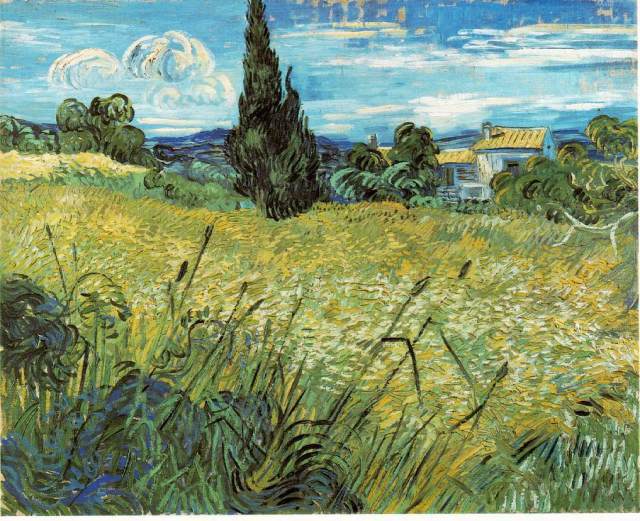
Wheat Field and Cypress by Vincent Van Gogh, 1890

Jesus, however, viewed walking through the fields differently. He did not consider the Sabbath as trivial; Jesus instead stood back and took a big picture perspective of it all. And that view included the ancient story of David, who took the consecrated bread in the tabernacle which was reserved only for Levite priests. (1 Samuel 21:1-6; Leviticus 24:8-9)

The reason David wanted the bread was because he was a fugitive, on the run from King Saul who was trying to take his life. Jesus insisted, on that day, the priest on duty did nothing wrong in giving the special bread to David. Yes, the strict letter of the law was broken; and, no, this was not wrong – because the priest was helping to save a life, and a very important one at that.

Jesus discerned there are times when particular laws come into conflict; so it’s necessary to maintain the spirit of a law in order to maintain a high value and meet a pressing human need. In a sense, Jesus gave a covenant code legal opinion on the subject.

It’s no surprise, to any reader of the New Testament Gospels, that Christ would behave this way; and that it would drive the religious leaders bananas. After all, they, the Pharisees, upheld law and rendered legal decisions – not this upstart wannabe. Jesus took an authoritative stance on what was happening, and the leaders did not at all like their own authority questioned.

This wasn’t some maverick interpretation by Jesus. He simply pointed out that the Sabbath is a gift, given to people to promote life and health – and not a burden that folks are to carry. Any decent Sabbath-keeper knew this.

It appears the leaders didn’t like being reminded of it from Jesus. What’s more, Jesus was much too close to likening himself to David. Yet another reason to despise this uppity teacher.

The Legality of Suffering

A second controversy brought the issue of who is in charge and who gets to arbitrate community values into a greater light. There is perhaps no other place for that conflict to happen than in the synagogue, the meeting place of worshipers. The juiciest things always seem to happen in a place of worship.

In the first story, the religious leaders were caught surprised over the behavior of Jesus and his disciples. They’re determined not to make that mistake again. From this point forward, it seems the Pharisees are continually waiting for a chance to put down Jesus as a lawbreaker and rabblerouser.

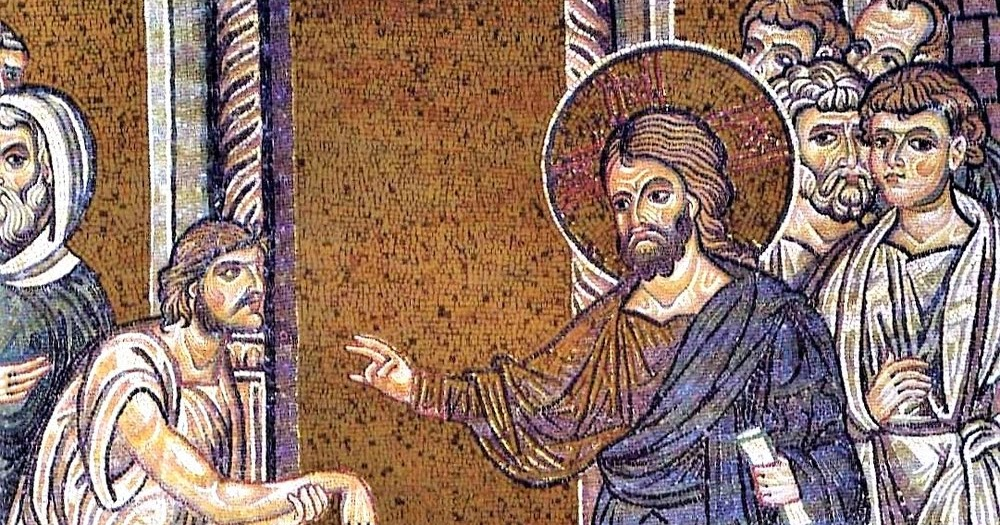
Byzantine mosaic of Christ healing the man with a withered hand, Cathedral of Monreale, Palermo, Sicily

For them, the issue wasn’t about the ability to heal, but whether it’s being done on the Sabbath. Much like the grainfield incident, healing is work, and working on the Sabbath is a direct violation of God’s immutable law. The religious leaders wanted to prove that Jesus has no regard for God’s will.

Law, for many Pharisees in Christ’s day, was meant to bring order so that chaos does not rule. Obedience to the law is a pre-condition for blessing. Without a clear demonstration of holy living, the community could be under a curse, much like their ancestors before them who were exiled for disregarding God’s law.

Yet again, Jesus cut through the anxious fear and authoritative posturing and went directly to the intended spirit of the law. The Sabbath, of all days in the week, ought to be a time for doing good, not harm; and to save life, not kill it. Jesus was not doing anything that could be considered work, anymore than his disciples were actually gleaning or harvesting grain.

There is no better day than the Sabbath for restoring a man’s withered and malformed hand, for giving him back his ability to make a living and contribute to the community. Much more was restored to the man than a physical ability; he now had the ability to better his life and his family, not to mention the local economy. It ought to be all good…

Unfortunately, the Pharisees didn’t see it that way, that the man gained his dignity back, his wholeness and his joy. They could only see a threat to their own hegemony.

The Beginning of the End

So, this marks the beginning of the end. The leaders are so upset and angry, they began plotting for Christ’s destruction. Unlikely political allies came together because of a common enemy. To view Jesus as a threat to society is, at the least, messed up. But that’s what happens when people cannot see beyond the end of their nose. They make bad choices.

Even though Jesus came to give life, others want to take his. Despite the fact that Jesus did not reject the law or demean the Sabbath, people with a short-sighted agenda and hard hearts could only see someone upsetting the status quo.

Today, these same things can quickly turn to hostility. The legal implications of one’s values and commitments can get nasty fast. Opinions can harden, resulting in oppression, persecution, and even death.

The most noble of motives can go sour; and the best of intentions, the highly educated, and the most gifted persons among us can become despotic in their leadership. Indeed, absolute power corrupts absolutely.

This is why the gracious and benevolent kingdom of God will win the day. Hard-hearted people become desperately out of touch with what is most important; they are calloused to the human need in front of their faces. I believe that the words and ways of Jesus can dispel those dark forces and impulses.

I’ll take a controversial Christ any day because that is the path to life abundant and everlasting.

Whenever unjust, oppressive, harmful, and fearful systems hold on, the ministry of Jesus exposes them for what they are, and will deliver us from evil.

Thanks be to God!