Matthew 5:27-36 – Lusting, Liquidating, and Lying

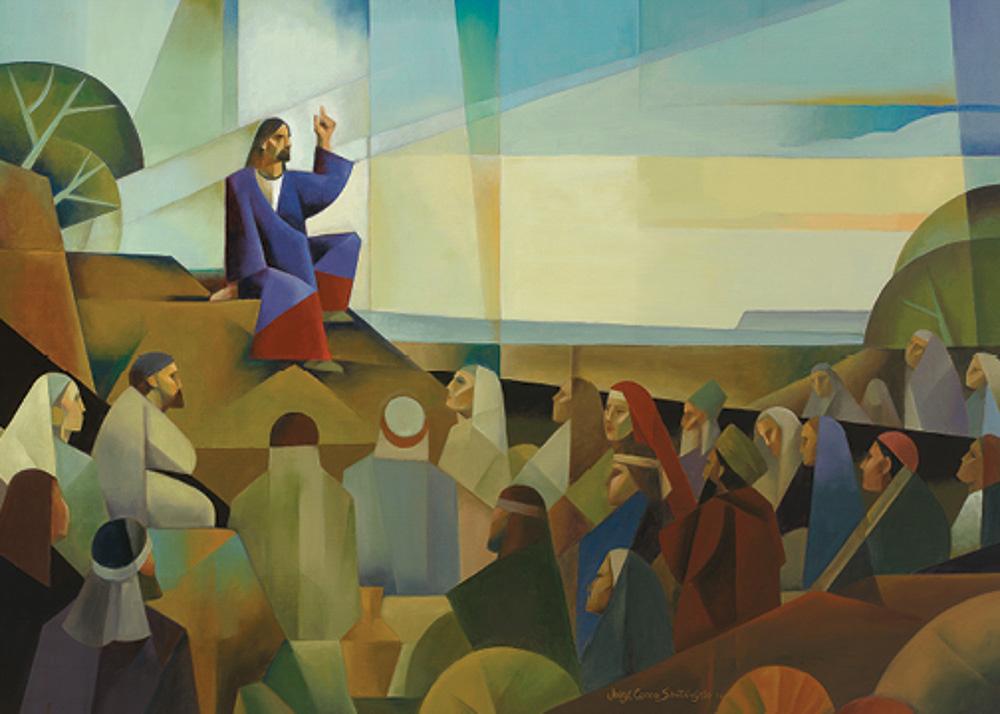
Sermon on the Mount by Argentine artist Jorge Cocco Santángelo

“You have heard that it was said, ‘You shall not commit adultery.’But I tell you that anyone who looks at a woman lustfully has already committed adultery with her in his heart. If your right eye causes you to stumble, gouge it out and throw it away. It is better for you to lose one part of your body than for your whole body to be thrown into hell. And if your right hand causes you to stumble, cut it off and throw it away. It is better for you to lose one part of your body than for your whole body to go into hell.

“It has been said, ‘Anyone who divorces his wife must give her a certificate of divorce. ’But I tell you that anyone who divorces his wife, except for sexual immorality, makes her the victim of adultery, and anyone who marries a divorced woman commits adultery.

“Again, you have heard that it was said to the people long ago, ‘Do not break your oath, but fulfill to the Lord the vows you have made.’ But I tell you, do not swear an oath at all: either by heaven, for it is God’s throne; or by the earth, for it is his footstool; or by Jerusalem, for it is the city of the Great King. And do not swear by your head, for you cannot make even one hair white or black. (New International Version)

Adultery. Divorce. Oaths. Jesus chose these topics from the Ten Commandments (7, 9, and 10) to uphold the ethical law of God.

In Christ’s Sermon on the Mount, Jesus gets to the heart of immorality and unethical behavior. The physical act of adultery arises from mental adultery. Divorce results from hardness of heart. Breaking oaths as a form of lying.

Adultery

Pornography is a 60 billion dollar a year industry, worldwide. It is the church’s problem, as well:

  • 53% of Christian men consume pornography.
  • 51% of pastors say porn is a temptation.
  • 69% of pastors started looking at porn out of curiosity.
  • 37% of pastors say it’s currently a struggle.
  • 35% of men have used pornography in the past month.
  • 4 in 10 of pastors looked at porn today.
  • There are 100,000 websites that offer illegal child pornography.
  • 90% of 8-16 year old’s have viewed porn online (most while doing homework).
  • 20% of men, and 13% of women, admit to viewing pornography at work.
  • 70 percent of all internet porn traffic occurs during the 9-to-5 workday.

Adultery initially occurs when someone feeds on mental sexual activity with another person. As with most of Christ’s solutions, he lays out a radical means of overcoming it.

Jesus is not condemning normal gender attraction, nor sex itself (which is a gift of God). Rather, Jesus condemns the leering upon another with sexual fantasy. All adulterous relationships and inappropriate sexual relations start with the “look.”

“Lust” is to intensely desire and burn for something, to seek mastery over another. The reason people stare, and lust, is not because of the other person’s manner or dress; it’s because they already have an adulterous heart. 

Whenever we are caught in physical or mental adultery, decisive and drastic action is needed. Jesus used hyperbole to drive his point home about the need of dealing with adultery. The approach is not applying a band aid; it is amputation.

The reason many men and women are snared by adultery, and seem unable to stop, is that they deal with it on their own. The radical action needed is accountability; confession must be offered.

Trying to manage lust on our own is like one individual attempting to contain a nuclear meltdown.

Jesus leaves no room to think it is okay to lust in the heart because I am not hurting anybody. Pornography enslaves its users and degrades women.

As powerful and addictive lust is, God’s grace is bigger and more powerful. There’s no need to be burdened with shame and guilt when the cross of Christ has already taken care of it.

There would not be a multi-billion dollar industry if there were not places in our hearts that are black. Now is the time for forgiveness, grace, and healing.
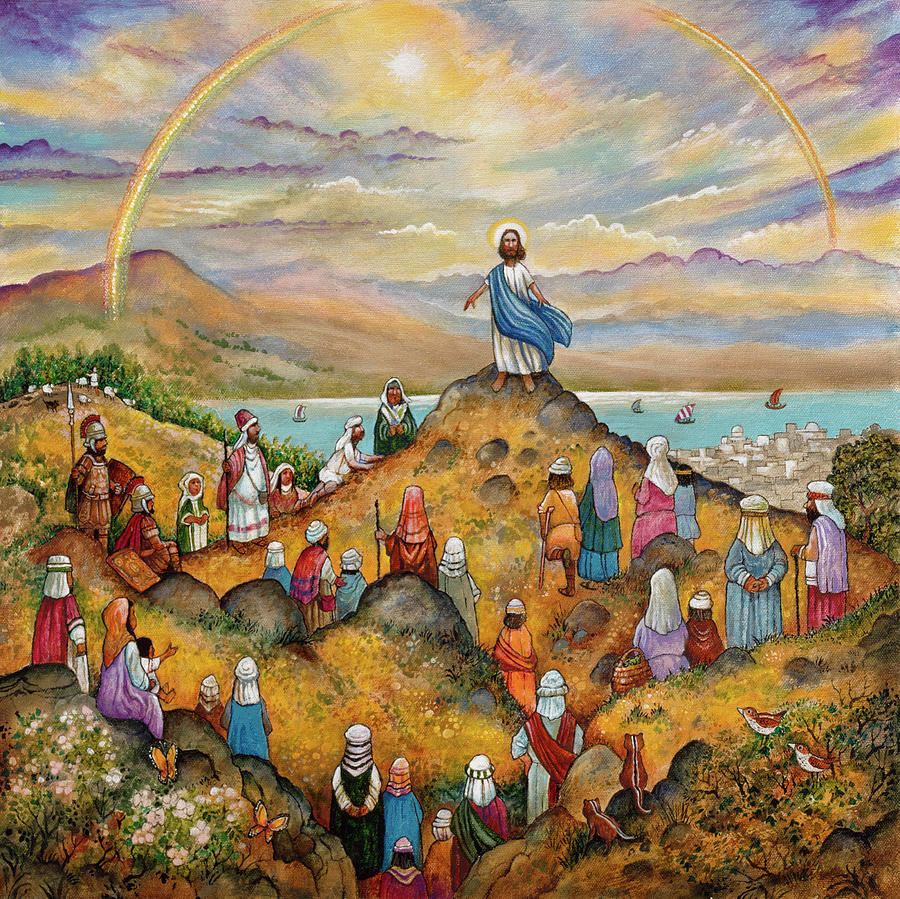
Sermon on the Mount by American artist Bill Bell

Divorce

Today in America more than one-third of all adults have experienced divorce.

Unfortunately, many divorced persons feel their faith community provided rejection rather than support and healing. There is a lot of room for improvement when to help families, and those having experienced divorce.

Please know Jesus condemns the cavalier divorce, and not all divorce. Anybody who doesn’t like their spouse doesn’t have ground for divorce. They entertain the thought of having a better spouse, even though there is no marital unfaithfulness. 

This is yet another form of mental adultery (and idolatry) which believes someone else can better meet my needs. 

Jesus clearly makes provision for divorce to occur in certain circumstances. Yet, he will not bend to liquidating a marriage over unhappiness with what God has joined together.

The intent of Old Testament legislation on divorce is to avoid a casual stance toward marriage (Deuteronomy 24:1-4). Over the centuries, people found creative ways of getting around the law. Although a divorce may be legal, it might not be ethical. Jesus wanted divorce practiced with concern for the woman, so that her rights and needs were considered.

Many took a loose view of divorce and focused solely on “indecency” as grounds for divorce. They did not interpret the term solely as sexual infidelity, as Jesus did, but had a broad understanding of indecency.

For example, if a husband did not like his wife, or, in the words of one rabbi, she continually burns the supper, he may “put her away” (divorce her). Jesus, however, insisted divorce must not happen because of a hard time getting along; or don’t love your spouse anymore; or that your spouse keeps irritating you. 

Being frustrated or unhappy are not biblical grounds for divorce. The answer to most marital problems does not lie in a new spouse, but in the hard work of identifying the idols of our hearts, overthrowing them, and re-connecting. Sin is crouching at the door, but you and I must master it.

Jesus said the ground for divorce is marital unfaithfulness, that is, any sexual activity outside the bounds of the marriage relationship. And, even in this case, divorce need not be an option, if the two people can reconcile.

Christ sought to defend women who are genuine victims. In biblical times, if a wife was given a certificate of divorce, she had four options: 1) Return to her family of origin; 2) Become a beggar; or 3) Become a prostitute to make ends meet; or, 4) Marry again, thus committing adultery if she was divorced because her husband didn’t like her. 

Jesus doesn’t take sides between spouses. Instead, he lifts the original intent of marriage: oneness. Divorce was never meant to be. Separating two people is damaging. However, it obviously occurs. (Matthew 19:1-12)

Divorce exists because of the heart’s hardness in one or both of the marriage partners. Divorce, really, is a legal testimony verifying that a separation has already occurred. It’s a recognition that disunity and non-oneness is already present. Legal divorce affirms that a terrible break already happened, damaging the people involved.

Just as God is one, two marital partners are to be one. Oneness is the primary goal of any marriage relationship. God did not institute marriage for people to live as roommates, but to be a new entity operating as one.

If God found it necessary to divorce his own covenant people, then it is inevitable divorce will occur among people (Jeremiah 3:1-8).  Therefore, let’s be discerning in how we handle each individual situation of marital difficulty.

Sermon on the Mount by Janice Elizabeth Steward

Oaths

“I swear on a stack of Bibles I won’t…” “I will, if I get around to it….” These are a few of the caveats we give when making a promise or oath. Oaths communicate our level or ability of getting it done, or not.

That’s fine. What isn’t fine is making excuses or false promises with no intention of doing what you say you will do. So, Jesus wants all the extraneous language out. Say “yes” or “no” and then follow through. And if you don’t, you’re a liar.

We often lie because we don’t want to do something to begin with. “Yes” and “no” are clear boundary words. Boundaries are needed so there is no oath-breaking.

Boundaries define where I end and someone else begins, leading me to a sense of ownership. Knowing what I am to take and not take responsibility for gives me freedom.

  • Boundaries keep the good in and the bad out. Setting boundaries involves taking responsibility for your choice of “yes” and “no” and living with the consequences.
  • Boundaries protect us from “gaslighting.” Gaslighting is a form of emotional abuse. The abuser manipulates another into doubting their thoughts, feelings, judgments, perceptions, and/or memories.
  • Boundaries hold people accountable for their words and actions. Without boundaries, we can easily feel used and mistreated.

Jesus wants us to clarify our values and live them out; make wise decisions; identify what we will accept and reject; and follow through on what we say we will do.

Conclusion

Adultery, divorce, and oaths are related. Boundaries – making and keeping promises – deals with outside forces trying to compromise our values. Accountability in naming our struggles mitigates covetousness.

Dissolved marriages and broken promises still happen. Yet, Jesus is there offering grace, not judgment. We may become emotionally damaged, however, there is healing available through the mercy of Christ. Amen.


Hosea 3:1-5 – Reconcile the Past

Then the Lord said to me, “Go and love your wife again, even though she commits adultery with another lover. This will illustrate that the Lord still loves Israel, even though the people have turned to other gods and love to worship them.”

So, I bought her back for fifteen pieces of silver and five bushels of barley and a measure of wine. Then I said to her, “You must live in my house for many days and stop your prostitution. During this time, you will not have sexual relations with anyone, not even with me.”

This shows that Israel will go a long time without a king or prince, and without sacrifices, sacred pillars, priests, or even idols! But afterward the people will return and devote themselves to the Lord their God and to David’s descendant, their king. In the last days, they will tremble in awe of the Lord and of his goodness. (New Living Translation)

Sometimes you have to get your behind in the past before you can put your past behind you.

The ancient nation of Israel was in a spiritual pickle. Gradually, over hundreds of years, they made small decisions of compromised religion which added up to a severe breach of faith with their historic God.

The relationship between God and God’s people, throughout the prophetic books of the Old Testament, is many times likened to a marriage of two spouses – God, the faithful spouse, and Israel, the unfaithful spouse who adulterated themselves by seeking the love of other gods.

This situation evoked feelings of sadness and anger within God. To help restore the broken marriage, the Lord used the prophet Hosea as an earthly illustration of the divine/human dilemma.

Just as Hosea graciously took a wife of dubious repute, so God mercifully took Israel. Just as Hosea’s wife, Gomer, slept with other men, so Israel went to bed with other gods. And just as Hosea remained faithful and actively sought to reconcile the past with his wife, so God tenaciously and dramatically honored the covenant relationship with Israel by showing steadfast love, despite her sordid past.

Israel needed to do her part by reconciling the past – returning to the Lord through acknowledging the truth of the situation and owning their responsibility to make things right.

Holy Scripture exhorts the believer to live according to truth. Whenever we fail to do so, we suffer spiritual loss. We are told to confess and reject unfaithful patterns of past behavior and not allow them to influence us today (Titus 2:12; 1 Peter 1:14, 18). 

Neglecting our responsibility inevitably causes emotional, mental and physical repercussions, as well as spiritual. In the New Testament, when the Apostle Paul said he was forgetting what is behind and straining toward what is ahead, he could say that because he had come to terms with and reconciled his own terrible unfaithful past with God. (Philippians 3:4-13)

It is both helpful and necessary to go back into one’s life and deal with the past on the basis of truth. In doing so, we honor our relationship with God. We must ask the Lord to turn the searchlight of truth on us and our past. 

Trust God to help you remember all the times in which you need to reconcile what has happened (or failed to happen). Make the choice before God to be as honest as you possibly can. 

The following are some suggestions from a former professor and mentor, the late Dr. Victor Matthews, (put in my own words) to carefully follow:

  1. Write out every time you were unfaithful or were hurt by another’s unfaithfulness (reject the temptation to just think and/or talk about it). Be complete, name the people involved, state what happened, do not try and protect yourself or other people and do not fantasize and let your thoughts run amok.
  2. Evaluate each past event on the basis of truth. If you were unfaithful, then confess it to God truthfully and receive forgiveness and cleansing (1 John 1:9). If you were hurt by someone, and it was their fault, then state out loud that “_______ should not have done that to me.” When you have finished writing out the event(s) deliberately stop and completely forgive the person(s) (Mark 11:25-26).  If you were at fault in some way, then confess that to God, as well.
  3. Resist the temptation to hurry with this process! Do not generalize by putting many events into one. Be specific and take the time necessary to get in touch with what God is trying to help you connect with.  This practice of reconciling the past is not introspection, so do not indulge in self-pity, self-criticism, or develop a martyr syndrome.
  4. Affirm that your inner critic, others, and any dark force may no longer use your past against you. “In the Name of the Lord Jesus Christ I take this event away from Satan and declare that he may not use it against me anymore!” (Ephesians 4:27; 5:11; 6:14).
  5. Receive the healing provided for those who believe and live according to God’s words and ways (Isaiah 53:5). “Now that I have made this right with you, O Lord, I receive the healing you have provided for me through the cross of Jesus Christ.” (Galatians 2:19-20)

When you have finished your work, then count it finished. When Jesus said, “It is finished!” he meant what he said. (John 19:30)

Reconciling the past means leaning into the finished work of Jesus for our complete healing. If and when we think of our unfaithful past, then firmly state: “I have dealt with that truthfully. It is settled, once and for all.” 

Whenever unfaithful, from this point forward, confess it, receive forgiveness, and make the affirmations of truth. In doing so, we are living by faith in the Son of God who loved us and gave himself for us. Amen.

1 Samuel 31:1-13 – Warning Signs from a Tragic Life

The Philistines made war on Israel. The men of Israel were in full retreat from the Philistines, falling left and right, wounded on Mount Gilboa. The Philistines caught up with Saul and his sons. They killed Jonathan, Abinadab, and Malki-Shua, Saul’s sons.

The battle was hot and heavy around Saul. The archers got his range and wounded him badly. Saul said to his weapon bearer, “Draw your sword and put me out of my misery, lest these pagan pigs come and make a game out of killing me.”

But his weapon bearer wouldn’t do it. He was terrified. So, Saul took the sword himself and fell on it. When the weapon bearer saw that Saul was dead, he too fell on his sword and died with him. So, Saul, his three sons, and his weapon bearer—the men closest to him—died together that day.

When the Israelites in the valley opposite and those on the other side of the Jordan saw that their army was in full retreat and that Saul and his sons were dead, they left their cities and ran for their lives. The Philistines moved in and occupied the sites.

The next day, when the Philistines came to rob the dead, they found Saul and his three sons dead on Mount Gilboa. They cut off Saul’s head and stripped off his armor. Then they spread the good news all through Philistine country in the shrines of their idols and among the people. They displayed his armor in the shrine of the Ashtoreth. They nailed his corpse to the wall at Beth Shan.

The people of Jabesh Gilead heard what the Philistines had done to Saul. Their valiant men sprang into action. They traveled all night, took the corpses of Saul and his three sons from the wall at Beth Shan, and carried them back to Jabesh and burned off the flesh. They then buried the bones under the tamarisk tree in Jabesh and fasted in mourning for seven days. (The Message)

Life is a process. Rarely does anything happen instantly. Human growth, maturation, life, and death unfold over years. So, a major life issue is attending to what process are we given to – a process which allows for human thriving – or a process that causes a failure to thrive.

King Saul sadly gave himself to a downward spiral of jealousy, paranoia, and poor decisions. His end was tragic. Yet perhaps we might learn some lessons in the form of warnings. Let’s consider the life of Saul as a cautionary tale, heeding us to avoid his foibles and pitfalls.

Unfortunately, Saul made deliberate choices in his life which led to his ignominious death. In fact, Scripture makes it plain that Saul died because of unfaithfulness:

Saul died because he was unfaithful to the Lord; he did not keep the word of the Lord and even consulted a medium for guidance and did not inquire of the Lord. So, the Lord put him to death and turned the kingdom over to David son of Jesse. (1 Chronicles 10:13-14, NIV)

Premeditated, deliberate, conscious wrongdoing can only expect a predictable process of moral failure and divine judgment. Consider some observations from Saul’s life so that we will be kept from going down his path of destruction:

  • Saul made decisions which solely benefited himself, and not the entire community. He deliberately disobeyed orders from the prophet Samuel and tried to justify his behavior with a godly veneer (1 Samuel 13:1-14; 15:1-26). Later, King David engaged in some deliberate acts of sin and disobedience. Yet, David did not share Saul’s outcome because he humbled himself before God, admitted his guilt, and turned away from disobedience (2 Samuel 12:1-13). There always remains the opportunity to turn to God, as long as we are alive.
  • Saul never owned his bad decisions, and it led to his paranoia and warped thinking. Saul kept believing he was okay – and that everyone else was wrong or against him. If we ever get to the point of living with our sin as if it’s acceptable, then we need a prophet to come along and show us the error of our ways and beliefs. Saul had a prophet in his life: Samuel, who was one of the best. Yet, Saul often altered Samuel’s advice or dispensed with it altogether.
  • Saul’s wrongdoing did not always lead to immediate negative consequences. That is the typical nature of sin. It bites, but the pain isn’t felt until later. Saul was rejected by God as king. In reality, this rejection did not occur until Saul’s death. Whenever Saul made poor decisions, he felt gratification in the immediate moment. Later, however, he was tormented by an evil spirit (1 Samuel 16:14). Conversely, the righteous person understands the principle of delayed gratification.
  • It wasn’t just Saul who suffered because of his own jealousy and paranoia. Other people suffered, as well. David clearly suffered emotional and spiritual duress because of Saul’s jealousy. The priests and the people of Nob were mercilessly murdered because of Saul’s paranoia (1 Samuel 22:6-19). We must be quite careful to avoid being shortsighted about our decisions. Just because we might neither anticipate nor see any negative consequences to others doesn’t mean there aren’t any. Sin destroys, period, whether we know it, or not.
  • Saul’s identity and worth as a person was dependent on his title and position as king. So, when that position was threatened, Saul thought his very personhood was in grave danger. The truth is that our worth as humans is not tied to whether we have a lofty position, or a particular pedigree. Our dignity as people is forever tethered to bearing the divine image.

A healthy life process of decision-making which includes consulting wise voices and collaborating with people of integrity will surely result in good things, not bad. So, let us walk in the narrow path of wisdom, while continually forsaking the broad road that leads to destruction.

Gracious God, our sins are too heavy to carry, too real to hide, and too deep to undo. Forgive what our lips tremble to name, what our hearts can no longer bear, and what has become for us a consuming fire of judgment. Set us free from a past that we cannot change; open to us a future in which we can be changed; and grant us grace to grow more and more in your likeness and image, through Jesus Christ, the light of the world. Amen.

*Above: woodcut of King Saul’s death by George Wigland, 1860

Jeremiah 26:1-9, 12-15 – How to Use Our Voice

The Prophet Jeremiah by Marc Chagall (1887-1985)

Early in the reign of Jehoiakim son of Josiah king of Judah, this word came from the Lord: “This is what the Lord says: Stand in the courtyard of the Lord’s house and speak to all the people of the towns of Judah who come to worship in the house of the Lord. Tell them everything I command you; do not omit a word. Perhaps they will listen, and each will turn from their evil ways. Then I will relent and not inflict on them the disaster I was planning because of the evil they have done. Say to them, ‘This is what the Lord says: If you do not listen to me and follow my law, which I have set before you, and if you do not listen to the words of my servants the prophets, whom I have sent to you again and again (though you have not listened), then I will make this house like Shiloh and this city a curse among all the nations of the earth.’”

The priests, the prophets and all the people heard Jeremiah speak these words in the house of the Lord. But as soon as Jeremiah finished telling all the people everything the Lord had commanded him to say, the priests, the prophets and all the people seized him and said, “You must die! Why do you prophesy in the Lord’s name that this house will be like Shiloh and this city will be desolate and deserted?” And all the people crowded around Jeremiah in the house of the Lord….

Then Jeremiah said to all the officials and all the people: “The Lord sent me to prophesy against this house and this city all the things you have heard. Now reform your ways and your actions and obey the Lord your God. Then the Lord will relent and not bring the disaster he has pronounced against you. As for me, I am in your hands; do with me whatever you think is good and right. Be assured, however, that if you put me to death, you will bring the guilt of innocent blood on yourselves and on this city and on those who live in it, for in truth the Lord has sent me to you to speak all these words in your hearing.” (NIV)

Although much attention is given to Christmas Day, the Christian season of Christmas spans twelve days from December 25 through January 5. Celebrating Christmas as a season helps us immerse ourselves in Christ’s incarnation more fully than merely celebrating for one day.

Perhaps today’s Old Testament lesson is a curious choice for a Christmas season Scripture text. Yet, although we hold in one hand the joy and celebration of Christ’s birth, in the other hand we hold the deep sadness of recognizing that not everyone was or is excited about Jesus. For Christ is both the cornerstone of faith and the stone which causes people to stumble and fall. (1 Peter 2:8)

The fact of the matter is that God is not okay with cruel injustice, hollow worship, and an inattention to both the divine and human. Jesus came to make things right. But not everyone wants that. Systemic evil persists because there are always people who benefit from how power and resources are structured – and they care little about how it impacts those on the underbelly of their control.

Therefore, just as important it is to recognize the inbreaking of God into this world and celebrate the incarnation of Christ, it is equally necessary to acknowledge that the world is broken and that we must speak truth to power. This is no easy task because rarely are things simply black and white, all good or all bad.

Jeremiah by Marc Chagall, 1956

In Jeremiah’s day, it was not that his opponents were pure evil with no acknowledgment of God. Rather, the problem was that the power brokers in Judah tried to keep a strict separation of religion from everything else. In other words, they were perfectly fine with God, that is, if the Lord would stay in the temple where he belonged. But Jeremiah would have none of it. Keeping Yahweh out of matters of social justice, geopolitics, and institutional governance led to great humanitarian problems. Jeremiah became God’s voice to a generation of people who ignored the divine in everything but religious ritual.

Bifurcating worship and work disconnect daily life from divine resources. Without God infused in all of life, a lack of grace fills the empty places. What is more, the sovereign Lord of all can neither be silenced nor dismissed; God will find a way to accomplish peace and justice for the common good of everyone, and not just the few.

The heart of Jeremiah’s message was for king and people to be obedient in all of life, to recenter themselves around God’s law – not just the religious bits but the social ones, as well. Jeremiah did not proclaim something new. He was just calling the powers that be to Torah observance.

The true needs and interests of our communities can never be addressed and lifted-up in the narrow self-serving interests of persons in power who turn a blind eye to anyone unlike them. The needs and interests of our world lie in becoming who we were designed from the beginning to be: A people belonging to God, tapping into the deep reservoir of spirituality inside us.

For the Christian, we are to acknowledge the baby born as a king and follow in the way of grace and truth. There is to be no division between sacred and secular because Jesus is Lord of all. We are to continually use our voice for both praise and prophecy, for shouting celebration to God and speaking truth to power.

Holy God, Sovereign of all, we give you praise for sending your Son, our Savior, Jesus as a baby, a human just like us. Keep us grounded in humility, sensitive to sin, attentive to that which is just and right, merciful in all things, pure in worship, and peace-loving through Christ our Lord in the strength of your Spirit. Amen.