
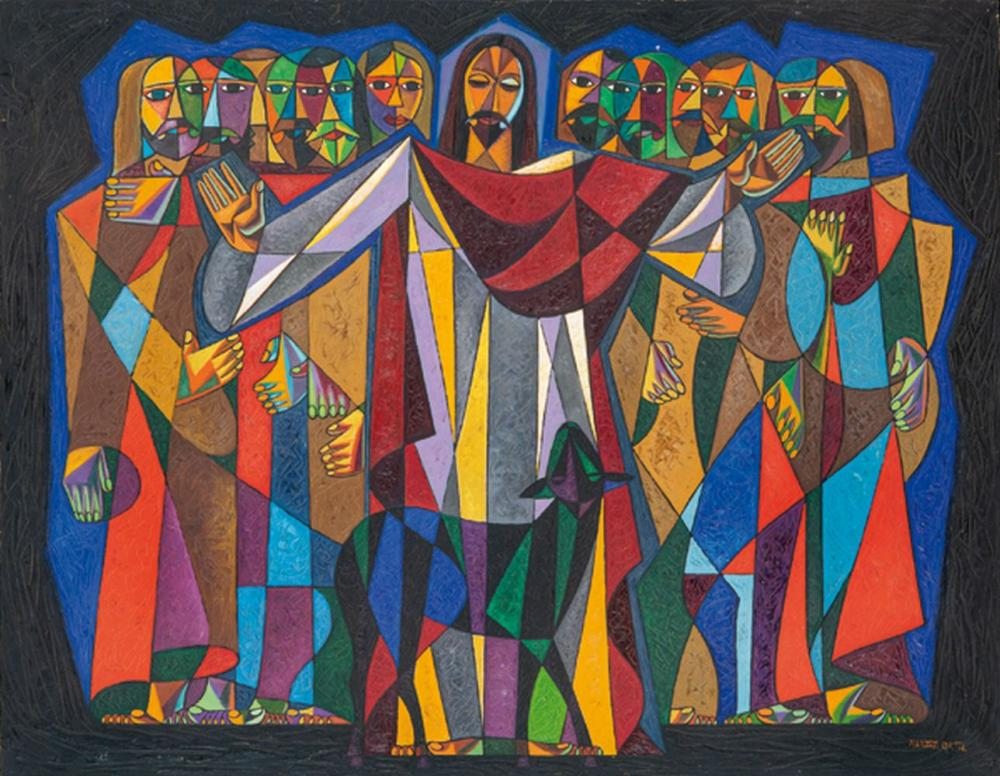
The Source of True Godliness (1 Timothy 3:14-16)

Jesus Christ and the Apostles, by Nicolás Martínez Ortiz (1907-1990)

Although I hope to come to you soon, I am writing you these instructions so that, if I am delayed, you will know how people ought to conduct themselves in God’s household, which is the church of the living God, the pillar and foundation of the truth. Beyond all question, the mystery from which true godliness springs is great:

He appeared in the flesh,
    was vindicated by the Spirit,
was seen by angels,
    was preached among the nations,
was believed on in the world,
    was taken up in glory. (New International Version)

Godliness is an important thing for those who seek to follow God.

So, the Apostle Paul wrote to his young protégé, Timothy, who was leading the church in Ephesus. Paul gave Timothy some sound practical instructions regarding how things ought to be conducted between pastor and people. Paul did this because he wasn’t quite sure how long it would be before he could show up in person, and he wanted to ensure that the ministry would go forward in a way that honored Christ.

Christian ministry is important because it doesn’t simply have to do with one’s private abilities and affairs. Rather, Christian leaders and pastors are entrusted with the household of God, the church. Believers are a holy sanctuary of the soul, the place where God dwells by means of the Spirit.

The Church is not a brick and mortar building, but the place of the living God, the pillar and foundation of the truth. Pastor and parishioners alike are to support the truth of the gospel, that is, the good news about the person and work of Jesus Christ.

Both believers and bishops who make up the Church support gospel truth by doing the following:

  1. Hear and heed the truth. “Whoever has ears to hear, let them hear… This is the meaning of the parable: The seed is the word of God. Those along the path are the ones who hear, and then the devil comes and takes away the word from their hearts, so that they may not believe and be saved. Those on the rocky ground are the ones who receive the word with joy when they hear it, but they have no root. They believe for a while, but in the time of testing they fall away. The seed that fell among thorns stands for those who hear, but as they go on their way they are choked by life’s worries, riches and pleasures, and they do not mature. But the seed on good soil stands for those with a noble and good heart, who hear the word, retain it, and by persevering produce a crop.” (Luke 8:8, 11-15, NIV)
  2. Handle the truth rightly. Make an effort to present yourself to God as a tried-and-true worker, who doesn’t need to be ashamed but is one who interprets the message of truth correctly. (2 Timothy 2:15, CEB)
  3. Hide the truth in your heart. I have hidden your word in my heart that I might not sin against you. (Psalm 119:11, NIV)
  4. Hold the truth as the Word of Life. Hold firmly to the word of life; then, on the day of Christ’s return, I will be proud that I did not run the race in vain and that my work was not useless. (Philippians 2:16, NLT)
  5. Ingest and digest the truth. Study, meditate, and devote yourself to God’s Word. Your words were found, and I ate them, and Your word was to me the joy and rejoicing of my heart. (Jeremiah 15:16, NKJV) You must not depend on bread alone to sustain you, but on everything that the Lord says. (Deuteronomy 8:3, GNT)
  6. Interest yourself in the truth, and defend it. “I have been put here for the defense of the gospel.” (Philippians 1:16, NRSV) I must write and ask you to defend the faith that God has once for all given to his people. (Jude 1:3, CEV)
  7. Impart the truth and disseminate it to others. The unfolding of your words gives light; it imparts understanding to the simple. (Psalm 119:130, NRSV) Teach these new disciples to obey all the commands I have given you. (Matthew 28:20, NLT)
  8. Indicate and demonstrate the power of the truth in the way you live your life. Let the message about Christ completely fill your lives, while you use all your wisdom to teach and instruct each other. With thankful hearts, sing psalms, hymns, and spiritual songs to God. Whatever you say or do should be done in the name of the Lord Jesus, as you give thanks to God the Father because of him. (Colossians 3:16-17, CEV)

The Church is a big deal because the head of the Church, Jesus Christ, is a big deal.

In many quarters of the world, the Church no longer has much influence or impact. For some, the Church is nothing more than an outdated antiquarian club that’s irrelevant to us today. For others, the Church is an abusive institution that looks to extend selfish power over others. And for many, the Church is simply not something they want to be a part of, having neither strong opinions one way nor the other.

Yet, the Apostle Paul, in his letters to all the churches, presents the Church as united to Christ and an extension of his person and work on this earth. Now, that’s a big deal!

Therefore, the Church is meant to confess Christ in its daily witness in all it says and does. In other words, the Church is to embody the words and ways of Jesus, and even Christ himself, by means of God’s Holy Spirit.

Everything about the Christian is to exude the very life of Christ.

How we can possess such a vital union and connection with Jesus is a mystery. Rather than trying to understand it, we embrace it and live it with all the energy the Spirit of God grants us.

We do, however, seek to know Jesus Christ ever more, every day. The more we know Christ, the better we will be able to know the height and depth of love, and to extend that love in all the places of this fallen planet that lack it. This is where true godliness and goodness spring from.

The Church everywhere and for all time confesses and proclaims that Jesus Christ descended to this earth, was visibly seen in a human body by both people and angels, proved right by the invisible Spirit, proclaimed among all kinds of peoples, believed in all over the world, and ascended into heavenly glory.

After two thousand years of church history, Christians are still unpacking the incredible richness and mystery of what all that means for us and for our salvation. And it is a spiritual journey worth taking for the rest of our lives.

May I walk this day, O Christ, in the realm of grace, walking with you, my feet firmly on your earth-path, my heart loving all as kindred, my words and deeds alive with justice. Amen.

The Seven Deadly Sins (Proverbs 12:10-21)

A 14th century personification of the Seven Deadly Sins, by Unknown artist

The righteous care for the needs of their animals,
    but the kindest acts of the wicked are cruel.

Those who work their land will have abundant food,
    but those who chase fantasies have no sense.

The wicked desire the stronghold of evildoers,
    but the root of the righteous endures.

Evildoers are trapped by their sinful talk,
    and so the innocent escape trouble.

From the fruit of their lips people are filled with good things,
    and the work of their hands brings them reward.

The way of fools seems right to them,
    but the wise listen to advice.

Fools show their annoyance at once,
    but the prudent overlook an insult.

An honest witness tells the truth,
    but a false witness tells lies.

The words of the reckless pierce like swords,
    but the tongue of the wise brings healing.

Truthful lips endure forever,
    but a lying tongue lasts only a moment.

Deceit is in the hearts of those who plot evil,
    but those who promote peace have joy.

No harm overtakes the righteous,
    but the wicked have their fill of trouble. (New International Version)

Many of the biblical proverbs are set as contrasts between the way of righteousness and the way of wickedness.

Being aware of both vice and virtue in our personal lives, the workplace, neighborhood, family, and faith communities can create an environment of trust, love, fellowship, and enjoyment. Intentionally pursuing the good, while identifying and forsaking the bad, contributes to a thriving community who intentionally cultivates righteousness.

It’s likely that you have heard of “the seven deadly sins.” In medieval Christianity, these were vices to avoid at all costs, because they eroded personal integrity and poisoned the social community. A “vice” is a bad habit which corrupts character and debases society.

The early church eventually formed a short list of the most corrosive vices, the seven deadly sins, which were considered the most heinous desires/actions of all. We find them in our proverbs for today.

The wicked covet the proceeds of wickedness. Desiring evil is a trap for them. They chase after sinister fantasies.

Lust is an intense desire, coupled with a lack of mental self-control, which is manifested in pursuing that desire in the heart. It is to have a passion for someone (or something) that is neither yours, nor meant for you. Lust leers at and indulges in selfish daydreams, without any concern for another person.

Do not desire to possess anything that belongs to another person—not a house, a wife, a husband, a slave, an ox, a donkey, or anything else. (Exodus 20:17, CEV)

The wicked have their fill of trouble. They’ve gobbled up evil as if dining at an all-you-can-eat buffet.

Whereas lust and covetousness is mostly a lack of mental self-control, gluttony is the lack of bodily self-control.

So, whether you eat or drink or whatever you do, you should do it all for God’s glory. (1 Corinthians 10:31, CEB)

Gluttony doesn’t stop eating, buying, talking, drinking, or binging. It only excessively indulges to the point of physical and/or relational sickness. Addictions and workaholism are some modern-day forms of gluttony – it consumes to the point where it cannot control the consumption any more. The thing desired and indulged becomes the master.

Observe the Sabbath and keep it holy. You have six days in which to do your work, but the seventh day is a day of rest dedicated to me. On that day no one is to work—neither you, your children, your slaves, your animals, nor the foreigners who live in your country. (Exodus 20:8-10, GNT)

The tools of greed are deceit and lies; the greedy person goes to just about any lengths to obtain more wealth. They will misrepresent another and spread gossip and slander to get what they want.

Do not tell lies about others.

The Ninth Commandment (Exodus 20:16, CEV)

Money. More money – is the mantra of the greedy person. It is to have an inordinate desire and pursuit of wealth. Just as sex and food are good, but have their proper boundaries, so money is both good and necessary. 

But money is powerful in more ways than one. It can take over a person’s life in such a way that charging exorbitant interest, rent, or price gouging is justified by satisfying the greed. The greedy person lives every waking moment for leveraging wealth to get more wealth.

People who want to be rich fall into all sorts of temptations and traps. They are caught by foolish and harmful desires that drag them down and destroy them. The love of money causes all kinds of trouble. Some people want money so much that they have given up their faith and caused themselves a lot of pain. (1 Timothy 6:9-10, CEV)

The sloth much prefers get-rich-quick schemes to actual hard work. They spend their time in worthless projects, and are easily annoyed at others.

Sloth is more than laziness. It is also failing to do good when it is in your power and ability to do so. To be slothful is to be indifferent to the great need of the world. 

Whereas the previous sins have a more active pursuit of some desire, the sloth is passive, not wanting to get involved in making a difference. The slothful person always has an excuse why they can’t participate; they expect everyone else to do the work. 

Do your work willingly, as though you were serving the Lord himself, and not just your earthly master.

Colossians 3:23, CEV

The irony is that for all of Ebenezer Scrooge’s hard work and thrift, he was really a sloth who had no intention of improving the condition of humanity; he depended on poor houses and work farms to do all the work. It took supernatural means to get him to think differently. It typically takes a lot for the sloth to go out of their way to honor, respect, and bless another.

You must honor and respect your father and your mother. Do this so that you will have a full life in the land that the Lord your God gives you. (Exodus 20:12, ERV)

A wicked person is often an angry person – so full of anger that they abuse their pets and animals who have done nothing against them. And they let their tongues wag and fly off the handle anytime they are perturbed.

Stop being angry!  Turn from your rage!  Do not lose your temper— it only leads to harm. (Psalm 37:8, NLT)

That doesn’t mean that anger itself is a bad thing. As with most things in life, anger has its proper place. For example, we ought to be angry in the face of evil perpetrators. Anger motivates us to not be slothful, but helpful. 

But excessive selfish anger is a vice. Whereas righteous anger seeks to help a victimized person or group, sinful anger is fueled by hatred. Whether it’s a violent verbal decapitation of another, or a deep seated bitterness, such anger destroys relationships – and even life itself.

No murder.

The Sixth Commandment (Exodus 20:13, MSG)

Envy and lust are kissing cousins. They both traffic in excessive desire for what they don’t possess. 

Envy rots the bones.

Proverbs 14:30, NIV

The subtle difference has more to do with the object of the affection. Lust leers at, longs for, a person who belongs to someone else. Envy fixes its gaze on a material possession or a respected position which someone else has. It is to have a passionate pursuit of taking over someone else’s job or keeping up with Jones’s.

For where there is envy and selfish ambition, there will also be disorder and wickedness of every kind. (James 3:16, NRSV)

The wicked and the proud share a table together for lunch every day. They don’t listen to anybody else, because they believe they already have the answers and know what is best.

Pride is an over-inflated view of one’s opinions, thoughts, and self. Proud persons have an overestimation of themselves. They seem to actually believe that if only others followed their thinking and advice, the world would be a better place.  

Every antagonist in the movies, comics, and classic literature are full of themselves. They justify stepping on others to achieve what they think is the greater good of imposing their agenda in the situation. It’s no wonder that in the Bible, Satan is the ultimate antagonist.

The proud must eventually contend with God. And the Lord has no allowance for the foolishness and idolatry of any human believing they know better.

“No other gods, only me.”

First Commandment (Exodus 20:3, MSG)

Consider the following questions:

How will you respond to the seven deadly sins?

In what ways and/or behaviors do you see these vices being manifested in both the church and the world?

What can the book of Proverbs bring to such a discussion?

Have Some Spiritual Discernment (Deuteronomy 13:1-5)

Prophet, by Théophile Alexandre Steinlen, 1902

Prophets or interpreters of dreams may promise a miracle or a wonder, in order to lead you to worship and serve gods that you have not worshiped before. Even if what they promise comes true, do not pay any attention to them. The Lord your God is using them to test you, to see if you love the Lord with all your heart. Follow the Lord and honor him; obey him and keep his commands; worship him and be faithful to him. 

But put to death any interpreters of dreams or prophets that tell you to rebel against the Lord, who rescued you from Egypt, where you were slaves. Such people are evil and are trying to lead you away from the life that the Lord has commanded you to live. They must be put to death, in order to rid yourselves of this evil. (Good News Translation)

It’s a foolish notion that a servant of God can have a moonlighting gig with another god. A shortsighted philosophy believes that worshiping God on the Sabbath allows one to then do whatever they want on the other six days. And a downright deadly act is to become enamored with a miracle and then follow the miracle worker who did it, even though they want nothing to do with devotion to the Lord.

It only takes one bad apple to spoil the whole bushel basket of them. Just one rotten egg in a six egg omelet will ruin the entire thing. And one bad prophet amongst the people will end up destroying the congregation. Evil isn’t something to dabble with; instead, wickedness is something to rid yourself of altogether.

“If your right eye causes you to stumble, gouge it out and throw it away. It is better for you to lose one part of your body than for your whole body to be thrown into hell. And if your right hand causes you to stumble, cut it off and throw it away. It is better for you to lose one part of your body than for your whole body to go into hell.” Jesus (Matthew 5:29-30, NIV)

Jesus declared that believers must take decisive, drastic, and radical action against idolatry. Serving other gods, along with the one true God, requires an amputation. The biblical text of both Testaments leaves us no room to believe that it’s okay to dabble in things that the Lord condemns. And if we think we are not hurting anybody to hold onto such a thought, we very much need to think again.

True prophets and preachers don’t lead people into idolatry, no matter how spectacular their omens, wonders, or miraculous signs. False prophets and preachers exist only to test the sincerity of a believer’s love for the Lord. Israel was to take decisive and radical measures to rid themselves of false gods. Failing to do so would certainly lead to idolatry.

These are the regulations and the case laws that you must carefully keep in the fertile land the Lord, your ancestors’ God, has given to you to possess for as long as you live on that land:

You must completely destroy every place where the nations that you are displacing worshipped their gods—whether on high mountains or hills or under leafy green trees. Rip down their altars and shatter their sacred stones. Burn their sacred poles with fire. Hack their gods’ idols into pieces. Wipe out their names from that place.

Don’t act like they did toward the Lord your God! (Deuteronomy 12:1-4, CEB)

Believers of every era need to learn that the occurrence of supernatural manifestations, and/or wild success in ministry, does not automatically authenticate the prophet or preacher.

Theology always takes precedence over miraculous signs and wonders. A growing church doesn’t necessarily mean that God’s favor rests upon it, anymore than a declining church signals God’s displeasure. This is why we are to never add to or take away from God’s Word to people. (Deuteronomy 12:32)

“It is the nature of false prophets to create a conscience where there is none, and to cause conscience to disappear where it does exist.”

Martin Luther

If Christians are ever invited to disobey and rebel against the words and ways of Jesus, they are to refuse the offer. This, of course, requires actually knowing God’s Word and handling the worship of God and the interpretation of God’s Word with great care, humility, and wisdom.

There are many times that false preachers are quite sincere, believing that they are proclaimers of truth, when they are really leading others astray. We are always to be students of Holy Scripture, consistently discerning the difference between truth and error, right and wrong. Let us be careful to avoid the situation of the believers in the New Testament book of Hebrews:

In fact, though by this time you ought to be teachers, you need someone to teach you the elementary truths of God’s word all over again. You need milk, not solid food! Anyone who lives on milk, being still an infant, is not acquainted with the teaching about righteousness. But solid food is for the mature, who by constant use have trained themselves to distinguish good from evil. (Hebrews 5:12-14, NIV)

Let’s be people who take the time and effort to grow in the grace and knowledge of the Lord Jesus; and be patient and humble enough to learn over time what truly pleases the Lord.

Blessed God, give your servant a discerning heart to govern, lead, and teach your people, so that we may all be able to distinguish between right and wrong, doing your divine will and obeying your divine commands, to the glory of Jesus Christ, in the power of the Holy Spirit. Amen.

The Truth about Lying (Acts 5:1-11)

Now a man named Ananias, together with his wife Sapphira, also sold a piece of property. With his wife’s full knowledge he kept back part of the money for himself, but brought the rest and put it at the apostles’ feet.

Then Peter said, “Ananias, how is it that Satan has so filled your heart that you have lied to the Holy Spirit and have kept for yourself some of the money you received for the land? Didn’t it belong to you before it was sold? And after it was sold, wasn’t the money at your disposal? What made you think of doing such a thing? You have not lied just to human beings but to God.”

When Ananias heard this, he fell down and died. And great fear seized all who heard what had happened. Then some young men came forward, wrapped up his body, and carried him out and buried him.

About three hours later his wife came in, not knowing what had happened. Peter asked her, “Tell me, is this the price you and Ananias got for the land?”

“Yes,” she said, “that is the price.”

Peter said to her, “How could you conspire to test the Spirit of the Lord? Listen! The feet of the men who buried your husband are at the door, and they will carry you out also.”

At that moment she fell down at his feet and died. Then the young men came in and, finding her dead, carried her out and buried her beside her husband. Great fear seized the whole church and all who heard about these events. (New International Version)

We all know what a deceitful liar is because, well, we have all lied and practiced deceit in our lives. How ubiquitous is lying? According to one Harris poll:

  • The average person tells at least 2 lies every day. (That’s the equivalent of 730 lies per year)
  • 60% of people lie at least once in a 10-minute conversation.
  • 40% of people deceive prospective employers by lying on their resumes.
  • 90% of peoplelie on their online dating profiles.
  • 80% of spouses lieto their partner about their spending habits.
  • 50% of teenagers lieto their parents about their whereabouts.

And those are just lies that have been admitted. So, how many more lies and deceptions are there really out there?…

We also all know why we lie. You will likely find yourself in these top five reasons for lying:

  1. Fear of punishment
  2. Protection from harm
  3. Avoidance of shame or embarrassment
  4. To gain advantage and/or power over others
  5. Out of habit and/or compulsion

However, maybe you aren’t in touch with how lying really impacts you, how powerful deceitfulness truly is on your own psyche and personhood. Lying has major consequences for us including:

  • Loss of trust and damage to relationships
  • Loss of physical health and damage to mental health
  • Loss of job and damage to reputation
  • Loss of resources and experience of damages in lawsuits

In the instance of two people, Ananias and Sapphira, it meant loss of life and damage to the fellowship of new believers in the fledgling church.

The couple’s guilt, in front of the Apostle Peter and the entire church, is that they were counterfeit community members. Ananias and Sapphira were not what they seemed to others. They were not truthful because they were not vulnerable.

By lying in order to achieve an honor and a status they had not earned, Ananias and Sapphira not only dishonored and shamed themselves as patrons; they also unwittingly exposed themselves as outsiders who were pretending to be honest believers. In short, the two of them were imposters.

Their deceit demonstrates that they were still functioning within the existing Roman patronage system. Yet, true followers of Christ in the believing community, purposefully practiced a different system. The Christians had an interpersonal relation of giving and receiving love – which worked out itself in sharing all things in common with one another, without the class distinctions of the patronage system.

The cross of Christ abolished walls of separation and established a truly egalitarian society. To feign equality, but actually still live about in the inequitable world, is tantamount to rejecting the work of Christ’s cross.

The deception of Ananias and Sapphira was an attempt to appear just like Barnabas – who was the real deal, and the consummate steward of resources. Barnabas was an encourager, always thinking of others and the needs of the community (Acts 4:36-37).

Ananias and Sapphira wanted to look generous, but their motives were really to give in order to maintain their class status, and not for the sake of love. What’s more, their lie about it and their lack of honesty and vulnerability was clearly seen by Peter and interpreted by him as nothing less than lying to the Holy Spirit of God.

One of the purposes of the Holy Spirit is to form God’s people into a community that uses resources in accordance with a deep concern for others. It’s not surprising, then, that Ananias and Sapphira’s fakery of generosity is presented as falsifying the work of the Spirit. Their deception was an outright threat to Christian spiritual identity and community.

Like Ananias and Sapphira of old, our contemporary lying is typically to misrepresent who we are and how we are really doing and feeling.

The most common lie of people in the United States is saying “I’m fine” when they are really and truly not okay. Anxiety, depression, and the appearance of negativity is a source of guilt and shame for many Americans – so they lie about how they’re really doing.

It’s better to fake it, they believe, because no one actually cares how I’m doing. There is still very much a cultural stigma around people who admit not feeling well or not being okay. And that, my friends, very much needs to change.

It’s always good to begin with being honest with small things and avoiding white lies. Instead of lying, practice gratitude. Being thankful for all the small things in life is a truthful replacement to a lie. I wonder what Anania and Sapphira would have been like with that sort of healthy spiritual practice. But alas, we can only imagine.

In the case of you and I, we need not have to wonder. We can begin today by observing the good, the beautiful, and the truthful, and express gratitude for all the little ways for the good which is seen.

Grant me today, O God, some new vision of your truth. Inspire me with the spirit of joy and gladness. Make me the cup of strength to suffering souls; in the name of the strong Deliverer, our Lord and Savior, Jesus Christ. Amen.