When to Stay, When to Move (Numbers 9:15-23)

Pillar of Fire, Pillar of Cloud in the Desert, stained glass at the Congregation Beth Emeth, Herndon, Virginia

On the day the Tent of the Lord’s presence was set up, a cloud came and covered it. At night the cloud looked like fire. Whenever the cloud lifted, the people of Israel broke camp, and they set up camp again in the place where the cloud came down. The people broke camp at the command of the Lord, and at his command they set up camp.

As long as the cloud stayed over the Tent, they stayed in the same camp. When the cloud stayed over the Tent for a long time, they obeyed the Lord and did not move on. Sometimes the cloud remained over the Tent for only a few days; in any case, they remained in camp or moved, according to the command of the Lord. Sometimes the cloud remained only from evening until morning, and they moved on as soon as the cloud lifted.

Whenever the cloud lifted, they moved on. Whether it was two days, a month, a year, or longer, as long as the cloud remained over the Tent, they did not move on; but when it lifted, they moved. They set up camp and broke camp in obedience to the commands which the Lord gave through Moses. (Good News Translation)

I know a few believers who would really like to have their spiritual lives governed by a cloud lifting and moving and settling. Then, there wouldn’t be any doubt about what to do and when to do it.

But keep in mind that this arrangement of a cloud was temporary; it was only meant to get the Israelites from one place to another until they entered the Promised Land. Anytime we try and make something permanent which is designed to be temporary, we become stuck, not to mention missing out on the good things intended for us.

Clouds of Glory, by Yoram Raanan, 2014

In a time of transition for the nation of Israel, the gracious presence of God provided both guidance and assurance. The Lord was with them; and the divine presence reminded the people that God’s promise would be fulfilled.

The book of Numbers begins at the point where the book of Exodus leaves off. Leviticus is in between, interrupting the narrative flow with detailed legislation, especially of the sacrificial worship system. Exodus ends with the construction of the tabernacle (the sacred tent with the ark of the covenant and worship utensils).

Numbers then begins a year after Israel came out of Egypt. It covers the years of wandering in the desert wilderness in which an entire generation dies off and their children are poised to enter the Promised Land. The bulk of the book is given to the beginning and ending of the 40 years of wandering.

The Sinai Peninsula, where the Israelites walked, is a rather harsh environment. This is on purpose; it’s part of the nation’s spiritual development. The desert is the place where failures are acknowledged and purged. It’s a unique place and time which required a special system to safeguard the people. They needed to be guided toward holiness so that they could be a holy nation, set apart for God.

In many ways, Numbers is a depressing book. It tells us the painful shortcomings of Israel to their divinely appointed calling. There are plenty of murmurings, rebellions, and outright transgressions of all kinds. I can just imagine God shaking his head in disappointment.

Yet, even though many individuals were punished and an entire generation died, God’s covenant with the people held firm – namely because the Lord tenaciously held to it and did not abandon Israel altogether. The tabernacle remained, despite the fickle people.

The point is strongly made that God was with the people and governed their comings and goings. And this teaches us something about our own spiritual pilgrimage on this earth; and the decisions and discernments which must be made in that sojourn.

There are times we need to pack up and get moving; and there are other times when we need to stay put, pause, and wait on the Lord’s timing. Our entire earthly life is one big sojourn from birth to death. How we go about this pilgrimage is of upmost importance.

We are meant to connect with transcendent things, to discover the Divine. The Lord wants us to discern what to do, when to do it, and where. So we keep moving, learning both the value of putting down roots and blessing a particular place, as well as the importance of walking, traveling, and spreading out across the earth. In engaging these dynamics of movement and stillness, we learn about realities greater than ourselves.

There is a lot of work to do with discernment and decision-making. We may long for a pillar of cloud, but the Lord seems to want us leaping into the unknown with faith when it’s time; or to stop talking, sit down, and listen for the still small voice of God. And we’ll need to work together for this discernment to happen.

A change in direction requires right motives and proper attitudes. It’s got to have some solid knowledge, understanding, and wisdom behind it. And our movements must be purposeful in a way which blesses the world and doesn’t curse it.

In short, faith and trust are to be developed. Faith is not a static word, but dynamic. Believing is always moving, either in redemptive and helpful ways, or in the unbelieving ways of self-centeredness and ignorance. And since the believer serves a good God who has our best interests at mind, we can trust that we’re headed toward the place of promise and abundance.

Course corrections will always be needed, and that’s okay. But what’s not okay is the refusal to change, move, and discern next steps. One of the wonderful gifts of taking time for silence, solitude, and prayer is that we learn the subtle movements of God’s spiritual rhythms. We discern who we are, how we are, where we are, and where we need to be.

May it please the supreme and divine Goodness to give us all abundant grace ever to know his most holy will and perfectly to fulfill it. Amen.  —St. Ignatius of Loyola

The Thundering Voice of the Lord (Psalm 29)

Ascribe to the Lord, O heavenly beings,
    ascribe to the Lord glory and strength.
Ascribe to the Lord the glory of his name;
    worship the Lord in holy splendor.

The voice of the Lord is over the waters;
    the God of glory thunders,
    the Lord, over mighty waters.
The voice of the Lord is powerful;
    the voice of the Lord is full of majesty.

The voice of the Lord breaks the cedars;
    the Lord breaks the cedars of Lebanon.
He makes Lebanon skip like a calf
    and Sirion like a young wild ox.

The voice of the Lord flashes forth flames of fire.
The voice of the Lord shakes the wilderness;
    the Lord shakes the wilderness of Kadesh.

The voice of the Lord causes the oaks to whirl
    and strips the forest bare,
    and in his temple all say, “Glory!”

The Lord sits enthroned over the flood;
    the Lord sits enthroned as king forever.
May the Lord give strength to his people!
    May the Lord bless his people with peace! (New Revised Standard Version)

I grew up in rural middle America, on the land, and working the land. All of that outdoor work of the farmer makes one very attuned to the weather. In fact, my dad could often predict a coming thunderstorm with an almost precise accuracy.

There is something of a weather report from the psalmist in today’s lesson. He describes a powerful storm forming and moving its way inland from over the sea. It does its damage as a result of high winds, incredible lightning, and of course, the loud rumble of thunder. It is this thunderous display of strength that is the voice of the Lord.

Seven times in Psalm 29 the psalmist repeats the phrase, “the voice of the Lord.” There’s a lot more going on than a meteorological thunderstorm; behind the storm is theological Being who controls all things. The Lord God almighty is not your run-of-the-mill ordinary local deity.

Israel did not have multiple gods of thunder, lightning, clouds, and rain; they worshiped Yahweh, one God, who was Lord of the entire storm, as well as the whole world. The point of the psalmist is that no one, no other god, can compete with this awesome God of Israel.

Yet, despite the theological reality of Israel and their God, there was an entire panoply of gods that the Canaanites worshiped in ancient Palestine. The Canaanite god Baal is mentioned many times in the Old Testament. Baal was the lord of the storm, the god who hung out in the clouds and brought needed rain for the crops to grow.

What’s more, ancient Israel was continually tempted toward the worship of Baal. There were even those who gave the ancient god credit for the harvest of crops. But the psalmist will have none of that business. The real lord of the storm, the actual power behind everything in the universe, is Yahweh.

This is why there is the invitation to praise the Lord. And it isn’t just people who are invited; the heavenly beings are called upon to praise. It’s likely that the psalmist is putting those pagan gods in their place by encouraging them to recognize who is really in charge and in control of all things.

Whatever is going on with the psalmist’s intention, there is clearly a universal and cosmic call to acknowledge the majesty and sovereignty of Yahweh and offer appropriate praise for the One who is over everything.

The description of the powerful thunderstorm is presented as evidence of Yahweh’s power, glory, and sovereignty. It’s as if the entire earth is a temple, with every creature on earth called upon to offer up their praise and honor. Beings in both heaven and earth join together in a great universal choir of praise to the God who makes all things possible.

Even when the rains turn into a flood and brings chaos, God is over those chaotic waters, as well. It is the Lord who brings order from chaos, and who tames the mighty waters. In the New Testament, Jesus demonstrated this godly power in front of the fearful disciples:

A great windstorm arose, and the waves beat into the boat, so that the boat was already being swamped. But he was in the stern, asleep on the cushion, and they woke him up and said to him, “Teacher, do you not care that we are perishing?” And waking up, he rebuked the wind and said to the sea, “Be silent! Be still!” Then the wind ceased, and there was a dead calm. He said to them, “Why are you afraid? Have you still no faith?” And they were filled with great fear and said to one another, “Who then is this, that even the wind and the sea obey him?” (Mark 4:37-41, NRSV)

God, as absolute Sovereign, is able to provide peace and well-being from fearful hearts and anxious minds. And this is something to celebrate, to offer gratitude to God for such absolute authority.

People today may not be tempted to worship Baal; but in the middle of our fear and anxiety of life’s many storms, we might search for help and deliverance from the stock market, technology companies, a capitalist economy, social networking, or our own hard work and ingenuity.

Those things may easily become the gods we worship – offering our time, commitment, money, and emotional energy to them – and leaving God in the dugout of our lives to be available, just in case, as a pinch-hitter. But this approach never accounts for the inevitable game being rained out – perhaps permanently.

Just as the wise person saves their money for the inevitable rainy day, so the spiritual person who is aware of God’s authority and power will wisely invest their time and energies into discovering this God. They will engage in spiritual practices designed for relatable connection.

The believer realizes that, although today might be bright and sunny, there will be a damaging thunderstorm in the future for which preparations must be made now.

The voice of the Lord can be a reassuring presence and a healing balm; or it can be a fearful and devastating experience. How you see it and prepare for it makes a big difference.

Glorious God, I worship and praise you in response to your voice. I join with all the voices of the earth, together with all the voices of the heavens, to praise your glorious name; and to bow down in awe before your mighty power. Amen.

Trust and Obey (Deuteronomy 32:44-47)

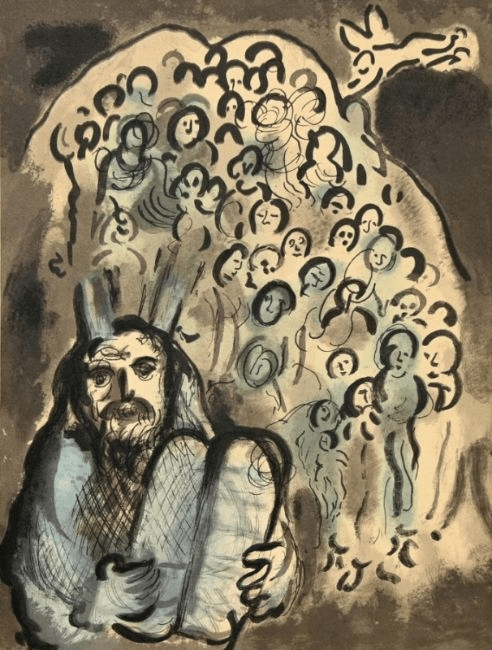
Moses and His People, by Marc Chagall, 1973

Moses and Joshua son of Nun recited this song, so that the people of Israel could hear it.

When Moses had finished giving God’s teachings to the people, he said, “Be sure to obey all these commands that I have given you today. Repeat them to your children, so that they may faithfully obey all of God’s teachings. These teachings are not empty words; they are your very life. Obey them and you will live long in that land across the Jordan that you are about to occupy.” (Good News Translation)

It seems that most people don’t like being told to do anything. There’s a lot of reasons for that. For me, it’s a trust issue. I have a very hard time obeying an authority that I don’t have much faith in.

That’s why I’m just fine submitting myself to God and obeying God’s commands and instructions – because I am firmly convinced that God knows what God is doing; and what’s more, that God has my best interests at mind and at heart.

The ancient Israelites were exhorted by Moses to obey all of God’s teachings because it would be the best way for them to live as a new nation in a new land. The Lord truly wanted what was best for the people, and so, God made sure to give them solid instructions on how to live and thrive together as a nation.

Deuteronomy is the fifth and final book of the Hebrew Torah, and of the Bible’s Pentateuch. The core of the book is a restatement of God’s Law received at Mount Sinai 40 years earlier for the generation about to enter the Promised Land.

The book of Deuteronomy emphasizes God’s love, justice, and transcendence; and stresses the covenant relationship between God and Israel. It looks forward to Israel’s life in the land being established. Foundational to their society, was maintaining God’s social and religious laws.

And those laws were in no way meant to be onerous or oppressive, but were a divine gift to the people. By obeying the Law, the divine/human relationship was secured and the people brought close to God. Foremost to the society was a humanitarianism and concern for the welfare of the poor and disadvantaged.

What’s more, Deuteronomy has a strong intellectual orientation. It urges all Israelites to study God’s laws. There is the expectation that everyone is to be smart and learn how to live wisely.

The participation of Joshua with Moses in teaching he laws was appropriate and important because Joshua was the one who would take over the leadership of Israel and bring them into the Promised Land. The leaders of the people were thoroughly committed to God’s Law – and it was through their wholehearted devotion that they could encourage others to follow them and do the same.

They were to take all of God’s words to heart. The mind, will, and emotions of individuals and families were to be captivated by the standard of God’s divine gift of the law to them. Only in this way would obedience truly become a reality. In other words, it takes complete faith and trust in order to obey.

The way to receive all the blessings of being in the land is through knowing God’s instructions and following them with wholehearted obedience. That means future generations need to be educated about the Law’s stipulations and about the necessity of obeying them with confidence.

Moses made it clear to the people that the divine laws are what life is to be oriented around. God and God’s Law cannot be separated because God’s Law is an expression of God’s very character. For the ancient Israelites, there was no other way.

Many generations later, King David received and learned these laws, understanding the relationship between the Lord and the Law:

The law of the Lord is perfect;
    it gives new strength.
The commands of the Lord are trustworthy,
    giving wisdom to those who lack it.
The laws of the Lord are right,
    and those who obey them are happy.
The commands of the Lord are just
    and give understanding to the mind. (Psalm 19:7-8, GNT)

When it comes to passing on the faith and spiritually forming others, we must have a holistic concern for both what and whom is being taught, as well as how to teach and why we do it. 

For Moses, he was open about expressing the great redemptive acts of God that brought deliverance and vindication to the people. He was convinced that there is no God but the Lord. And he wanted all Israel to know this and to never forget.

All of us, in every generation of believers, are to remember, recite, and rehearse the mighty acts of God, who secured salvation for us. We are responsible to learn, know, and keep the commands of the Lord in our hearts so that we can live into the freedom we possess as believers.

And the Lord has made it known that learning, knowing, remembering, and doing is no trifle thing; rather, this is our very life.

This is one reason why I have devoted myself to the reading, learning, teaching, and living of the Bible. It’s important stuff! And I can testify that living according to the understanding I have of God and Scripture is satisfying, as well as far superior to any other way I have ever tried to live before.

God’s Word must be personally received – no one else can do the work that I myself must do. God’s Word must be faithfully shared and communicated with our children. And God’s Word must be carefully obeyed and observed with head, heart, and hands. This is the responsibility of every believer.

Moses knew that the people could not possibly enjoy life if they deliberately chose to ignore the words given to them in love. I’m glad that, by grace, I know that, too.

Blessed Lord, who caused all Holy Scriptures to be written for our learning: Grant us so to hear them, read, mark, learn, and inwardly digest them, that we may embrace and ever hold fast the blessed hope of everlasting life, which you have given us in our Savior Jesus Christ. Amen.

A Warning and a Reassurance (Isaiah 32:9-20)

Prophet Isaiah, by Sefira Lightstone

You women who are so complacent,
    rise up and listen to me;
you daughters who feel secure,
    hear what I have to say!
In little more than a year
    you who feel secure will tremble;
the grape harvest will fail,
    and the harvest of fruit will not come.
Tremble, you complacent women;
    shudder, you daughters who feel secure!
Strip off your fine clothes
    and wrap yourselves in rags.
Beat your breasts for the pleasant fields,
    for the fruitful vines
and for the land of my people,
    a land overgrown with thorns and briers—
yes, mourn for all houses of merriment
    and for this city of revelry.
The fortress will be abandoned,
    the noisy city deserted;
citadel and watchtower will become a wasteland forever,
    the delight of donkeys, a pasture for flocks,
till the Spirit is poured on us from on high,
    and the desert becomes a fertile field,
    and the fertile field seems like a forest.
The Lord’s justice will dwell in the desert,
    his righteousness live in the fertile field.
The fruit of that righteousness will be peace;
    its effect will be quietness and confidence forever.
My people will live in peaceful dwelling places,
    in secure homes,
    in undisturbed places of rest.
Though hail flattens the forest
    and the city is leveled completely,
how blessed you will be,
    sowing your seed by every stream,
    and letting your cattle and donkeys range free. (New International Version)

The biblical prophets spoke their prophecies for a reason, usually because there was some sort of injustice happening. And typically they addressed those with power, authority, and influence within society – who were doing something wrong, or were simply unaware of what was happening around them. In other words, the people ought to know better.

A Warning Against Complacency

The prophet Isaiah was specifically addressing particular folks, in our Old Testament lesson for today. Isaiah was calling out those who were complacent and living a life of ease. There was a chunk of society in Isaiah’s day who were safe, secure, affluent, comfortable, and rested on their laurels and their resources. Such persons didn’t ever think the thought that their lifestyle was temporary.

The warning of Isaiah was directed specifically to the well-off women in society. Concerning the rich and powerful, the biblical prophets had a tendency to address the women, e.g. the prophet Amos went after the women, calling them “the cows of Bashan.” (Amos 4:1)

The tone of Isaiah’s warning here is much more toward preparing the rich for a time when they won’t be able to rely on their wealth and affluence – they will be stripped of what they have. The women, Isaiah warned, need to prepare themselves for a time of grief.

In other words, they need to face up to what is about to occur, and not idle their lives away merrily as if nothing will ever happen to change their way of life.

Realize, Isaiah says, that the land will be emptied of life, and that resources will become scarce. You women will be reduced to near poverty. The once pride and joy of your nice house will quickly become, in no time at all, a turn of pride and joy in at least having a donkey to sit on.

The happy world they presently know will soon become nothing but a memory.

That is, until a new spirit takes over…

A Reassurance of Newness

Lamenting a loss will not happen forever. The grief shall eventually break. Not everything will be doom and gloom, as if it is some sort of new normal. Positive hope is also on the horizon. A spirit will be given, Isaiah insists, that will generate a wonderful restorative newness.

From a New Testament perspective, the spirit which is given is the Comforter. The Holy Spirit of God moves us through our grief and helps us realize a new lease on life.

“But when the Counselor comes, whom I shall send to you from the Father, the Spirit of truth who proceeds from the Father, He will bear witness of Me.”

Jesus (John 15:26, MEV)

The Spirit is the very force of God in the world, given to help us live into grace and truth – thus, turning injustice to justice, fear to faith, complacency to action, foolishness to wisdom. The desert is transformed into a garden, the dry land becomes lush and fruitful. All things are restored to vitality; people flourish and thrive again.

People’s needs, along with their great need for peaceful relational connections, will take their rightful place. Throughout the land there shall be human well-being. In other words, there is real peace – wholesomeness and integrity, with settled trust and rest in the plans and purposes of God.

In this present contemporary world of political instability for so many, instead of running about like Chicken Little believing that the sky is falling, people of faith can exhibit a peaceful confidence and a settled trust that grace and mercy will have the day.

We don’t need to live in fear, continually and anxiously vigilant to the bad thing around the corner. And when something good happens, we don’t have to wonder when the other shoe will drop. A good God has good purposes in store for humanity.

At the same time, those who are complacent and either cannot or will not see beyond the end of their nose, are served a merciful notice: They can become aware of how things really are – and do something about it.

Cycles of violence, pain, and injustice can and will be broken. Yet we must all do our part to become self-aware, acknowledge the arrogance within society, and determine that in faith we will trust in the name of the Lord who made heaven and earth; and that we will work for a better society and a more fruitful culture.

We are truly not far from the kingdom of God.

Almighty Father, who gave your only Son to die for our sins and to rise for our justification, give me grace to put away the leaven of malice and evil – so that I may always serve you in purity of heart and truthfulness of mind; through Jesus Christ your Son, my Lord, who lives and reigns with you and the Holy Spirit, one God, now and forever. Amen.