The Farewell Speech of Joshua (Joshua 23:1-16)

The tomb of Joshua in the West Bank

After a long time had passed and the Lord had given Israel rest from all their enemies around them, Joshua, by then a very old man, summoned all Israel—their elders, leaders, judges and officials—and said to them:

“I am very old. You yourselves have seen everything the Lord your God has done to all these nations for your sake; it was the Lord your God who fought for you. Remember how I have allotted as an inheritance for your tribes all the land of the nations that remain—the nations I conquered—between the Jordan and the Mediterranean Sea in the west. The Lord your God himself will push them out for your sake. He will drive them out before you, and you will take possession of their land, as the Lord your God promised you.

“Be very strong; be careful to obey all that is written in the Book of the Law of Moses, without turning aside to the right or to the left. Do not associate with these nations that remain among you; do not invoke the names of their gods or swear by them. You must not serve them or bow down to them. But you are to hold fast to the Lord your God, as you have until now.

“The Lord has driven out before you great and powerful nations; to this day no one has been able to withstand you. One of you routs a thousand, because the Lord your God fights for you, just as he promised. So be very careful to love the Lord your God.

“But if you turn away and ally yourselves with the survivors of these nations that remain among you and if you intermarry with them and associate with them, then you may be sure that the Lord your God will no longer drive out these nations before you. Instead, they will become snares and traps for you, whips on your backs and thorns in your eyes, until you perish from this good land, which the Lord your God has given you.

“Now I am about to go the way of all the earth. You know with all your heart and soul that not one of all the good promises the Lord your God gave you has failed. Every promise has been fulfilled; not one has failed. 

“But just as all the good things the Lord your God has promised you, have come to you, so he will bring on you all the evil things he has threatened, until the Lord your God has destroyed you from this good land he has given you. If you violate the covenant of the Lord your God, which he commanded you, and go and serve other gods and bow down to them, the Lord’s anger will burn against you, and you will quickly perish from the good land he has given you.” (New International Version)

Orthodox icon of Joshua

The Person

Joshua, the son of Nun, was the protégé of Moses, as the Israelites wandered the wilderness. After the death of Moses, Joshua became their military commander, leading the people into the Promised Land.

The biblical book of Joshua involves the Israelite conquest and settlement of Canaan. After securing decisive victories in the middle, north, and south of Canaan, the land was allotted to the twelve tribes of Israel.

Close to his death at 110 years old, Joshua gave a farewell speech to the people in which he called them to remember God’s actions, and be faithful to the Lord. He also warned them that if they failed in their memory and in their faith, they would lose the very land which was promised to them.

The Conquest

Throughout the Book of Joshua, there is a very positive view of conquering the land of Canaan. There are several notable stories of stepping out in faith despite the fear of engaging a much larger foe.

God is pictured as the real force behind all of the Israelite success, bringing the people into the land by through a miraculous parting of the Jordan River, and securing victory over great cities like Jericho by means of supernatural help.

After entering the land, the covenant with God was reaffirmed. The Israelites had moved around the Sinai desert for 40 years, and the new generation of people needed both circumcision and law in order to become faithful inhabitants of the land.

By the end of chapter 12 of Joshua, each of the native nations in Canaan had fallen. The conquest was complete, albeit with some of the Canaanites still living in the land. This would eventually prove to be a problem after Joshua’s death.

Allocation of the Land

A detailed account of the land’s division for all of the Israelite tribes covers chapters 13 to 22 in Joshua. Nearly all of the tribes settled between the Jordan River and the Mediterranean Sea, with a few exceptions settling along the eastern bank of the Jordan.

The reason for this traces back to a story in the Book of Numbers in which the tribes of Gad, Reuben, and Manasseh ask to settle there. At the time, Moses agreed to their request on the condition that they help complete the conquest of the land before being allowed to return and settle in their own, which they did.

Moses and Joshua

The book of Joshua and the story of Moses have a lot of similarities, such as:

  • Moses led the Israelites out of Egypt; and Joshua led them into Canaan.
  • Moses led the Israelites miraculously through the Red Sea; and Joshua led them miraculously across the Jordan River.
  • Moses sent out spies into Canaan; and Joshua sent spies to Jericho.
  • Moses allocated land on the east side of the Jordan River; and Joshua allocated land on the west side of the Jordan.
  • Moses gave a prolonged address before dying; and Joshua also gave a parting address to the people.

The Farewell Speech

Joshua’s farewell speech was both an exhortation and an encouragement to the Israelites. Joshua gave them a charge to remain faithful to God, just as God had faithfully fulfilled the promise of giving the people the land of Canaan. We get the sense that Joshua knew what was coming down the pike, and that unfaithfulness was in their future.

We also get the spiritual sense from Joshua that unless one’s heart is filled to the full of God’s law and love, something or someone else will come along and fill the void, no matter how big or small. Our happiness, fulfillment, and satisfaction is to be found in the Lord.

Joshua was insistent that to remain true to God is to remember what God has done. The Israelites were to always keep in their memory how the Lord brought them victory and fought their battles for them. By being continually reminded, the people would always trust and obey their God.

Indeed, even for believers today, if we can keep in mind God’s past faithfulness, it will help us have faith in God for the present time.

And just as the Israelites needed to hold onto and keep the Book of the Law in their minds and hearts, so we are to be ever mindful of God’s Holy Word. Christians are especially to realize the connection we have with Jesus and the Spirit.

“Be strong and very courageous. Be careful to obey all the law my servant Moses gave you; do not turn from it to the right or to the left, that you may be successful wherever you go. Keep this Book of the Law always on your lips; meditate on it day and night, so that you may be careful to do everything written in it. Then you will be prosperous and successful.”

Joshua 1:7-8, NIV

We are to avoid compromising our faith and marrying into foreign concepts that would take us away from our fidelity to the Lord. As Christians, our lives are to maintain the center of Christ. It is therefore imperative that we continually have the words and ways of Jesus ever before us. Otherwise, false gods can easily take over our lives.

The consequences of disobedience are much like those of trying to defy the law of gravity. It won’t go well with you to believe you can walk off the roof of your house in faith and be just fine.

Whereas many people may believe that God is punishing them when there are devastating consequences, typically we create our own problems by refusing to pay attention and listen to God’s warnings to avoid stupidity.

But if we remember our history with God, and God’s history with others, perhaps we will not take our spiritual lives for granted, nor let our spirits fall into disuse.

Not one good promise from God failed to be realized for the ancient Israelites. And all the good promises fulfilled in the person of Jesus are connected to his Church. Ultimately, our blessings come through the person and work of Christ – and not our own abilities, or lack thereof.

God almighty, Lord of heaven and earth, renew us with your divine love, energize our souls, nourish our spirits, empower us to show our faith, help us to walk with you, abide in us always, and teach us to continually remember you and follow you at all times and in every way. Amen.

A Ruler for the Good of the People (2 Samuel 5:11-16)

King David, by Sefira Lightstone

King Hiram of Tyre sent some officials to David. Carpenters and stone workers came with them, and they brought cedar logs so they could build David a palace.

David knew that the Lord had made him king of Israel and that he had made him a powerful ruler for the good of his people.

After David left Hebron and moved to Jerusalem, he married many women from Jerusalem, and he had a lot of children. His sons who were born there were Shammua, Shobab, Nathan, Solomon, Ibhar, Elishua, Nepheg, Japhia, Elishama, Eliada, and Eliphelet. (Contemporary English Version)

Once David became ruler of a united kingdom – Israel and Judah – he established the capital in a central place between the two (much like how Washington D.C. was built at a geographical juncture between North and South of the United States).

The Jebusites were firmly lodged within Jerusalem. Yet, with a good deal of ingenuity, David and his men found a way into the formidable stronghold of Jerusalem and took it. It then became the City of David. (2 Samuel 5:8-10)

King David has the spiritual sense to understand that the Lord was with him; and that his own greatness was directly tied to the greatness of God. The Lord is concerned for the divine/human covenant, and for the glory of Israel and Judah. David did not believe that his success was in any way tied to his own personal skills or abilities.

In light of David’s spiritual stance, it seems a bit strange that today’s text then turns to David’s response of taking more women as wives in Jerusalem. The text also lets us know that David established diplomatic ties with Tyre and worked toward building a royal palace in the new capital.

Typically, Old Testament stories don’t give us explicit moral commentary, telling us what is good and what is bad. Sometimes they inform us of people’s motives, but usually not. So, what was David up to, and why was he doing it? The story invites us to offer up an answer from our own consideration. So, here’s mine…

All of us do the best we can, with what we know at the time. That’s why it is so important to be continually cultivating and nurturing a life of wisdom.

Most things in life don’t have ready-made answers for us. David certainly didn’t Google how to capture Jerusalem, or how to establish a kingdom. He instead had a lifetime of walking with God, learning God’s law, and experiences which God brought him through. And that is exactly what all of us need to do for just about everything.

If you and I were in David’s shoes, within his culture of the ancient world, we might very well do what he did by marrying up and bringing political stability to a new united kingdom that was surrounded by non-Jewish nations.

King David, by Adamo Tadolini, on the Colonna dell’Immacolata, Rome, Italy

Trusting the Lord doesn’t mean that we become passive; it isn’t a let go and let God attitude. Faith requires actively pursuing justice and righteousness for the good of everyone. It takes creativity and a wise mind, a compassionate heart, and a well-attuned sense of one’s own gut.

This approach to life indeed requires a lifetime of learning, growing, and experiencing new things. The following are some ways of developing the experiential knowledge that we understand as wisdom:

Pursue and be open to new experiences

If you don’t like the experience you’re having, create a new one. David was open to following God and engaging in whatever new experiences required fulfilling the will of God. To keep growing as an individual, it’s important to explore unfamiliar and sometimes uncomfortable things; those experiences can teach us how to be more humble and honest, which is especially important for leaders.

Show empathy and be compassionate

This was at the heart of David’s rule as king. He showed steadfast love and commitment to Israel and Judah. Yes, he was a man of war, and did his share of soldiering. And, at the same time, David valued life and went out of his way to show mercy.

After becoming king, instead of wiping out all of King Saul’s family (as was custom for many kings in the Ancient Middle East) David looked for anyone in the family of Jonathan (Saul’s son) to which he could show kindness to (2 Samuel 9:1). There is no path to wisdom that doesn’t go through the land of compassion.

Don’t be afraid to fail

Growth in wisdom usually comes from messing up. How we respond to failure and/or imperfection influences our decision-making and problem-solving skills. A significant part of self-development is learning how not to repeat mistakes. But to do that, you have to make them first.

David made plenty of mistakes, and even outright sinned in ways that effected all Israel and Judah. Yet, he learned his lessons by turning away from the mistakes (repentance) and moving forward (faith).

Ask for help when you need it

A wise person doesn’t have all the answers. They are wise because they know when to consult others and ask for resources. David always had counselors in his court who he knew could give him sage advice whenever he needed it.

Mentor others

One of the best ways of learning and developing wisdom is by coming alongside others and helping them become successful in life. This is one of the main reasons I enjoy teaching and discipling others – so that I can learn from the process, and from the people I mentor. Since David was attuned to this, Israel and Judah had the wisest king in history, his son, King Solomon.

Wisdom is a virtue that goes beyond knowledge. Wisdom is really the study of life. And only by wisdom’s experiential understanding can we make effective changes, influence others, and please God. David was a king for the good of the people.

O God, by whom the meek are guided in judgment, and light rises up in darkness for the godly: Grant us, in all our doubts and uncertainties, the grace to ask what you would have us to do, so that the Spirit of wisdom may save us from all false choices, and that in your light we may see light, and in your straight path, we may not stumble. Amen.

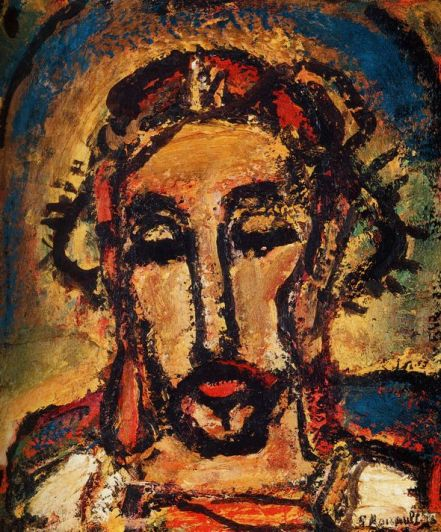
The Wounded Healer (Psalm 18:1-6, 43-50)

By French painter Georges Rouault (1871-1958)

I love you, Lord;
    you are my strength.
The Lord is my rock, my fortress, and my savior;
    my God is my rock, in whom I find protection.
He is my shield, the power that saves me,
    and my place of safety.
I called on the Lord, who is worthy of praise,
    and he saved me from my enemies.

The ropes of death entangled me;
    floods of destruction swept over me.
The grave wrapped its ropes around me;
    death laid a trap in my path.
But in my distress I cried out to the Lord;
    yes, I prayed to my God for help.
He heard me from his sanctuary;
    my cry to him reached his ears…

You gave me victory over my accusers.
    You appointed me ruler over nations;
    people I don’t even know now serve me.
As soon as they hear of me, they submit;
    foreign nations cringe before me.
They all lose their courage
    and come trembling from their strongholds.

The Lord lives! Praise to my Rock!
    May the God of my salvation be exalted!
He is the God who pays back those who harm me;
    he subdues the nations under me
    and rescues me from my enemies.
You hold me safe beyond the reach of my enemies;
    you save me from violent opponents.
For this, O Lord, I will praise you among the nations;
    I will sing praises to your name.
You give great victories to your king;
    you show unfailing love to your anointed,
    to David and all his descendants forever. (New Living Translation)

King David, the psalmist, had no problem with publicly expressing his great feeling of love for God. His desire was to be thoroughly devoted to the Lord; and he confidently discerned God as the source of his strength.

What’s more, David freely recognized God as the One who brought him deliverance. David cried out in distress. In his despair and desperation, he looked to the Lord, and God responded.

This is in contrast to those who complain about God and consider the Lord as distant and uncaring – if existing at all. David’s experience was that of being heard by God. And he wanted everyone to know, so that the faithful may be encouraged.

David didn’t want people becoming discouraged because of the bitterness of others who accuse God of being unconcerned.

The psalmist was not just talking about some mundane request, like asking for parking spot close to the building. David was in a life-and-death situation, stressful beyond imagination. Things were not looking good for him.

It seemed that the insolent, who think God isn’t watching, believed they could act unjustly and do whatever they wanted. Sadly, their lust for power and control blinds them to the larger reality of an invisible God who sees, and who responds at just the right time.

David wanted people to remember and not to forget about the saving actions of God. Because by keeping in mind who God truly is, then we can have confident trust, and will live in a way that is right, just, and good.

“Our service will not be perceived as authentic unless it comes from a heart wounded by the suffering about which we speak.”

Henri Nouwen

A good, right, and just life is always the appropriate response to divine mercy and deliverance. We are saved from evil, so that we might live in the spiritual freedom of purity and peace. And David gave God some due praise, adoration, and thanksgiving for rescuing him from his enemies.

Since David went through all of the adversity, hardship, stress, and suffering of dealing with unjust people, he was in a position to be a wounded healer for us.

A wounded healer is not someone who endorses a victim mentality. Rather, this is a person who has been profoundly hurt – physically, mentally, emotionally, or spiritually – and comes through the experience with an ability to be present with others and help facilitate healing in those who suffer.

Surely he took up our pain
    and bore our suffering,
yet we considered him punished by God,
    stricken by him, and afflicted.
But he was pierced for our transgressions,
    he was crushed for our iniquities;
the punishment that brought us peace was on him,
    and by his wounds we are healed. (Isaiah 53:4-5, NIV)

We all suffer and face various hard circumstances. And we are all changed by the hurtful encounters. But we don’t all respond the same way to that adversity. The difficult experiences of pain lead us to become either bitter or better.

If we have a wounded healer in our life, there is a good chance that we will be able to move through the hardship and come to a place of gratitude for what the Lord has done for us and how God brought us deliverance.

“As followers of Jesus we can also allow our wounds to bring healing to others.”

Henri Nouwen

Deliverance may not end up looking like anything we anticipate. If we are stuck on particular outcomes and have a singular expectation, then we may very well miss the Rescuer when the ship of salvation shows up.

Yet, if we can remain open to and aware of God – as well as of what’s going on inside us – then we shall likely experience healing for our deep wounds of pain. And we will embrace the scars it leaves as a reminder of the Lord’s deliverance.

It could be that things don’t change, at least like we want. In such times, perhaps the greatest healing that can take place is to be healed from the need for healing.

The Lord shows unfailing commitment and steadfast love to the faithful, to those who seek God. We shall find the divine in all circumstances, that is, if we seek God with all our heart.

“You will seek me and find me when you seek me with all your heart.” (Jeremiah 29:13, NIV)

Pain cannot be taken away unless we enter into it. So, it only makes sense to me, that we have a guide like the psalmist to lead us, and a Savior like Jesus to rescue us.

“Wholeness is not achieved by cutting off a portion of one’s being, but by integration of the contraries.”

Carl Jung

May you be patient in suffering, as Christ was in his earthly pain.

May the Lord be near you in your time of weakness and wondering.

May God sustain you by divine grace, and grant you courage not to have a failure of faith.

May you know healing of both body and soul.

And may you always believe that what happens to you in this present life is of little account if you hold Christ in eternal life. Amen.

Fear or Faith? (1 Samuel 13:23-14:23)

The pass at Micmash had meanwhile been secured by a contingent of the Philistine army.

One day Jonathan said to his armor bearer, “Come on, let’s go over to where the Philistines have their outpost.” But Jonathan did not tell his father what he was doing.

Meanwhile, Saul and his 600 men were camped on the outskirts of Gibeah, around the pomegranate tree at Migron. Among Saul’s men was Ahijah the priest, who was wearing the ephod, the priestly vest. Ahijah was the son of Ichabod’s brother Ahitub, son of Phinehas, son of Eli, the priest of the Lord who had served at Shiloh.

No one realized that Jonathan had left the Israelite camp. To reach the Philistine outpost, Jonathan had to go down between two rocky cliffs that were called Bozez and Seneh. The cliff on the north was in front of Micmash, and the one on the south was in front of Geba.“Let’s go across to the outpost of those pagans,” Jonathan said to his armor bearer. “Perhaps the Lord will help us, for nothing can hinder the Lord. He can win a battle whether he has many warriors or only a few!”

“Do what you think is best,” the armor bearer replied. “I’m with you completely, whatever you decide.”

“All right, then,” Jonathan told him. “We will cross over and let them see us. If they say to us, ‘Stay where you are or we’ll kill you,’ then we will stop and not go up to them. But if they say, ‘Come on up and fight,’ then we will go up. That will be the Lord’s sign that he will help us defeat them.”

When the Philistines saw them coming, they shouted, “Look! The Hebrews are crawling out of their holes!” Then the men from the outpost shouted to Jonathan, “Come on up here, and we’ll teach you a lesson!”

“Come on, climb right behind me,” Jonathan said to his armor bearer, “for the Lord will help us defeat them!”

So they climbed up using both hands and feet, and the Philistines fell before Jonathan, and his armor bearer killed those who came behind them. They killed some twenty men in all, and their bodies were scattered over about half an acre.

Suddenly, panic broke out in the Philistine army, both in the camp and in the field, including even the outposts and raiding parties. And just then an earthquake struck, and everyone was terrified.

Saul’s lookouts in Gibeah of Benjamin saw a strange sight—the vast army of Philistines began to melt away in every direction. “Call the roll and find out who’s missing,” Saul ordered. And when they checked, they found that Jonathan and his armor bearer were gone.

Then Saul shouted to Ahijah, “Bring the ephod here!” For at that time Ahijah was wearing the ephod in front of the Israelites. But while Saul was talking to the priest, the confusion in the Philistine camp grew louder and louder. So Saul said to the priest, “Never mind; let’s get going!”

Then Saul and all his men rushed out to the battle and found the Philistines killing each other. There was terrible confusion everywhere. Even the Hebrews who had previously gone over to the Philistine army revolted and joined in with Saul, Jonathan, and the rest of the Israelites. Likewise, the men of Israel who were hiding in the hill country of Ephraim joined the chase when they saw the Philistines running away. So the Lord saved Israel that day, and the battle continued to rage even beyond Beth-aven. (New Living Translation)

The vicinity of Micmash (modern Mukmas) in Israel

Israel had demanded a king. The people wanted to be like everyone else in the world. All the other nations had a king. The Israelites believed that they needed one, too. (1 Samuel 8)

Not unlike today, Israel got a king who looked the part. Saul was tall, dark, and handsome. The only problem was that he didn’t act much like a king at all.

On the day he was anointed king, Saul hid in the baggage, like some guy ducking into a dumpster to avoid people chasing him. If the kings of other nations acted boldly on behalf of their subjects, Saul was not that sort of king. He seemed bent toward cowardice, and more concerned about his reputation than actually accomplishing anything.

Saul could have distinguished his royal kingship through listening to God and obeying the Lord; instead, his rule and reign was often marked by a half obedience, if he obeyed at all.

Old Testament stories are filled with contrasting characters. And in the narrative for today, there is a clear difference between King Saul and his son Jonathan. Saul was supposed to be leading the charge against the Philistine threat to Israel, but he was hiding out.

But Jonathan was determined to deal with the arrogant Philistines, even though it meant going against an entire garrison of troops with only his armor-bearer alongside him.

In the story, we find Saul and the army cowering in secrecy. But we find Jonathan in the bright light of day for the entire Philistine army to see. The contrast couldn’t be any more obvious:

  • Saul is afraid, and Jonathan is brave
  • Saul is fearfully passive; Jonathan is faithfully aggressive
  • Saul could only see reasons not to face the Philistines; Jonathan saw no obstacles to facing them, even though he had to scale crags and thorns in order to get to the Philistines

The opposite of faith is not unbelief; it’s fear. All of the Israelite soldiers were afraid, except Jonathan and his armor-bearer. The two of them had remarkable faith.

Jonathan had full confidence in the power of God. It wasn’t stupidity that led him toward an entire army by himself; it was the firm conviction that nothing is too difficult for the Lord.

It was neither pride nor glory-seeking that caused Jonathan to go, against all odds, to fight the Philistine army. He simply reasoned by faith that perhaps God would work on their behalf and bring about a great deliverance for Israel.

What’s more, Jonathan trusted the Lord without making assumptions that God would act in a particular way. There wasn’t any ‘name-it-and-claim-it’ theology happening with him.

Indeed, God did intend to defeat the Philistines. Maybe the Philistines thought Jonathan was bluffing by coming up to them; and they were going to teach this guy a lesson! But false confidence is typically shown through talking smack, whereas real confidence is born of faith.

Trust fully expects God to show up and take on injustice, unrighteousness, and arrogant pride.

Jonathan did some damage; and God got into the thick of it by directly intervening. The Lord turned the tables by bringing great fear on the Philistines. This turning of the tables emboldened the Israelites. The result was a decisive victory for Israel, leaving Philistia slack-jawed and confused.

We may be uncertain about the future; but if we are pursuing a good thing, and are confident in God’s power, there’s no need to be afraid in pursuing it.

We are free to step out in faith and attempt great things for the sake of the Lord, knowing that God may indeed bless our trusting initiative.

Almighty and everlasting Father, you have given the Holy Spirit to abide with us forever: Bless us with divine grace and presence so that, being preserved in true faith and confident hope, we may fulfill all the good that is in our mind and heart to do; through Jesus Christ your Son, our Lord, who lives and reigns with you, in the unity of the Holy Spirit, one God, today and always. Amen.