

Overcoming the World

Everyone who believes that Jesus is the Christ is born of God, and everyone who loves the father loves his child as well. This is how we know that we love the children of God: by loving God and obeying his commands. In fact, this is love for God: to keep his commands. And his commands are not burdensome, for everyone born of God overcomes the world. This is the victory that has overcome the world, even our faith. Who is it that overcomes the world? Only the one who believes that Jesus is the Son of God. This is the one who came by water and blood—Jesus Christ. He did not come by water only, but by water and blood. And it is the Spirit who testifies because the Spirit is the truth. (1 John 5:1-6, NIV)

Faith, love, and obedience are tightly woven together to such an extent that to pull one of them out is to unravel the whole bunch. These three characteristics of the true Christian are vital and necessary to living the Christian life. They all must be present for the church to overcome the world.

The main verbs throughout the verses are the word “is.” And the verb tense is key. The verb clearly describes a past action of God which we as people need to receive. In other words, the grammar dictates that God has given us new birth.  We do not give ourselves spiritual birth any more than we can tell our mothers that it was us who gave birth to ourselves.

God saves us from sin and grants us forgiveness. This action is from God. We are recipients of God’s good grace toward us. There are three participles connected to this main verb:

  1. Believe
  2. Love
  3. Obey

A participle is a word which is connected to the verb’s action. So then, our actions are a result of God’s action toward us. To put it simply, a person born from God will believe, love, and obey. Just as a newborn baby first breathes, then learns to eat, sleeps, grows-up, learns to walk, and over time develops into an adult just like their mother and father, so the Christian who is born again from God exhibits faith, learns to love, and grows up developing the skills of obeying Jesus and following him, learning to walk in his ways, becoming just like him.

In the same way a child must learn and grow to have the necessary skills for facing the world in all its bigness, trials, and temptations, so the Christian must develop the abilities necessary to overcome the world. Those skills are faith, love, and obedience. Without them, we will be unable to deal with the world. But with them, we experience victory over the world.

The word, “overcome,” is a cognate word (related to) of “victory.”  That is, to overcome is to have firsthand exposure to the victory the Lord Jesus has achieved on the cross. Through being spiritually born again by God, we are set on a course requiring faith, love, and obedience to overcome the world. As we learn to apply these three spiritual characteristics to our lives, we experience practical victory over the world.
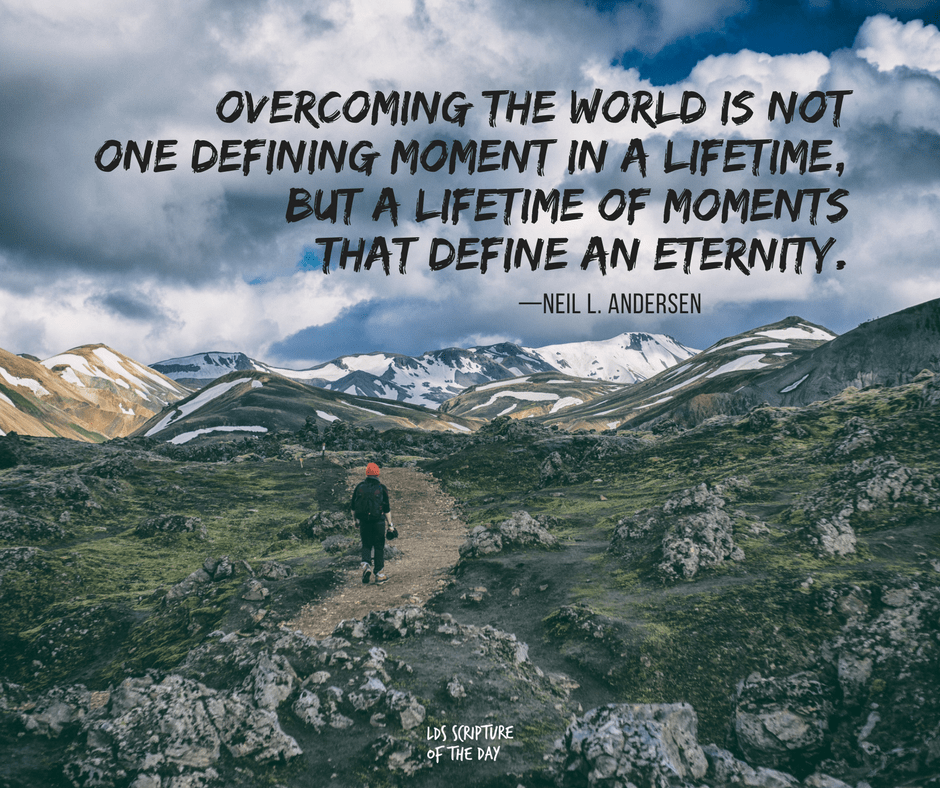
The term “world” are the patterns, systems, and operations of the world in direct contrast to how God operates. For example:

  • The world engages in revenge and payback when wronged, whereas the Christian learns to believe God as the Judge, loves the person who has offended them through prayer for their enemy, and obeys God through good works that seeks the welfare of the other. 
  • The world uses other people as either objects of their pleasure or to get ahead in life, whereas the Christian believes God will take care of their needs, will seek to love the other person instead of use them, and would rather obey God than be selfish. 
  • The world thinks nothing of lying, cheating, and stealing, if they can get away with it, whereas the Christian believes Jesus is the way, the truth, and the life, loves being a person of integrity, and obeys God even when it hurts.

This in no way means we avoid or belittle the world. In facing and overcoming the world, we need principled civility. Using faith, love, and obedience, we respect another’s viewpoint through growing in faith, expanding our hearts in love, and learning obedience through interaction with others for whom we disagree.

Where do we feel “the pull” in life from? Do we feel it from the world, or from God’s Word? We must learn how to deal with the worldly elements of our society in which we feel a pull and a tug to go along with it and want to give in to it. This requires a community of Christians engaging the world through faith, love, and obedience to overcome that pull.

Our call as Christians is not to just survive the world. If anyone could have had that kind of mentality, it was Helen Keller. Deaf, mute, and blind, she could have settled into just getting by and waiting for heaven. Yet, she accepted her situation, coped with it, and even transcended her limitations.  She did more than survive – she thrived. Helen Keller once said:

“The marvelous richness of human experience would lose something of rewarding joy if there were not limitations to overcome. The mountaintop would not be half so wonderful if there were no dark valleys to traverse.”

Helen Keller

We need faith in God, not ourselves. The Scripture says:

Trust in the Lord with all your heart,
    and do not rely on your own insight.
In all your ways acknowledge him,
    and he will make straight your paths. (Proverbs 3:5-6, NRSV)

We need to love God and others, and not the world. The Scripture says:

Don’t love the world’s ways. Don’t love the world’s goods. Love of the world squeezes out love for the Father. Practically everything that goes on in the world—wanting your own way, wanting everything for yourself, wanting to appear important—has nothing to do with the Father. It just isolates you from him. The world and all its wanting, wanting, wanting is on the way out—but whoever does what God wants is set for eternity. (1 John 2:15-17, MSG)

We need to obey the call of God, not the call of the world. Hear what Scripture says: 

The commandment that God has given us is: “Love God and love each other!” (1 John 4:21, CEV)

When faith, love, and obedience are working together as they were intended to, we will overcome the world and all its crud. We will keep ourselves from being polluted and stained by it.

Overcoming the world is a high calling from God. Faith means putting aside fear and taking the kind of risk God wants you to take. Love means putting aside hate and serving others, even when it hurts. Obedience means putting aside selfishness and choosing to do what is best for another person’s welfare. Being characterized by these three Christian virtues will have the effect of overcoming the world. It is not a burdensome or heavy way to live. It’s the way of Jesus.

Blessed Father, Son, and Holy Spirit, the God whom we serve: Sometimes our hearts and minds are flooded with fears. Sometimes we are paralyzed and overwhelmed and feel unable to go on. Yet today we hold onto the victory you have accomplished through the blood of Jesus Christ. You have told us not to fear, for you have overcome the world. So, we cling to you, believing your Word and your promises. In moments of crippling fear, we choose to hold your hand and believe; to love as we have been loved; and, to obey even in the most fearful places because we know that you have risen again.

Loving Lord Jesus, we surrender to you all that we are and hope to be. Holy Spirit, we invite you and all your ministry within us. Holy God of all, we offer you our heart, mind, body, soul, spirit, hopes, plans and dreams. We surrender to you our past, present and future problems, habits, character defects, attitudes, livelihood, resources, finances, medical coverage, occupation and all relationships. We give you our health, physical appearance, disabilities, family, marriage, children, grandchildren, and friendships.

We ask for your Lordship over every aspect of our lives. We surrender to you all our hurt, pain, worry, doubt, fear and anxiety, and ask you to wash us clean. We release everything into your compassionate care. Speak to us clearly, Lord. Open our ears to hear your voice. Open our hearts to commune with you more deeply. Open the doors that need to be opened and close the doors that need to be closed. Set our feet upon the straight and narrow road that leads to everlasting life. Amen.

Psalm 95 – Worship and Whining

Psalm 95 verse 4, by Cecelia Nedlin

Come, let us sing for joy to the Lord;
    let us shout aloud to the Rock of our salvation.
Let us come before him with thanksgiving
    and extol him with music and song.

For the Lord is the great God,
    the great King above all gods.
In his hand are the depths of the earth,
    and the mountain peaks belong to him.
The sea is his, for he made it,
    and his hands formed the dry land.

Come, let us bow down in worship,
    let us kneel before the Lord our Maker;
for he is our God
    and we are the people of his pasture,
    the flock under his care.

Today, if only you would hear his voice,
“Do not harden your hearts as you did at Meribah,
    as you did that day at Massah in the wilderness,
where your ancestors tested me;
    they tried me, though they had seen what I did.
For forty years I was angry with that generation;
    I said, ‘They are a people whose hearts go astray,
    and they have not known my ways.’
So I declared on oath in my anger,
    ‘They shall never enter my rest.’”
(New International Version)

Revelation and Response

Praise and thanksgiving. Complaining and grumbling. These two sets of words are antithetical to each other. Yet, out of the same mouth can come both worship and whining. Maybe the psalmist was trying to teach us a thing or two by inviting us to sing and bow to the Lord, as well as hear God’s voice.

Worship and listening are meant to go hand in hand. Revelation and response are to be the spiritual rhythm of the believer. True worship is a divine conversation between us and God. The Lord speaks. We listen and answer. Back and forth we go together. God and God’s people are in dialogue.

When the worship rhythm is off, then our response will be off. And that is what happened to the ancient Israelites. They were miraculously delivered from their cruel bondage in Egypt. You can imagine the kind of praise and worship service the people had in the desert! After four-hundred years of slavery, freedom!

The Rhythm is Off

Before you know it, the thanksgiving turned sour into grumbling. At the first instance of adversity, when there was no water to drink, it was as if the people had some sort of collective dementia set in. Suddenly, hardness of heart. Talk about fickle! One minute hands are raised in praise, the next minute, those same hands clench into fists shaking at God.

The people forgot that this was an ongoing dialogue – not a one and done conversation of revelation and response. God acted by delivering the people. The people responded with praise and thanksgiving. And they didn’t want it to stop. Yet, all of life is a rhythm. What goes up, comes down. Good times eventually fade into tough times. The real muster of any person or group is the response when the hardship comes.

God knew exactly what he was doing. The Lord purposely brought the Israelites out into the desert to face a difficult circumstance. God was teaching them to trust. The Lord wanted a response of faith and prayer to the adverse situation. But the people weren’t looking for a dialogue. They were looking for water. And when they didn’t have it, their hearts hardened through murmuring, bellyaching, and dissatisfaction.

However, God was still in the conversation. The generation who saw the incredible deliverance from bondage would die in the desert, never setting eyes on the Promised Land. And it all began because of grumbling.

Complaining is Unhealthy

We need to take complaining seriously. Why? Because it rots the soul, like Mr. Grinch who incessantly complained every year about Christmas. Grumbling makes one into a Grinch-like creature, like the song says:

You’re as cuddly as a cactus
You’re as charming as an eel…

You got termites in your smile
You have all the tender sweetness
Of a seasick crocodile…

Your heart’s an empty hole
You got garlic in your soul.

It was only when the Grinch forsook his isolation of complaining and began connecting in conversation with the folks in Whoville, that he had his rhythm restored.

The Need for Encouragement

When our rhythm is off kilter, what will it take to get it back? The author of the New Testament letter to the Hebrews helps us here. After quoting our psalm lesson for today, the writer responded to the biblical revelation by saying:

Be careful, brothers and sisters, that none of you ever develop a wicked, unbelieving heart that turns away from the living God. Encourage each other every day while you have the opportunity. If you do this, none of you will be deceived by sin and become stubborn. After all, we will remain Christ’s partners only if we continue to hold on to our original confidence until the end. Scripture says, “If you hear God speak today, don’t be stubborn. Don’t be stubborn like those who rebelled.”

Hebrews 3:12-15, God’s Word Translation

Revelation and response are the rhythmic dynamism of the Christian community. Lone Ranger Christians are an oxymoron, as well as moronic. We are hard-wired by God for community. All of us need to encourage one another – every day. Without the communal connections of encouraging conversations, it will be difficult to sustain a divine dialogue of God speaking, with people listening and responding in obedient faith.

Celebration is wonderful. We need times and experiences of celebrating deliverance from bondage. Eventually, when Christ returns, there will be unending worship in the form of jubilation. That time is not yet here. This side of heaven, we must learn to engage God in ways which address our hardships and difficulties. Otherwise, our hearts will become stubborn and hard.

Let your heart become open enough to receive encouragement. And let it also be brave enough to encourage others.

Lord Jesus Christ, by your patience in suffering you caused earthly pain to be holy. And you gave us the example of obedience to your Father’s will. Be near me in my time of weakness and pain. Sustain me by your grace so that my strength and courage may not fail. Heal me according to you will. Help me always believe that what happens to me here is of little account if you hold me in eternal life, my Lord and my God. Amen.

Psalm 4 – Rhythms of Trust

God, you are my righteousness, my Champion Defender.
    Answer me when I cry for help!
    Whenever I was in distress, you enlarged me.
    I’m being squeezed again—I need your kindness right away!
    Grant me your grace, hear my prayer, and set me free!
Listen to me, you elite among men:
    How long will you defame my honor
    and drag it down into shame?
    Will you ever stop insulting me?
    How long will you set your heart on shadows,
    chasing your lies and delusions?
May we never forget that Yahweh works wonders
    for every one of his devoted lovers.
    And this is how I know that he will answer my every prayer.
Tremble in awe before the Lord, and do not sin against him.
    Be still upon your bed and search your heart before him.
Bring to Yahweh the sacrifice of righteousness and put your trust in him.
Lord, prove them wrong when they say, “God can’t help you!”
    Let the light of your radiant face
    break through and shine upon us!

The intense pleasure you give me
    surpasses the gladness of harvest time,
    even more than when the harvesters
    gaze upon their ripened grain
    and when their new wine overflows.
Now, because of you, Lord, I will lie down in peace and sleep comes at once,
    for no matter what happens, I will live unafraid! (TPT)

This is a psalm of David. It is a heartfelt and confident plea for deliverance.

David had a track record with God. For most of his life, David had a spiritual and relational rhythm of looking to God, trusting God, and resting secure in God.

Small Faith

I’m not sure where the idea popped up amongst some Christians that faith and trust in God means everything in life is going to be hunky-dory and a bowl of cherries. That was not true of any godly character in the Bible. In fact, it seems the more integrity one has in Scripture, the more they faced trouble and suffering.

It is the pea-brained, small-hearted, and gutless who have the time and privilege of leveling criticism and defamation on the ones sincerely trying to make a difference in this world. On the one hand, it is unfortunate that the spiritually devoted must put up with the petulance of puny people. Yet, on the other hand, the faithful recognize God controls all things and uses anything and anyone to shape them as persons who have grown expansive spiritual faculties, enlarged hearts, and gut-feeling compassion. The wise truly learn from all things.

“Trust the Lord completely, and don’t depend on your own knowledge. With every step you take, think about what he wants, and he will help you go the right way.”

Proverbs 3:5-6, ERV

Big Faith

The godly have become so because they have learned over-and-over again to let God champion their cause and defend their personhood. The faithful reflexively cry out to the Lord with all their troubles. The devoted aren’t shy in boldly telling God exactly what they want and need. They find joy in their spirituality, and they let it support them in stressful times.

God has shown them steadfast love. And they are supremely secure in the settled conviction that God has their backs. They believe it so much that followers of God can lay their heads on their pillows at night and fall asleep – despite the reality there are those who would take their life, if given half the chance.

No Sleep

Insomnia happens for a lot of reasons. Many, like me, have sleep apnea and restless leg disorder, both diagnosed medical conditions. Others can’t get a good night’s rest because of poor sleep hygiene by not planning for adequate sleep, drinking too much caffeine during the day, inattention to a healthy diet, or a host of other habits. Some, like my dear wife, have issues of chronic pain which can make it difficult to sleep well.

And then there are yet others who suffer from racing thoughts, anxiety, and depression. The stress of their waking life is so significant that several hours of deep sleep seems only like some pipe dream. It’s impossible to sleep when the weight of the day is pressing on you. Finding a sense of calm before bed isn’t easy—especially when you can’t unplug from the demands of your day.

I am wondering if many of us will even allow ourselves to unplug and establish some quiet wind-down time. Reading a real book – not one on a backlit tablet device – or talking with a friend or family member are simple ways of easing our anxiety and letting rest come.

Sleep ZZzz

The psalmist, David, had a regular practice of meditating on Scripture, recalling the events of God, and expressing gratitude and praise for answered prayer. Each of us has a built-in spiritual rhythm just like we have a circadian rhythm. Always trying to buck those God-given rhythms will inevitably result in being “off,” at the least, and experiencing debilitating depression, at worst.

Yet, when we learn to move with the unforced rhythms of grace, there is a groove we slip into which serves us well. In other words, allowing ourselves to be human brings health.

David had neither delusions nor illusions about his enemies, friends, others, and himself. He didn’t try to be somebody he was not. Instead, David had firm and confident convictions about God and the place of prayer. A steady diet of David’s psalms teaches us to hold together both faith and doubt, confidence and confusion, perseverance and perplexity in ways which strengthens belief.

Christ be with you: Christ within you;
Christ before you: Christ behind you;
Christ on your right: Christ on your left;
Christ above you: Christ beneath you;
Christ around you: now and ever. Amen.

Psalm 71:1-14 – Tuesday of Holy Week

O Lord, I have come to you for protection;
    don’t let me be disgraced.
Save me and rescue me,
    for you do what is right.
Turn your ear to listen to me,
    and set me free.
Be my rock of safety
    where I can always hide.
Give the order to save me,
    for you are my rock and my fortress.
My God, rescue me from the power of the wicked,
    from the clutches of cruel oppressors.
O Lord, you alone are my hope.
    I’ve trusted you, O Lord, from childhood.
Yes, you have been with me from birth;
    from my mother’s womb you have cared for me.
    No wonder I am always praising you!

My life is an example to many,
    because you have been my strength and protection.
That is why I can never stop praising you;
    I declare your glory all day long.
And now, in my old age, don’t set me aside.
    Don’t abandon me when my strength is failing.
For my enemies are whispering against me.
    They are plotting together to kill me.
They say, “God has abandoned him.
    Let’s go and get him,
    for no one will help him now.”

O God don’t stay away.
    My God, please hurry to help me.
Bring disgrace and destruction on my accusers.
    Humiliate and shame those who want to harm me.
But I will keep on hoping for your help;
    I will praise you more and more. (NLT)

Today’s psalm is a lament. It is included in Holy Week because the Christian can imagine Jesus saying these very words in the last days of his earthly life and ministry.

Lament is both important and necessary. Without lament our grief comes out sideways, inevitably harming others with our snarky vitriol. Lament gives expression to our deep grief. It enables us to come to grips with what has happened or is happening to us and within us.

  • A lament is an expression of personal grief to any significant change or loss; it is the normal emotional, spiritual, physical, and relational reaction to that loss.
  • Lamenting is an intentional process of letting go of relationships and dreams and living into a new identity after the loss or change.
  • Expressing grief through lament is personal; there is no one-size-fits-all.

Psalms of lament have a typical structure to them, including:

  • Addressing God: Crying out for help. Some psalms of lament expand to include a statement of praise or a recollection of God’s intervention in the past. (Psalm 71:1-3)
  • Complaint: Telling God (said with some flavor!) about our problem or experience through a range and depth of emotional, relational, and spiritual reactions to the change or loss. (Psalm 71:4)
  • Confession of Trust: Remaining confident in God despite the circumstances. Beginning to see problems differently. (Psalm 71:5-8)
  • Petition: Proclaiming confidence in God. Appealing to God for deliverance and intervention. Keep in mind that petitioning is not bargaining with God or a refusal to accept loss. Rather, it is a legitimate seeking of help. (Psalm 71:9-13)
  • Words of Assurance: Expressing certainty that the petition will be heard by God. (Psalm 71:14a)
  • Vow of Praise: Vowing to testify in the future to what God will do with praise. (Psalm 71:14b-24)

I urge you to do the following spiritual practice this Holy Week – set aside some time and craft your own psalm of lament. Choose an event from your past which created grief for you. It can be recent or from years ago. Using the structure of lament psalms, thoughtfully write out each element as I have outlined it. Then, read it aloud to God. Perhaps even take another step by reading your lament aloud to a trusted family member, friend, or Pastor.

Our grief needs the outlet of lament. Grief which is not expressed only sits in the soul and eventually, over time, can easily become putrid and rancid, poisoning our spirit, and compromising our faith. Sharing your story through lament is biblical, practical, and I will insist, necessary. Let me know how it goes…