Psalm 11 – Fight, Flight, or Faith

Photo by Pixabay on Pexels.com

The Lord is my fortress!
    Don’t say to me,
    “Escape like a bird
    to the mountains!”
You tell me, “Watch out!
Those evil people
    have put
    their arrows on their bows,
and they are standing
in the shadows,
    aiming at good people.
What can an honest person do
    when everything crumbles?”

The Lord is sitting
in his sacred temple
    on his throne in heaven.
He knows everything we do
    because he sees us all.
The Lord tests honest people,
but despises those
    who are cruel
    and love violence.
He will send fiery coals
and flaming sulfur
    down on the wicked,
and they will drink nothing
    but a scorching wind.

The Lord always does right
    and wants justice done.
    Everyone who does right
    will see his face. (Contemporary English Version)

Part of the human condition is that we will eventually take the brunt of someone’s poison darts. And it’s scary. In our state of fear, and sometimes panic, will we fight, flight, or faith?

Fight, Flight, or Freeze by Qieer Wang

If you have ever received a nasty email based on half-truths and accusations; stood dumbfounded as someone hurled misinformation and criticism at you; and/or experienced the victimization that comes from slanderous and gossiping tongues, then the psalmist knows exactly how you feel. 

Cobbling together a hasty email response, full of anger and vitriol, only sucks us into the person’s evil ways. Metaphorically punching someone in the face for their slap to your face is how the demonic realm handles offenses. Fighting back with an equal or greater force is diametrically opposed to the way of Jesus in loving our enemies and praying for those who persecute us.

Then, there is the response of taking flight from the nastiness. Indeed, it sometimes seems as if good people are always getting swallowed whole by unjust words and behaviors directed squarely at them. And it doesn’t help when the downers among us stroll along and give us their unhelpful fatalism about how there is nothing we can do and how nothing will ever change.

To be the target of evil speech or malevolent actions is, at the least, unsettling, and, at worst, can bring years of struggle, depression, and inability to serve. Yet, there is someone who sees it all, and that someone will address the wrong. We have an option beyond fighting back in anger or fleeing altogether in fear. We can trust God.

“Pray, and let God do the worrying.”

Martin Luther

The Lord sits aloft, overseeing all, and knows everything humanity does and says. God always does right and wants justice done. Everyone who shares a divine sense of what is right and just will see God’s face. God will act because the Lord abhors and despises those who are cruel and enjoy violence.

It’s not a good idea to get on God’s bad side. The way to flare God’s anger is by possessing an acerbic tongue; relishing in verbal violence; and, having no remorse about any of it. Because God loves people, God hates evil. The righteous are to take solace in the truth that God really does see the harm done and is in a position to do something about it. Like the psalmist, we seek the Lord. The Lord fights our battles.

Whenever we are harassed and the ungodly give us a hard time, the psalmist isn’t just offering some nice religious platitudes such as, “Just let go and let God,” “Everything works for the good of those who love God,” or “It’s okay, you’ll be in heave someday.”

In another context, maybe those statements are helpful. But being in the teeth of the wicked, all is not okay. As much as some folks try to sanitize an evil situation with rainbows and butterflies, the evil is real, and it’s there. The truth is that everything is not okay. The earth is filled with violence, malevolence, oppression, injustice, and systemic evil. The psalmist knows this, all too well.

Humble yourselves under God’s power so that he may raise you up in the last day. Throw all your anxiety onto him because he cares about you. (1 Peter 5:6-7, CEB)

Today’s psalm is reminding and assuring us that the Lord is aware of what’s going on and will most certainly do something about it. God will act to punish the wicked and deliver the Lord’s people. There may not be peace this present moment, yet it will not always be this way. We shall behold the face of the Lord.

“Never be afraid to trust an unknown future to a known God.”

Corrie Ten Boom

The Lord is a righteous judge. Justice is the foundation of God’s throne. God sees the entire spectrum of humanity and can make a right assessment of people’s thoughts, intents, words, and actions. We, however, cannot. Therefore, it is most necessary for us to put our trust in a Divine Being who cares about right and wrong and has the power to act with justice.

Whenever we are hemmed-in through the schemes of diabolical persons and are powerless, there is always the choice to trust in the Lord. In the hands of God rest the outcome of every life on earth. And it will be a just and right rendering.

Trust in the Lord and do good. Seek peace and pursue it. We might struggle mightily on both the inside and outside – our hard circumstance might not change immediately – yet God is the One who will vindicate the just person when the time is right.

You are never alone. May the Lord be with you always.

God of justice, look at the state of your servant and act on my behalf. Do not let evil prevail. Thwart the ungodly so that they can no longer do any harm. Amen.

2 Samuel 15:13-31 – Unflagging Trust

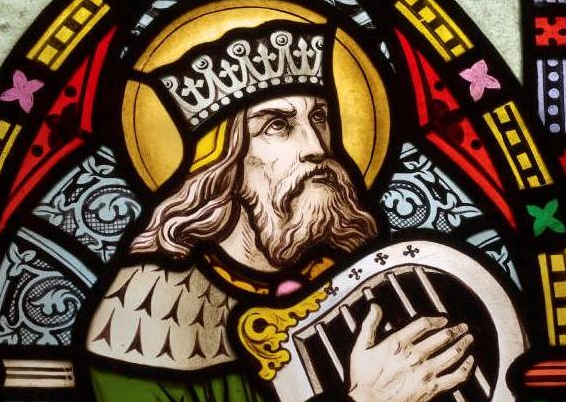
Stained glass of King David, Fringford, England church

A messenger came and told David, “The hearts of the people of Israel are with Absalom.”

Then David said to all his officials who were with him in Jerusalem, “Come! We must flee, or none of us will escape from Absalom. We must leave immediately, or he will move quickly to overtake us and bring ruin on us and put the city to the sword.”

The king’s officials answered him, “Your servants are ready to do whatever our lord the king chooses.”

The king set out, with his entire household following him; but he left ten concubines to take care of the palace. So, the king set out, with all the people following him, and they halted at the edge of the city. All his men marched past him, along with all the Kerethites and Pelethites; and all the six hundred Gittites who had accompanied him from Gath marched before the king.

The king said to Ittai the Gittite, “Why should you come along with us? Go back and stay with King Absalom. You are a foreigner, an exile from your homeland. You came only yesterday. And today shall I make you wander about with us when I do not know where I am going? Go back and take your people with you. May the Lord show you kindness and faithfulness.”

But Ittai replied to the king, “As surely as the Lord lives, and as my lord the king lives, wherever my lord the king may be, whether it means life or death, there will your servant be.”

David said to Ittai, “Go ahead, march on.” So Ittai the Gittite marched on with all his men and the families that were with him.

The whole countryside wept aloud as all the people passed by. The king also crossed the Kidron Valley, and all the people moved on toward the wilderness.

Zadok was there, too, and all the Levites who were with him were carrying the ark of the covenant of God. They set down the ark of God, and Abiathar offered sacrifices until all the people had finished leaving the city.

Then the king said to Zadok, “Take the ark of God back into the city. If I find favor in the Lord’s eyes, he will bring me back and let me see it and his dwelling place again. But if he says, ‘I am not pleased with you,’ then I am ready; let him do to me whatever seems good to him.”

The king also said to Zadok the priest, “Do you understand? Go back to the city with my blessing. Take your son Ahimaaz with you, and also Abiathar’s son Jonathan. You and Abiathar return with your two sons. I will wait at the fords in the wilderness until word comes from you to inform me.” So Zadok and Abiathar took the ark of God back to Jerusalem and stayed there.

But David continued up the Mount of Olives, weeping as he went; his head was covered, and he was barefoot. All the people with him covered their heads too and were weeping as they went up. Now David had been told, “Ahithophel is among the conspirators with Absalom.” So, David prayed, “Lord, turn Ahithophel’s counsel into foolishness.” (New International Version)

“Faith is taking the first step even when you don’t see the whole staircase.”

Martin Luther King, Jr.

It’s an understatement to say that King David had family drama.

Maybe that’s because he had a lot of wives and even more kids. Or it could be that being a king didn’t transfer well to being a father. And it just might be that his experience was mostly about simply living in a fallen world, full of icky relational dynamics and human conflict.

David seemed to be at his best when at his lowest. His son, Absalom, carefully designed a conspiracy to take over the kingdom. And it was looking as though he might just do it. David, and those loyal to him, fled Jerusalem to avoid being overthrown and killed. They were between a rock and a hard place, to put it mildly. David was literally running for his life.

If we put ourselves in David’s sandals, how would we respond? 

I suppose, at the least, we would likely complain. Who is Absalom that he should dishonor his father in such a way as this? Then, we may try and find ways to maintain power, and get back at Absalom for being a rebellious and destructive son. 

I am humbled by David’s unflagging trust in God. Like the suffering Job centuries before him, David was willing to receive anything from the hand of God, whether for good or evil. He wholesale accepted whatever seemed good to God, without attempting to force anything on the Lord. “Let God do to me what seems good to him,” was the faith affirmation of David.

Yet, at the same time, David was aware and in touch with his emotions as he left the city and ascended the Mount of Olives. He wept and lamented over the situation he and all those with him had to experience. 

A thousand years later, Jesus took the same trek out of the city in great sorrow because of people who conspired against him. Christ faced the agony of the cross through the machinations of sinful humanity who did not want him as Lord over their lives.

Our confidence must rest in the God who is never caught unaware of our situations and always knows how to respond. We must rely on our prayers to the Lord as we navigate the difficulties of this life. 

Humility goes a long way toward letting the will of God rule the day.

O Lord, please turn the plans and the counsel of evil persons into foolishness. Do not let the sinfulness of people have its way and run roughshod over my life.  I trust in you to bend a bad situation toward your own good purpose through Jesus Christ my Lord.  Amen.

Mark 6:45-52 – Facing Fear

Immediately Jesus made his disciples get into the boat and go on ahead of him to Bethsaida, while he dismissed the crowd. After leaving them, he went up on a mountainside to pray.

Later that night, the boat was in the middle of the lake, and he was alone on land. He saw the disciples straining at the oars because the wind was against them. Shortly before dawn he went out to them, walking on the lake. He was about to pass by them, but when they saw him walking on the lake, they thought he was a ghost. They cried out because they all saw him and were terrified.

Immediately he spoke to them and said, “Take courage! It is I. Don’t be afraid.” Then he climbed into the boat with them, and the wind died down. They were completely amazed, for they had not understood about the loaves; their hearts were hardened. (New International Version)

Sometimes, we are afraid – even terrified. And Christians aren’t immune to the feeling of fear and terror.

The truth of the Christian life is that it is a herky-jerky process of three-steps-forward, two-steps-backward, not always knowing with certainty everything we encounter.  

The expectation that we will have a consistent upward trajectory of spiritual development with no scary experiences is wrongheaded and misguided. Throw into the mix that our self-awareness is often skewed, and that we have difficulty assessing ourselves with any accuracy, and voila! we have a recipe for the true human condition.

Doubt, fear, failure, and stubbornness aren’t just endemic to other people – it also characterizes many Christians, as well. We will face severe storms in life. They will be harsh. We will wonder if we’ll even make it out alive, or not. And it may very well seem like Jesus is nowhere to be found. Then, when he does show up, we don’t recognize him, and it scares the bejabbers out of us.

This was the experience of Christ’s disciples, who too often reflect our own stories of faith and fear all rolled up in one person. Today’s Gospel lesson is this: Our fears and foibles do not need to define us because Jesus is Lord over the water, the weather, the wondering, the waiting, the wildness, and our own whimsical natures of seeing miracles accomplished in others, then not believing it can happen in our own lives.

So, what are we really afraid of? Failure? Fear itself? Death? Irrelevance? Loss? Change? Perhaps, everything? Yes, all of life is a risky scary business. There are no guarantees, except one: Christ is present with us, whether we are aware of it, or not.

If the worst scenario you worry about in your head would actually come to pass, it will still never change the reality that God loves you and is with you.  And it will not stop Jesus from assuring us of his presence and climbing into the boat to be with us.

We don’t have any accounts of Jesus freaking out in fear, or when other people flip out in their own fear. Jesus was a person of prayer, completely grounded in his relationship with the Father.   

Jesus made his disciples get into a boat and go out on the lake – all the while knowing what they were about to face with the weather. Even though the disciples were doing God’s will by going out on the lake, they were not spared from adversity. In fact, Jesus wanted them to experience the storm because it is through the storm that we really learn faith and to face down our fears. 

There is no shame in being afraid. We all experience it. And there is no shame in admitting we’re scared. Where shame exists, our instinct is to run away like our ancestors Adam and Eve and hide, thus hiding ourselves from the grace that could be ours.

Being out on the middle of a lake during a storm did not prevent Jesus from being present with the disciples – he just walked on the water to be with them. Even though the disciples had just seen and participated in the miracle of Jesus feeding the five thousand, they were not looking for another miracle – which is why they did not recognize Jesus and were afraid when they saw him.

Jesus never chided his disciples for their fear, or their hard hearts. He simply invited them, with the tone of grace and mercy, to not be afraid. And the Scripture is replete with continual encouragements to not be afraid because of God’s presence. Along with psalmist, we can say:

But when I am afraid,
    I will put my trust in you.
I praise God for what he has promised.
    I trust in God, so why should I be afraid?
    What can mere mortals do to me? (Psalm 56:3-4, NLT)

I sleep and wake up refreshed
    because you, Lord,
    protect me.
Ten thousand enemies attack
from every side,
    but I am not afraid. (Psalm 3:5-6, CEV)

When I called, you answered me.
You made me bold by strengthening my soul. (Psalm 138:3, GW)

Ultimately, fear has to do with disconnection. It is to feel powerless, separated from any resources, unable to do anything about what is presently staring us in the face and scaring us.

Yet, when we have an awareness and a sense of connection with Jesus, there are unlimited resources of grace to accept, cope, and transcend any and every storm we find ourselves in the middle of.

May the risen and ascended Christ, mightier than the hordes of hell, more glorious than the heavenly hosts,
be with you in all your ways. 

May the cross of the Son of God protect you by day and by night, at morning and at evening, at all times and in all places.

May Christ Jesus guard and deliver you from the snares of the devil, from the assaults of evil spirits, from the wrath of the wicked, from all base passions, and from the fear of the known and unknown. 

And may the blessing of God almighty – Father, Son, and Spirit – be upon you and remain with you always. Amen.

*Above painting of Jesus walking on water by Brian Whelan

**Above Orthodox icon of Christ walking on water

***Above painting: Christ walking on the sea, by French artist Amédée Varint (1818-1883)

1 Samuel 17:1-49 – Faith in Action

The story of David and Goliath is one of the best known stories in the entire Bible. It’s a classic example of what can be accomplished through one person who chooses to exercise faith. Puny David taking on giant Goliath has served as one of the greatest inspirations for believers through the centuries – seeing God give victory to people against dramatically overwhelming odds.

Whereas the New Testament exhorts us to live by faith, this Old Testament narrative demonstrates what can happen when a person of faith decides to put that faith into action.

Old Testament stories are framed in a way to help the reader or listener discern the differences between the characters of the story – to understand the contrasts between good and bad. So, then, the account of David and Goliath revolves around four character contrasts so that we will learn the lessons of faith God wants to teach us.

First Contrast: David and Saul

David is brave. Saul is fearful. In the ancient world, a typical tactic of warfare, when the battle lines were drawn, was to choose a champion from each side. They would fight together, just the two of them, on behalf of the entire army. It was a fight to the death, and the losing side would submit to the winning side. 

This was a way of preventing the terrible carnage of war. It also created some incredible individual champions.  A champion would be selected not only for his ability to fight, but also for his impressive stature so that there was an intimidation factor to it all.

Saul was the King of Israel. He was the logical choice for the combat since he was a head taller than all the other Israelites and a rather impressive looking soldier. But compared to Goliath, Saul looked like a midget.  The intimidation factor worked. Saul was downright afraid and not about to put himself out there to face a giant.

David is brave because he has faith in God. Saul is fearful because he is not a man of faith in God. The opposite of faith is not unbelief, but fear. As the muscle of faith grows through trusting God in the daily stresses of life, fear is better confronted and managed. The development of faith is a process, and it takes time.

Considering this story in light of Father’s Day, Dads have the daily opportunity of being a hero to their kids through faith in God. That means dealing with two great fears: being found inadequate; and, being controlled by another person or circumstance.

Those two fears were evident in Saul. He felt inadequate because he compared himself to Goliath. He felt controlled by the situation because the Philistines were picking a fight. So, he froze. There are many men who would rather do nothing than be labelled as inadequate or controlled.

David, in contrast, had plenty of practice facing down foes as a shepherd – the bear and the lion – who threatened the sheep. David was often out in the countryside all by himself, guarding the sheep, and his skills were improved in a place where no one was looking.

The way to progress our faith is to be assertive in owning our relationship with God through prayer and Bible reading (or listening on a Bible app) on a daily basis. It’s something everyone can do.

Second Contrast:  David and the Israelites

It was not only Saul who was intimidated by Goliath; the entire army of Israel was hiding behind the battle lines cringing in fear. David, however, discerned no reason to avoid this bullying blowhard. It appears he is the only person able to see Goliath as a small person in comparison to a big God. By faith, David understands Goliath is no match for God.

So, we see that one person full of faith can accomplish the impossible – whereas an army full of fear cannot accomplish a thing. 

We might tend to believe everything has to be large with a big splash to it – that only then can we accomplish big things for God. But really, if we want to achieve something for God, we need to step out in faith and do it – instead of recruiting an army of people or hiding in the group, nursing our fears and anxieties.

No one can do your personal faith work for you; you must do it. The Beaver Cleaver philosophy of life says, “Gee, Wally, if I get in trouble or in a pickle, I’ll just ignore it and hope it goes away….” But Goliath is not going anywhere. He will still be there tomorrow.

Third Contrast: David and Goliath

Goliath represents the other extreme to the fear of Saul and the Israelites. He had absolutely no fear, including any fear of God. Goliath trusted in himself, his abilities, and his stature. David, however, trusted in God alone.

The story gives a detailed description of Goliath’s weapons and physical appearance because Goliath trusted in his aptitude and the ancient technology of his day to face down the Israelites. Conversely, David was small and too young to even be considered for military service. He was too small to wear anybody’s armor. But David did not need any of that – he just needed his faith.

Humanly speaking, David appears insignificant; there is nothing about him that caused anyone to think there was something special or different about him. Goliath, however, was the Arnold Schwarzenegger of his day, ready to terminate anybody who got in his way.

It can be easy to trust in ourselves, another person, or our technology to accomplish something in the face of insurmountable odds, instead of looking to God. The battle is not ours; it is the Lord’s.

Most things in life take a great deal of bravery – especially parenthood! It takes more than copious Dad speeches (and I had a lot of speeches for my kids). Fatherly courage requires modeling for boys what they are expected to become and modeling for girls what they should expect from males.

Children need to observe men who have courage to do the right thing, even when it has personal cost. They need to see them bravely shouldering responsibilities – even when they don’t feel like it. Kids need to see men who demonstrate the courage to be vulnerable, as well as strong and self-disciplined. They need to experience fathers and men with courage to pay attention to them – even, and especially, when those men are angry or disappointed with their own choices.

Fourth Contrast:  David and Eliab

Eliab was David’s big brother. Eliab was a soldier in the army. David was just a kid. It did not matter he was a kid; David was concerned for God’s name and glory. In contrast, Eliab was concerned about his little brother being an embarrassment and superseding him.

When we choose to step out in faith and act, there will likely be opposition, even among family and fellow believers. But David did not let a little criticism stop him. Criticism and opposition will inevitably happen. David was determined to please God, not his brother. He did not wilt and was not deterred from his concern to face down Goliath.

Conclusion

If we want to be brave in the Christian life; if we desire to live a life full of faith in Christ that deals with problems; then, the story of David and Goliath will serve as an inspiration in those times we feel less than mighty for God. 

Goliath was defeated and fell because David trusted God. The issue is not how much faith we have, but in whom our faith is placed. David trusted God. Saul did not even acknowledge God. Goliath trusted in himself. Eliab was too busy quibbling about things that didn’t matter. 

What is your response?