John 3:31-36 – Believe the Son

The Trinity by Alex Rapoport, 1994

God’s Son comes from heaven and is above all others. Everyone who comes from the earth belongs to the earth and speaks about earthly things. The one who comes from heaven is above all others. He speaks about what he has seen and heard, and yet no one believes him. But everyone who does believe him has shown that God is truthful. The Son was sent to speak God’s message, and he has been given the full power of God’s Spirit.

The Father loves the Son and has given him everything. Everyone who has faith in the Son has eternal life. But no one who rejects him will ever share in that life, and God will be angry with them forever. (Contemporary English Version)

When Jesus ascended to heaven, he left instructions to his disciples to pray and to witness (Acts 1:1-11). Jesus asks of us what he himself does or has already done. The life and ministry of Christ on this earth was marked continually with prayer and bearing witness. Just as Jesus bore witness to what he saw and heard as the Divine Word, so his followers are to do likewise. The evidence and the veracity of Christ’s witness is the giving of God’s Spirit – the One whom confirms this testimony to us.

I, personally, have found Jesus to be precisely whom he claims to be. I have come to accept his testimony as gracious, truthful, and life-giving. I have wholeheartedly embraced the New Testament Gospel accounts of his birth, life, teaching, death, resurrection, and ascension. This belief came neither quickly nor easily for me – it resulted from an honest straightforward reading of the Bible, along with the gracious wooing of the Holy Spirit.

It really isn’t my job to convince you of Jesus Christ’s authenticity and trustworthiness. That is the work of the Holy Spirit. Instead, it is my task to bear witness of the things I have seen and heard concerning Jesus. 

My life has been thoroughly turned upside-down because of Jesus. With Jesus, I have been invited into the life of God. By the wounds of Jesus, I have experienced healing of damaged emotions and recovery from spiritual hurts inflicted by others. Through union with Christ, I have grace and forgiveness of things I have done and left undone. With Brother Jesus as my friend and companion, I enjoy loving attention and am never dismissed by him.

The Trinity by Jyoti Sahi

For those who have not read the Gospel accounts and refuse Christ, then, for honesty’s sake, please have the integrity to give Jesus a hearing before you dismiss him with a slight of hand. It is one thing to genuinely no little about Jesus, and it is quite another thing to ignore him when you have knowledge about how to discover him.

For those of us who have read the New Testament Gospels and accept the testimony of Jesus, we come back again and again to his life-giving words and seek continually to follow him in his way of mercy, purity, and peace. We bear witness to how Jesus has changed our lives and offers a life worth living.

Everyone with faith in Jesus has a life-giving connection with God. Those who don’t, don’t. If you disagree with this, then contend with Jesus himself. Give him a hearing. Watch him in action. Observe how he deals with people. See if he lives up to his words. Then, bear witness to what you have seen and heard.

Christian faith is a complete trust in the person and work of Jesus Christ as Lord and Savior. Because God has been revealed as faithful through steadfast love, the Lord gifts people with faith to know the Divine.

Faith, a noun, is closely accompanied by it’s verb, believe. Together, as identical twin sisters, they let us know that both knowledge and action are needed. We need information in knowing what step to take, and an active commitment to actually take that step.

Others’ faith in Jesus led to a man’s healing of both body and soul:

And behold, some people brought to him a paralytic, lying on a bed. And when Jesus saw their faith, he said to the paralytic, “Take heart, my son; your sins are forgiven.” (Matthew 9:2, ESV)

The size of faith is irrelevant; even a smidge of Jesus has incredible power:

“I [Jesus] assure you that if you have faith the size of a mustard seed, you could say to this mountain, ‘Go from here to there,’ and it will go. There will be nothing that you can’t do.” (Matthew 17:20, CEV)

Human weakness and inability is no problem because of faith in Christ:

Everyone who believes has God’s approval through faith in Jesus Christ…. We conclude that a person has God’s approval by faith, not by his own efforts.

Romans 3:22, 28, GW

A person acts upon knowledge of Jesus with total trust in Christ’s finished work of deliverance from all which is evil:

It’s the word of faith that welcomes God to go to work and set things right for us. This is the core of our preaching. Say the welcoming word to God — “Jesus is my Master”— embracing, body and soul, God’s work of doing in us what he did in raising Jesus from the dead. That’s it. You’re not “doing” anything; you’re simply calling out to God, trusting him to do it for you. That’s salvation. With your whole being you embrace God setting things right, and then you say it, right out loud: “God has set everything right between him and me!” (Romans 10:9-12, MSG)

Faith is not an event; it is continual trust in the person and work of Christ for practical living and compassionate serving:

I have been crucified with Christ; and it is no longer I who live, but it is Christ who lives in me. And the life I now live in the flesh I live by faith in the Son of God, who loved me and gave himself for me. (Galatians 2:19b-20, NRSV)

Outward rituals only have their proper place as they help inform belief in order to engage in loving actions:

For in Christ Jesus, neither circumcision nor uncircumcision counts for anything, but only faith working through love. (Galatians 5:6, NAB)

You are saved by God’s grace because of your faith. This salvation is God’s gift. It’s not something you possessed. It’s not something you did that you can be proud of. Instead, we are God’s accomplishment, created in Christ Jesus to do good things. God planned for these good things to be the way that we live our lives. (Ephesians 2:8-10, CEB)

Understanding and experience go together like a hand in a glove:

I keep hearing about your faith in the Lord Jesus and your love for all of God’s people.  And I am praying that you will put into action the generosity that comes from your faith as you understand and experience all the good things we have in Christ. (Philemon 5-6, NLT)

Absolute certainty isn’t in the realm of Christian spirituality – there’s always more information one could obtain. Faith discerns, intuits, and knows God is there, and orders it’s steps accordingly with faithful activity:

And without faith it is impossible to please God, for whoever would approach him must believe that he exists and that he rewards those who seek him. (Hebrews 11:6, NRSV)

My brothers and sisters, if people say they have faith, but do nothing, their faith is worth nothing. Can faith like that save them?… Just as a person’s body that does not have a spirit is dead, so faith that does nothing is dead! (James 2:14, 26, NCV)

In the power of the Spirit and in union with Christ, I pray to you, the God and Father of all:

For empowerment by the Spirit, that I may be a faithful witness

For those who wait on You, that they may find renewal

For all people, that they may acknowledge the kingdom of the ascended Christ

For all who are struggling with broken relationships

I commend myself and all for whom I pray, to Your mercy and protection through Jesus Christ, my Lord and Savior. Amen.

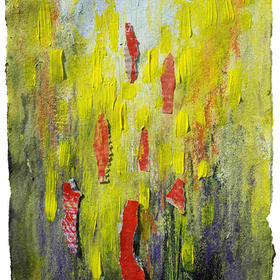
Psalm 28 – Prayer, Praise, and Possibility

Psalm 28 by Dutch artist Wim van de Wege

I pray to you, O Lord, my rock.
    Do not turn a deaf ear to me.
For if you are silent,
    I might as well give up and die.
Listen to my prayer for mercy
    as I cry out to you for help,
    as I lift my hands toward your holy sanctuary.

Do not drag me away with the wicked—
    with those who do evil—
those who speak friendly words to their neighbors
    while planning evil in their hearts.
Give them the punishment they so richly deserve!
    Measure it out in proportion to their wickedness.
Pay them back for all their evil deeds!
    Give them a taste of what they have done to others.
They care nothing for what the Lord has done
    or for what his hands have made.
So he will tear them down,
    and they will never be rebuilt!

Praise the Lord!
    For he has heard my cry for mercy.
The Lord is my strength and shield.
    I trust him with all my heart.
He helps me, and my heart is filled with joy.
    I burst out in songs of thanksgiving.

The Lord gives his people strength.
    He is a safe fortress for his anointed king.
Save your people!
    Bless Israel, your special possession.
Lead them like a shepherd,
    and carry them in your arms forever. (New Living Translation)

The biblical character David, in frustration and agony, cried out for help, for God to hear his prayers. And, when his prayer was heard, David gave exuberant praise to the Lord for listening to him.

We are not told specifically of how that prayer was answered and what happened between the request and the response. It seems the juicy details are left out on purpose, so that maybe we would not get lost in the retribution but stick with the fact that there was a desperate need and the Lord stepped in and did something about it.

As I pondered this psalm and its lack of life-detail, I wondered about David’s situation:

Could it be that David gave God praise just for being heard by him? 

Was David cured in some way, or was he healed from the need to be healed? 

Was there even any actual deliverance that occurred? 

Did David come to praise God despite a lack of deliverance? 

Was David’s joy in his relationship with God conditional, or unconditional?

William Shakespeare’s Hamlet (c.1601 C.E.) put the question this way: “To be, or not to be, that is the question.” Hamlet’s soliloquy went on to say:

“Whether ’tis nobler in the mind to suffer
The slings and arrows of outrageous fortune,
Or to take arms against a sea of troubles,
And by opposing end them? To die: to sleep;
No more; and by a sleep to say we end
The heartache and the thousand natural shocks
That flesh is heir to, ’tis a consummation
Devoutly to be wish’d. To die, to sleep;
To sleep: perchance, to dream: ay, there’s the rub;
For in that sleep of death what dreams may come
When we have shuffled off this mortal coil,
Must give us pause: there’s the respect
That makes calamity of so long life;
For who would bear the whips and scorns of time,
The oppressor’s wrong, the proud man’s contumely,
The pangs of despised love, the law’s delay,
The insolence of office and the spurns
That patient merit of the unworthy takes,
When he himself might his quietus make
With a bare bodkin (knitting needle)?”

Hamlet, much like David of old, was miserable and burdened with a profound lack of power to change his circumstances. So, he reflects on life and death in a morbid and melancholy way. It’s not that Hamlet was contemplating suicide as much as he meditated on what life truly is and finding some meaning within it. Unlike David, Hamlet cannot find the courage to deal with his frustration and feels stymied with fear of the unknown.

If we are blatantly honest with ourselves, we must admit that far too often we have a particular outcome in mind that we want or expect God to do.  Our hopes become tethered to God doing something extremely specific so that, if it does not come to pass (or does not come quickly!) we become discouraged and disillusioned. Like Hamlet, we become lost in the shadows of our thinking and ponder some sort of escape.

So, here is another set of questions I am asking myself: 

If my adverse circumstances do not change, can I praise God anyway? 

Can I, like David, take joy in simply being heard? 

Can I find gratitude in all situations? 

Do I only express thanks and praise to God when things are going my way? 

Am I open to whatever God wants to do in my life, even if it is not what I would choose? 

Do I feel that I am above having to put up with the wickedness of this world? 

Am I expecting heaven on earth, or am I willing to suffer as Jesus did? 

I honestly believe the answers to those questions will determine the trajectory of our Christian experience. For the identity and meaning of all persons is found in the divine.

I praise you, O God, in the good and the bad, the easy and the difficult, the failures and the victories.  You are Lord over all things.  You are my strength and shield in every circumstance.  When I am weak, I am strong. I can do all things through Christ who strengthens me. Amen.

Psalm 55:1-15 – Pray as First Response

God, listen to my prayer;
    don’t avoid my request!
Pay attention! Answer me!
    I can’t sit still while complaining.
    I’m beside myself
        over the enemy’s noise,
        at the wicked person’s racket,
        because they bring disaster on me
        and harass me furiously.

My heart pounds in my chest
    because death’s terrors have reached me.
Fear and trembling have come upon me;
    I’m shaking all over.
I say to myself,
    I wish I had wings like a dove!
    I’d fly away and rest.
    I’d run so far away!
    I’d live in the desert.
    I’d hurry to my hideout,
    far from the rushing wind and storm.

Baffle them, my Lord!
    Confuse their language
    because I see violence and conflict in the city.
Day and night they make their rounds on its walls,
    and evil and misery live inside it.
Disaster lives inside it;
    oppression and fraud never leave the town square.

It’s not an enemy that is insulting me—
    I could handle that.
It’s not someone who hates me
    who is exalted over me—
    I could hide from them.
No. It’s you, my equal,
    my close companion, my good friend!
It was so pleasant when
    together we entered God’s house with the crowd.

Let death devastate my enemies;
    let them go to the grave alive
        because evil lives with them—
        even inside them! (Common English Bible)

We all likely know he modern day proverb, “The squeaky wheel gets oiled.” The saying is often used in reference to someone who is loud, even obnoxious, about what they want. 

In today’s psalm, David cannot avoid the squeaky wheel. There are people in his face and all up in his grill. The only thing we know about David’s enemies from the psalm is that they were nursing a grudge against him about something. David was hurt and betrayed.

So, David prayed. He pleaded with God to hear his prayer – to not hide from his plea for mercy. David desperately wanted the Lord to respond to his terrible plight. He couldn’t sleep. He had racing thoughts. He was hyper-vigilant. He was downright anxious. David felt the ache of people speaking against him. For whatever reason, they had an axe to grind and were determined to make David’s life difficult.

Although, like David, we sometimes feel like flying away and being at rest from the turmoil, we must deal with the insults, the false rhetoric, and half-truths of others. 

The way David confronted the problem was primarily through prayer. Whenever David prayed, it was never a quick on-the-run sort of prayer to God in the rush of dealing with all his kingly duties. Instead, David offered specific, agonizing, timely prayers, asking, even begging God to not let the violent speech and actions of his enemies prevail.

David was committed to maintaining peace, equity, and justice in the public square. In those times when injustice reared it’s ugly head, David’s first response was to pray.

Out of the range of possibilities we might do in response to slander, gossip, backbiting, threats, and general sins of the tongue against us, prayer needs to be the primary tool to face it all. Heartfelt, passionate, detailed, and pointed prayers can and must be offered to the God who hears the righteous in their grief. 

If you are in such a position of being oppressed by another, a sage way to begin addressing the situation is through praying the very same psalm that David did when he was under duress.

The biblical psalms are prayers which are meant to be prayed as our own. There is no such thing as praying them too often. It is always open season on praying the psalms for our own contemporary purposes.

The prayers are more than personal. They are public, as well. Violence, strife, iniquity, trouble, oppression, fraud, and injustice effect the entire community. Our prayers can and must include asking God to put an end to all this awful muck.

It’s one thing to have some schmuck we’ve never met make a disparaging social media comment against us, or some random persons spout baseless lies. And it’s quite another thing when it is someone close to us, a trusted friend who turns on us.

God cares about our adverse situations. Unlike fickle friends, the Lord is a faithful companion who will neither leave us nor forsake us. The New Testament affirms and encourages prayer to God in anxious times:

God cares for you, so turn all your worries over to him.

1 Peter 5:7, CEV

Jesus modeled a life of prayer in response to injustice, suffering, and belligerence.

“Into your hands I entrust my life.” (Luke 23:46, CEB)

“I don’t ask you to take my followers out of the world but keep them safe from the evil one.” (John 17:15, CEB)

May we know that loneliness is far from us. God is with us, always and forever. Amen.   

Listening God, you hear the cries of the righteous. Give ear to my plea. I cry out to you for respite from those allayed against me.  I ask for justice in my life and in the public square so that the wicked and the unrighteous do not have their way in this world, through Jesus Christ in the power of the Holy Spirit. Amen.

Psalm 73:21-28 – God Is Near

When my thoughts were bitter
    and my feelings were hurt,
I was as stupid as an animal;
    I did not understand you.
Yet I always stay close to you,
    and you hold me by the hand.
You guide me with your instruction
    and at the end you will receive me with honor.
What else do I have in heaven but you?
    Since I have you, what else could I want on earth?
My mind and my body may grow weak,
    but God is my strength;
    he is all I ever need.

Those who abandon you will certainly perish;
    you will destroy those who are unfaithful to you.
But as for me, how wonderful to be near God,
    to find protection with the Sovereign Lord
    and to proclaim all that he has done! (Good News Translation)

Sometimes we put our foot in our mouth. We know how it feels saying rash words that we later regret. And we also know what it feels like to get dumped on by another who has some choice words for us.

The psalmist, Asaph, records an encounter with God. Asaph was upset. He gave God a piece of his mind. Then later, after reflecting on the experience, Asaph admitted that his soul was embittered and let his base nature take over.

The human brain is a complicated organ. We process information in different parts of the brain. The neo-cortex (the rational part of the brain) allows us to engage in logical analysis and complex decision making. 

Another part, the limbic system (sometimes referred to as the “reptilian brain”) processes information very quickly, largely by instinct. When we become scared, surprised, upset, or angry, adrenaline gets pumped into our limbic system so that we can quickly react to the perceived threat, danger, or injustice.

Having our brains flooded with adrenaline when there is real danger is necessary. There are life-threatening circumstances in which we need that quick response. Yet, if our brains remain on high alert and are continually fearful and upset, even when there is no real problem, we don’t calm down, and the result is less than stellar behavior. 

So, what is the answer to this situation? Asaph said God holds his right hand and guides him with wise counsel. Being near to God brings the brain chemistry to appropriate levels so that we can relax and trust.

God is with us always in the person of the Holy Spirit. There is never a time, place, or situation where God is absent. As we learn to rely on God’s presence, and remind ourselves of it on a daily basis, we can restore more rational thoughts to our lives. We can live knowing God is in control and continually vigilant to watch over us.

Gracious God, I have no one in my life like you. My flesh and my heart may fail, my brain might become overwhelmed with irrational fears, but you are my strength and the Rock of my salvation. Thank you for your continual provision and help each day through Jesus Christ, my Lord. Amen.