2 Samuel 15:13-31 – Unflagging Trust

Stained glass of King David, Fringford, England church

A messenger came and told David, “The hearts of the people of Israel are with Absalom.”

Then David said to all his officials who were with him in Jerusalem, “Come! We must flee, or none of us will escape from Absalom. We must leave immediately, or he will move quickly to overtake us and bring ruin on us and put the city to the sword.”

The king’s officials answered him, “Your servants are ready to do whatever our lord the king chooses.”

The king set out, with his entire household following him; but he left ten concubines to take care of the palace. So, the king set out, with all the people following him, and they halted at the edge of the city. All his men marched past him, along with all the Kerethites and Pelethites; and all the six hundred Gittites who had accompanied him from Gath marched before the king.

The king said to Ittai the Gittite, “Why should you come along with us? Go back and stay with King Absalom. You are a foreigner, an exile from your homeland. You came only yesterday. And today shall I make you wander about with us when I do not know where I am going? Go back and take your people with you. May the Lord show you kindness and faithfulness.”

But Ittai replied to the king, “As surely as the Lord lives, and as my lord the king lives, wherever my lord the king may be, whether it means life or death, there will your servant be.”

David said to Ittai, “Go ahead, march on.” So Ittai the Gittite marched on with all his men and the families that were with him.

The whole countryside wept aloud as all the people passed by. The king also crossed the Kidron Valley, and all the people moved on toward the wilderness.

Zadok was there, too, and all the Levites who were with him were carrying the ark of the covenant of God. They set down the ark of God, and Abiathar offered sacrifices until all the people had finished leaving the city.

Then the king said to Zadok, “Take the ark of God back into the city. If I find favor in the Lord’s eyes, he will bring me back and let me see it and his dwelling place again. But if he says, ‘I am not pleased with you,’ then I am ready; let him do to me whatever seems good to him.”

The king also said to Zadok the priest, “Do you understand? Go back to the city with my blessing. Take your son Ahimaaz with you, and also Abiathar’s son Jonathan. You and Abiathar return with your two sons. I will wait at the fords in the wilderness until word comes from you to inform me.” So Zadok and Abiathar took the ark of God back to Jerusalem and stayed there.

But David continued up the Mount of Olives, weeping as he went; his head was covered, and he was barefoot. All the people with him covered their heads too and were weeping as they went up. Now David had been told, “Ahithophel is among the conspirators with Absalom.” So, David prayed, “Lord, turn Ahithophel’s counsel into foolishness.” (New International Version)

“Faith is taking the first step even when you don’t see the whole staircase.”

Martin Luther King, Jr.

It’s an understatement to say that King David had family drama.

Maybe that’s because he had a lot of wives and even more kids. Or it could be that being a king didn’t transfer well to being a father. And it just might be that his experience was mostly about simply living in a fallen world, full of icky relational dynamics and human conflict.

David seemed to be at his best when at his lowest. His son, Absalom, carefully designed a conspiracy to take over the kingdom. And it was looking as though he might just do it. David, and those loyal to him, fled Jerusalem to avoid being overthrown and killed. They were between a rock and a hard place, to put it mildly. David was literally running for his life.

If we put ourselves in David’s sandals, how would we respond? 

I suppose, at the least, we would likely complain. Who is Absalom that he should dishonor his father in such a way as this? Then, we may try and find ways to maintain power, and get back at Absalom for being a rebellious and destructive son. 

I am humbled by David’s unflagging trust in God. Like the suffering Job centuries before him, David was willing to receive anything from the hand of God, whether for good or evil. He wholesale accepted whatever seemed good to God, without attempting to force anything on the Lord. “Let God do to me what seems good to him,” was the faith affirmation of David.

Yet, at the same time, David was aware and in touch with his emotions as he left the city and ascended the Mount of Olives. He wept and lamented over the situation he and all those with him had to experience. 

A thousand years later, Jesus took the same trek out of the city in great sorrow because of people who conspired against him. Christ faced the agony of the cross through the machinations of sinful humanity who did not want him as Lord over their lives.

Our confidence must rest in the God who is never caught unaware of our situations and always knows how to respond. We must rely on our prayers to the Lord as we navigate the difficulties of this life. 

Humility goes a long way toward letting the will of God rule the day.

O Lord, please turn the plans and the counsel of evil persons into foolishness. Do not let the sinfulness of people have its way and run roughshod over my life.  I trust in you to bend a bad situation toward your own good purpose through Jesus Christ my Lord.  Amen.

Psalm 68:24-35 – A Mighty God Who Rides the Skies

O God, your march of triumph is seen by all,
    the procession of God, my king, into his sanctuary.
The singers are in front, the musicians are behind,
    in between are the young women beating the tambourines.
“Praise God in the meeting of his people;
    praise the Lord, all you descendants of Jacob!”
First comes Benjamin, the smallest tribe,
    then the leaders of Judah with their group,
    followed by the leaders of Zebulun and Naphtali.

Show your power, O God,
    the power you have used on our behalf
    from your Temple in Jerusalem,
    where kings bring gifts to you.
Rebuke Egypt, that wild animal in the reeds;
    rebuke the nations, that herd of bulls with their calves,
    until they all bow down and offer you their silver.
Scatter those people who love to make war!
Ambassadors will come from Egypt;
    the Ethiopians will raise their hands in prayer to God.

Sing to God, kingdoms of the world,
    sing praise to the Lord,
    to him who rides in the sky,
    the ancient sky.
Listen to him shout with a mighty roar.
Proclaim God’s power;
    his majesty is over Israel,
    his might is in the skies.
How awesome is God as he comes from his sanctuary—
    the God of Israel!
He gives strength and power to his people.

Praise God! (Good News Translation)

The biblical psalms are uniform in praising God for God’s inherent character and for how that character acts in the world.

Since God is an infinitely immense Being, our human language cannot begin to adequately contain or describe such divinity. Yet, words are what we have for trying to communicate the attributes of such an incredible and awesome God.

This is why the use of metaphors is significant. Whenever we can picture something we are familiar with, then imaginatively place God alongside it, it helps give us at least a rudimentary idea and feeling of who this God is, what this God is all about.

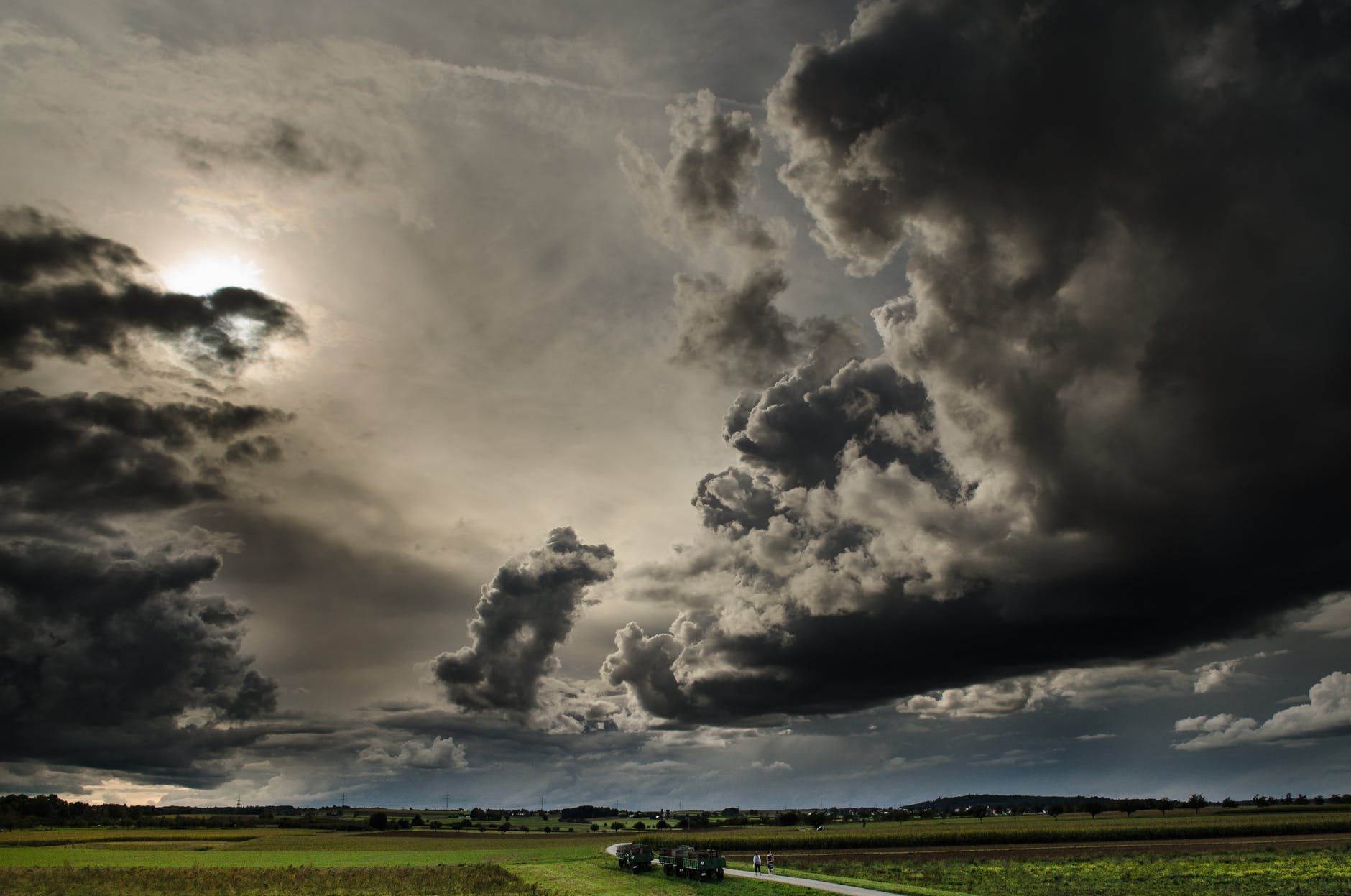
To gain a glimpse of God’s majesty and sovereignty over the universe, we are invited to see with our spiritual eyes, God riding the sky; to hear with our spiritual ears the thunderous shout which roars and reverberates throughout the cosmos.

We are also invited to respond to what we see and hear by using our power of words and speech to proclaim God’s power. And that power is well beyond our ability to describe. With all of the powerful forces in this world, they are but a mere puff of breath to the God who reigns supreme over all powers, both in heaven and on earth. God’s power is a thunderous beauty. God’s splendor and strength rise larger than thunderheads.

Having grown up in Midwest America, I’ve seen my share of large thunderheads (massive cumulus clouds which form just before a storm), thunderstorms replete with bright lightning and noise so awesome it shakes the farmhouse, and tornados with such force that they rip the roof off a barn as if it were a Lego building.

And God is bigger than that – stronger, louder, and brighter.

The appropriate response to such a God is to make music for the one who strides the ancient skies in a heavenly chariot yet stoops to listen and care about puny humans.

The reasonable response to such a God is to listen to the divine voice thundering in the world and submit to the sound which seems like it might split the heavens open.

To gain a mere glimpse of God’s strength and power will inevitably result in a response of giving up our all to the Lord of the universe, everything we have, and all that we are.

To know, even a tiny smidgeon, of such a God will bring our own loud shouts of proclaiming God’s goodness, grace, and generosity to anyone who will listen to us.

To glimpse what the psalmist sees will consume us with awe, as we intuitively connect with the glory which is constantly streaming from heaven.

God shares divine strength with people. God doesn’t have to do that. The Lord has no obligation to do so. Yet, it happens, despite our fickle praise and inconsistent devotion.

So, let’s give our highest praise to the God of the psalms. Let’s imbibe of God’s thunderous presence among us.

Then, we will likely be happier than a gopher in soft dirt; or a butcher’s dog; or a unicorn eating cake on a rainbow.

Eternal Trinity – blessed Father, Son, and Spirit – the awesome God whom I serve: The more I enter you, the more I discover, and the more I discover, the more I seek you. A massive thunderhead is but a small cloud next to you, the Godhead, the incredible Three-in-One.

Through you, almighty Lord, I shall come to know myself and my world. And that knowledge is a mighty love for humanity which spans longer and higher than the universe itself. May the love, unity, harmony, community, goodness, and power which is always present within yourself, mighty God, be present with me, your servant.

For just a molecule of You is enough to power me for eternity. Amen.

*Above photo by Moritz Bu00f6ing on Pexels.com

Psalm 130 – Believe, Hope, and Love

I cry out to you from the depths, Lord—

my Lord, listen to my voice!
    Let your ears pay close attention to my request for mercy!
If you kept track of sins, Lord—
    my Lord, who would stand a chance?
But forgiveness is with you—
    that’s why you are honored.

I hope, Lord.
My whole being hopes,
    and I wait for God’s promise.
My whole being waits for my Lord—
    more than the night watch waits for morning;
    yes, more than the night watch waits for morning!

Israel, wait for the Lord!
    Because faithful love is with the Lord;
    because great redemption is with our God!
He is the one who will redeem Israel
    from all its sin.
(Common English Bible)

Throughout church history, the book of Psalms has been used and understood as the Church’s prayer book.  Indeed, the psalms are much more than a collection of beautiful poems, words of assurance, and songs of praise – they are designed and meant to have regular and ongoing use as prayers. And I’m not just talking about the psalms being somebody else’s prayers; they are my prayers and your prayers. 

There are times when words fail us – where we find ourselves between a rock and a hard place and want to pray. Our stress and/or anxiety is so high, we can neither think straight, nor form anything coherent with our mouths. It’s in such times that the psalms present themselves to us as the path forward. 

What’s more, psalms are meant to be spoken out loud and more than once. And I’m not talking about saying them with a quiet mumble or a flat monotone.  No! These precious prayers of Holy Scripture are meant to be declared with full voice and a large amount of flavor!  They are to repeatedly roll off our lips with all the emotional and spiritual gusto which resides within us!  Tears and yelling are both appropriate and encouraged. 

For we do not possess a mere heady faith of thoughts and ideas; we also possess a faith that is robustly heartfelt, and dwells down deep in the gut where our bowels of compassion have their abode. 

Even with a cursory reading of today’s psalm, we can easily observe there’s more going on here than beliefs of faith, hope, and love. 

The psalmist is expressive, clinging to faith with a patient longing for God to make good on divine promises. It is chocked full of emotion, a prayer coming from the depths of the gut. The whole being is involved, and rightly so, because our faith affects the entirety of a person and everyone in the community of the redeemed.

If this psalm resonates with you in any way, let your proclamation of it be with the expanse of feeling inside you. After all, as people created in the image of God, we share God’s own deep sense of love – and love is genuinely love when it is outwardly expressed with a sacred combination of words, actions, and feelings.

Waiting, watching, hoping. We as humans do a lot of that. While we anticipate God’s response, we keep up the praying. We keep reminding God to be God. We encourage others to watch and wait and hope, all the while encouraging ourselves, as well.

Whenever we are stressed, more often than not, we thrash about, like a desperate swimmer in the middle of a lake, just trying to keep his head above water. Yet, the psalm tells us to do the counterintuitive: Don’t do something. Just stay there and relax. Why, in heaven’s name, should I do nothing?

Because the Lord will act.

And that action of God will redeem, renew, refresh, and revitalize. It will be new, like the morning dawn. A fresh day, that will not be like any other day before it.

God does his best saving work in the worst and most impossible of circumstances. We need not fear the overwhelming depths of difficulty and trouble. We can trust the Lord.

Perhaps the most awful of deep holes are emotional – deep depression and/or anxiety – a lostness inside oneself because of mental disorder. In such a dark oblivion, and terrible morass, one tries to survive into another hour, not just another day. Like a watchman waiting for the night to dissipate and dawn to break, there is a longing for God.

Deliverance and rescue seem slim. Hopelessness begins to calcify the spirit. Only love can release the hardening situation; the steadfast love of God is a gentle hammer, picking away at the grief.

This is a love which never gives up.

Today’s psalm begins as a desperate cry for help. It ends with an awareness of the need to trust, hope, and wait….

Blessed Jesus, in the comfort of your love, I lay before you the memories that haunt me, the anxieties that perplex me, the despair that frightens me, and my frustration at my inability to think clearly. Help me to discover your forgiveness in my memories and know your peace in my distress. Touch me, O Lord, and fill me with your light and your hope. Amen.

*Above painting of Psalm 130 by Virginia Wieringa

Mark 6:45-52 – Facing Fear

Immediately Jesus made his disciples get into the boat and go on ahead of him to Bethsaida, while he dismissed the crowd. After leaving them, he went up on a mountainside to pray.

Later that night, the boat was in the middle of the lake, and he was alone on land. He saw the disciples straining at the oars because the wind was against them. Shortly before dawn he went out to them, walking on the lake. He was about to pass by them, but when they saw him walking on the lake, they thought he was a ghost. They cried out because they all saw him and were terrified.

Immediately he spoke to them and said, “Take courage! It is I. Don’t be afraid.” Then he climbed into the boat with them, and the wind died down. They were completely amazed, for they had not understood about the loaves; their hearts were hardened. (New International Version)

Sometimes, we are afraid – even terrified. And Christians aren’t immune to the feeling of fear and terror.

The truth of the Christian life is that it is a herky-jerky process of three-steps-forward, two-steps-backward, not always knowing with certainty everything we encounter.  

The expectation that we will have a consistent upward trajectory of spiritual development with no scary experiences is wrongheaded and misguided. Throw into the mix that our self-awareness is often skewed, and that we have difficulty assessing ourselves with any accuracy, and voila! we have a recipe for the true human condition.

Doubt, fear, failure, and stubbornness aren’t just endemic to other people – it also characterizes many Christians, as well. We will face severe storms in life. They will be harsh. We will wonder if we’ll even make it out alive, or not. And it may very well seem like Jesus is nowhere to be found. Then, when he does show up, we don’t recognize him, and it scares the bejabbers out of us.

This was the experience of Christ’s disciples, who too often reflect our own stories of faith and fear all rolled up in one person. Today’s Gospel lesson is this: Our fears and foibles do not need to define us because Jesus is Lord over the water, the weather, the wondering, the waiting, the wildness, and our own whimsical natures of seeing miracles accomplished in others, then not believing it can happen in our own lives.

So, what are we really afraid of? Failure? Fear itself? Death? Irrelevance? Loss? Change? Perhaps, everything? Yes, all of life is a risky scary business. There are no guarantees, except one: Christ is present with us, whether we are aware of it, or not.

If the worst scenario you worry about in your head would actually come to pass, it will still never change the reality that God loves you and is with you.  And it will not stop Jesus from assuring us of his presence and climbing into the boat to be with us.

We don’t have any accounts of Jesus freaking out in fear, or when other people flip out in their own fear. Jesus was a person of prayer, completely grounded in his relationship with the Father.   

Jesus made his disciples get into a boat and go out on the lake – all the while knowing what they were about to face with the weather. Even though the disciples were doing God’s will by going out on the lake, they were not spared from adversity. In fact, Jesus wanted them to experience the storm because it is through the storm that we really learn faith and to face down our fears. 

There is no shame in being afraid. We all experience it. And there is no shame in admitting we’re scared. Where shame exists, our instinct is to run away like our ancestors Adam and Eve and hide, thus hiding ourselves from the grace that could be ours.

Being out on the middle of a lake during a storm did not prevent Jesus from being present with the disciples – he just walked on the water to be with them. Even though the disciples had just seen and participated in the miracle of Jesus feeding the five thousand, they were not looking for another miracle – which is why they did not recognize Jesus and were afraid when they saw him.

Jesus never chided his disciples for their fear, or their hard hearts. He simply invited them, with the tone of grace and mercy, to not be afraid. And the Scripture is replete with continual encouragements to not be afraid because of God’s presence. Along with psalmist, we can say:

But when I am afraid,
    I will put my trust in you.
I praise God for what he has promised.
    I trust in God, so why should I be afraid?
    What can mere mortals do to me? (Psalm 56:3-4, NLT)

I sleep and wake up refreshed
    because you, Lord,
    protect me.
Ten thousand enemies attack
from every side,
    but I am not afraid. (Psalm 3:5-6, CEV)

When I called, you answered me.
You made me bold by strengthening my soul. (Psalm 138:3, GW)

Ultimately, fear has to do with disconnection. It is to feel powerless, separated from any resources, unable to do anything about what is presently staring us in the face and scaring us.

Yet, when we have an awareness and a sense of connection with Jesus, there are unlimited resources of grace to accept, cope, and transcend any and every storm we find ourselves in the middle of.

May the risen and ascended Christ, mightier than the hordes of hell, more glorious than the heavenly hosts,
be with you in all your ways. 

May the cross of the Son of God protect you by day and by night, at morning and at evening, at all times and in all places.

May Christ Jesus guard and deliver you from the snares of the devil, from the assaults of evil spirits, from the wrath of the wicked, from all base passions, and from the fear of the known and unknown. 

And may the blessing of God almighty – Father, Son, and Spirit – be upon you and remain with you always. Amen.

*Above painting of Jesus walking on water by Brian Whelan

**Above Orthodox icon of Christ walking on water

***Above painting: Christ walking on the sea, by French artist Amédée Varint (1818-1883)