


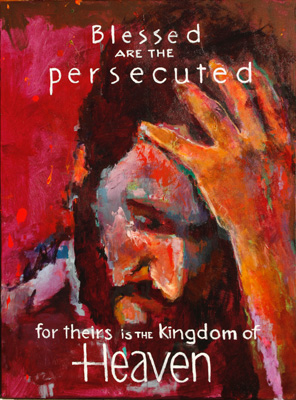
“You’re blessed when your commitment to God provokes persecution. The persecution drives you even deeper into God’s kingdom.
“Not only that—count yourselves blessed every time people put you down or throw you out or speak lies about you to discredit me. What it means is that the truth is too close for comfort, and they are uncomfortable. You can be glad when that happens—give a cheer, even! —for though they don’t like it, I do! And all heaven applauds. And know that you are in good company. My prophets and witnesses have always gotten into this kind of trouble. (The Message)
No matter our vocation or avocation, what we do, or don’t do, what we say, or don’t say, we will not avoid insult and persecution. Just ask Jesus.
The issue is not if we will suffer but why we suffer. The Apostle Peter devoted his first epistle to helping Christians deal with their suffering. He made his point clear about suffering:
If you suffer, it should not be as a murderer or thief or any other kind of criminal, or even as a meddler. However, if you suffer as a Christian, do not be ashamed, but praise God that you bear that name. (1 Peter 4:15-16, NIV)
That’s Peter’s way of saying, “Blessed are those who are persecuted because of righteousness.” We will endure abuse, in some form, from others. So, let’s make sure it’s for being characterized by Christ’s Beatitudes, and not for being obnoxious.
Christ’s followers take up their cross and share with him in the world’s hatred directed toward us. This kind of living is blessed and receives the approval of God.
What is persecution?
Persecution is not only physical abuse. It is also verbal abuse, ridicule, slander, discrimination, and generally making one’s life harder just because of a commitment to Christ. Persecution is not necessarily a sign of doing something wrong. It could be that something right is being done.
Thomas à Kempis (1380-1471) wrote what has become one of the best-selling Christian books of all-time, The Imitation of Christ. Thomas had the right perspective on the subject of persecution:
“Sometimes it is to our advantage to endure misfortunes and adversities, for they make us enter into our inner selves and acknowledge that we are in a place of exile and that we ought not to rely on anything in this world. And sometimes it is good for us to suffer contradictions and know that there are those who think ill and badly of us, even though we do our best and act with every good intention. Such occasions are aids in keeping us humble and shield us from pride. When men ridicule and belittle us, we should turn to God, who sees our innermost thoughts, and seek His judgment.
Therefore, we should so firmly establish ourselves in God that we have no need to seek much human encouragement. It is when a person of good will is distressed, or tempted, or afflicted with evil thoughts, that they best understand the overwhelming need for God, without whom we can do nothing. While enduring these afflictions they take themself to prayer with sighs and groans; they grow tired of this life and wish to be undone in order to live with Christ. It is in such times of trial they realize that perfect security and full peace are not to be found in this world.”
Insult, negativity, and verbal abuse can trip us up and discourage us. It doesn’t feel good to be disliked. Trouble and conflict is something most of us would like to avoid, as much as possible.
We might be able to steel ourselves for a large persecution against denying Christ and would be willing to die a martyr’s death to hold on to our faith. Yet, conversely, we may:
- Crumble in a heap if we think someone is mad or displeased with us.
- Worry that our lives will get complicated and difficult if we uphold the righteousness and justice of God.
- Be afraid of others who might think bad of us if we showed mercy by standing with the unpopular person or if we actively and overtly engage in peacemaking.

It is the “small” abuses which can cause us so much grief. We are determined to stand tall when the bullets of blatant, oppressive, and systemic persecution comes. Then, when the gun is thrown at us, we may flinch, duck, and fret over one person being upset.
Back when I was a kid, I watched old reruns of the original Superman television series. In more than one episode, Superman stood tall and faced the person peppering him with bullets. Then, when the bullets ran out, the villain threw his gun at Superman, who then promptly flinched and ducked the gun!
It is not our job to ensure that everyone is happy – it is our business to do God’s will and to embody Christ’s Beatitudes. Our calling as believers in Jesus is not to worry about what people (including family) are going to think if we live a humble, righteous life of mourning over the world’s sins, exhibiting a meek and gentle spirit, standing for grace when others want blood, refusing to defile our hearts with impure thoughts and actions, and standing up to do something about the injustice around us.
How and why do respond to persecution?
The proper response to persecution is joy! There are two reasons why we can face persecution and come away glad instead cringing and discouraged:
- Because being characterized by the Beatitudes of Jesus brings heavenly reward. Show me a person who puts all their eggs in the earthly basket, and I’ll show you a person who is never satisfied and constantly unhappy. Show me a person who lives to please God and pursues the blessing of Christ, accepting any flak from others, and I’ll show you a person who is inwardly rejoicing that they are a Christian, loved by God, and counting it a privilege to suffer for the Name of Jesus. (Acts 5:27-29, 40-42)
- Because we are in good company. God’s people throughout history have endured the same kinds of sufferings and received a Christian purple heart award. We are not just to face persecution with a stoic, grind-it-out mentality, but with rejoicing! (Hebrews 11:36-40)
Who does the persecuting?
The ones who persecuted the prophets were religious folks. I wish I could say the worst persecution I ever received was from evil people who live ungodly lives. However, the most insult, hardship, and slander I have ever endured has come from the lips and the efforts of people who claim the name of Christ. The reason abuse happens is because there are people not characterized by the Beatitudes of Jesus, so they become the persecutors, instead of the persecuted.
All the sufferings and hardships of Jesus, all the persecution he faced did not come from the world, but from his own people, including a person from his inner circle of disciples. Although the church, throughout its history, has done immense good, it also has had a chronic problem of shooting its wounded.
Far too many people have adopted a legalistic form of righteousness that focuses on outward conformity and myriad rules and regulations. Abundant grace is needed. Not judgment.
Conclusion
If we are persecuted, let’s make sure it is because we are advocating for others who need mercy and are facing injustice; addressing the brokenness of this world through specifically Christian lenses; and desiring the applause of heaven.
See if you can hear the Beatitudes in what the Apostle Peter, had to say about persecution:
For it is commendable if someone bears up under the pain of unjust suffering because they are conscious of God. But how is it to your credit if you receive a beating for doing wrong and endure it? But if you suffer for doing good and you endure it, this is commendable before God. To this you were called, because Christ suffered for you, leaving you an example, that you should follow in his steps. (1 Peter 2:19-21, NIV)
Be like-minded and sympathetic. Love one another. Be compassionate and humble. Do not repay evil with evil or insult with insult. On the contrary, repay evil with blessing, because to this you were called so that you may inherit a blessing. For,
“Whoever would love life
and see good days
must keep their tongue from evil
and their lips from deceitful speech.
They must turn from evil and do good;
they must seek peace and pursue it.
For the eyes of the Lord are on the righteous
and his ears are attentive to their prayer,
but the face of the Lord is against those who do evil.” (1 Peter 3:8-12, NIV)
Dear friends, do not be surprised at the fiery ordeal that has come on you to test you, as though something strange were happening to you. But rejoice inasmuch as you participate in the sufferings of Christ, so that you may be overjoyed when his glory is revealed. If you are insulted because of the name of Christ, you are blessed, for the Spirit of glory and of God rests on you. (1 Peter 4:12-14, NIV)
May you know the blessing of solidarity with Christ through the afflictions of this present life.


