Skilled Work (1 Kings 5:1-12)

King Solomon and King Hiram, by Unknown artist

Because King Hiram of Tyre was loyal to David throughout his rule, Hiram sent his servants to Solomon when he heard that Solomon had become king after his father. Solomon sent the following message to Hiram: 

“You know that my father David wasn’t able to build a temple for the name of the Lord my God. This was because of the enemies that fought him on all sides until the Lord put them under the soles of his feet. Now the Lord my God has given me peace on every side, without enemies or misfortune. So I’m planning to build a temple for the name of the Lord my God, just as the Lord indicated to my father David, ‘I will give you a son to follow you on your throne. He will build the temple for my name.’ Now give the order and have the cedars of Lebanon cut down for me. My servants will work with your servants. I’ll pay your servants whatever price you set, because you know we have no one here who is skilled in cutting wood like the Sidonians.”

Hiram was thrilled when he heard Solomon’s message. He said, “Today the Lord is blessed because he has given David a wise son who is in charge of this great people.” Hiram sent word back to Solomon:

“I have heard your message to me. I will do as you wish with the cedar and pinewood. My servants will bring the wood down the Lebanon Mountains to the sea. I’ll make rafts out of them and float them on the sea to the place you specify. There I’ll dismantle them, and you can carry them away. Now, as for what you must do for me in return, I ask you to provide for my royal house.”

So Hiram gave Solomon all the cedar and pinewood that he wanted. In return, Solomon gave an annual gift to Hiram of twenty thousand kors [2,000 tons] of wheat to eat, and twenty thousand kors [4,000 liters] of pure oil for his palace use. Now the Lord made Solomon wise, just as he had promised. Solomon and Hiram made a covenant and had peace. (Common English Bible)

King Solomon was granted by God all the wisdom necessary to rule over Israel and Judah (1 Kings 3:1-15). Early in his reign, he began the construction of a permanent Temple in Jerusalem – a task that was originally in the heart of his father King David.

Today’s Old Testament lesson is the beginning of the account of Solomon’s grand building project. It focuses on the assistance offered by King Hiram of Tyre.

Skilled Leaders

The city of Tyre was a major port in Lebanon. The cedar trees of Lebanon were renowned in the ancient world as being large and strong. Solomon – always the savvy one in knowing where to find the best of the best – looked to King Hiram for the cedar logs needed for building the Temple.

What’s more, Solomon asked Hiram for the builders to help in construction of God’s Temple. King Solomon not only had a broad knowledge of just about everything in creation, but he also understood human nature. He named the reality that the Sidonians were the best at handling their exceptional lumber.

Furthermore, Solomon was clear about the reason for the ambitious building project of the Temple. He believed that the task of erecting the Temple was divinely given to him. Solomon therefore trusted God to help him complete the job.

As a result, the two kings negotiated a treaty in which Hiram provided the lumber and the lumbermen, with Solomon providing grain and olive oil for Hiram’s court. In recounting this, the editor of Kings emphasized Solomon’s wisdom, and the peaceful relations that Jerusalem and Tyre enjoyed.

Perhaps all of this rehashing of an old agreement between a couple of ancient kings seems irrelevant to the modern and post-modern person. Yet, it is a classic example of the realities concerning communication and theology.

Skilled Communication

Hiram had the resources for building, and the skilled builders; Solomon had the money, goods, and administrative knowledge to make their relationship a mutually beneficial one.

Each king negotiated successfully, namely because there was no disadvantage in their treaty relationship. The two nations balanced one another by offering it’s advantages to the other.

Solomon and Hiram came to a genuine win-win agreement. Each of them stated exactly what they wanted and what they would provide, without apology. Both kings promoted their own interests while showing concern for the other’s interests, as well.

The success of their deal was based on mutual trust, which began years earlier with King David.

Skilled Theology

Today’s narrative is more than an example of how to negotiate a deal. It fits into a larger narrative of what God was doing with the nation of Israel. Central to every biblical story is God, who is both object and subject of Holy Scripture.

The Lord revealed a slow and unfolding drama of redemption for people. The construction of the Temple was a prominent way of God revealing divine mercy to the people. It’s central place at the highest point in Jerusalem communicated that the Lord is in the middle of everything, and high above it all.

And the way in which Solomon went about constructing the Jewish Temple included non-Jewish builders. God, through divine sovereignty and grace, led Gentiles to hob-nob with Jews who worship Yahweh, and to thus experience a glimpse of the Lord through the people and the place.

Indeed, all things work together for good to those who love God. (Romans 8:28)

Gracious God, I ask that your love and goodness will have its way for all those who seek to live according to justice and righteousness. You are full of steadfast in love and abounding in mercy. Help me accept your love and mercy. May it flow powerfully in me, and through me, to your glory and honor. Amen.

For the Sake of Beauty (1 Kings 7:1-12)

King Solomon’s throne room, by Edward Poynter, 1890

Solomon’s palace took 13 years to build.

Forest Hall was the largest room in the palace. It was 44 meters long, 22 meters wide, and 13.5 meters high, and was lined with cedar from Lebanon. It had 4 rows of cedar pillars, 15 in a row, and they held up 45 cedar beams. The ceiling was covered with cedar. Three rows of windows on each side faced each other, and there were three doors on each side near the front of the hall.

Pillar Hall was 22 meters long and 13.5 meters wide. A covered porch supported by pillars went all the way across the front of the hall.

Solomon’s throne was in Justice Hall, where he judged cases. This hall was completely lined with cedar.

The section of the palace where Solomon lived was behind Justice Hall and looked exactly like it. He had a similar place built for his wife, the daughter of the king of Egypt.

From the foundation all the way to the top, these buildings and the courtyard were made out of the best stones carefully cut to size, then smoothed on every side with saws. The foundation stones were huge, good stones—some of them four and a half meters long and others three and a half meters long. The cedar beams and other stones that had been cut to size were on top of these foundation stones. The walls around the palace courtyard were made out of three layers of cut stones with one layer of cedar beams, just like the front porch and the inner courtyard of the temple. (Contemporary English Version)

By Bible Art

Having secured the throne after his father’s death, King Solomon set himself to the task of following his father David’s ardent desire to build a temple for the Lord. The work took seven years to complete. (1 Kings 5-6)

Then, Solomon turned to building a royal palace with a complex of buildings (or halls). It seems these had the purpose of being both residences and government structures. This architectural achievement took nearly twice as long as constructing the temple of God.

Some commentators are rather hard on Solomon about this fact of taking so much time to build himself a palace. They interpret him as being distracted, almost self-absorbed – that somehow his heart was more into his own buildings than God’s temple.

I don’t really buy into that line of thinking. It seems to me this reads more into the text than what’s there. They could be right. However, it appears such commentary does an anachronistic reading of the text. Taking a standpoint of Solomon’s later devotion to his many wives, and hence their many other gods, a lack of commitment is then superimposed upon the construction projects. It’s as if Solomon finished the temple stuff in order to get his real architectural passions.

I think there’s a more plausible explanation for King Solomon’s dedication to erecting buildings in addition to the temple. The editor of 1 Kings includes the detail and dedication that went into the temple.

Let’s keep in mind that King David had been stockpiling and preparing materials, and planning for the temple, well before he died. Just because the Lord told David that he would not be the one to build it, that Solomon would, did not mean that David kept his thoughts and his hands off of getting as much ready as he could for his son.

What’s more, once Solomon put together such a marvelous and intricate building as the temple, the experience gave him a desire to work on other projects, as well. Solomon had an expansive vision of his kingdom.

As the wisest person on earth, he put his money where his mouth was, by constructing beautiful structures given to justice, and reflecting the abundance of a goodness and justice which comes through living by God’s covenant code.

Did Solomon go overboard? Yes, and no. It depends on the project, and with whom you talk to. The issue of Solomon’s building projects, as I would frame it, has much more to do with demonstrating a particular theology.

The theology I believe Solomon was trying to reflect was that Israel serves a God who is given to beauty, justice, and abundance. And those qualities are also seen in the New Testament. I think of the story when Mary came to Jesus with her expensive and beautiful perfume:

Mary took a very expensive bottle of perfume and poured it on Jesus’ feet. She wiped them with her hair, and the sweet smell of the perfume filled the house.

A disciple named Judas Iscariot was there. He was the one who was going to betray Jesus, and he asked, “Why wasn’t this perfume sold for 300 silver coins and the money given to the poor?” Judas did not really care about the poor. He asked this because he carried the moneybag and sometimes would steal from it.

Jesus replied, “Leave her alone! She has kept this perfume for the day of my burial. You will always have the poor with you, but you won’t always have me.” (John 12:3-7, CEV)

I would argue that Judas Iscariot was the one distracted – and not Mary. Thus, returning to the story of Solomon’s building the palace complex, I would also argue that perhaps some of the commentators, with an eerily familiar criticism, are actually the ones distracted – and not Solomon.

Anyway, I like my positive reading of today’s Old Testament lesson, rather than the others’ negative reading. What about you?…

O heavenly God, who has filled the world with beauty: Open my eyes to see what is beautiful, to behold your gracious hand in all your works. Open my mind to know what is true. Open my heart to love what is good. May I learn to serve you with gladness, justice, and righteousness. Amen.

What Will You Do with Jesus? (John 5:1-18)

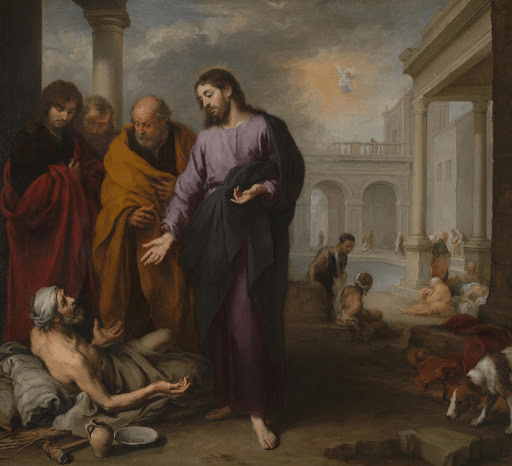
Healing the Paralytic, by Bartolomé Esteban Murillo, 1670

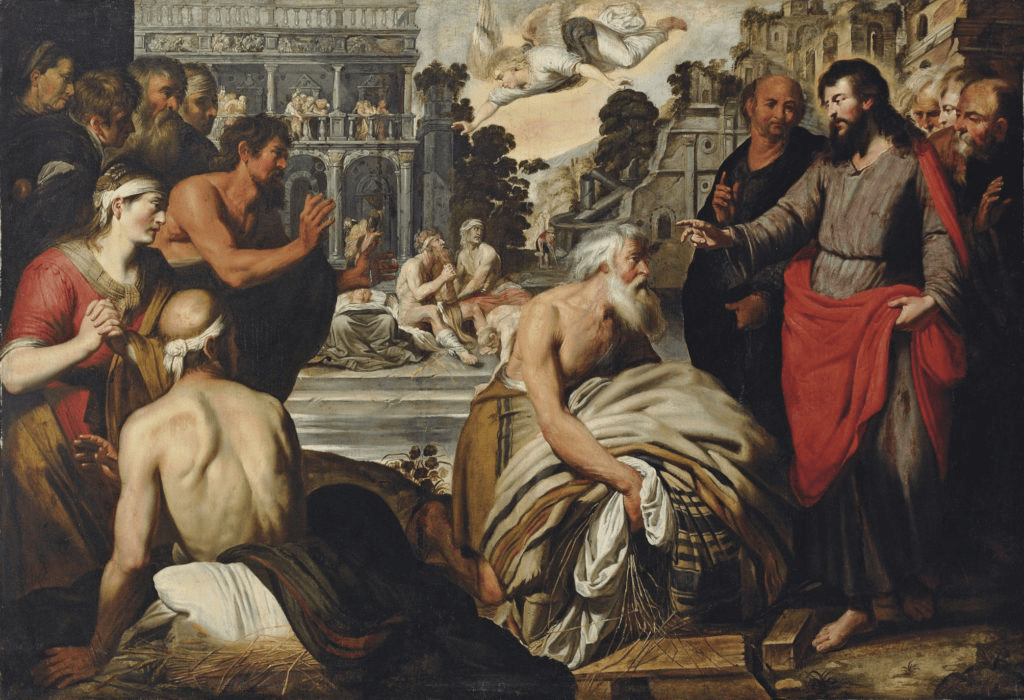
Sometime later, Jesus went up to Jerusalem for one of the Jewish festivals. Now there is in Jerusalem near the Sheep Gate a pool, which in Aramaic is called Bethesda and which is surrounded by five covered colonnades. Here a great number of disabled people used to lie—the blind, the lame, the paralyzed. One who was there had been an invalid for thirty-eight years. When Jesus saw him lying there and learned that he had been in this condition for a long time, he asked him, “Do you want to get well?”

“Sir,” the invalid replied, “I have no one to help me into the pool when the water is stirred. While I am trying to get in, someone else goes down ahead of me.”

Then Jesus said to him, “Get up! Pick up your mat and walk.” At once the man was cured; he picked up his mat and walked.

The day on which this took place was a Sabbath, and so the Jewish leaders said to the man who had been healed, “It is the Sabbath; the law forbids you to carry your mat.”

But he replied, “The man who made me well said to me, ‘Pick up your mat and walk.’ ”

So they asked him, “Who is this fellow who told you to pick it up and walk?”

The man who was healed had no idea who it was, for Jesus had slipped away into the crowd that was there.

Later Jesus found him at the temple and said to him, “See, you are well again. Stop sinning or something worse may happen to you.” The man went away and told the Jewish leaders that it was Jesus who had made him well.

So, because Jesus was doing these things on the Sabbath, the Jewish leaders began to persecute him. In his defense Jesus said to them, “My Father is always at his work to this very day, and I too am working.” For this reason they tried all the more to kill him; not only was he breaking the Sabbath, but he was even calling God his own Father, making himself equal with God. (New International Version)

Christ at the Pool of Bethesda, by Artus Wolffort, c. 1625

During one of the yearly Jewish festivals, on a Sabbath day, a miracle happened. Miracles of healing are typically accompanied by celebration and joy. But not so much with this one.

It’s one of those things about living in a messed up world of broken systems, that an invalid can start walking and there are people who have frowns and furrowed brows about it.

Granted, the man who was healed by Jesus may seem a bit hard to like in some ways. We don’t really know what he was into, but when Christ bestows healing on you, then says to stop sinning, it’s probably a significant sin to warrant the Lord’s exhortation.

Regardless of any sort of sin, the man appears to be paraplegic. Especially in the ancient world, this meant all sorts of problems had to be navigated – such as needing others to literally carry you around (no wheelchair or handicapped accessible anything), long periods of social isolation, lack of bodily control over your bowels and bladder, and the continual needs for cleanliness.

This made the man hard to like by many people just because he likely had strong body odors and had to crawl to get around if no one would help. He would not have been pleasant to look at. But he would have to make sure you did because, in the absence of any charity, the guy’s only option was to beg.

I’m glad there are greater forces in the world than indifference and dislike. There is grace – which is an act of bestowing honor and/or forgiveness to another person. It is not dependent upon whether one deserves it. Grace chooses not to hold something over or against another. It is a deep concern for others that comes from within and not from without.

“I do not understand at all the mystery of grace – only that it meets us where we are but does not leave us where it found us.”

Anne Lamott

Another gracious act that Jesus did was to honor the man’s dignity by respecting him with a question. By asking a question, we don’t assume we know what’s best for another. Sincere questions acknowledge another’s basic humanity. “Do you want to get well?” Jesus asked.

In the life of being an invalid and having little control over much of anything, including one’s own body, being asked a question is to receive the gift of autonomy.

There are many times in my work as a hospital chaplain that I speak with patients who don’t have a lot of control in their lives. I go out of my way to ask questions such as, “May I come in?” “Is it alright with you if I pull up a chair and sit down?” “Would you be okay telling me about what is going on?” “May I pray with you?”

This is important, because there are too many other people in this world who would just barge into a room, act like they own the place, and talk at them, and not with them – hence reinforcing to the person that they’re nothing compared to others, that they don’t have any real say.

The man’s response to Jesus was to essentially say that he is alone. He has no one to help him. Even though the man is in a city, surrounded by hundreds and thousands of others, he is lonely.

Not anymore. Jesus saw him, even inquired about him and learned about the man. Jesus Christ, the Lord of all, cared about a non-descript invalid and was sincerely curious about him. In a world of everyone for himself, Jesus championed the lonely and the lost.

A simple command to obey was all. Christ told the man to pick up his mat and walk. That’s it. Just as words created the world, so a few words created a whole new life for the man. So, he got up, and he walked.

It’s interesting that the religious leaders never seemed to notice the man when he was lame, but now that he’s up and walking around, they pay attention to his apparent work on a Sabbath.

The invalid was validated by Jesus, but Jesus, the one validated by the Father, was invalidated by the religious leaders, who are the spiritual invalids.

It was against the (their) rules to carry something around. Apparently, it was okay for people to be lonely, not contribute to society in meaningful and dignifying ways, and to suffer; but it’s not okay to walk and carry a mat.

Even worse, is anyone who would heal on the Sabbath and tell the healed person to walk and carry a mat. It was so bad, apparently, that it warranted persecuting such a person. But that’s what happens when people are forced to serve rules, instead of the rules serving people.

On top of it all, Jesus was working; and he justified it by stating that his Father keeps working. This was dangerously close to blasphemy by likening himself to God. For the religious leaders, not only was Jesus unethical in breaking the law, but he was also theologically immoral; he claimed a special relation with God.

The more that laypeople get to know Jesus, the more compelling he becomes; they want to follow him. But the more that clergy discover Jesus, the more angry they become and want to do away with him.

Ultimately, it is Jesus we must contend with, and not the law and our interpretations of scripture. We need to decide what we are going to do with Jesus… what will you do?…

Our Creator and Sustainer (Psalm 104:24-34, 35b)

Our Lord, by your wisdom
    you made so many things;
the whole earth is covered
    with your living creatures.
But what about the ocean
    so big and wide?
It is alive with creatures,
    large and small.
And there are the ships,
    as well as Leviathan,
the monster you created
    to splash in the sea.

All of these depend on you
    to provide them with food,
and you feed each one
with your own hand,
    until they are full.
But when you turn away,
    they are terrified;
when you end their life,
    they die and rot.
You created all of them
    by your Spirit,
and you give new life
    to the earth.

Our Lord, we pray
that your glory
    will last forever
and that you will be pleased
    with what you have done.
You look at the earth,
    and it trembles.
You touch the mountains,
    and smoke goes up.
As long as I live,
I will sing and praise you,
    the Lord God.
I hope my thoughts
    will please you,
because you are the one
    who makes me glad…

With all my heart
I praise you, Lord!
    I praise you! (Contemporary English Version)

In the wake of the Day of Pentecost, we are reminded by the psalmist that the Spirit was not only involved in forming the church, but was already experienced in forming creation. Everything about the Spirit’s work at the origins of the earth was immensely good, wonderfully complex, and intricately interrelated. Indeed, it all reflects the wisdom and majesty of God.

According to the psalmist, God is the Creator and is therefore sovereign over all of this vast dominion of earthly space and ecological systems. We humans are workers in this ordered world; and created in God’s image and likeness as the Lord’s vice-regents over this incredible domain. Humanity is thus both intimately connected with and distinctly separate from all the rest of the world.

This sustaining force of God includes gracious, loving, and compassionate guidance. Everything holds together and has its meaning within God. The breath of God – the Spirit – gives life to both our physical and spiritual selves.

The psalmist paints a picture of creation as full of life – with life itself as the highest expression of its purpose. Our delight in living and being comes from a profound connection with the Creator, Sustainer, and Guide of the universe.

Because of humanity’s deep connection with God and the rest of creation, everything we do as people on this earth impacts God and God’s big world. Every human action exerts an influence. Theology, anthropology, and ecology all exist with complex interconnectedness. God, people, and the world are bound to each other. Since God is relationship itself, relational connection is built into all creation.

Humanity is the apex and climax of God’s creative activity; yet, at the same time, we are but one piece within this intricate whole of creation. We humans are tasked by God to serve the earth and care for it – not to rule in such a way that exploits its grand resources, but to maintain and strengthen the existing connected systems of the earth.

This means we are meant to think of the common good of all earth’s citizens, as well as to consider future generations, and equip them to steward our vast world with practical wisdom and spiritual sensitivity.

Everything that brings disconnection, and thus harm, is to be weeded out and discarded. Wickedness, injustice, oppression, exploitation, unrighteousness, and arrogance are to be purged from the good earth, so that all creatures great and small can thrive and enjoy what God has provided.

Even the seemingly uncontrollable elements of this world – sea monsters and leviathans, chaos and evil – are ultimately subject to the sovereign God of this realm. It is the Lord who brings order from chaos, life from death, and calms the churning waters – quieting all of those ancient leviathans which cause so much of a stir.

It would be great if everyone everywhere found joy in their lives, brought God joy, and enjoyed being with everyone else and caring for all creation. Yet, those chaotic disconnecting powers are there – causing harm and division, splitting that which is designed to be connected, and disrespecting the inherent goodness of God’s image bearers and God’s world.

By being in harmony and in sync with God’s Spirit, we can work together against wickedness and not separate or dismantle what God has built and joined. Through our spiritual awareness, we can help, and not harm. In maintaining our proper spiritual connections, we can be agents of upholding the good, the right, and the just; and not underhandedly undermining God’s sovereignty.

Let us then offer our hallelujahs; our praise, adoration, and gratitude, to God who is the source of life. Because it’s awfully hard to be bad when you’re being good.

May you be able to say with the psalmist – and with all creation, including the trees and even the rocks – that with my whole heart I praise you, almighty God, Creator and Sustainer of heaven and earth.

And may your prayers be pleasing to the Lord and be full of mercy and love. Amen, amen.